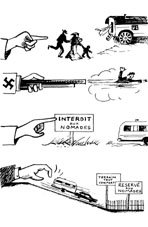
Romani settlement and inhabitants being threatened
by Michael Smith (Veshengro)
While Gyöngyöspata in Hungary may only be a village and a relatively small village at that the truth remains that Neo-Nazis have usurped police powers and are terrorizing the local Roma (Gypsy) population because, so the organizers of this “militia”, the Gypsies terrorize all Hungary and Hungarians.
Local white Hungarians offer the militia personnel of the Jobbik organization free board and lodging and the authorities, what do they do? They let it all happen and do nothing. Is this the new “Roma policy” of the Hungarian government? It would appear to be just that. Worrying in the extreme for anyone who, like me, is of the ethnic groups of the Romani, the Gypsy. It should also be of concern of everyone who does not want to see a repetition of the 1930s and 1940s in Europe.
For weeks already black uniformed skinheads of the “Militia Beautiful Future” who call themselves “Gendarmerie” patrol the street of the area and threaten everyone who is not prepared to follow their rules.
They have told the local Roma population in no uncertain terms that they'd better pack up and leave Hungary if they wish to live.
Hungary is an EU member state and still this is going on and this, and call me a conspiracy theorist if you wish, seems to me that the policy of the European Union is one that wishes to get rid of the Gypsy and permits ethnic cleansing by proxy.
© 2011

Italy wants to expel Gypsies without housing and income
by Michael Smith (Veshengro)
ROME: Italy wants to expel Gypsies who are citizens of other EU states who live solely off state benefits, the interior minister said recently, a move that would extend a crackdown on the Gypsy People criticised by rights groups as discriminatory.
France has sent masses of Roma on flights home to Romania in a mass repatriation that it says is voluntary, though some said they were coerced to leave. In fact, it is about as voluntary as were the round ups and deportations of the Nazi era.
Applauding France's move, Maroni, from the anti-immigrant Northern League party, said mandatory deportation of Roma who do not meet basic requirements should now be allowed.
The policy would apply to all non-Italian EU citizens who fail to meet certain criteria, not just Roma, said Maroni when asked if such a plan would be discriminatory.
"If anything, the problem is something else: unlike in France, many Roma and Sinti here have Italian citizenship. They have the right to remain here. Nothing can be done," said Maroni.
Maroni's comments were immediately denounced by the political opposition, including the Italy of Values party which said the plan smacked of racism.
What we can see is how the government of Italy thinks as regards to the Sinti and Roma in the country. If they could but find a way they would also consider throwing those Gypsies with Italian citizenship out of the country.
I am sure they will find a way soon; removing the citizenships off them is something that they, I am sure, are thinking about already.
At the same time Jobbik in Hungary is calling for all Gypsies in Hungary to be put into internment camps and if Jobbik can get the general public of Hungary behind it then the government of the country might just think of this too, I would not be surprised.
And while the European Commission may have spoken out rather strongly, finally, against the actions of the government of France with regards to their removal of Gypsies from their country. But, it would appear, France is going to take absolutely no notice of what they are told. Now let us see as to whether the Commission is prepared to go all the way and drag France before the court. I am not holding my breath.
All I am seeing is that the EU is permitting an ethnic cleansing by proxy...
© 2011


Sonia Meyer, Gypsy Activist, to Speak on KOGA Radio
Sonia Meyer, famed Gypsy activist and scholar will be appearing on the Josh Mackey radio program on KOGA (http://www.930koga.com) in Ogallala, Nebraska on February 22 2011 at 1:30 PM Mountain Time to talk about the oppression of Gypsies across Europe and the impact her book, Dosha, flight of the Russian Gypsies, has had on her battle for recognition of the rights of Gypsies all over the world.
Littleton, MA (PRWEB) February 19, 2011: Sonia Meyer, famed Gypsy activist and scholar will be appearing on the Josh Mackey radio program on KOGA (http://www.930koga.com) in Ogallala, Nebraska on February 22 2011 at 1:30 PM Mountain Time to talk about the oppression of Gypsies across Europe and the impact her book, Dosha, flight of the Russian Gypsies, has had on her battle for recognition of the rights of Gypsies all over the world.
Sonia Meyer (http://www.soniameyer.com) is renowned Gypsy (Romani) activist. She fled the Nazis with her parents when she was two years old to live in the woods of Germany and Poland among partisans and Gypsies. They lived in the woods, in abandon houses, and inns, always dodging the German and later Soviet armies who hunted them relentlessly. Her father taught her to throw hand grenades using a wooden darning egg. Just after the war Sonia and her family returned to Cologne Germany where she foraged for food with a band of Gypsies camped nearby.
Sonia Meyer is the author of the novel, “Dosha, flight of the Russian Gypsies.” The novel spans the early life of a Gypsy girl, from a childhood spent with partisans in the Polish forests to her defection to the West during Khrushchev’s visit to Helsinki.
Clarion Review said, “…Dosha: Flight of the Russian Gypsies tells the three-part story of a talented gypsy equestrian woman who gets drafted into the Soviet dressage team in Leningrad. Even as she is promoted as a star and given elevated status, Dosha’s only desire is to defect. Well-integrated into the book’s gripping plot are historical facts and vivid descriptions of the Russian gypsies and their role fighting the Nazi invasion during Stalin’s reign, followed by their oppression during Khrushchev’s Thaw in 1956, which instigated the Hungarian Revolution. Khrushchev’s first state visit to Helsinki, Finland, on June 6, 1957, plays a crucial part in this enthralling story.
“Edgy, entertaining, and filled with political stratagem, even a jaded fan of novels set during the Soviet era will not be disappointed. Indeed, Meyer’s knowledge and research shines on every page. At no point does she neglect her story to force sterile history on the reader, yet she manages to convey all essential information effortlessly. Her ability to capture the unique relationship between a sensitive rider and her dedicated horse is outstanding. This beautiful stallion is such an integral character in the book that his emotions can be felt during the hard training sessions and unexpected separations from Dosha.”
Dosha, flight of the Russian Gypsies
ISBN: 978-0-9827115-1-4
Available on Amazon as well as all fine book stores.
(http://www.wildernesshousepress.com)
Nicolas Sarkozy to target Muslim prayers
Is the man actually still sane? Don't answer that; it was a rhetorical question...
by Michael Smith (Veshengro)
French President Nicolas Sarkozy has taken another lurch to the Right with a speech on New Year's Eve calling Muslim prayers in the street "unacceptable".
After his expulsions of Roma-Gypsies, predominately from Romania and Bulgaria and also an attack on the resident Romani with the reintroduction of the “Carnet de Circulation” and a crackdown on immigrant crime, the French President warns that the overflow of Muslim faithful on to the streets at prayer time when mosques are packed to capacity risks undermining the French secular tradition separating state and religion.
He will doubtless be accused of pandering to the far Right: the issue of Muslim prayers in the street has been brought to the fore by Marine Le Pen, the charismatic new figurehead of the National Front, who compared it to the wartime occupation of France.
Her words provoked uproar on the Left, whose commentators took them as evidence that far from being the gentler face of the far Right, Ms Le Pen, 42, is no different from Jean-Marie, 82, her father, who has been accused of racism and Holocaust denial.
According to his aide, Mr Sarkozy agrees with the junior Le Pen that the street cannot be allowed to become "an extension of the mosque" as it does in some parts of Paris, which are closed to traffic because of the overflow of the faithful. Local authorities have declined to intervene, despite public complaints, because they are afraid of sparking riots.
It is such a shame to see France head into such a right wing direction not that the country, in the way it is run, is not, theoretically, a fascist country, in the true sense of the word and term.
Gypsies have had a bad time always, and not just during the Vichy era, but to this very day, including French Manush and others, in that they are required to carry a special passport that identifies them – point blank – as Gypsy, the Carnet de Circulation.
While the use of this document was, supposedly, stopped in the 1980s it would appear from what we have learned from Rom in France that the use has been reinstated and that all must carry this and the requirements of registering with the police prefecture upon arrival, when on voyage, are still as strict as ever.
It can just be hoped that France will not become a leading light in this and that the rest of Europe will follow as to the treatment of Gypsies and other “outsiders”. I do, however, fear that that is exactly the very way that we are headed.
© 2011
by Michael Smith (Veshengro)
French President Nicolas Sarkozy has taken another lurch to the Right with a speech on New Year's Eve calling Muslim prayers in the street "unacceptable".
After his expulsions of Roma-Gypsies, predominately from Romania and Bulgaria and also an attack on the resident Romani with the reintroduction of the “Carnet de Circulation” and a crackdown on immigrant crime, the French President warns that the overflow of Muslim faithful on to the streets at prayer time when mosques are packed to capacity risks undermining the French secular tradition separating state and religion.
He will doubtless be accused of pandering to the far Right: the issue of Muslim prayers in the street has been brought to the fore by Marine Le Pen, the charismatic new figurehead of the National Front, who compared it to the wartime occupation of France.
Her words provoked uproar on the Left, whose commentators took them as evidence that far from being the gentler face of the far Right, Ms Le Pen, 42, is no different from Jean-Marie, 82, her father, who has been accused of racism and Holocaust denial.
According to his aide, Mr Sarkozy agrees with the junior Le Pen that the street cannot be allowed to become "an extension of the mosque" as it does in some parts of Paris, which are closed to traffic because of the overflow of the faithful. Local authorities have declined to intervene, despite public complaints, because they are afraid of sparking riots.
It is such a shame to see France head into such a right wing direction not that the country, in the way it is run, is not, theoretically, a fascist country, in the true sense of the word and term.
Gypsies have had a bad time always, and not just during the Vichy era, but to this very day, including French Manush and others, in that they are required to carry a special passport that identifies them – point blank – as Gypsy, the Carnet de Circulation.
While the use of this document was, supposedly, stopped in the 1980s it would appear from what we have learned from Rom in France that the use has been reinstated and that all must carry this and the requirements of registering with the police prefecture upon arrival, when on voyage, are still as strict as ever.
It can just be hoped that France will not become a leading light in this and that the rest of Europe will follow as to the treatment of Gypsies and other “outsiders”. I do, however, fear that that is exactly the very way that we are headed.
© 2011
The Government has adopted guidelines for the policy on Roma
by Michael Smith (Veshengro)
The Government of Finland has, on December 9, 2010, adopted a “Resolution on guidelines to promote Finland's policy on Roma.”
The Resolution, so say speakers for the government, is a strong message from the Government of Finland that it considers the policy on Roma important and is committed to the implementation of the National Policy on Roma.
The Government will initiate intensified measures to enhance the inclusion of the Roma population at local level and to investigate their housing conditions.
The Government also wants to improve the status of the Romani language and to increase the opportunities of the Roma children and adolescents for social participation and pursuing hobbies. Furthermore, an international strategy will be drawn up to influence policies on Roma.
According to the Resolution the Government Ministries will implement the measures that are assigned to them in the National Policy on Roma within the framework of the appropriations available to them.
The implementation of the measures will be monitored. The Ministry of Social Affairs and Health will set up a monitoring group for the National Policy on Roma to evaluate the implementation of this cross-sectoral Policy. The first monitoring report will be submitted in 2013.
The Resolution is based on Finland's first National Policy on Roma that was published in December 2009. The objective is to promote the inclusion and equality of the Roma in various spheres of life. The National Policy on Roma comprises a total of 10 policy guidelines and 147 measures, which several administrative sectors are responsible for implementing.
The goal is that Finland will be a forerunner in promoting the equal treatment and inclusion of the Roma in Europe by 2017.
And while this sounds all very good, what really stands out in contrast to this is the recent policy of – basically – rounding up foreign Roma on the streets of Helsinki as unwanted beggars.
Does the inclusion, which we can but hope to just mean integration and not, like in France, more or less forced assimilation, only apply to the Finish Kaale or also to Romani from other countries who wish to make Finland their home, whether on a permanent or only temporary basis? This is a question that must be borne in mind and asked here.
Source: Press release 389/2010
© O NEVO DROM 2011
The Government of Finland has, on December 9, 2010, adopted a “Resolution on guidelines to promote Finland's policy on Roma.”
The Resolution, so say speakers for the government, is a strong message from the Government of Finland that it considers the policy on Roma important and is committed to the implementation of the National Policy on Roma.
The Government will initiate intensified measures to enhance the inclusion of the Roma population at local level and to investigate their housing conditions.
The Government also wants to improve the status of the Romani language and to increase the opportunities of the Roma children and adolescents for social participation and pursuing hobbies. Furthermore, an international strategy will be drawn up to influence policies on Roma.
According to the Resolution the Government Ministries will implement the measures that are assigned to them in the National Policy on Roma within the framework of the appropriations available to them.
The implementation of the measures will be monitored. The Ministry of Social Affairs and Health will set up a monitoring group for the National Policy on Roma to evaluate the implementation of this cross-sectoral Policy. The first monitoring report will be submitted in 2013.
The Resolution is based on Finland's first National Policy on Roma that was published in December 2009. The objective is to promote the inclusion and equality of the Roma in various spheres of life. The National Policy on Roma comprises a total of 10 policy guidelines and 147 measures, which several administrative sectors are responsible for implementing.
The goal is that Finland will be a forerunner in promoting the equal treatment and inclusion of the Roma in Europe by 2017.
And while this sounds all very good, what really stands out in contrast to this is the recent policy of – basically – rounding up foreign Roma on the streets of Helsinki as unwanted beggars.
Does the inclusion, which we can but hope to just mean integration and not, like in France, more or less forced assimilation, only apply to the Finish Kaale or also to Romani from other countries who wish to make Finland their home, whether on a permanent or only temporary basis? This is a question that must be borne in mind and asked here.
Source: Press release 389/2010
© O NEVO DROM 2011
Guilty until Proven Innocent

Guilty until Proven Innocent is the 35th part of the award-winning news documentary series “Mundi Romani - the World through Roma Eyes” and was shot in September 2010 in France. Since July 2010, the French government's policies on the expulsion of Eastern European Roma have fed an unprecedented media frenzy in Europe and beyond. Rarely had the world heard so much about the Roma. Rarely had so many prejudices and oversimplifications been mirrored in public speech about the state of affairs. Mundi Romani uncovers the roots of the issues at stake, brings to light damning evidence of institutionalized racism in Europe and presents one of the biggest media stories of 2010 as seen through the eyes of the Roma.

New film available at: http://www.mundiromani.com/videos/?video[video][item]=80
Budapest, December 13, 2010.
Source: Romedia
Dosha - Book Review
“Dosha, flight of the Russian Gypsies”
A novel Sonia Meyer
“Dosha, flight of the Russian Gypsies”
Sonia Meyer
ISBN: 978-0-9827115-1-4
Published: November 1, 2010
Wilderness House Press
Price: $24.94 (hardcover) 6 x 9
First Edition: 386 pages
“Dosha, flight of the Russian Gypsies” begins and ends with Nikita s state visit to Helsinki on June 6, 1957. It begins with security and propaganda preparations for the State Visit and the uneasy wait for his arrival. The end unfolds during the arrival of the Soviet delegation and the motorcade that takes them from the train station to the Soviet Embassy. Within this frame the novel tells the story of the Gypsy girl Dosha; from her childhood spent with Russian partisans in Polish forests to her defection during Khrushchev’s visit.
After the wait for Khrushchev in Helsinki in the first chapter we are then led into the story fully and it begins with 1941 when Russian nomadic Gypsies answer Stalin’s call to sabotage areas already occupied by the advancing German army. They move into Poland where they join Russian partisans and fight for the country that for centuries has shown the Gypsy people love and acceptance.
After the war they return to Russia to resume their traditional nomadic life, only to find increased hostility toward traveling Gypsy people. Finally in l956, during the short-lived Cultural Thaw, while releasing millions of innocent victims of purges still languishing in gulags of Siberia and Russia’s High North, Khrushchev secretly clamps down on the freedom of the last Gypsy tribes still roaming free. So, as a reward for having helped the Soviet forces as partisans during the war they were forced to settle down, and that often in the very same gulags from which dissidents had been released.
The book also introduces the readers to the legend and ancient taboos, including the cult of the horse and others, as well as to some parts of the language.
There will, no doubt, be a fair number of those who will condemn this book and its author, as it seems to happen so often with such novels with a Gypsy theme regardless of how positive the authors may present the People.
Others will, in addition or especially, condemn the author for having revealed, as they would have it, secrets of the Rom too the Gadje, such as the notion of the “Cult of the Horse” and other practices of the People, as well as parts of the Romani Language. And that despite the fact that in the latter case some words have, in fact, come out wrong in the book, such as the word for horse, for instance.
I will say, however, that as an ethnic Romani-Gypsy myself, I have found the book extremely good and the history of the Russian Lovara, and that of the Ruska Rom and Ruska Roma per se, and their persecution by the Soviet state after the Great Patriotic War has been presented finally to the world.
The Soviet persecution of the Rom in the USSR is not well known in the West at all where people believe the Rom to have been treated very well by the state due to, more often than not, simply how the Theater Romen was promoted and presented. The picture of the Romani People having had a good life in the USSR having had a fairly good life is nothing but fiction conjured up by the Soviet propaganda machine and “Dosha, flight of the Russian Gypsies” presents this rather well to the world.
This book is very important and timely right now in the light of the way that the Rom are still be persecuted to this very day – in fact as you are reading this – in many countries of the European Union even, with Italy, France, Germany and Denmark, it would appear, in the very forefront. The persecution of the Romani People has, in fact, never ever stopped.
The author makes makes probably one of the most important points and observations in this book when she has Dosha, the heroine, realize that the fatal danger to all Rom lies not only in the external enemy that they share but in the deep-rooted divisions among themselves. It is this very division that makes too many of the People oblivious to the fate of other Rom and thus they even endanger themselves.
There is one final point that I think that must be mentioned though the fault does not lie with the author but with those that may have advised her and that is the term “Poriamos” for the Romani Holocaust. This very word is an invention of Prof. Ian Hancock and the International Roma(ni) Union and would not have existed and been used that shortly after the war. It also is created in a Romanian Romani dialect, with the ending of “-mos” being the dead giveaway. The older term of Samudaripen, as used by Sinti groups, may already have been in existence and use at that time but even of that we cannot be sure.
 The author of “Dosha, flight of the Russian Gypsies”, Sonia Meyer fled the Nazis with her parents when she was 2 years old to live in the woods of Germany and Poland with partisans and Gypsies. There her father taught her to throw hand grenades using a wooden darning egg.
They lived in the woods, in abandoned houses, in isolated excursion inns, in fields and barns, always dodging the German and later Soviet armies who hunted them relentlessly.
Shortly after the war Sonia and her family returned to Cologne, Germany where she foraged for food with a band of Gypsies camped nearby. She now lives in Wellington, FL, USA.
In conclusion I would just like to say, aside from the fact that I have immensely enjoyed the book, that I am also very happy to recommend it.
© 2010

A novel Sonia Meyer
“Dosha, flight of the Russian Gypsies”
Sonia Meyer
ISBN: 978-0-9827115-1-4
Published: November 1, 2010
Wilderness House Press
Price: $24.94 (hardcover) 6 x 9
First Edition: 386 pages
“Dosha, flight of the Russian Gypsies” begins and ends with Nikita s state visit to Helsinki on June 6, 1957. It begins with security and propaganda preparations for the State Visit and the uneasy wait for his arrival. The end unfolds during the arrival of the Soviet delegation and the motorcade that takes them from the train station to the Soviet Embassy. Within this frame the novel tells the story of the Gypsy girl Dosha; from her childhood spent with Russian partisans in Polish forests to her defection during Khrushchev’s visit.
After the wait for Khrushchev in Helsinki in the first chapter we are then led into the story fully and it begins with 1941 when Russian nomadic Gypsies answer Stalin’s call to sabotage areas already occupied by the advancing German army. They move into Poland where they join Russian partisans and fight for the country that for centuries has shown the Gypsy people love and acceptance.
After the war they return to Russia to resume their traditional nomadic life, only to find increased hostility toward traveling Gypsy people. Finally in l956, during the short-lived Cultural Thaw, while releasing millions of innocent victims of purges still languishing in gulags of Siberia and Russia’s High North, Khrushchev secretly clamps down on the freedom of the last Gypsy tribes still roaming free. So, as a reward for having helped the Soviet forces as partisans during the war they were forced to settle down, and that often in the very same gulags from which dissidents had been released.
The book also introduces the readers to the legend and ancient taboos, including the cult of the horse and others, as well as to some parts of the language.
There will, no doubt, be a fair number of those who will condemn this book and its author, as it seems to happen so often with such novels with a Gypsy theme regardless of how positive the authors may present the People.
Others will, in addition or especially, condemn the author for having revealed, as they would have it, secrets of the Rom too the Gadje, such as the notion of the “Cult of the Horse” and other practices of the People, as well as parts of the Romani Language. And that despite the fact that in the latter case some words have, in fact, come out wrong in the book, such as the word for horse, for instance.
I will say, however, that as an ethnic Romani-Gypsy myself, I have found the book extremely good and the history of the Russian Lovara, and that of the Ruska Rom and Ruska Roma per se, and their persecution by the Soviet state after the Great Patriotic War has been presented finally to the world.
The Soviet persecution of the Rom in the USSR is not well known in the West at all where people believe the Rom to have been treated very well by the state due to, more often than not, simply how the Theater Romen was promoted and presented. The picture of the Romani People having had a good life in the USSR having had a fairly good life is nothing but fiction conjured up by the Soviet propaganda machine and “Dosha, flight of the Russian Gypsies” presents this rather well to the world.
This book is very important and timely right now in the light of the way that the Rom are still be persecuted to this very day – in fact as you are reading this – in many countries of the European Union even, with Italy, France, Germany and Denmark, it would appear, in the very forefront. The persecution of the Romani People has, in fact, never ever stopped.
The author makes makes probably one of the most important points and observations in this book when she has Dosha, the heroine, realize that the fatal danger to all Rom lies not only in the external enemy that they share but in the deep-rooted divisions among themselves. It is this very division that makes too many of the People oblivious to the fate of other Rom and thus they even endanger themselves.
There is one final point that I think that must be mentioned though the fault does not lie with the author but with those that may have advised her and that is the term “Poriamos” for the Romani Holocaust. This very word is an invention of Prof. Ian Hancock and the International Roma(ni) Union and would not have existed and been used that shortly after the war. It also is created in a Romanian Romani dialect, with the ending of “-mos” being the dead giveaway. The older term of Samudaripen, as used by Sinti groups, may already have been in existence and use at that time but even of that we cannot be sure.
 The author of “Dosha, flight of the Russian Gypsies”, Sonia Meyer fled the Nazis with her parents when she was 2 years old to live in the woods of Germany and Poland with partisans and Gypsies. There her father taught her to throw hand grenades using a wooden darning egg.
They lived in the woods, in abandoned houses, in isolated excursion inns, in fields and barns, always dodging the German and later Soviet armies who hunted them relentlessly.
Shortly after the war Sonia and her family returned to Cologne, Germany where she foraged for food with a band of Gypsies camped nearby. She now lives in Wellington, FL, USA.
In conclusion I would just like to say, aside from the fact that I have immensely enjoyed the book, that I am also very happy to recommend it.
© 2010
Paris: Fake Cops “raid” Gypsy Camp
by Michael Smith (Veshengro)
France, October 30, 2010: Unknown perpetrators in the night from Friday 10/29/2010 to Saturday 10/30/2010 attacked a Roma camp in the small Parisian suburb of Triel-sur-Seine.
The masked attackers, armed with firearms and batons, entered the camp with a car fitted with a blue light.
The unknown perpetrators who, according to residents of the camp, were “dressed just like police officers” forced entry to the caravans of the Roma who originate from Romania. One woman claimed that she was forced to undress and many residents of the camp claim that those fake cops took their identity documents from them.
The perpetrators said to have discharged several rounds from their guns into the air and after about half an hour finally left the scene.
According to agency reports around thirty Roma families are living on a private piece of land for a number of years already under constant threat of forced removal on the plain of Triel-Chanteloup, an otherwise rather posh suburb of Paris, and have already for a long time requested from the authorities that they be given access to municipal water or alternative accommodation.
This story obviously has two rather sinister connotations. One is that probably right-wingers pretending to be police officers have attacked this camp or, two, that the attackers were, in fact, police officers and not fake cops at all.
Either way, this is a rather worrying state of affairs for any of us, whatever minority or race we may happen to be, other that white, and, probably, not just in France.
Acts such as those could happen anywhere and the reason that I am saying that there could be the possibility that those attackers were, in fact, real cops is that incidents like that have happened in Britain, in a particular South-Eastern county, at a more or less regular basis. On incident that I am aware of was perpetrated by officers on their way home from an exercise. Something that was vehemently denied by the chief of the county's police despite of evidence to the contrary.
Methinks that the Romani People in Europe have to be very much on their guard again, especially those of us that still travel, regardless from where in Europe we may come and where we may be.
© 2010
France, October 30, 2010: Unknown perpetrators in the night from Friday 10/29/2010 to Saturday 10/30/2010 attacked a Roma camp in the small Parisian suburb of Triel-sur-Seine.
The masked attackers, armed with firearms and batons, entered the camp with a car fitted with a blue light.
The unknown perpetrators who, according to residents of the camp, were “dressed just like police officers” forced entry to the caravans of the Roma who originate from Romania. One woman claimed that she was forced to undress and many residents of the camp claim that those fake cops took their identity documents from them.
The perpetrators said to have discharged several rounds from their guns into the air and after about half an hour finally left the scene.
According to agency reports around thirty Roma families are living on a private piece of land for a number of years already under constant threat of forced removal on the plain of Triel-Chanteloup, an otherwise rather posh suburb of Paris, and have already for a long time requested from the authorities that they be given access to municipal water or alternative accommodation.
This story obviously has two rather sinister connotations. One is that probably right-wingers pretending to be police officers have attacked this camp or, two, that the attackers were, in fact, police officers and not fake cops at all.
Either way, this is a rather worrying state of affairs for any of us, whatever minority or race we may happen to be, other that white, and, probably, not just in France.
Acts such as those could happen anywhere and the reason that I am saying that there could be the possibility that those attackers were, in fact, real cops is that incidents like that have happened in Britain, in a particular South-Eastern county, at a more or less regular basis. On incident that I am aware of was perpetrated by officers on their way home from an exercise. Something that was vehemently denied by the chief of the county's police despite of evidence to the contrary.
Methinks that the Romani People in Europe have to be very much on their guard again, especially those of us that still travel, regardless from where in Europe we may come and where we may be.
© 2010
Dark Clouds Gather over Europe once again!
by Michael Smith (Veshengro)
The dark clouds of racism and xenophobia and of fascism, once again, gather over Europe and the actions against the Romani People in many countries of the European Union is ample proof of that.
We had hoped, like Viviane Reding of the Council of Europe said in her condemnation of the actions of the French government against Gypsies in its country, that those scenes would be a thing of the past; of the darkest times of the history of Europe.
But, alas, as I have been predicting for years, the past is coming back to haunt us because we never buried it properly.
When it comes to us, the Gypsy, all the legislations and all the talk of equality and all that jazz are nothing but empty words. To the powers that be and the majority of the Gadje per se we are and remain but the dirty Gypsy.
Now, in the economic climate of the Great Recession, the Gypsy is made to be the scapegoat for all of society's ills. The Gypsy takes away jobs, the Gypsy does this and the Gypsy does that. I am waiting when we are being accused, once again, of poisoning wells, carrying the Plague and being spies for the Turks or whoever.
While I am the first to admit that there are bad apples in the barrel of the Romani People that are involved in criminal activities, from low-level to very serious stuff, this does not mean that every Gypsy is a thief or even a child-trafficker.
However, the way the governments of many European Union member states behave it will be community punishments for those few that are involved in crimes. This is the same what happened under the Nazis in Germany and elsewhere. And the EU does what? Precisely...
In fact, to all intents and purposes, it is beginning to look as if we are seeing “ethnic cleansing by proxy” here in many of the EU member states on the European mainland. This is worrying and scary at the same time.
In Switzerland anti-Gypsy xenophobia is spreading too, but then again it was in Switzerland where Gypsy children were routinely stolen from their parents and placed in institutions and sold as slaves to farmers well into the second half of the twentieth century.
Is the entire European mainland about to go mentally deranged once again as far as the Gypsy is concerned? It would appear thus. And the world had thought that that was all behind us.
For years I have been saying that I could see the spectre of anti-Gypsyism of the Nazi kind rising in Europe again and that I could see the EU as, more than likely, having a part in such persecutions even and everyone thought me to be out of my mind. Looks like my fears are coming true, unfortunately.
And what do our “leaders? Where are the IRU and where is the ERTF? Conspicuous by their silence and this silence is really deafening and it proves where they really stand and what really counts for them; power and money. The People are but a means to an end for them.
The grassroots let it happen too and are lethargic as always. If we do not make a stand now then we deserve no better than to be seen as a People as scroungers and whatever else.
While we may be Stini or Cale and not Roma we are, nevertheless, all Romani and hence cousins and that alone should make us do something but...
So keren?
© 2010
The dark clouds of racism and xenophobia and of fascism, once again, gather over Europe and the actions against the Romani People in many countries of the European Union is ample proof of that.
We had hoped, like Viviane Reding of the Council of Europe said in her condemnation of the actions of the French government against Gypsies in its country, that those scenes would be a thing of the past; of the darkest times of the history of Europe.
But, alas, as I have been predicting for years, the past is coming back to haunt us because we never buried it properly.
When it comes to us, the Gypsy, all the legislations and all the talk of equality and all that jazz are nothing but empty words. To the powers that be and the majority of the Gadje per se we are and remain but the dirty Gypsy.
Now, in the economic climate of the Great Recession, the Gypsy is made to be the scapegoat for all of society's ills. The Gypsy takes away jobs, the Gypsy does this and the Gypsy does that. I am waiting when we are being accused, once again, of poisoning wells, carrying the Plague and being spies for the Turks or whoever.
While I am the first to admit that there are bad apples in the barrel of the Romani People that are involved in criminal activities, from low-level to very serious stuff, this does not mean that every Gypsy is a thief or even a child-trafficker.
However, the way the governments of many European Union member states behave it will be community punishments for those few that are involved in crimes. This is the same what happened under the Nazis in Germany and elsewhere. And the EU does what? Precisely...
In fact, to all intents and purposes, it is beginning to look as if we are seeing “ethnic cleansing by proxy” here in many of the EU member states on the European mainland. This is worrying and scary at the same time.
In Switzerland anti-Gypsy xenophobia is spreading too, but then again it was in Switzerland where Gypsy children were routinely stolen from their parents and placed in institutions and sold as slaves to farmers well into the second half of the twentieth century.
Is the entire European mainland about to go mentally deranged once again as far as the Gypsy is concerned? It would appear thus. And the world had thought that that was all behind us.
For years I have been saying that I could see the spectre of anti-Gypsyism of the Nazi kind rising in Europe again and that I could see the EU as, more than likely, having a part in such persecutions even and everyone thought me to be out of my mind. Looks like my fears are coming true, unfortunately.
And what do our “leaders? Where are the IRU and where is the ERTF? Conspicuous by their silence and this silence is really deafening and it proves where they really stand and what really counts for them; power and money. The People are but a means to an end for them.
The grassroots let it happen too and are lethargic as always. If we do not make a stand now then we deserve no better than to be seen as a People as scroungers and whatever else.
While we may be Stini or Cale and not Roma we are, nevertheless, all Romani and hence cousins and that alone should make us do something but...
So keren?
© 2010
Has the EU finally has decided to take France to task?
by Michael Smith (Veshengro)
Epsom, UK, 09/29/2010: In follow on to my previous article where Reuters had reported that the EU is dropping any action against France over the expulsions and forced deportations of Roma-Gypsies, it would appear that it is on again.
When the powers that be can work out whether they are in the potato field or out of it it would be nice if they could let us all know.
So, apparently, the European Commission, which to all intents and purposes is the real power behind the European Union, has now decided to start proceedings against France over the issue of deportations of Roma-Gypsies from its territory.
I must say that I am not going to hold my breath as blue does not suit me as a color in the face and I also don't have any intention of dying that way.
That is to say that I do not hold out any hopes that anything will come of all the talk and rhetoric and all the posturing.
France will, I am sure, just like Italy did last year, put two fingers up at the European Union legal bodies and decide to carry on with “business as usual”, especially as it would appear that there are a number of EU countries that, even if not all that publicly, actually have congratulated France on its actions.
There is one thing what they say in public, in the view of the world, and another what they say and do in private. While many of us have a beef with Israel, the Zionist entity in Palestine, at least the Zionists don't seem to say one thing to the world and do another. They just stick the two fingers up at world opinion, period.
I am waiting EU, but not holding my breath. Surprise me and my People.
© 2010
Epsom, UK, 09/29/2010: In follow on to my previous article where Reuters had reported that the EU is dropping any action against France over the expulsions and forced deportations of Roma-Gypsies, it would appear that it is on again.
When the powers that be can work out whether they are in the potato field or out of it it would be nice if they could let us all know.
So, apparently, the European Commission, which to all intents and purposes is the real power behind the European Union, has now decided to start proceedings against France over the issue of deportations of Roma-Gypsies from its territory.
I must say that I am not going to hold my breath as blue does not suit me as a color in the face and I also don't have any intention of dying that way.
That is to say that I do not hold out any hopes that anything will come of all the talk and rhetoric and all the posturing.
France will, I am sure, just like Italy did last year, put two fingers up at the European Union legal bodies and decide to carry on with “business as usual”, especially as it would appear that there are a number of EU countries that, even if not all that publicly, actually have congratulated France on its actions.
There is one thing what they say in public, in the view of the world, and another what they say and do in private. While many of us have a beef with Israel, the Zionist entity in Palestine, at least the Zionists don't seem to say one thing to the world and do another. They just stick the two fingers up at world opinion, period.
I am waiting EU, but not holding my breath. Surprise me and my People.
© 2010
EU backs down on action against France over deportation of Roma
by Michael Smith (Veshengro)
Brussels, EU, 09/29/2010: An astonishing U-turn in the conflict in the European Union about France's mass deportation of Roma-Gypsies with EU citizenship (and even French citizenship?) has occurred.
The European Union is now, despite all the talk and rhetoric, after all not going to start legal proceedings against France, according to the Reuters news agency, who gives an EU-diplomat who is dealing with this case as source.
The European Commission will, instead, ask the French government in writing for further information on the issue, said the EU insider.
This decision comes as rather a surprise to many – though not me: Only a few days ago everything pointed to the European Commission taking action and bringing – or at least trying to – France before the European court.
I must say that, having been in Gypsy politics long enough and never trusted the European Union, it does come as no surprise to me. I would have been surprised had the EU via the Commission done something that really would give France a rap over the knuckles at least.
All the talk about freedom of movement of EU citizens does not, it would appear, apply to the Romani, the Gypsy, regardless as to whether he is a citizen of France, Italy or Romania.
France, so I understand, has even reinstated the travel pass for the Gypsies in France, the “Carnet de Circulation” (sp?), which supposedly had been abolished in the 1980s.
So much for the “Liberte, Egalite, Fraternite” of the French Republic. It applies to all as long as you are not Gypsy or immigrant, it would seem.
In Germany things are not much better either; I am well aware of that, and in many of the new EU member states, such as Hungary, Romania, Bulgaria, the former Czechoslovakia, and Poland. Even in the supposed bastions of freedom such as Denmark and Sweden things do not look rosy for the Gypsy.
Europe of the early 21st century very much looks like Europe 70 years ago, at least as far as the Gypsy is concerned, and a real sense of deja vu comes over me when I see what is happening all over the European Union on the mainland.
It would appear that the only one who can help the Gypsy is the Gypsy.
© 2010
Brussels, EU, 09/29/2010: An astonishing U-turn in the conflict in the European Union about France's mass deportation of Roma-Gypsies with EU citizenship (and even French citizenship?) has occurred.
The European Union is now, despite all the talk and rhetoric, after all not going to start legal proceedings against France, according to the Reuters news agency, who gives an EU-diplomat who is dealing with this case as source.
The European Commission will, instead, ask the French government in writing for further information on the issue, said the EU insider.
This decision comes as rather a surprise to many – though not me: Only a few days ago everything pointed to the European Commission taking action and bringing – or at least trying to – France before the European court.
I must say that, having been in Gypsy politics long enough and never trusted the European Union, it does come as no surprise to me. I would have been surprised had the EU via the Commission done something that really would give France a rap over the knuckles at least.
All the talk about freedom of movement of EU citizens does not, it would appear, apply to the Romani, the Gypsy, regardless as to whether he is a citizen of France, Italy or Romania.
France, so I understand, has even reinstated the travel pass for the Gypsies in France, the “Carnet de Circulation” (sp?), which supposedly had been abolished in the 1980s.
So much for the “Liberte, Egalite, Fraternite” of the French Republic. It applies to all as long as you are not Gypsy or immigrant, it would seem.
In Germany things are not much better either; I am well aware of that, and in many of the new EU member states, such as Hungary, Romania, Bulgaria, the former Czechoslovakia, and Poland. Even in the supposed bastions of freedom such as Denmark and Sweden things do not look rosy for the Gypsy.
Europe of the early 21st century very much looks like Europe 70 years ago, at least as far as the Gypsy is concerned, and a real sense of deja vu comes over me when I see what is happening all over the European Union on the mainland.
It would appear that the only one who can help the Gypsy is the Gypsy.
© 2010
Green Party conference passes Emergency Motion on Roma
by Michael Smith (Veshengro)
September 2010: On the heels of French deportations of Roma that have hit international headlines in recent weeks, Green Party autumn conference has passed an emergency motion on the issue.
The emergency motion urged "all Green Party elected representatives in local, national and international governments apply maximum pressure toward improving equality and access to services for Roma people and asserting their human rights."
Keith Taylor, the proposer of the emergency conference motion, and the Green Party's MEP for South East England, said: "The Roma are European citizens, yet some of their most fundamental rights – including freedom of movement within the EU and access to services – have been abused. It's clear that the actions against them are driven by xenophobia, and represent a flouting of national obligations under international law."
The motion expresses "profound concerns over the recent treatment of Roma people in France and Italy. In particular, the mass deportations of Roma people which appear to have been made purely on the grounds of ethnicity." It also points out that similar actions by the governments of Sweden, Denmark and Germany.
There are an estimated 10-12 million Roma people in the EU, making them the EU's largest ethnic minority.
Full text of emergency resolution can be found below:-
This conference:
Notes
- that the Roma community is Europe's largest ethnic minority, at 10-12 million people, and trace their roots back to India in the Middle Ages
Expresses
- profound concerns over the recent treatment of Roma people in France and Italy. In particular, the mass deportations of Roma people which appear to have been made purely on the grounds of ethnicity
- concerns also about similar government actions in Germany, Denmark and Sweden
- support for the calls for legal action against the Member State governments for their deportation of Roma people
Believes
- that deportation on ethnicity is wholly wrong and immoral and cannot be tolerated
- that such deportations are illegal, run counter to the Charter of Fundamental Human Rights and infringe the freedom of movement to which all European citizens are entitled
- that travelling Roma people are entitled to suitable health, housing, education and social services in every EU Member State
- that this week's decision by the European Parliament to condemn the French government and demand an immediate halt to deportations is to be welcomed
- that UK national and local government must improve service provision for gypsies and travelling people
& Therefore Requests
- that all Green Party elected representatives in local, national and international governments apply maximum pressure toward improving equality and access to services for Roma people and asserting their human rights
- the European Commission to urgently develop a pan-European Roma integration strategy
- that GPEx communicates' members wishes
It is such a shame that the Green Party and the governments of most countries seem to have no idea as to the fact that not all Romani People, the real and true Gypsy, are Roma. There are in fact two if not three groups and those are the Sinti, the Roma and the Cale (Kale/Kaale), though the later group may, in fact be part of the Sinti People.
In addition there are certain groups that are called Roma, such as the Lovara, but which are honor-bound to the Sinti.
Therefore it is wrong to call all Romani Roma and the term Romani should be used. The Sinti, whatever some misguided people claim, are not part of the the Roma or a sub-tribe of the Roma but are Sinti and while Romani are NOT Roma.
Another thing that must be said is that the Green Party, unfortunately, also has not comprehension of ethnicity and that ethnic people's names, even though they may be terms the people may or may not use, are proper nouns and that Gypsy is written thus and not gypsy.
Some people appear to be educated beyond their capacity. But then again, that is nothing new. Most journalists who have spent years at university studying journalism also do not know that Gypsy is a noun.
© 2010
September 2010: On the heels of French deportations of Roma that have hit international headlines in recent weeks, Green Party autumn conference has passed an emergency motion on the issue.
The emergency motion urged "all Green Party elected representatives in local, national and international governments apply maximum pressure toward improving equality and access to services for Roma people and asserting their human rights."
Keith Taylor, the proposer of the emergency conference motion, and the Green Party's MEP for South East England, said: "The Roma are European citizens, yet some of their most fundamental rights – including freedom of movement within the EU and access to services – have been abused. It's clear that the actions against them are driven by xenophobia, and represent a flouting of national obligations under international law."
The motion expresses "profound concerns over the recent treatment of Roma people in France and Italy. In particular, the mass deportations of Roma people which appear to have been made purely on the grounds of ethnicity." It also points out that similar actions by the governments of Sweden, Denmark and Germany.
There are an estimated 10-12 million Roma people in the EU, making them the EU's largest ethnic minority.
Full text of emergency resolution can be found below:-
This conference:
Notes
- that the Roma community is Europe's largest ethnic minority, at 10-12 million people, and trace their roots back to India in the Middle Ages
Expresses
- profound concerns over the recent treatment of Roma people in France and Italy. In particular, the mass deportations of Roma people which appear to have been made purely on the grounds of ethnicity
- concerns also about similar government actions in Germany, Denmark and Sweden
- support for the calls for legal action against the Member State governments for their deportation of Roma people
Believes
- that deportation on ethnicity is wholly wrong and immoral and cannot be tolerated
- that such deportations are illegal, run counter to the Charter of Fundamental Human Rights and infringe the freedom of movement to which all European citizens are entitled
- that travelling Roma people are entitled to suitable health, housing, education and social services in every EU Member State
- that this week's decision by the European Parliament to condemn the French government and demand an immediate halt to deportations is to be welcomed
- that UK national and local government must improve service provision for gypsies and travelling people
& Therefore Requests
- that all Green Party elected representatives in local, national and international governments apply maximum pressure toward improving equality and access to services for Roma people and asserting their human rights
- the European Commission to urgently develop a pan-European Roma integration strategy
- that GPEx communicates' members wishes
It is such a shame that the Green Party and the governments of most countries seem to have no idea as to the fact that not all Romani People, the real and true Gypsy, are Roma. There are in fact two if not three groups and those are the Sinti, the Roma and the Cale (Kale/Kaale), though the later group may, in fact be part of the Sinti People.
In addition there are certain groups that are called Roma, such as the Lovara, but which are honor-bound to the Sinti.
Therefore it is wrong to call all Romani Roma and the term Romani should be used. The Sinti, whatever some misguided people claim, are not part of the the Roma or a sub-tribe of the Roma but are Sinti and while Romani are NOT Roma.
Another thing that must be said is that the Green Party, unfortunately, also has not comprehension of ethnicity and that ethnic people's names, even though they may be terms the people may or may not use, are proper nouns and that Gypsy is written thus and not gypsy.
Some people appear to be educated beyond their capacity. But then again, that is nothing new. Most journalists who have spent years at university studying journalism also do not know that Gypsy is a noun.
© 2010
Romanichal – The Origin of the Word
by Michael Smith (Veshengro)
The word Romanichal, or Romanichel in the French-speaking areas, has the “experts” in a quandary again and again. They claim the word “chal” to be from this or that, even as far as suggesting it has something to do with the ancient Chaldea, but they just come nowhere near the truth.
Especially as the truth is so much simpler. All one has to understand is how languages are perceived by those that do not know the way of their pronunciation.
The truth, as I said, to the origin of the word Romani Chal, now written Romanichal, is so much simpler than the experts try to think and make out.
It all originates from a misunderstanding and then a misspelling of what the People originally said.
They did not call themselves Romani Chal, Romanichal – nay – but Romane Chave or Romano Chav for a single male.
As the word “Chav” for “chavo” – boy – is pronounced by the Sinti groups as “chau”, written in the German writing of the Sinti Chib often as “Tschau”, but sounding like “chow”. Thus a misunderstanding occurred and outsiders began calling them Romani Chal, thus “chal” was born, for the untrained ear of the outsiders did now here an “au” ending but a “l” ending.
And yes, it is as simple as that.
Romane Chave was once the collective name for most of the Eastern Sinti, such as nowadays are called Bergtike, Veshtike, Feldtike, and, Fortike, and all which are Sinti, though referred to as Rom Polska – as opposed to Polska Roma.
The Gypsyologists all, whether Gypsy or Gadje, just claim, when suggestions of origin, though like Chaldea rather outlandish, that the word “chal” has an Indian origin. This shows how little they actually know and how little understanding of the language they actually have.
While I no longer speak much of the Chib and many of them are quite fluent in a bookish version of Kalderash Romanes, which would not be my dialect anyway and one that I would never even consider learning, as I am of the Sinti and not of the Kalderash Roma, they have no true understanding, it would appear, of the sounds of the language, especially amongst some groups.
Thus, the origin of the word is that simple as I have outlined and is but a misunderstanding and thus a misspelling of the word “Chavo” or “Chav”.
Mystery solved!
© 2010
The word Romanichal, or Romanichel in the French-speaking areas, has the “experts” in a quandary again and again. They claim the word “chal” to be from this or that, even as far as suggesting it has something to do with the ancient Chaldea, but they just come nowhere near the truth.
Especially as the truth is so much simpler. All one has to understand is how languages are perceived by those that do not know the way of their pronunciation.
The truth, as I said, to the origin of the word Romani Chal, now written Romanichal, is so much simpler than the experts try to think and make out.
It all originates from a misunderstanding and then a misspelling of what the People originally said.
They did not call themselves Romani Chal, Romanichal – nay – but Romane Chave or Romano Chav for a single male.
As the word “Chav” for “chavo” – boy – is pronounced by the Sinti groups as “chau”, written in the German writing of the Sinti Chib often as “Tschau”, but sounding like “chow”. Thus a misunderstanding occurred and outsiders began calling them Romani Chal, thus “chal” was born, for the untrained ear of the outsiders did now here an “au” ending but a “l” ending.
And yes, it is as simple as that.
Romane Chave was once the collective name for most of the Eastern Sinti, such as nowadays are called Bergtike, Veshtike, Feldtike, and, Fortike, and all which are Sinti, though referred to as Rom Polska – as opposed to Polska Roma.
The Gypsyologists all, whether Gypsy or Gadje, just claim, when suggestions of origin, though like Chaldea rather outlandish, that the word “chal” has an Indian origin. This shows how little they actually know and how little understanding of the language they actually have.
While I no longer speak much of the Chib and many of them are quite fluent in a bookish version of Kalderash Romanes, which would not be my dialect anyway and one that I would never even consider learning, as I am of the Sinti and not of the Kalderash Roma, they have no true understanding, it would appear, of the sounds of the language, especially amongst some groups.
Thus, the origin of the word is that simple as I have outlined and is but a misunderstanding and thus a misspelling of the word “Chavo” or “Chav”.
Mystery solved!
© 2010
Denmark following Italy in Anti-Gypsy measures?
by Michael Smith (Veshengro)
Is Denmark, a country once thought of, alongside of the Netherlands, as a bastion of liberty and liberalism in Europe, following Italy now in anti-Gypsy measures? It would appear so if recent reports are anything to go by.
Danish media reported on July 6, 2010 that 23 ethnic Roma who are citizens of other EU member states were arrested following anti-Roma statements by Mayor Jensen, who called on the Danish government to adopt measures to rid Copenhagen of criminal Roma, blaming them for thefts and asking the police to expel them.
The Mayor’s statements caused Minister of Justice Barfoed to react, condemning the Roma in question to be illegal residents and pledging strong police action against them. Despite the apparent absence of an investigation or conviction for the alleged thefts, Danish authorities are reported to have expelled the detained EU Roma.
It would appear that all over Europe members of the Romani People, aka Gypsies, are, once again, being used as scapegoats for all manner of things.
While I will be the first to admit that there are bad apples in the Gypsy basket there are criminal elements also other, non-Gypsy groups, and none of their ethnicity is being broadcast when some engage in criminal activities.
When a couple of Turks or Albanians commit crimes somewhere does a country round up all of those of that community with view of expelling them? No, they do not. Why then when it comes to members of the Romani People?
Once again the Gypsy People are the scapegoats for all things evil in Europe and Europe is turning into an Anti-Gypsy society as it was in the 19th century and the Nazi era.
Not that I had ever expected anything else from the European Union, at least as far as the treatment of the Romani People is concerned, and have stated so more than once. The worst Anti-Gypsy countries are in charge; Germany, Italy, France and Denmark for starters, and the “new” countries in the East are even worse in their anti-Gypsyism.
© 2010
Is Denmark, a country once thought of, alongside of the Netherlands, as a bastion of liberty and liberalism in Europe, following Italy now in anti-Gypsy measures? It would appear so if recent reports are anything to go by.
Danish media reported on July 6, 2010 that 23 ethnic Roma who are citizens of other EU member states were arrested following anti-Roma statements by Mayor Jensen, who called on the Danish government to adopt measures to rid Copenhagen of criminal Roma, blaming them for thefts and asking the police to expel them.
The Mayor’s statements caused Minister of Justice Barfoed to react, condemning the Roma in question to be illegal residents and pledging strong police action against them. Despite the apparent absence of an investigation or conviction for the alleged thefts, Danish authorities are reported to have expelled the detained EU Roma.
It would appear that all over Europe members of the Romani People, aka Gypsies, are, once again, being used as scapegoats for all manner of things.
While I will be the first to admit that there are bad apples in the Gypsy basket there are criminal elements also other, non-Gypsy groups, and none of their ethnicity is being broadcast when some engage in criminal activities.
When a couple of Turks or Albanians commit crimes somewhere does a country round up all of those of that community with view of expelling them? No, they do not. Why then when it comes to members of the Romani People?
Once again the Gypsy People are the scapegoats for all things evil in Europe and Europe is turning into an Anti-Gypsy society as it was in the 19th century and the Nazi era.
Not that I had ever expected anything else from the European Union, at least as far as the treatment of the Romani People is concerned, and have stated so more than once. The worst Anti-Gypsy countries are in charge; Germany, Italy, France and Denmark for starters, and the “new” countries in the East are even worse in their anti-Gypsyism.
© 2010
Mapping the Invisible - EU-ROMA Gypsies – Book Review
 Review by Michael Smith (Veshengro)
Mapping the Invisible - EU-ROMA Gypsies
Edited by Lucy Orta
Published by Black Dog Publishing April 2010
Paperback 192 pages 153 b/w and color illustrations 11.5 x 8.5 in
ISBN: 978-1-906155-91-9
UK £24.95 US $29.95
Mapping the Invisible is the first publication dedicated to Gypsies of the European Union.
Gypsies are constantly in the news and Gypsy folk bands are rising up the charts. “Mapping the Invisible” expands on this and takes a more complete look at the culture and lifestyle of the Romani Gypsies, unfortunately though, and this detracts from a great quality book, all under the term Roma, which is incorrect, especially when also Irish Travellers are being incorporated.
Mapping the Invisible: EU-Roma Gypsies takes the reader on a visual journey across Europe with a focus on its fastest-growing ethnic minority: the Romani, the Gypsy People.
It is sad though that the editor and writers of this book fall into the trap created by the academics and people with a vested interest and call all of the Romani People Roma, which is incorrect. The Roma are but one part of the Romani; others are the Sinti, to which the Romanichals belong, and the Cale (Kale). There are Kale in Spain and Kale in Wales (United Kingdom) as well as Kale in Finland.
Then, in the same breath, they have included, as I have indicated already, yet again, more than likely due to bad advice, the Irish Travellers in the whole and while it may be correct that some Irish Travellers have married with Romanichals and Romanichals with Irish Travellers in general there is not much love lost between them and the Romanichals want little if anything to do with them.
Irish Travellers are not Romani and definitely not Roma, though there are some Irish Gypsies that are of Romani origin. In general, however, the Irish Traveller is no more Romani than the ordinary Gadje, the non-Romani. It is not the lifestyle that makes one Romani, that makes one Gypsy but the Blood that courses through one's veins.
This publication is the result of a unique partnership called EU-ROMA, formed by a group of architects, designers and artists wishing to raise awareness of the diversity and richness of the Roma people. The book shows us the EU-ROMA projects conducted together with the Gypsy communities in Romania, Greece, Italy and the UK.
The EU-ROMA partnership was formed as a result of European Community funding, linking the four countries, with the emphasis on an open dialogue on Roma housing issues and public space. The outcomes of EU-ROMA form the heart of this book.
It is also a shame that the writers of this book have not realized that Gypsy and Gypsies is written with a capital first letter, as any ethnic groups and not a lowercase one.
What no one seems to mention when they talk about Gypsy housing in the UK is the fact – unless I have missed it in the book – that residents on Gypsy Caravan Sites provided by the local authorities, whether borough or county level, have no security of tenure, unlike those that rent ordinary council houses.
The Gypsy on a site, even though he will pay rent, council tax, and all the rest has no rights of his plot on which he parks his trailer, his caravan and also the castle doctrine of the inviolability of a home and no search without a warrant and due course does not apply to him.
Should the police raid a Gypsy site all trailers will be searched, and that often in the most demeaning, to a Gypsy, manner.
Britain is seen by many as a bastion of liberty and equal rights and human rights but that does not extend to the Gypsy population who have been here for hundreds of years if not longer even. The Gypsy is a third class citizen, if he is even regarded as a citizen, in Britain.
It is that that must be brought out as well in books. We know how bad it is in the rest of Europe, in Italy, in Hungary, in Romani, Bulgaria, etc. Little is said, however, as to the human rights violations against the indigenous Romani in Britain and also in Germany.
The great European beacons of freedom and justice are not thus when it comes too the Gypsy. Let us not forget that.
“Mapping the Invisible - EU-ROMA Gypsies” is a very interesting book that has, as far as general housing ideas for Gypsies, quite some good food for thought as well, as long as the People would just be allowed to do things for themselves in this department.
A good and interesting book that is being degraded by the fact that the research has not been done in the right places as regards to the understanding of who or what the Romani are and how they are constituted and also as to the fact that at times the noun Gypsy is not written as one.
The book could have gotten a 10 out of 10 were it not for those issues and can therefore only be given a 7 out of 10. Such a shame.
© 2010
Sinti and Roma in Germany protest against “marginalization”
by Michael Smith (Veshengro)
The Central Council of German Sinti and Roma (Zentralrat Deutscher Sinti und Roma) demands that the Gypsy victims of the Holocaust shall be represented by a speaker of their own People for the opening of the Documentation Center of the Nazi Time “Topography of the Terror” (Topographie des Terrors).
It cannot be justified that the genocide on the Sinti and Roma should be marginalized at the ceremony in the grounds of the former Nazi Terror control center in Berlin said the Central Council of German Sinti and Roma Tuesday, May 4, 2010, and rightly so.
The President of the Central Council of Jews in Germany, Charlotte Knobloch, will speak on Thursday, May 6, 2010, on behalf of all groups of victims, said a speaker for the “Topography of the Terror” in reply to a media request.
This means once again the Romani People are being denied their voice and representation in this.
At least half a million – a very conservative estimate – of Sinti and Roma were murdered by the Nazis in Germany and in the occupied territories and some studies talk of at least 1.5 million to even 2 million murdered Gypsies.
But, once again, the Jewish-dominated Holocaust memorial machinery will not permit Gypsies their rightful place, for lack of a better word, for the Romani People were persecuted for the same reasons as the Jews, namely for reasons of Race. Time this was understood by the Jews and others.
All too often, however, one finds that Jews will comment that Jews were persecuted for reasons of race but Gypsies were only sent to the gas because of them having been asocial.
It is, in my opinion, rather awful when one group, in this case the Jews, demand, basically, that the Holocaust, as far as Race is concerned, is their sole domain, especially when it is not.
The Gypsy Peoples of Germany, and later in the occupied areas, were in fact and truth the very first victims of the madness of racial purity that was the Nazi laws.
The first victims of Zyklon B gas were Gypsy children in Bohemia, who were being used as guinea pigs to see if the gas worked and how much was needed to kill a person.
It is high time that those facts became common knowledge but I doubt that those that try to keep the Holocaust a unique event for themselves will ever permit that.
© 2010
The Central Council of German Sinti and Roma (Zentralrat Deutscher Sinti und Roma) demands that the Gypsy victims of the Holocaust shall be represented by a speaker of their own People for the opening of the Documentation Center of the Nazi Time “Topography of the Terror” (Topographie des Terrors).
It cannot be justified that the genocide on the Sinti and Roma should be marginalized at the ceremony in the grounds of the former Nazi Terror control center in Berlin said the Central Council of German Sinti and Roma Tuesday, May 4, 2010, and rightly so.
The President of the Central Council of Jews in Germany, Charlotte Knobloch, will speak on Thursday, May 6, 2010, on behalf of all groups of victims, said a speaker for the “Topography of the Terror” in reply to a media request.
This means once again the Romani People are being denied their voice and representation in this.
At least half a million – a very conservative estimate – of Sinti and Roma were murdered by the Nazis in Germany and in the occupied territories and some studies talk of at least 1.5 million to even 2 million murdered Gypsies.
But, once again, the Jewish-dominated Holocaust memorial machinery will not permit Gypsies their rightful place, for lack of a better word, for the Romani People were persecuted for the same reasons as the Jews, namely for reasons of Race. Time this was understood by the Jews and others.
All too often, however, one finds that Jews will comment that Jews were persecuted for reasons of race but Gypsies were only sent to the gas because of them having been asocial.
It is, in my opinion, rather awful when one group, in this case the Jews, demand, basically, that the Holocaust, as far as Race is concerned, is their sole domain, especially when it is not.
The Gypsy Peoples of Germany, and later in the occupied areas, were in fact and truth the very first victims of the madness of racial purity that was the Nazi laws.
The first victims of Zyklon B gas were Gypsy children in Bohemia, who were being used as guinea pigs to see if the gas worked and how much was needed to kill a person.
It is high time that those facts became common knowledge but I doubt that those that try to keep the Holocaust a unique event for themselves will ever permit that.
© 2010
Romani People in Italy – Milan in 2010, Warsaw in 1940
by Michael Smith (Veshengro)
In spite of the recent resolution issued by the European Parliament reasserting the illegality of the camp clearances without alternative lodgings; despite the warning from the UN High Commissioner for Human Rights that Roma settlements must be protected and the forced evictions stopped, the Milanese local authorities, undaunted, are still persecuting the Roma and Sinti communities present on its territory.
On April 9th, a deployment of 30 local police officers cleared the three settlements in Via Siccoli, Via Guglielmo Pepe and Ponte delle Milizie. More than 100 Roma citizens living in conditions of extreme hardship (among them sick and handicapped people, pregnant women and children) were charged with illegally occupying private land and forced to leave their makeshift shelters despite having nowhere else to go, or being offered any social assistance.
The huts the families were living in were bulldozed, while the areas will soon be “secured” to prevent the Roma or homeless returning to the site. While Riccardo De Corato, the deputy-mayor, gives interviews to newspapers and TV channels boasting about the operation that has led to the umpteenth humanitarian crisis, Milan has also adopted repressive measures against the Roma who live in “authorized camps”.
Before next summer, in fact, twenty surveillance cameras are due be installed over the entrances to the settlements in Via Triboniano, Via Idro, Via Chiesa Rossa and Via Martirano.
Those cameras will be linked up to police and Carabinieri stations to control the families living in the camp around the clock; families who have already suffered the humiliation of having to adhere to “a sociality pact”, which are special laws very similar to the rules in force in the ghettoes during the Nazi period. The project, initiated by the local authorities, has been approved by the City Police Chief, Gian Valerio Lombardi.
The cost of installing these cameras amounts to 479,000 Euros - an astronomical sum, 24,000 Euros per camera ! “With this amount, added to the other 12 million Euros that Milan spends every year on clearing Roma settlements,” say EveryOne Group's co-presidents, Roberto Malini, Matteo Pegoraro and Dario Picciau, “our organization could have funded thirty factories in the “Romasia Project”, and this would have provided a home and work for all the Roma families present in Milan today. Instead, these policies, which are prompted by racial hatred, have led to a huge waste in public money; offered a terrible image to the world of a city that claims to be a European metropolis - and caused a disastrous situation of hardship and marginalization for more than one thousand human beings”.
Let us not forget that Gypsy children in Italy – those from those special new camps particularly – have to wear badges on their clothing identifying as Gypsies. If that is not a rerun of the Nazi era then I do not know what is.
Britain 2010
In addition to that may I issue a warning to the Romani and Travellers in Britain for many of the local authorities intend to also place CCTV cameras on and near the official Gypsy Caravan Sites that they manage, with the cameras pointing into the sites in order “to monitor for acts of anti-social behavior. This is not part of a Tory manifesto, folks, but one that Labor has on its books.
Recently we were treated here to a publication by the government aimed at local authorities which is a guide on how to tackle anti-social behavior amongst Gypsies and Travellers. Could anyone imagine such a document to read as to tackling anti-social behavior amongst Blacks or Asians or Jews? No, and rightly so. But when it comes to the Gypsy then that all is OK under the British government and in the EU too.
Human rights for all unless they are Gypsy, it would seem to be the case.
© 2010
In spite of the recent resolution issued by the European Parliament reasserting the illegality of the camp clearances without alternative lodgings; despite the warning from the UN High Commissioner for Human Rights that Roma settlements must be protected and the forced evictions stopped, the Milanese local authorities, undaunted, are still persecuting the Roma and Sinti communities present on its territory.
On April 9th, a deployment of 30 local police officers cleared the three settlements in Via Siccoli, Via Guglielmo Pepe and Ponte delle Milizie. More than 100 Roma citizens living in conditions of extreme hardship (among them sick and handicapped people, pregnant women and children) were charged with illegally occupying private land and forced to leave their makeshift shelters despite having nowhere else to go, or being offered any social assistance.
The huts the families were living in were bulldozed, while the areas will soon be “secured” to prevent the Roma or homeless returning to the site. While Riccardo De Corato, the deputy-mayor, gives interviews to newspapers and TV channels boasting about the operation that has led to the umpteenth humanitarian crisis, Milan has also adopted repressive measures against the Roma who live in “authorized camps”.
Before next summer, in fact, twenty surveillance cameras are due be installed over the entrances to the settlements in Via Triboniano, Via Idro, Via Chiesa Rossa and Via Martirano.
Those cameras will be linked up to police and Carabinieri stations to control the families living in the camp around the clock; families who have already suffered the humiliation of having to adhere to “a sociality pact”, which are special laws very similar to the rules in force in the ghettoes during the Nazi period. The project, initiated by the local authorities, has been approved by the City Police Chief, Gian Valerio Lombardi.
The cost of installing these cameras amounts to 479,000 Euros - an astronomical sum, 24,000 Euros per camera ! “With this amount, added to the other 12 million Euros that Milan spends every year on clearing Roma settlements,” say EveryOne Group's co-presidents, Roberto Malini, Matteo Pegoraro and Dario Picciau, “our organization could have funded thirty factories in the “Romasia Project”, and this would have provided a home and work for all the Roma families present in Milan today. Instead, these policies, which are prompted by racial hatred, have led to a huge waste in public money; offered a terrible image to the world of a city that claims to be a European metropolis - and caused a disastrous situation of hardship and marginalization for more than one thousand human beings”.
Let us not forget that Gypsy children in Italy – those from those special new camps particularly – have to wear badges on their clothing identifying as Gypsies. If that is not a rerun of the Nazi era then I do not know what is.
Britain 2010
In addition to that may I issue a warning to the Romani and Travellers in Britain for many of the local authorities intend to also place CCTV cameras on and near the official Gypsy Caravan Sites that they manage, with the cameras pointing into the sites in order “to monitor for acts of anti-social behavior. This is not part of a Tory manifesto, folks, but one that Labor has on its books.
Recently we were treated here to a publication by the government aimed at local authorities which is a guide on how to tackle anti-social behavior amongst Gypsies and Travellers. Could anyone imagine such a document to read as to tackling anti-social behavior amongst Blacks or Asians or Jews? No, and rightly so. But when it comes to the Gypsy then that all is OK under the British government and in the EU too.
Human rights for all unless they are Gypsy, it would seem to be the case.
© 2010
No Gypsies Served - Book Review
 Review by Michael Smith (Veshengro)
No Gypsies Served
by Miriam Wakerly
Paperback 262 pages
Published 01/03/2010
by Strongman Publishing
ISBN: 9780955843211
Price: £8.99
“No Gypsies Served” is to all intents and purposes the sequel to “Gypsies Stop tHere”, which was Miriam Wakerly's first novel, published 2008, however, both books can equally stand alone even though they are connected. I would therefore recommend to buy both books. The reader won't regret it, of that I am sure.
The back cover of the book reads: “Two years have passed since Kay successfully campaigned for the Appley Green Gypsy Site,and four years since her husband was murdered. Life in the village was going so well until the phone call and letter. Then comes the disastrous site opening. Worst of all, Dunstan, whom she realises is her best friend and ally, is giving her the cold shoulder for some unknown reason. Dunstan is taking an emotional trip down memory lane, into childhood as a Gypsy on the road, and his eventual break from his people. Why is he so angry with Kay that he keeps away from her? Chances of a longed for reconciliation look slim ...” More I shall not give away of the story, for that would no be fair.
This is another great book by Miriam Wakerly dealing with the subject of Gypsies and Travellers in Britain and this one may possibly be even better than the previous one entitled “Gypsies stop tHere”. In fact I would say that it is a brilliant book and one that will have the reader spellbound. The story is extremely well written and the information regarding the Gypsy persecution at home and abroad is well represented. The story has multiple strands that are all extremely believable and real and which will have the reader riveted. Personally, I can identify with the figure of the Gypsy Dunstan in the story as growing up in a bender was also part of my childhood. Much has changed since and I am now, amongst other things, a journalist and living in a house. In the end the story turns out well for all concerned and it would be so good if this book would lead to such things in real life too."
Some of Dunstan's memories that he is writing down reminded me, as I have said above, of my own childhood around the highways and byways of the English countryside. But would I want to ever return to that life? The answer here is an definite no. And I must say that anyone who claims, after living in bricks and mortar, he wishes to be back po drom cannot be serious. But, I digressed.
This book is one that I can wholeheartedly recommend to the reader and the story will leave the reader spellbound throughout the entire book. Miriam has put so many different angles and plots into this book that boredom just cannot ever rear its head, making this book a real page turner.
I initially read the book, in manuscript form, when I was suffering from the Swine Flu and the side effects of Tamiflu and it was reading the manuscript for this book that kept me sane.
In both her books “Gypsies Stop tHere” and “No Gypsies Served” the author portrays Gypsies (and Travellers) as individual people, just like the rest of the population, making their way in life in the best way that they are able to.
Reading this compelling story allows one to hope for it to become perfectly possible for Gypsies to be accepted successfully into our communities. This will, however, require a deal of give and take, and that on both sides.
Miriam's books, hopefully, will go some distance towards this understanding in that it may make the Gohja, the non-Gypsy, understand that Gypsies do not have cloven hooves and do not steal children, etc., and also, hopefully, for I also recommend that Gypsies and Travellers read this book, for members of the Gypsy and Traveller communities to understand why, possibly, there are those prejudices in the non-Gypsy population towards us.
Miriam Wakerly has many articles and short stories published in magazines. “No Gypsies Served” is her second published novel. She has a BA Degree in Combined Studies (English, French, Sociology and Politics)from Leicester University and is a member of the Society of Authors. a non-Gypsy she has studied the subject and gives talks. She was on BBC Oxford, The Write Lines, in November 2009.
© 2010
Full Disclosure Statement: O NEVO DROM received no compensation for any component of this article.
FIRST EUROPEAN ROMA YOUTH SUMMIT
While the Spanish EU Presidency invites hundreds of politicians and Roma activists for the Second European Roma Summit in Cordoba, more than sixty Roma youngsters from all over Europe organize the first European Roma YOUTH Summit on April 7th-9th2010. In a base camp in a public square in Cordoba there will be a point for discussions, presentations, market of organizations, film screening, music, arts and media conference.
Our activities take place in the framework of the international youth network –“ternYpe’’. We are a network of youth and youth associations which create space for young people to become active citizens through empowerment, mobilization, self-organization and participation. We believe in the common efforts by creating trust, and mutual respect between Roma and non-Roma youth. The actions are organized in cooperation with the campaign “Typical Roma?” of the “ERGO Network”.
Special thematic workshops are organized by and for youngsters to discuss their issues and to share experiences. Although we young people do not participate in the official Summit, we want to show that we are actively engaged in constructive discussions and that we can contribute with our own ideas and visions.
The program of the First European Roma YOUTH Summit under the slogan “Be young, be Roma” includes street actions in Cordoba, and an artistic performance on stage of an international youth group from 12 countries prepared during a 7-day training on creative campaigning.
The Roma youngsters want to raise the awareness for active citizenship of ALL in ONE society. On behalf of “ternYpe” we appeal to politicians and MEP’s to put the youth issue on the agenda and to include young people in the decision making process, to promote a positive image of Roma and to strengthen the voice of Roma youth in order to stand up against discrimination and stigmatization.
The training-course and the European Roma Youth Summit is an independent initiative of ternYpe and is sponsored by the “Youth in Action” program of the European Union, OSCE, ERGO Network, “Foundation Remembrance, Responsibility, and Future” and Consell de la Joventut de Barcelona.
www.ternype.eu
www.romayouth.com
Our activities take place in the framework of the international youth network –“ternYpe’’. We are a network of youth and youth associations which create space for young people to become active citizens through empowerment, mobilization, self-organization and participation. We believe in the common efforts by creating trust, and mutual respect between Roma and non-Roma youth. The actions are organized in cooperation with the campaign “Typical Roma?” of the “ERGO Network”.
Special thematic workshops are organized by and for youngsters to discuss their issues and to share experiences. Although we young people do not participate in the official Summit, we want to show that we are actively engaged in constructive discussions and that we can contribute with our own ideas and visions.
The program of the First European Roma YOUTH Summit under the slogan “Be young, be Roma” includes street actions in Cordoba, and an artistic performance on stage of an international youth group from 12 countries prepared during a 7-day training on creative campaigning.
The Roma youngsters want to raise the awareness for active citizenship of ALL in ONE society. On behalf of “ternYpe” we appeal to politicians and MEP’s to put the youth issue on the agenda and to include young people in the decision making process, to promote a positive image of Roma and to strengthen the voice of Roma youth in order to stand up against discrimination and stigmatization.
The training-course and the European Roma Youth Summit is an independent initiative of ternYpe and is sponsored by the “Youth in Action” program of the European Union, OSCE, ERGO Network, “Foundation Remembrance, Responsibility, and Future” and Consell de la Joventut de Barcelona.
www.ternype.eu
www.romayouth.com
Corin Redgrave, British Actor and political activist dies aged 70
 by Michael Smith (Veshengro)
Corin Redgrave, Tony-nominated British actor, has died on April 6, 2010 at St. George's Hospital in London. Redgrave, who was previously treated for heart problems and prostate cancer, was 70 years old.
He was a member of a prominent British acting family, and his siblings Vanessa and Lynn have also led successful careers in theatre, as well as his niece, the late Natasha Richardson.
He made his Broadway début in 1963 in “Chips With Everything”, but is perhaps best known for his role in the 1994 film “Four Weddings and a Funeral”.
Redgrave was nominated in 1999 for a Tony Award for Best Actor in “Not About Nightingales”. He won an Olivier Award for the same role in the Tennessee Williams play in 1998. His other theatre credits include the Off-Broadway production of “The General from America” in which he played Benedict Arnold.
Redgrave also appeared in Shakespearean plays such as “Much Ado About Nothing”, “Henry IV, Part 1”, and “The Tempest”. He gained the approval of critics in the works of Noel Coward, notably a highly successful revival of “A Song At Twilight” co-starring his sister Vanessa Redgrave and wife Kika Markham.
He was also a lifelong activist in left-wing politics and together with his elder sister Vanessa, he was a prominent member of the Workers' Revolutionary Party. More recently, he became a defender of the interests of the Romani people.
Redgrave is survived by his four children, Luke, Harvey, Arden and Jemma.
Once again our People have lost someone, though a Gohja, who was prepared to make a stand for the rights of the Gypsy, the Romani. May he rest in peace.
© 2010
Subscribe to:
Posts (Atom)