by Michael Smith (Veshengro)
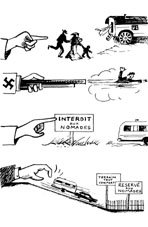
More than 100 members of the European Parliament - including party group leaders – added their own fingerprints to a petition protesting against Italy's policy against Gypsies.
While this may be a very nice gesture initiated by Italian Communist MEP Giusto Catania what does he and there others think to achieve with this. This is nothing, really, but a gimmick as most of those parliamentarians are not of the Romani People and it, therefore, is nothing but a publicity stunt to be seen to do something.
The European Parliament has adopted a resolution that asks the Italian government to halt its plans. Euro MPs say it is unacceptable "to violate fundamental rights of the Gypsy People and to criminalise them."
This resolution was, however, passed on such a small margin – with 52 to 48 votes, so we understand – that all it needs is some more EU states, and this surely is going to happen in the not too distant future, to swing to the right and the Romani are once again in real deep trouble.
While no one dares to speak against Jews anymore – and probably rightly so – the Gypsy is still free and fair game to the politicians of that persuasion and the general public at large, and not just in Italy.
Should, as I said, we get a swing of two or three more politicians in the European Parliament and – as that does not really count much – the parliament, I mean – more importantly in the European Commission, that unelected body which is the real power of the European Union and the Council of Europe, then things could really, once again, turn out nasty for the Romani-Gypsy of Europe.
We must prepare to stand against this as a Nation and to this end we must, properly, unite as a Nation, and the medium of the Internet and such can be out greatest asset here. And no, we do not need a standardized Romani Language for this.
Ava! Ame Shai! (Yes! We Can!)
© M Smith (Veshengro), July 2008

Showing posts with label European Parliament. Show all posts
Showing posts with label European Parliament. Show all posts
Roma in Europe: MEPs vote on anti-discrimination measures
With 10 million Roma people in the European Union and levels of employment and poverty disproportionately high among them, MEPs on Thursday voted on a European strategy to try and improve the lives of the Roma community. Often discrimination in jobs and schooling are just some of the problems that Roma people face in Europe. Ahead of the vote we spoke to Hungarian MEP's of Roma origin Lívia Járóka and Viktória Mohácsi about the strategy and the situation of the Roma in Europe today.
It is estimated that there are 10 million Roma in the EU. This makes them more numerous than the population of 14 of the Union's 27 members. Roma communities are mainly based in Romania, Bulgaria or in Hungary. In the last four years all these states have joined the EU pushing the issue up the political agenda. Roma often suffer from racial discrimination, poverty and social exclusion.
Ahead of the vote we put some questions to the two MEPs:
The draft resolution recognizes "that the social inclusion of Romani communities is still a goal to be achieved". Why hasn’t this been the case yet?
Viktória Mohácsi (Liberal ALDE) told us that "while Member States recognize the need of integration of Roma, most of them are not taking responsibility for creating steps to solve the problems".
She went on to say that "the lack of minority policy of the EU could also be a possible reason: some countries recognise the Roma as a minority, some of them declare that all people have the same rights according to the constitutions".
LíviaJáróka (EPP-ED): "The successful integration of Europe's youngest and most rapidly thriving minority shouldn't fall victim of narrow-minded party politics, since it would be a national, moreover an all-European interest. Unfortunately parties are afraid of losing their voters by bringing up the Roma issue and also the civil movements are too weak, so there is no real Roma representation".
In many States Roma live in slums and are can be even expelled from the country. What can be done to provide better living conditions?
LíviaJáróka: "The appearance of large migrant groups in Western Europe is the complete failure of the states that they have left. Roma and also non-Roma migrants leave their countries, because of the terrible situation they have to face, namely segregated living conditions and segregated education-systems as well as poverty and social exclusion. Roma people see the country they live in as their motherland and they want to contribute to their societies as well".
"The European Parliament has sent a clear answer when it adopted the resolution on free movement, on November 14, 2007", says Viktória Mohácsi. (This resolution "reaffirm" the value of the free movement of persons as a fundamental principle of the European Union” and advocate the establishment of a network of organisations dealing with the social inclusion of Roma as well as the promotion of awareness-raising instruments regarding the rights and duties of the Roma community).
Ms Mohácsi told us that "in some Member States ignoring the fact that free movement is basic principle for the Roma also. That's why this resolution on European Roma Strategy reflecting on the case of housing is important".
One of the concrete solutions proposed would be micro-credit: can you explain why it can be a solution?
LíviaJáróka: "I believe that a properly elaborated micro-credit scheme might be an important instrument for the empowerment of excluded communities, as the example of Muhammad Yunus and the Grameen Bank (which won the 2006 Nobel peace prize) shows. Micro-credit might be the only tool that can replace usury which is one of the greatest problems within Roma communities".
"In most countries, the unemployment rates amongst Romani communities are still higher than 80%, because of exclusion from the education system. Micro-credit scheme could be one of the adequate possibilities to promote self-employment" says Mohácsi.
Do we need a more collective, pan-European effort to tackle Roma issues?
"Only 5 Member States (out of 27) created an action plan for the integration of Roma but we still do not have a result. Life long learning, anti-discrimination, right to education has to be established on the level of most excluded group of people, too, says Mohácsi.
LíviaJáróka: "This plan should identify and effectively address the practical barriers that Roma face by accessing their unalienable fundamental rights in the fields of housing, employment, health care and education".
Thursday's vote on draft Resolution follows up plenary debate of 16 January 2008 on steps planned to improve the situation of the Roma.
Editorial Comment:
Before anything else we need for the European Union and the European Parliament and its MEPs and officers to understand the very fact that not all of the Romani People are Roma, despite the fact what the idiots with a hidden agenda pedal.
The Sinti and the Cale are separate Romani Nations; separate from the Roma. While we may have a related Culture we do not have an entirely common Culture as there are cultural practices of the Roma that are foreign to the Sinti and the Cale, such as child marriage and bride price. While this is basically the same for all Roma groups the Sinti and the Cale know no bride price, no child marriage and also, basically, no haggled arranged marriage. But that is all that I am prepared to say about the differences, as much does not belong into the world of the Gadje. Suffice to say that there are profound cultural differences twixt Sinti and Cale one the one side and Roma on the other. So we cannot, therefore, that is the Sinti and the Cale, be a tribe of the Roma. Dosta penauas!
Michael Smith (Veshengro), March 2008
It is estimated that there are 10 million Roma in the EU. This makes them more numerous than the population of 14 of the Union's 27 members. Roma communities are mainly based in Romania, Bulgaria or in Hungary. In the last four years all these states have joined the EU pushing the issue up the political agenda. Roma often suffer from racial discrimination, poverty and social exclusion.
Ahead of the vote we put some questions to the two MEPs:
The draft resolution recognizes "that the social inclusion of Romani communities is still a goal to be achieved". Why hasn’t this been the case yet?
Viktória Mohácsi (Liberal ALDE) told us that "while Member States recognize the need of integration of Roma, most of them are not taking responsibility for creating steps to solve the problems".
She went on to say that "the lack of minority policy of the EU could also be a possible reason: some countries recognise the Roma as a minority, some of them declare that all people have the same rights according to the constitutions".
LíviaJáróka (EPP-ED): "The successful integration of Europe's youngest and most rapidly thriving minority shouldn't fall victim of narrow-minded party politics, since it would be a national, moreover an all-European interest. Unfortunately parties are afraid of losing their voters by bringing up the Roma issue and also the civil movements are too weak, so there is no real Roma representation".
In many States Roma live in slums and are can be even expelled from the country. What can be done to provide better living conditions?
LíviaJáróka: "The appearance of large migrant groups in Western Europe is the complete failure of the states that they have left. Roma and also non-Roma migrants leave their countries, because of the terrible situation they have to face, namely segregated living conditions and segregated education-systems as well as poverty and social exclusion. Roma people see the country they live in as their motherland and they want to contribute to their societies as well".
"The European Parliament has sent a clear answer when it adopted the resolution on free movement, on November 14, 2007", says Viktória Mohácsi. (This resolution "reaffirm" the value of the free movement of persons as a fundamental principle of the European Union” and advocate the establishment of a network of organisations dealing with the social inclusion of Roma as well as the promotion of awareness-raising instruments regarding the rights and duties of the Roma community).
Ms Mohácsi told us that "in some Member States ignoring the fact that free movement is basic principle for the Roma also. That's why this resolution on European Roma Strategy reflecting on the case of housing is important".
One of the concrete solutions proposed would be micro-credit: can you explain why it can be a solution?
LíviaJáróka: "I believe that a properly elaborated micro-credit scheme might be an important instrument for the empowerment of excluded communities, as the example of Muhammad Yunus and the Grameen Bank (which won the 2006 Nobel peace prize) shows. Micro-credit might be the only tool that can replace usury which is one of the greatest problems within Roma communities".
"In most countries, the unemployment rates amongst Romani communities are still higher than 80%, because of exclusion from the education system. Micro-credit scheme could be one of the adequate possibilities to promote self-employment" says Mohácsi.
Do we need a more collective, pan-European effort to tackle Roma issues?
"Only 5 Member States (out of 27) created an action plan for the integration of Roma but we still do not have a result. Life long learning, anti-discrimination, right to education has to be established on the level of most excluded group of people, too, says Mohácsi.
LíviaJáróka: "This plan should identify and effectively address the practical barriers that Roma face by accessing their unalienable fundamental rights in the fields of housing, employment, health care and education".
Thursday's vote on draft Resolution follows up plenary debate of 16 January 2008 on steps planned to improve the situation of the Roma.
Editorial Comment:
Before anything else we need for the European Union and the European Parliament and its MEPs and officers to understand the very fact that not all of the Romani People are Roma, despite the fact what the idiots with a hidden agenda pedal.
The Sinti and the Cale are separate Romani Nations; separate from the Roma. While we may have a related Culture we do not have an entirely common Culture as there are cultural practices of the Roma that are foreign to the Sinti and the Cale, such as child marriage and bride price. While this is basically the same for all Roma groups the Sinti and the Cale know no bride price, no child marriage and also, basically, no haggled arranged marriage. But that is all that I am prepared to say about the differences, as much does not belong into the world of the Gadje. Suffice to say that there are profound cultural differences twixt Sinti and Cale one the one side and Roma on the other. So we cannot, therefore, that is the Sinti and the Cale, be a tribe of the Roma. Dosta penauas!
Michael Smith (Veshengro), March 2008


MEPs highlight "ghettoisation" of Roma and call for EU anti-discrimination measures
The European Parliament adopted a report warning of the risks of anti-Gypsyism promoted by extremists and calling for fresh efforts to integrate Roma through positive measures in housing, health, education and employment. Of the 12 to 15 million Roma living in Europe, about 10 million live in EU countries. The majority became EU citizens after the 2004 and 2007 enlargements. Yet MEPs believe Roma communities still suffer clear discrimination.
"Anti-Gypsyism or Romaphobia is still widespread in Europe and is promoted and used by extremists, which can culminate in racist attacks, hate speech, physical attacks, unlawful evictions and police harassment", warn MEPs in an own-initiative report adopted by 510 votes to 36, with 67 abstentions. The situation of European Roma communities is distinct from other national minorities, they say, arguing that this justifies specific measures at European level. Highlighting the "lack of progress made in combating racial discrimination against the Roma" in Europe, the resolution points out that, in the negotiation and accession process, all candidate countries committed to improving the inclusion of this community. It asks "the European Commission to make an assessment of the implementation of those commitments and of the current situation of the Roma in all EU Member States".
Parliament also maintains that "the Romani holocaust (Porajmos) deserves full recognition commensurate with the gravity of Nazi crimes" and, among many other measures, calls on the relevant authorities "to abolish the pig fattening industry on the former concentration camp in Lety (Czech Republic) and to create a memorial to honour the victims of persecution".
Housing
MEPs believe that "evidence of ghettoisation exist on a wide scale", with Roma regularly being either victims of forced evictions or prevented from moving out of such neighbourhoods. The Commission should therefore support active programmes to end Romani slums and provide housing for Roma citizens. Parliament also urged Member States to solve the problem of camps, "where there are no hygienic and safety standards at all and where a large number of Romani children die in domestic accidents, particularly fires".
Health
Member States need to improve the health situation of Roma communities, say MEPs, and "remedy without delay the systemic exclusion" of certain Roma communities from health care. In addition, "extreme human rights abuses (...) including racial segregation in health facilities and coercive sterilisation of Romani women" must be ended.
Education
Deploring the fact that segregation in education is still tolerated in the Member States, MEPs call on the Commission to look for new ways of tightening up anti-discrimination legislation in this field and to report back to the EP within one year. They believe positive action is needed in most areas of education and vocational training.
Employment
The Roma community also suffers "unacceptably high levels of unemployment", according to the resolution. The Commission is urged to support the integration of the Roma into the labour market through training, retraining and other measures, and also to consider granting micro-credits to Roma to help them start up small businesses.
Go local
While the EU and the Member States have crucial roles to play in key policy areas, MEPs also stress the need to involve local authorities in all active measures to integrate the Roma.
Measures within the European Commission
Lastly, MEPs urge the Commission to "shape a Community Action Plan on Roma Inclusion", to give one Commissioner "responsibility for coordinating a Roma policy" and "to promote Roma staff within its structure".
Editorial Comment:
As the MEPs keep mentioning the Roma Community this can lead the reader of the document released by the European Parliament to believe that it is ONLY the Roma that are thus affected and not the like of Sinti and Cale who, and the EU will never understand that as long as those with a hidden agenda keep telling them that Sinti and Cale are but tribes of the Roma, are NOT Roma but Romani. While all Roma are Romani not all Romani are Roma.
I guess this is difficult to understand, and then again, we, the People, don't know what we are talking about as the Romani Institute and the Gypsy Union we told by officers of the EU and the Parliament. They know better than us that all Sinti and Cale are part of the Roma.
We must also remember that they know everything so well that they have included the Irish Travellers I amongst the tribes of the Roma.
Michael Smith (Veshengro), March 2008
"Anti-Gypsyism or Romaphobia is still widespread in Europe and is promoted and used by extremists, which can culminate in racist attacks, hate speech, physical attacks, unlawful evictions and police harassment", warn MEPs in an own-initiative report adopted by 510 votes to 36, with 67 abstentions. The situation of European Roma communities is distinct from other national minorities, they say, arguing that this justifies specific measures at European level. Highlighting the "lack of progress made in combating racial discrimination against the Roma" in Europe, the resolution points out that, in the negotiation and accession process, all candidate countries committed to improving the inclusion of this community. It asks "the European Commission to make an assessment of the implementation of those commitments and of the current situation of the Roma in all EU Member States".
Parliament also maintains that "the Romani holocaust (Porajmos) deserves full recognition commensurate with the gravity of Nazi crimes" and, among many other measures, calls on the relevant authorities "to abolish the pig fattening industry on the former concentration camp in Lety (Czech Republic) and to create a memorial to honour the victims of persecution".
Housing
MEPs believe that "evidence of ghettoisation exist on a wide scale", with Roma regularly being either victims of forced evictions or prevented from moving out of such neighbourhoods. The Commission should therefore support active programmes to end Romani slums and provide housing for Roma citizens. Parliament also urged Member States to solve the problem of camps, "where there are no hygienic and safety standards at all and where a large number of Romani children die in domestic accidents, particularly fires".
Health
Member States need to improve the health situation of Roma communities, say MEPs, and "remedy without delay the systemic exclusion" of certain Roma communities from health care. In addition, "extreme human rights abuses (...) including racial segregation in health facilities and coercive sterilisation of Romani women" must be ended.
Education
Deploring the fact that segregation in education is still tolerated in the Member States, MEPs call on the Commission to look for new ways of tightening up anti-discrimination legislation in this field and to report back to the EP within one year. They believe positive action is needed in most areas of education and vocational training.
Employment
The Roma community also suffers "unacceptably high levels of unemployment", according to the resolution. The Commission is urged to support the integration of the Roma into the labour market through training, retraining and other measures, and also to consider granting micro-credits to Roma to help them start up small businesses.
Go local
While the EU and the Member States have crucial roles to play in key policy areas, MEPs also stress the need to involve local authorities in all active measures to integrate the Roma.
Measures within the European Commission
Lastly, MEPs urge the Commission to "shape a Community Action Plan on Roma Inclusion", to give one Commissioner "responsibility for coordinating a Roma policy" and "to promote Roma staff within its structure".
Editorial Comment:
As the MEPs keep mentioning the Roma Community this can lead the reader of the document released by the European Parliament to believe that it is ONLY the Roma that are thus affected and not the like of Sinti and Cale who, and the EU will never understand that as long as those with a hidden agenda keep telling them that Sinti and Cale are but tribes of the Roma, are NOT Roma but Romani. While all Roma are Romani not all Romani are Roma.
I guess this is difficult to understand, and then again, we, the People, don't know what we are talking about as the Romani Institute and the Gypsy Union we told by officers of the EU and the Parliament. They know better than us that all Sinti and Cale are part of the Roma.
We must also remember that they know everything so well that they have included the Irish Travellers I amongst the tribes of the Roma.
Michael Smith (Veshengro), March 2008
Subscribe to:
Posts (Atom)