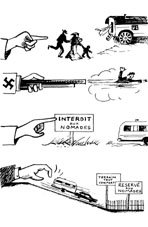
Dear Roma and non-Roma poets!
The Ethnographical Museum in Tarnow would like to invite you to participate in the second edition of the International Contest of Romani Poetry in Memory of Papusza on the title “For the Golden Pen of Papusza”.
The Contest is dedicated to Romani poetess, Bronisława Wajs called Papusza, who died in 1987 – to commemorate her 100th birthday. The aim of the Contest is to support and exhibit the integration and mutual contacts of Romani and Polish culture and looking for the young talents in the field of poetry.
The organizer of the Contest is The District Museum in Tarnow (Poland), partners are: Centre of the Roma Culture in Tarnow (Tarnow, Poland), Romani Baxt (Warsaw-Tirana-Paris), INALCO - Institut National des Languages et Civilisations Orientales (France).
The character of the Contest is open and is addressed to adults, students and pupils of secondary schools in Poland and abroad. The topics are the inspirations in culture, tradition and history of Roma, also knows as Gypsy.
The Contest has two categories of competition: poems in Romani and poems in Polish.
The participants of the contest should submit no more than three poems in the chosen category. Deadline for sending poems is 31st of March 2010.
For downloading the participation card and familiarising yourself with the contest rules please view the Tarnów Regional Museum website http://www.muzeum.tarnow.pl/wydarzenia.php?id=35. A knowledge of Polish would be advantageous, from what I have seen.
Source: Natalia Gancarz
The Ethnographical Museum in Tarnow
"Studia Romologica"
natalia@muzeum.tarnow.pl
http://www.stromo.pl

The Forgotten Genocide event reminds about the Romani Holocaust
Finnish association for creative Roma culture, ”Drom”, organizes an international event in Helsinki this spring, dedicated to the Romani Holocaust.
The main part of the event is an international two-day seminar ”The Roma and the Holocaust”, held in Helsinki, in the House of Science and Letters, which will start on an International Romani Day, April 8. The seminar will discuss the history and faith of the Roma in the Second World War in the different parts of Europe , including Nordic countries. The present European Roma question and future challenges will also be addressed. The seminar is accompanied by a rich cultural program.
Veijo Baltzar, a Finnish Romani writer, published a novel In Love and War in 2008, which unfolds the story about the Romani genocide. The book and its subject aroused a lot of interest in Finland which created a need to tell about the sufferings of the Romani People in the National Socialist genocide to the wide audience and to discuss present Roma politics through the prism of history.
The Forgotten Genocide is a significant step for the Nordic countries and all of Europe in the Roma question. Project aims at concrete and far-reaching actions for the benefit of European Roma. The aim of the creative parts of the event is to indicate the vitality of the Romani culture and to uphold its richness.
The events of the Forgotten Genocide project:
· Barvalo Drom - the thriving Roma culture exhibition,
International Cultural Centre Caisa 26.3 - 29.4
· The Roma and the Holocaust - International Seminar 8.4 - 9.4
· Barvalo Drom - Romani Music Concerts, Tammisaari 26.3 and Savoy theatre, Helsinki 9.4
· Die Zigeuner von W, Photograph exhibition by Espen Eichhöfer, Goethe Institut, Helsinki 9.4 -12.5
Barvalo Drom (“The Rich Way” in English) is a touching collection exhibiting Romani history, art and culture. The international music concert, bearing the same name, in Savoy Theatre on 9.4 presents outstanding Roma musical artists from Finland, Sweden and Czech Republic – the latter having represented their country in the last year’s Eurovision song contest.
President of the Republic of Finland Ms Tarja Halonen is a patron for The Forgotten Genocide project. The main co-partners of the project are Helsinki City Cultural Office, Helsinki Collegium for Advanced Studies, Finnish Historical Society and the Ministry of Foreign Affairs. Also the former Prime Minister of Finland Paavo Lipponen and a deputy and the chairman of the Roma advisory council Pekka Haavisto have both actively taken part in the rearrangements and the realization of the event.
The event is meant for everyone interested in Romani history and culture, researchers, officials and decision-makers. The Forgotten Genocide project will continue also after the Spring 2010 in the form of new projects related to the topic.
For more information log on at: www.drom.fi/forgottengenocide
<>


Dazzled by titles, blinded by bling
by Michael Smith (Veshengro)
Too many people, Gadje and Rom alike, are dazzled by the Gypsyologists and their titles, regardless of whether they are Gadje or Rom.
They have grand titles of Professor, or Doctor, in “Romani Studies”, “Romani Language”, etc. but what does that mean and prove. Who tested them on their skills and knowledge? Were those that awarded them the titles Romani Elders? No, it was Gadje academics that gave them title and position.
So, how much can we really depend on what those people then say?
What those people created is a complete industry revolving around the Roma and the language of the Roma, for few other Romani groups would ever share information with them, whether on Culture and Tradition or Language; the Sinti most certainly not.
That is the very reason that the entire thing revolves around the Roma and hence the reason why the academics are trying to elevate the Roma as the mother group of all the Romani People, which is not so.
But all their studies are based upon the material from the Roma and hence, in order to make themselves into more than what they are, they must try too make the Roma groups the leading lights, so to speak.
It is being claimed that this is done in order to bring about unity amongst the Gypsy People but that is a load of, as the Australians would say, bull dust. Dust thrown up in order to blind people so they do not see the real truth behind what is being done.
Many Romani “leaders” also work hand-in-glove with the self-acclaimed Romani academics, whether Gadje or Rom, as they seem to think that they get something out of it for themselves. The concern of most of those leaders anyway is not for the poor Gypsy who has to eek out a living by scavenging and such.
Let's stop being dazzled and blinded and learn to look behind the scenes. It is not that difficult when we learn to wear the shades of discernment. In the field of “Romani Studies” titles mean absolutely nothing; that is what we must remember, and the academic, whether Gypsy of Gadjo, only know what he or she does know because someone from the People gave him or her that information.
Wake up everyone and see the light.
© 2010
Too many people, Gadje and Rom alike, are dazzled by the Gypsyologists and their titles, regardless of whether they are Gadje or Rom.
They have grand titles of Professor, or Doctor, in “Romani Studies”, “Romani Language”, etc. but what does that mean and prove. Who tested them on their skills and knowledge? Were those that awarded them the titles Romani Elders? No, it was Gadje academics that gave them title and position.
So, how much can we really depend on what those people then say?
What those people created is a complete industry revolving around the Roma and the language of the Roma, for few other Romani groups would ever share information with them, whether on Culture and Tradition or Language; the Sinti most certainly not.
That is the very reason that the entire thing revolves around the Roma and hence the reason why the academics are trying to elevate the Roma as the mother group of all the Romani People, which is not so.
But all their studies are based upon the material from the Roma and hence, in order to make themselves into more than what they are, they must try too make the Roma groups the leading lights, so to speak.
It is being claimed that this is done in order to bring about unity amongst the Gypsy People but that is a load of, as the Australians would say, bull dust. Dust thrown up in order to blind people so they do not see the real truth behind what is being done.
Many Romani “leaders” also work hand-in-glove with the self-acclaimed Romani academics, whether Gadje or Rom, as they seem to think that they get something out of it for themselves. The concern of most of those leaders anyway is not for the poor Gypsy who has to eek out a living by scavenging and such.
Let's stop being dazzled and blinded and learn to look behind the scenes. It is not that difficult when we learn to wear the shades of discernment. In the field of “Romani Studies” titles mean absolutely nothing; that is what we must remember, and the academic, whether Gypsy of Gadjo, only know what he or she does know because someone from the People gave him or her that information.
Wake up everyone and see the light.
© 2010
What is being done for the protection of the Romani refugees from Kosovo?
by Michael Smith (Veshengro)
Thomas Hammarberg (High Commissioner for Human Rights of the Council of Europe) held a working lunch with the representatives of the EU's main institutions. Representing the European Parliament's largest political group, the European People's Party (EPP), MEP Lívia Járóka discussed the issue of Kosovar Roma repatriated from EU Member States with the High Commissioner.
Thomas Hammarberg came to Brussels to present his issue paper on “Criminalisation of Migration in Europe" and to meet with representatives of the European Union's three main institutions in order to discuss the human rights implications of immigration.
At the working lunch, Lívia Járóka (Fidesz - Hungarian Civic Union, EPP) asked the High Commissioner about the implementation of the bilateral readmission agreement between Kosovo and Germany.
During the war in 1999 and the following years, over 14,000 Roma fled from Kosovo to Germany, who due to the process, have lost their status of "toleration" providing the right to stay in the country and since staying in Kosovo at least officially "does not represent a direct threat to life and limb" they must leave Germany.
Járóka reminded that 25 % of Roma threatened by the forced deportation had been born in Germany having no ties to Kosovo at all and Kosovar authorities had proven to be unable to resettle not more than 480 internally displaced persons from the scandalous lead contaminated camps of Cesmin Lug and Leposavić.
"The security situation is also unsatisfactory and ethnically motivated violence is still wide-spread – Lívia Járóka added.
Hammarberg replied that regarding the serious malfunctions of Kosovar economy and the contradictory will of the refugees, he was also concerned about repatriation and that he wrote an open letter to Chancellor Angela Merkel in which he asked to consider suspending the repatriations, prolong the status of toleration and implement the readmission agreement only on voluntary basis.
Regarding NGOs, Hammarberg said that most civil organizations left a great deal to be desired both in terms of their professional capacity and their independence from politics. However, the contribution of strong, professional and independent NGOs would be essential in bringing up and discussing most issues related to human rights - added the High Commissioner. Hammarberg agreed with Járóka upon the necessity of empowering stakeholder NGOs in terms of both financial and human resources. Further participants of the negotiation included Hans Nilsson, Head of Unit of the Secretariat General of the EU, Thierry Bechet, Adviser of the European Commission's Directorate General for External Relations, as well as members of the European Parliament Ulrika Lunacek and Cecilia Wikström.
It is, however, well known and documented that most of the Roma, Egyptians and Ashkali, in short Gypsy, who return to Kosovo are not welcome there and are being hounded and even murdered by the ethnic Albanians in that province who want to have Kosovo as a part of a Greater Albania.
And while countries such as Germany, Switzerland, and others, must be made to stop any attempt of forcible repatriation of Gypsies from Kosovo the UN also must be held to account, and also by the likes of Lívia Járóka, MEP, as to the UN's role in ethnic cleansing of Gypsies from Kosovo who they have part in killing through forcing them to live in lead contaminated camps.
Germany has an obligation to the Gypsy People, and not just the Sinti and Roma in its midst but, in a way, to all of them. While Germany sees such an obligation towards the Jews and the illegal state of Israel, even, it tries to vest itself of anything to do with the Gypsy, the Romani, People. Not that that surprises me, seeing also the attitude that still prevails against the Romani Gypsy in Germany, and, it would appear, basically, the rest of the entire European Union, and Europe as a whole.
© 2010
Thomas Hammarberg (High Commissioner for Human Rights of the Council of Europe) held a working lunch with the representatives of the EU's main institutions. Representing the European Parliament's largest political group, the European People's Party (EPP), MEP Lívia Járóka discussed the issue of Kosovar Roma repatriated from EU Member States with the High Commissioner.
Thomas Hammarberg came to Brussels to present his issue paper on “Criminalisation of Migration in Europe" and to meet with representatives of the European Union's three main institutions in order to discuss the human rights implications of immigration.
At the working lunch, Lívia Járóka (Fidesz - Hungarian Civic Union, EPP) asked the High Commissioner about the implementation of the bilateral readmission agreement between Kosovo and Germany.
During the war in 1999 and the following years, over 14,000 Roma fled from Kosovo to Germany, who due to the process, have lost their status of "toleration" providing the right to stay in the country and since staying in Kosovo at least officially "does not represent a direct threat to life and limb" they must leave Germany.
Járóka reminded that 25 % of Roma threatened by the forced deportation had been born in Germany having no ties to Kosovo at all and Kosovar authorities had proven to be unable to resettle not more than 480 internally displaced persons from the scandalous lead contaminated camps of Cesmin Lug and Leposavić.
"The security situation is also unsatisfactory and ethnically motivated violence is still wide-spread – Lívia Járóka added.
Hammarberg replied that regarding the serious malfunctions of Kosovar economy and the contradictory will of the refugees, he was also concerned about repatriation and that he wrote an open letter to Chancellor Angela Merkel in which he asked to consider suspending the repatriations, prolong the status of toleration and implement the readmission agreement only on voluntary basis.
Regarding NGOs, Hammarberg said that most civil organizations left a great deal to be desired both in terms of their professional capacity and their independence from politics. However, the contribution of strong, professional and independent NGOs would be essential in bringing up and discussing most issues related to human rights - added the High Commissioner. Hammarberg agreed with Járóka upon the necessity of empowering stakeholder NGOs in terms of both financial and human resources. Further participants of the negotiation included Hans Nilsson, Head of Unit of the Secretariat General of the EU, Thierry Bechet, Adviser of the European Commission's Directorate General for External Relations, as well as members of the European Parliament Ulrika Lunacek and Cecilia Wikström.
It is, however, well known and documented that most of the Roma, Egyptians and Ashkali, in short Gypsy, who return to Kosovo are not welcome there and are being hounded and even murdered by the ethnic Albanians in that province who want to have Kosovo as a part of a Greater Albania.
And while countries such as Germany, Switzerland, and others, must be made to stop any attempt of forcible repatriation of Gypsies from Kosovo the UN also must be held to account, and also by the likes of Lívia Járóka, MEP, as to the UN's role in ethnic cleansing of Gypsies from Kosovo who they have part in killing through forcing them to live in lead contaminated camps.
Germany has an obligation to the Gypsy People, and not just the Sinti and Roma in its midst but, in a way, to all of them. While Germany sees such an obligation towards the Jews and the illegal state of Israel, even, it tries to vest itself of anything to do with the Gypsy, the Romani, People. Not that that surprises me, seeing also the attitude that still prevails against the Romani Gypsy in Germany, and, it would appear, basically, the rest of the entire European Union, and Europe as a whole.
© 2010
Czech Television reveals Gypsy children barred from enrolling in elementary school
by Michael Smith (Veshengro)
An elementary school in Brno is telling some students enrollment is closed while simultaneously keeping its doors open for others.
Czech Television recently performed a hidden camera investigation and discovered exactly how elementary schools approach the enrollment of Gypsy children.
In general, it is important that all children attend school together. For Romani children, it is important they do their best to achieve academically, while for non-Romani children it is important to learn tolerance of those who are different. “We’re full, go ask somewhere else,” is what Romani People often hear when trying to enroll their children in elementary school in the Czech Republic.
Czech Television tested how the Antoninska Elementary School in Brno, which specializes in offering foreign language instruction, responds to Romani parents and children. Two women, one of Gypsy origin, visited the school after the enrollment period had expired. The Romani parent was told there was no more room at the school for her child, but the other woman was much more successful – her child was added to a waiting list.
“I already have 70 people registered, which is three classes. I’m full, but I don’t know how many of these children will attend,” the director told the Romani mother. He recommended she try another school, which in his view is not as demanding, and warned her that at his school the pupils have to start foreign language instruction from the first grade.
In contrast, his meeting with the non-Romani mother was a completely different story. This mother visited the school the day after the Romani mother made her attempt. The director handed her over to the deputy director. “You are the third mother today who missed the deadline, but the registration must be done formally, you can’t just come here without bringing the child along. Next Wednesday I will not be teaching, and I am already agreed with some other mothers that they will come register, so you can too,” the deputy director said. The information about the school being full was never expressed to this mother. School officials did draw her attention to the foreign language instruction in the first grade, but in a completely different way, mentioning it as valuable for the child.
The result of the test has angered the Czech Education, Youth and Sport Ministry, but the Brno Regional Authority, who has established that school, responded calmly and downplayed its significance. “This is sensationalism. As far as I know, just because a mother has not yet enrolled her child does not mean it’s all over. If it should come to pass that they genuinely refuse to enroll a child because the child is Roma, then we would naturally address that and say it’s bad,” said Daniel Rychnovsky, Deputy Mayor of Brno.
According to the ministry, such an approach is not only unethical, it is illegal. “Basically every teacher, every director should proceed fairly and in the same way towards all pupils and their parents,” claims Deputy Education Minister Klara Laurencikova. Even though the school did not tell the Romani mother directly that it does not accept Romani children, the problem is still serious. “These days no one would permit themselves to state directly that they do not accept Roma. What makes it worse is that these various hidden methods are sought for refusing them,” explains Veronika Vankova of IQ Roma Servis in Brno.
The school management rejects the claim that it makes such distinctions, even though the report shows the mothers were handled differently. Government research has admitted that Romani children are 27 times more likely to end up in schools for lightly mentally disabled children than non-Romani children, irrespective of their actual state of mental health and intellectual capacity.
All-Roma classrooms are another problem. In Brno there are a minimum of three schools in which 90 % of the pupils are Romani children. City leaders see nothing wrong with this. “If we have it under control this way, if the parents agree with it, and if it works, I do not see a problem,” Rychnovsky said.
While it would appear that the Czech Television sees a problem with all-Romani classrooms, I personally, and I know of many Gypsy People who think similarly, can see nothing wrong with all-Romani classes. In fact, why not have real Romani Schools, entirely separate from those of the non-Romani so that Romani Culture and Traditions can be observed there, such as the Romani Cleanliness Code and such like.
However, to send Gypsy children away under the pretense that one school is full while at the same time the school is happy to take Gadje kids then that is discrimination and wrong, and there are no two ways about that.
But why are we actually surprised? It is happening still, has happened for ages, and whatever we may say or do and however much we may scream against it; changes will come but slowly as far as Anti-Gypsyism is concerned.
Instead of screaming that we want our children to go to Gadje brainwashing institutions having Gypsy owned and operated schools would be a much better bet as, firstly the younger children can gently be pulled over into the vernacular of the country and foreign languages while at the same time everyone still being taught in the Romani Language, and also being taught the Romani Language. Secondly it would be an education in the way the Romani work, which would be much better for the children.
But this is not something the do-gooders even want to hear and consider.
© 2010
An elementary school in Brno is telling some students enrollment is closed while simultaneously keeping its doors open for others.
Czech Television recently performed a hidden camera investigation and discovered exactly how elementary schools approach the enrollment of Gypsy children.
In general, it is important that all children attend school together. For Romani children, it is important they do their best to achieve academically, while for non-Romani children it is important to learn tolerance of those who are different. “We’re full, go ask somewhere else,” is what Romani People often hear when trying to enroll their children in elementary school in the Czech Republic.
Czech Television tested how the Antoninska Elementary School in Brno, which specializes in offering foreign language instruction, responds to Romani parents and children. Two women, one of Gypsy origin, visited the school after the enrollment period had expired. The Romani parent was told there was no more room at the school for her child, but the other woman was much more successful – her child was added to a waiting list.
“I already have 70 people registered, which is three classes. I’m full, but I don’t know how many of these children will attend,” the director told the Romani mother. He recommended she try another school, which in his view is not as demanding, and warned her that at his school the pupils have to start foreign language instruction from the first grade.
In contrast, his meeting with the non-Romani mother was a completely different story. This mother visited the school the day after the Romani mother made her attempt. The director handed her over to the deputy director. “You are the third mother today who missed the deadline, but the registration must be done formally, you can’t just come here without bringing the child along. Next Wednesday I will not be teaching, and I am already agreed with some other mothers that they will come register, so you can too,” the deputy director said. The information about the school being full was never expressed to this mother. School officials did draw her attention to the foreign language instruction in the first grade, but in a completely different way, mentioning it as valuable for the child.
The result of the test has angered the Czech Education, Youth and Sport Ministry, but the Brno Regional Authority, who has established that school, responded calmly and downplayed its significance. “This is sensationalism. As far as I know, just because a mother has not yet enrolled her child does not mean it’s all over. If it should come to pass that they genuinely refuse to enroll a child because the child is Roma, then we would naturally address that and say it’s bad,” said Daniel Rychnovsky, Deputy Mayor of Brno.
According to the ministry, such an approach is not only unethical, it is illegal. “Basically every teacher, every director should proceed fairly and in the same way towards all pupils and their parents,” claims Deputy Education Minister Klara Laurencikova. Even though the school did not tell the Romani mother directly that it does not accept Romani children, the problem is still serious. “These days no one would permit themselves to state directly that they do not accept Roma. What makes it worse is that these various hidden methods are sought for refusing them,” explains Veronika Vankova of IQ Roma Servis in Brno.
The school management rejects the claim that it makes such distinctions, even though the report shows the mothers were handled differently. Government research has admitted that Romani children are 27 times more likely to end up in schools for lightly mentally disabled children than non-Romani children, irrespective of their actual state of mental health and intellectual capacity.
All-Roma classrooms are another problem. In Brno there are a minimum of three schools in which 90 % of the pupils are Romani children. City leaders see nothing wrong with this. “If we have it under control this way, if the parents agree with it, and if it works, I do not see a problem,” Rychnovsky said.
While it would appear that the Czech Television sees a problem with all-Romani classrooms, I personally, and I know of many Gypsy People who think similarly, can see nothing wrong with all-Romani classes. In fact, why not have real Romani Schools, entirely separate from those of the non-Romani so that Romani Culture and Traditions can be observed there, such as the Romani Cleanliness Code and such like.
However, to send Gypsy children away under the pretense that one school is full while at the same time the school is happy to take Gadje kids then that is discrimination and wrong, and there are no two ways about that.
But why are we actually surprised? It is happening still, has happened for ages, and whatever we may say or do and however much we may scream against it; changes will come but slowly as far as Anti-Gypsyism is concerned.
Instead of screaming that we want our children to go to Gadje brainwashing institutions having Gypsy owned and operated schools would be a much better bet as, firstly the younger children can gently be pulled over into the vernacular of the country and foreign languages while at the same time everyone still being taught in the Romani Language, and also being taught the Romani Language. Secondly it would be an education in the way the Romani work, which would be much better for the children.
But this is not something the do-gooders even want to hear and consider.
© 2010
Leading Scottish Romany figure sadly taken from us
 Elic Kennedy – Obituary
 by Michael Smith (Veshengro)
Alexander (Elic) Kennedy
Scottish Romanichal Gypsy
Born: 22 August, 1949, in Lanark.
Died: 24 December, 2009, in East Kilbride, aged 60.
On Christmas Eve 2009 the Gypsy community saw, with great sadness, one of our finest men travel on from us into the great eternal journey. Following a short and sudden illness, Elic passed away at Hairmyres Hospital in South Lanarkshire.
Alexander Kennedy was born 60 years ago last August in Lanark, but it wouldn't have mattered where, as he loved every part of this country. He was a proud Romany Gypsy man whose family roots lay in and around the Lanark, Borders and Edinburgh areas. He was a direct descendant of one of the foremost Romany Gypsy families in Scotland and could trace his bloodline back to the “Queen” of the Yetholm Gypsies, Esther Faa Blyth.
He loved his culture, its traditions, its way of life, history and language, and was an artist of some considerable talent. He could make anything out of wood and created many paintings (none of which he would sell for profit) depicting scenes of Gypsy life including the caravans and wagons of yesteryear.
In a short film on YouTube Elic can be seen dancing and talking great sense, such as, when he says, that we are Romanichals and not Roma...
http://www.youtube.com/travellerstimes#p/u/22/7fVSIQXbn0U. Good onya Kako!
Another great one of ours has gone; gone but not forgotten, leading the way to a new future for the Romani-Gypsy.
Sovea mishto Kako!
© 2010
Forced evictions in Milan: EveryOne Group sends a report to the International Criminal Court of the Hague
by Michael Smith (Veshengro)
“The people who authorized these evictions in the freezing cold weather without the offer of alternative lodgings will come under investigation for crimes against humanity”.
On January 21st eighty makeshift shelters were bulldozed by the Milanese authorities. The huts were razed to the ground along with their contents: blankets, winter clothes, stoves for heating and essential medicines. The forced eviction took place in Via Sant'Arialdo, near the Chiaravalle Abbey, where about 150 Roma citizens, including children, pregnant women and sick people (many of them with cancer, heart problems, and handicaps) were thrown out onto the street and forced to set off on a tragic march to nowhere.
On the morning of January 28th, 2010, the co-presidents of EveryOne Group, Roberto Malini, Matteo Pegoraro and Dario Picciau delivered this report to the magistrates of the International Criminal Court of the Hague.
“Fortunately – after noticing the municipal police patrols driving up and down – many of the families left the settlement before the clearance began in order to avoid being charged for squatting and suffering the humiliation of the ethnic profiling that other families have been subjected to.
However, their homes, makeshift shelters made from wood, plastic and cardboard, no longer exist”. Ninety-five Romanian Roma were charged with illegally occupying a plot of land and are undergoing mass expulsion as the authorities have ordered them to leave the city: a reminder of the way the Roma were forced to leave centuries ago and during the pre-Holocaust years.
According to EveryOne Group, we are talking about intolerable violations of a person's fundamental rights and only a serious legal action can prevent the continuation of these clearance operations.
“For this reason” say Malini, Pegoraro and Picciau”, as a organization working in defence of minority groups, we have taken our complaint to the Prosecutor of the International Criminal Court of the Hague. Our report claims that the actions being carried out by Milan's local authorities are crimes against humanity consisting of forced evictions, failure to offer assistance, bodily harm, and mass expulsions”.
In the report EveryOne Group sent to the Hague, we read “the Court defines crimes against humanity any of the following acts when committed as part of a widespread or systematic attack directed against any civilian population, with knowledge of the
attack. In particular the Statute that regulates the Court's decisions identifies crimes against humanity: extermination, which according to article 7 of the Rome Statute includes the intentional infliction of conditions of life, inter alia the deprivation of access to food and medicine; deportation or forcible transfer of population; persecution - the intentional and severe deprivation of fundamental rights contrary to international law by reason of the identity of the group or collectivity; the crime of apartheid.”
“We sincerely hope” conclude the co-presidents of EveryOne Group, “that actions of this kind, that are undermining the integrity and the dignity of vulnerable human beings are severely punished by the judges and condemned by all the international legal organs.
A copy of this report has also been sent to the offices of the UN High Commissioner for Human Rights, the President of the European Commission and the EU Commissioner for Human Rights.
Hoping, even sincerely hoping, is not going to get us anywhere and the problem is that there are even European Parliament resolutions passed against Italy to have its authorities refrain from such actions and what has happened? Italy and its municipalities have thumbed their noses at the Parliament and the Council. It is a farce and no one has the slightest inclination to do anything for and on behalf of the Gypsy. We should have noticed that by now.
While the idea of sending a report to the ICC may be a good idea the fact is that in all truth and honesty it is a waste of time and things other than this might be much more appropriate.
I hate to be a cynic but I doubt that the ICC judges will even look at the report. If it does not get filed under “G” for “garbage” then it will be shelved somewhere to gather dust. Let no one hold his breath and expect something to happen. Blue in face is not good color unless you happen to be in Avatar.
© 2010
“The people who authorized these evictions in the freezing cold weather without the offer of alternative lodgings will come under investigation for crimes against humanity”.
On January 21st eighty makeshift shelters were bulldozed by the Milanese authorities. The huts were razed to the ground along with their contents: blankets, winter clothes, stoves for heating and essential medicines. The forced eviction took place in Via Sant'Arialdo, near the Chiaravalle Abbey, where about 150 Roma citizens, including children, pregnant women and sick people (many of them with cancer, heart problems, and handicaps) were thrown out onto the street and forced to set off on a tragic march to nowhere.
On the morning of January 28th, 2010, the co-presidents of EveryOne Group, Roberto Malini, Matteo Pegoraro and Dario Picciau delivered this report to the magistrates of the International Criminal Court of the Hague.
“Fortunately – after noticing the municipal police patrols driving up and down – many of the families left the settlement before the clearance began in order to avoid being charged for squatting and suffering the humiliation of the ethnic profiling that other families have been subjected to.
However, their homes, makeshift shelters made from wood, plastic and cardboard, no longer exist”. Ninety-five Romanian Roma were charged with illegally occupying a plot of land and are undergoing mass expulsion as the authorities have ordered them to leave the city: a reminder of the way the Roma were forced to leave centuries ago and during the pre-Holocaust years.
According to EveryOne Group, we are talking about intolerable violations of a person's fundamental rights and only a serious legal action can prevent the continuation of these clearance operations.
“For this reason” say Malini, Pegoraro and Picciau”, as a organization working in defence of minority groups, we have taken our complaint to the Prosecutor of the International Criminal Court of the Hague. Our report claims that the actions being carried out by Milan's local authorities are crimes against humanity consisting of forced evictions, failure to offer assistance, bodily harm, and mass expulsions”.
In the report EveryOne Group sent to the Hague, we read “the Court defines crimes against humanity any of the following acts when committed as part of a widespread or systematic attack directed against any civilian population, with knowledge of the
attack. In particular the Statute that regulates the Court's decisions identifies crimes against humanity: extermination, which according to article 7 of the Rome Statute includes the intentional infliction of conditions of life, inter alia the deprivation of access to food and medicine; deportation or forcible transfer of population; persecution - the intentional and severe deprivation of fundamental rights contrary to international law by reason of the identity of the group or collectivity; the crime of apartheid.”
“We sincerely hope” conclude the co-presidents of EveryOne Group, “that actions of this kind, that are undermining the integrity and the dignity of vulnerable human beings are severely punished by the judges and condemned by all the international legal organs.
A copy of this report has also been sent to the offices of the UN High Commissioner for Human Rights, the President of the European Commission and the EU Commissioner for Human Rights.
Hoping, even sincerely hoping, is not going to get us anywhere and the problem is that there are even European Parliament resolutions passed against Italy to have its authorities refrain from such actions and what has happened? Italy and its municipalities have thumbed their noses at the Parliament and the Council. It is a farce and no one has the slightest inclination to do anything for and on behalf of the Gypsy. We should have noticed that by now.
While the idea of sending a report to the ICC may be a good idea the fact is that in all truth and honesty it is a waste of time and things other than this might be much more appropriate.
I hate to be a cynic but I doubt that the ICC judges will even look at the report. If it does not get filed under “G” for “garbage” then it will be shelved somewhere to gather dust. Let no one hold his breath and expect something to happen. Blue in face is not good color unless you happen to be in Avatar.
© 2010
Gabfests, Gabfests, Gabfest
by Michael Smith (Veshengro)
While the Romani People suffer persecution and deprivation all over the globe, basically, the epidemics – pardon, I meant academics – Gadje and Rom alike, keep wasting time and money on one gabfest after they other. Much like the majority of politicians they are. They fiddle while Rome and the Rom, and the latter in some cases quite literally, burn. Academic and political aggrandizement is the aim of those conferences and gabfests and not the poor Gypsy, wherever they may be.
But dare anyone attack those “grand” men and women, whether of Gadje or Rom origin, and their actions, regardless whether it is the academics, the Gypsyologists, or the politicos. Then immediately legal threats are uttered and slander is forthcoming against those who disagree with them and with what they do and how they behave.
We have seen this by now more than once. Much like in the field of “climate science”. There too dissent results in such actions from those conspiring together to get themselves a nice living via research and what-have-you, funded by grants from universities and taxpayers' money.
The Gypsy “leaders”, by whatever title they may go, also, in the main, work along the same lines and like we have seen in Britain not so long ago when Romani journalist Jake Bowers was invited to, and then did, speak at a conference and one had “forgotten” to invite someone who thinks of himself as the only real Gypsy leader in the whole of the UK, if not even all of Europe. The ranting and raving against Mr. Bowers was just unbelievable, even to the point of stating that, according to the “great leader” Mr. Bowers was not Gypsy, etc.
The academics and the “leaders” alike seem to be the ones that think that they can decide and declare who is and who is not Gypsy, or, as they want to have it all nowadays, Roma.
The only reasons they beleaguer the point of “Roma” and trying to make all Romani into tribes and sub-tribes of the Roma is because only the Roma are willing to teach them the Language and aspects of the Culture. No Sinto would ever do that.
Most of the academics, even the Romani ones, have never grown up in the Language and the Culture and are about as far removed from it often as are the often despised Romungrie and such who do not speak the Language and/or have lost much of the Culture. As soon, however, as they have learned a little of the Language and Culture from the Roma they set themselves up as judges over what is the real version of the Language, etc. and that despite the fact that there are around sixty plus different dialects of the Romani Language and that there are cultural differences between many of the Romani groups, such as between Sinti and Roma, for instance.
But the academics (and “leaders”) do not want this even discussed as it interferes with their status as the great experts and leaders of the People (oh dear!); in the eyes of the Gadje world, at least.
Every time that a Rom is talking to some folks, especially in authority, about this or that aspect of the live and Culture of the Gypsy People it is being compared to what the academics have said in books and lectures and if what the ordinary Rom says is not in line what Prof this or that has said then the Rom must be lying; so the conclusion of the others.
Tell someone in government that Sinti and Roma are different they will retort with that “according to Prof this or that” this is not so and that all are Roma.
In the EU, because of what those academics have created, all Gypsy and Travelers are heaped together under Roma, including the Irish Travelers, and others, who have no link whatsoever, culturally and ethnically, to the Romani-Gypsy.
That is also why all those gabfests. Namely in order to keep perpetuating the myth that they are the experts and others are nothing.
Those experts would be nothing, none of them, without some Rom here and there having been stupid enough to share various bits of information with them and their careers have been built upon the backs of the poor Rom,, to who they give no credit.
© 2010
While the Romani People suffer persecution and deprivation all over the globe, basically, the epidemics – pardon, I meant academics – Gadje and Rom alike, keep wasting time and money on one gabfest after they other. Much like the majority of politicians they are. They fiddle while Rome and the Rom, and the latter in some cases quite literally, burn. Academic and political aggrandizement is the aim of those conferences and gabfests and not the poor Gypsy, wherever they may be.
But dare anyone attack those “grand” men and women, whether of Gadje or Rom origin, and their actions, regardless whether it is the academics, the Gypsyologists, or the politicos. Then immediately legal threats are uttered and slander is forthcoming against those who disagree with them and with what they do and how they behave.
We have seen this by now more than once. Much like in the field of “climate science”. There too dissent results in such actions from those conspiring together to get themselves a nice living via research and what-have-you, funded by grants from universities and taxpayers' money.
The Gypsy “leaders”, by whatever title they may go, also, in the main, work along the same lines and like we have seen in Britain not so long ago when Romani journalist Jake Bowers was invited to, and then did, speak at a conference and one had “forgotten” to invite someone who thinks of himself as the only real Gypsy leader in the whole of the UK, if not even all of Europe. The ranting and raving against Mr. Bowers was just unbelievable, even to the point of stating that, according to the “great leader” Mr. Bowers was not Gypsy, etc.
The academics and the “leaders” alike seem to be the ones that think that they can decide and declare who is and who is not Gypsy, or, as they want to have it all nowadays, Roma.
The only reasons they beleaguer the point of “Roma” and trying to make all Romani into tribes and sub-tribes of the Roma is because only the Roma are willing to teach them the Language and aspects of the Culture. No Sinto would ever do that.
Most of the academics, even the Romani ones, have never grown up in the Language and the Culture and are about as far removed from it often as are the often despised Romungrie and such who do not speak the Language and/or have lost much of the Culture. As soon, however, as they have learned a little of the Language and Culture from the Roma they set themselves up as judges over what is the real version of the Language, etc. and that despite the fact that there are around sixty plus different dialects of the Romani Language and that there are cultural differences between many of the Romani groups, such as between Sinti and Roma, for instance.
But the academics (and “leaders”) do not want this even discussed as it interferes with their status as the great experts and leaders of the People (oh dear!); in the eyes of the Gadje world, at least.
Every time that a Rom is talking to some folks, especially in authority, about this or that aspect of the live and Culture of the Gypsy People it is being compared to what the academics have said in books and lectures and if what the ordinary Rom says is not in line what Prof this or that has said then the Rom must be lying; so the conclusion of the others.
Tell someone in government that Sinti and Roma are different they will retort with that “according to Prof this or that” this is not so and that all are Roma.
In the EU, because of what those academics have created, all Gypsy and Travelers are heaped together under Roma, including the Irish Travelers, and others, who have no link whatsoever, culturally and ethnically, to the Romani-Gypsy.
That is also why all those gabfests. Namely in order to keep perpetuating the myth that they are the experts and others are nothing.
Those experts would be nothing, none of them, without some Rom here and there having been stupid enough to share various bits of information with them and their careers have been built upon the backs of the poor Rom,, to who they give no credit.
© 2010
Racist movements and parties to be declared illegal in the European Union
EveryOne Group promotes a campaign to have neo-Nazi or racist movements declared illegal in the European Union.
By Michael Smith (Veshengro)
“We are convinced”, says EveryOne Group, “that it has become necessary to promote a campaign to have neo-Nazi or racist movements declared illegal in the European Union. Otherwise, the risk of irreparable damage to democracy will soon become a reality. These movements spread ideologies that contaminate the entire political system and obtain electoral consensus.
It is absurd that in the Europe of human rights it is possible to initiate campaigns based on ethnic hatred or the criminalization of minority groups. The referendum in Switzerland on minarets is a perfect example. In which country, in the present climate of xenophobia, would the majority vote “yes” in favour of a minority group’s rights? After minarets, we could find ourselves voting in referendums against marriages between people of the same sex; the practice of traditions; books on minority religions and culture; practices like circumcision; the Roma marriage; assistance for the poor and marginalized; Gay Pride demonstrations and marches for human rights etc. We are very close to dangerous forms of nationalism and persecution.
In Italy, the persecution of the Roma people and “clandestini” (illegal immigrants) leads every day to deaths and humanitarian crises - while the dignity and liberty of these minorities are reduced to nothing. The activists and the few non-racist politicians are intimidated by the institutions, while helping the marginalized has become a crime with these news laws in force, laws which have turned refugees and the Roma people into “criminals”.
EveryOne Group wants to ask the European Union to consider the discussion and approval of a document – a directive – against nationalism, intolerant ideologies, propaganda that goes against people’s inviolable rights (through the spread of ideologies, the approval of national and local laws, the use of referendums). What is more, it must be established, once and for all, that neo-Nazi and racist movements must be deemed illegal and criminal, and should be removed from democratic institutions. Therefore they are asking everyone to consider joining the in an appeal to the European institutions to approve a document that reasserts the non-negotiable value of human rights and the dignity of minority groups.
While the ideas and the ideals behind this appeal certainly are laudable this is, however, a slippery slope for, and here the most important consideration, decides which groups falls into the category.
It also could open the floodgates to other groups that could be seen as causing some kind of “hatred” or whatever to also fall foul and the same legislations could be turned against other groups as well.
In addition to that it could push such racist and neo-Nazi groups underground where they could cause more damage than when permitted to operate openly.
However, one see the way that a great number of countries, and especially the most powerful ones, in the European Union have remained fascist to the core, such as Italy and also Germany, though in the latter case not as overtly as in the case of the former.
But, it was obvious, and still is, that, for instance, the Kommunistische Partei Deutschlands (KPD) (Communist Party of Germany) was banned after 1945 and could only, later, re-emerge as the Deutsche Kommunistische Partey (DKP) (German Communist Party) while the Nationaldemokratische Partei Deutschlands (NPD), the successor, and no denial, basically, is made of this, of the NSDAP, the Nazi Party, could emerge immediately and still can carry on to this very day.
The likes of the Young Pioneers and the Free German Youth were declared unlawful, basically, after the “fall” of the wall and reunification of Germany, but the Nazis can carry on without much of a problem. I think that shows from where the wind blows.
Banning any political organization just drives activity underground and could cause more grief than good and must be considered very carefully, in my opinion.
© 2010
By Michael Smith (Veshengro)
“We are convinced”, says EveryOne Group, “that it has become necessary to promote a campaign to have neo-Nazi or racist movements declared illegal in the European Union. Otherwise, the risk of irreparable damage to democracy will soon become a reality. These movements spread ideologies that contaminate the entire political system and obtain electoral consensus.
It is absurd that in the Europe of human rights it is possible to initiate campaigns based on ethnic hatred or the criminalization of minority groups. The referendum in Switzerland on minarets is a perfect example. In which country, in the present climate of xenophobia, would the majority vote “yes” in favour of a minority group’s rights? After minarets, we could find ourselves voting in referendums against marriages between people of the same sex; the practice of traditions; books on minority religions and culture; practices like circumcision; the Roma marriage; assistance for the poor and marginalized; Gay Pride demonstrations and marches for human rights etc. We are very close to dangerous forms of nationalism and persecution.
In Italy, the persecution of the Roma people and “clandestini” (illegal immigrants) leads every day to deaths and humanitarian crises - while the dignity and liberty of these minorities are reduced to nothing. The activists and the few non-racist politicians are intimidated by the institutions, while helping the marginalized has become a crime with these news laws in force, laws which have turned refugees and the Roma people into “criminals”.
EveryOne Group wants to ask the European Union to consider the discussion and approval of a document – a directive – against nationalism, intolerant ideologies, propaganda that goes against people’s inviolable rights (through the spread of ideologies, the approval of national and local laws, the use of referendums). What is more, it must be established, once and for all, that neo-Nazi and racist movements must be deemed illegal and criminal, and should be removed from democratic institutions. Therefore they are asking everyone to consider joining the in an appeal to the European institutions to approve a document that reasserts the non-negotiable value of human rights and the dignity of minority groups.
While the ideas and the ideals behind this appeal certainly are laudable this is, however, a slippery slope for, and here the most important consideration, decides which groups falls into the category.
It also could open the floodgates to other groups that could be seen as causing some kind of “hatred” or whatever to also fall foul and the same legislations could be turned against other groups as well.
In addition to that it could push such racist and neo-Nazi groups underground where they could cause more damage than when permitted to operate openly.
However, one see the way that a great number of countries, and especially the most powerful ones, in the European Union have remained fascist to the core, such as Italy and also Germany, though in the latter case not as overtly as in the case of the former.
But, it was obvious, and still is, that, for instance, the Kommunistische Partei Deutschlands (KPD) (Communist Party of Germany) was banned after 1945 and could only, later, re-emerge as the Deutsche Kommunistische Partey (DKP) (German Communist Party) while the Nationaldemokratische Partei Deutschlands (NPD), the successor, and no denial, basically, is made of this, of the NSDAP, the Nazi Party, could emerge immediately and still can carry on to this very day.
The likes of the Young Pioneers and the Free German Youth were declared unlawful, basically, after the “fall” of the wall and reunification of Germany, but the Nazis can carry on without much of a problem. I think that shows from where the wind blows.
Banning any political organization just drives activity underground and could cause more grief than good and must be considered very carefully, in my opinion.
© 2010
Remembering the Holocaust is key to fighting modern-day racism, OSCE Roma adviser said ahead of UN ceremony
by Michael Smith (Veshengro)
Remembering the Holocaust is key to fighting modern day manifestations of racism and intolerance, said the OSCE's senior Roma and Sinti adviser, attending a Holocaust remembrance ceremony at the United Nations headquarters in New York today.
Andrzej Mirga, the head of the Roma and Sinti Contact Point at the OSCE's Office for Democratic Institutions and Human Rights (ODIHR), stressed the need to teach people about the Holocaust, including the long-neglected ordeal of the tens of thousands of Roma and Sinti who perished in Nazi concentration camps.
"I hope that the narratives of Roma and Sinti and their stories about suffering and persecution under the Nazi regime will be heard and will become part of the teaching on the history of the Holocaust, and thus make clear what should never happen again," said Mirga, who will speak at a ceremony to mark today's International Day of Commemoration in Memory of the Victims of the Holocaust. The ceremony was organized by the Holocaust and the United Nations Outreach Programme, which has partnered with ODIHR since the programme was established in 2006.
He said racist ideologies remain virulent in modern society: "Those who suffered during the Nazi era, including Roma and Sinti, cannot forget that racist ideologies were the root cause of their persecution at the time, and that is also why they feel particularly threatened today by extremist or neo-Nazi groups."
Holocaust remembrance and education on tolerance must be complemented by laws protecting the dignity and human rights of all people, as well as by the effective application of law enforcement tools to prevent or punish violent manifestations of racist and extremist ideologies, Mirga added.
OSCE participating States have committed themselves to promote remembrance of the Holocaust. At least 41 of the OSCE's 56 participating States commemorate the Holocaust with official events, according to a new survey published by ODIHR today. Thirty-three OSCE states have established official memorial days for Holocaust victims.
The OSCE has played a prominent role in developing responses to anti-Semitism and other forms of intolerance. ODIHR assists participating States in implementing their commitments to combat hate crimes and promote tolerance and non-discrimination.
The shame is that while the OSCE participating states, and I do assume that Italy, the Czech Republic, Germany, Romania and Hungary are also part of those, may have committed themselves to promote remembrance of the Holocaust may are running official and unofficial anti-Gypsy pogroms with Italy in the forefront of those.
What good is commemorating the Holocaust when nothing is being learned out of the lessons, and the hypocritical governments just put on an outward show. Not that Jews are anymore being attacked. Nowadays it is just the Gypsy, the Romani.
And, no one cares as to what happens to the Gypsy, bar a few Righteous Gadje.
Too much waffle and not enough action by the European Union and the United Nations. Then again how can the UN tell states to stop persecuting the Gypsy when the UN and its agencies are as guilty of killing the Romani People. In that instance by imprisoning them on lead polluted camps in Kosovo, for example.
They Gypsy is, was and always will be scapegoat until we, the Gypsy, fight back against it. The time is NOW!
© 2010
Remembering the Holocaust is key to fighting modern day manifestations of racism and intolerance, said the OSCE's senior Roma and Sinti adviser, attending a Holocaust remembrance ceremony at the United Nations headquarters in New York today.
Andrzej Mirga, the head of the Roma and Sinti Contact Point at the OSCE's Office for Democratic Institutions and Human Rights (ODIHR), stressed the need to teach people about the Holocaust, including the long-neglected ordeal of the tens of thousands of Roma and Sinti who perished in Nazi concentration camps.
"I hope that the narratives of Roma and Sinti and their stories about suffering and persecution under the Nazi regime will be heard and will become part of the teaching on the history of the Holocaust, and thus make clear what should never happen again," said Mirga, who will speak at a ceremony to mark today's International Day of Commemoration in Memory of the Victims of the Holocaust. The ceremony was organized by the Holocaust and the United Nations Outreach Programme, which has partnered with ODIHR since the programme was established in 2006.
He said racist ideologies remain virulent in modern society: "Those who suffered during the Nazi era, including Roma and Sinti, cannot forget that racist ideologies were the root cause of their persecution at the time, and that is also why they feel particularly threatened today by extremist or neo-Nazi groups."
Holocaust remembrance and education on tolerance must be complemented by laws protecting the dignity and human rights of all people, as well as by the effective application of law enforcement tools to prevent or punish violent manifestations of racist and extremist ideologies, Mirga added.
OSCE participating States have committed themselves to promote remembrance of the Holocaust. At least 41 of the OSCE's 56 participating States commemorate the Holocaust with official events, according to a new survey published by ODIHR today. Thirty-three OSCE states have established official memorial days for Holocaust victims.
The OSCE has played a prominent role in developing responses to anti-Semitism and other forms of intolerance. ODIHR assists participating States in implementing their commitments to combat hate crimes and promote tolerance and non-discrimination.
The shame is that while the OSCE participating states, and I do assume that Italy, the Czech Republic, Germany, Romania and Hungary are also part of those, may have committed themselves to promote remembrance of the Holocaust may are running official and unofficial anti-Gypsy pogroms with Italy in the forefront of those.
What good is commemorating the Holocaust when nothing is being learned out of the lessons, and the hypocritical governments just put on an outward show. Not that Jews are anymore being attacked. Nowadays it is just the Gypsy, the Romani.
And, no one cares as to what happens to the Gypsy, bar a few Righteous Gadje.
Too much waffle and not enough action by the European Union and the United Nations. Then again how can the UN tell states to stop persecuting the Gypsy when the UN and its agencies are as guilty of killing the Romani People. In that instance by imprisoning them on lead polluted camps in Kosovo, for example.
They Gypsy is, was and always will be scapegoat until we, the Gypsy, fight back against it. The time is NOW!
© 2010
Announcing the Romani E Journal
 Romani E Journal – A new journal on anti-Gypsyism
by Michael Smith (Veshengro)
Recently a new e-journal, the Romani E Journal, has been launched and has published its first issue on “Experiencing Exclusion”.
This is an important subject, in my opinion, as the exclusion of the Gypsy People by the mainstream society from many aspects of ordinary life is a given fact but one often forgotten, especially as to Romani Exclusion in the countries of Western Europe.
Time and again we are being told about this or that factor of Gypsy Exclusion and Anti-Gypsyism in the former Com-Bloc countries, such as Hungary, the former Czechoslovakia, Romani, Bulgaria, but little, if anything, is said about Germany, Austria, Switzerland, Britain, etc.
While the practice of sending Gypsy children to “special schools” in the Czech Republic and also Hungary made and makes headlines in Romani and even non-Romani media, the fact that the same is happening in Germany, and other countries, is not even mentioned once.
Romani E Journal is dedicated to publishing articles on the different aspects and expressions of anti-Gypsyism and its Editor-in-chief is Gregor Dufunia Kwiek.
The website of Romani E Journal also contains audio visual materials, such as taped discussions and lectures, as well as a documentation archive with photos of various Romani events and texts related to the topic.
The aim of the documentation archive and journal is to provide teachers, students and scholars with accessible information on the Romani people.
Contributors should bear in mind that we seek contributions that will take a critical approach causing readers to be cautious about accepting information about Roma as a true representation both in media and literature.
The next and second issue will be published in April, and will focus on gender balance in Romani society. We welcome contributions related to this topic. Deadline for submissions is March 30th.
Romani E Journal welcomes and publishes contributions in English, Swedish and Romani.
Romani E Journal gratefully acknowledges the support of the Swedish National Board for Youth Affairs for the development and maintenance of the website.
For more information, please visit our website www.romaniejournal.com
Table of contents of the first issue (Winter No 1/2009):
- Gregor Dufunia KWIEK: Unintentional Exclusion
- Robert BRISENSTAM: On Antiziganism and the Importance of Education
- Emilia DOMURAT: Utbildningsväsendet och romer i Sverige
- MC ROM: När drömmar krossas
- Gregor Dufunia KWIEK: Titles, words, declarations and their misinterpretation
- Elin STRAND: ”Dessa synnerligen otacksamma främlingar”-Vetenskaplig antiziganism i ljuset av två svenska 1700-talsavhandlingar
© 2010
Gypsy children segregated in schools Czech Republic
by Michael Smith (Veshengro)
The Czech Republic is continuing to segregate Roma children into sub-standard schools for the mentally disabled, charged a report released recently by Amnesty International.
The 80-page report prepared by the London-based human rights group found that discrimination in the school system persists despite a 2007 ruling by the European Court of Human Rights, which found that the Czech Republic was sending Gypsy children to special remedial schools.
“What is needed is a very strong approach to discrimination,” said Fotis Filippou, the report’s author, adding that Amnesty was calling for a freeze in placements to schools for mental disabilities for the current school year while the system is reviewed.
According to the report, which studied four schools in the area around Ostrava, in the east of the country, Gypsy children are often sent to special schools, or sent to mainstream schools where they form the overwhelming bulk of the population, and the standards of education tend to be much lower than for Czech children. Many parents, often with little education themselves, are not equipped to keep their children in the mainstream system.
”There is no real choice – they can send their children to a mainstream school where the children will be bullied and ostracized, the other option is to send them to a practical school where they will receive more support, be with their Romani peers, but receive a lower quality education,” said Mr Filippou.
The Czech education ministry has officially eliminated the remedial special schools, renaming them “practical elementary schools”, but they continue to function in much the same way as before under a new label. This week, the ministry indicated that parents will be better informed before their children are recommended for the remedial schools.
There are thought to be as many as 300,000 Gypsies in the Czech Republic, making up about 3 per cent of the country’s population. Historically the Roma have faced discrimination at work and at school – their unemployment numbers are much higher than for the general population, and 80 per cent of working-age gypsies have only a primary school education.
The position of Gypsy children in Czech schools is similar to the situation they face across much of central Europe.
“Romani children are pushed into an inferior system in Slovakia , and similar problems exist in Hungary, Bulgaria and Romania – wherever there are large Romani minorities,” said Robert Kushen, managing director of the Budapest-based European Roma Rights Centre.
While, yet again, Amnesty, so nicely concentrates on one of the European Union member states in the East, in this case the Czech Republic, the “leading lights” in the EU with the very same practices.
In Germany, bar a few exception, it is common practices for Gypsy children to be, after the Einschulung (the induction into school), where they will be inducted initially into a “normal” elementary school, often afetr only being there for a few days, to be passed on, without the parents being allowed an appeal, to a Sonderschule, a Special School. The very same schools that once had the title of “schools for the educationally subnormal”.
This practice is common all over Germany, as well as other EU member states, some in the West and some in the East.
In Britain it used to be, and probably still is, that Gypsy children were placed at the back of the schoolroom and told to draw or play with toys, or such, often with the comments that they are too stupid to be taught anything worthwhile.
Again, Amnesty says nothing about those occurrences. Why not?
© 2010
The Czech Republic is continuing to segregate Roma children into sub-standard schools for the mentally disabled, charged a report released recently by Amnesty International.
The 80-page report prepared by the London-based human rights group found that discrimination in the school system persists despite a 2007 ruling by the European Court of Human Rights, which found that the Czech Republic was sending Gypsy children to special remedial schools.
“What is needed is a very strong approach to discrimination,” said Fotis Filippou, the report’s author, adding that Amnesty was calling for a freeze in placements to schools for mental disabilities for the current school year while the system is reviewed.
According to the report, which studied four schools in the area around Ostrava, in the east of the country, Gypsy children are often sent to special schools, or sent to mainstream schools where they form the overwhelming bulk of the population, and the standards of education tend to be much lower than for Czech children. Many parents, often with little education themselves, are not equipped to keep their children in the mainstream system.
”There is no real choice – they can send their children to a mainstream school where the children will be bullied and ostracized, the other option is to send them to a practical school where they will receive more support, be with their Romani peers, but receive a lower quality education,” said Mr Filippou.
The Czech education ministry has officially eliminated the remedial special schools, renaming them “practical elementary schools”, but they continue to function in much the same way as before under a new label. This week, the ministry indicated that parents will be better informed before their children are recommended for the remedial schools.
There are thought to be as many as 300,000 Gypsies in the Czech Republic, making up about 3 per cent of the country’s population. Historically the Roma have faced discrimination at work and at school – their unemployment numbers are much higher than for the general population, and 80 per cent of working-age gypsies have only a primary school education.
The position of Gypsy children in Czech schools is similar to the situation they face across much of central Europe.
“Romani children are pushed into an inferior system in Slovakia , and similar problems exist in Hungary, Bulgaria and Romania – wherever there are large Romani minorities,” said Robert Kushen, managing director of the Budapest-based European Roma Rights Centre.
While, yet again, Amnesty, so nicely concentrates on one of the European Union member states in the East, in this case the Czech Republic, the “leading lights” in the EU with the very same practices.
In Germany, bar a few exception, it is common practices for Gypsy children to be, after the Einschulung (the induction into school), where they will be inducted initially into a “normal” elementary school, often afetr only being there for a few days, to be passed on, without the parents being allowed an appeal, to a Sonderschule, a Special School. The very same schools that once had the title of “schools for the educationally subnormal”.
This practice is common all over Germany, as well as other EU member states, some in the West and some in the East.
In Britain it used to be, and probably still is, that Gypsy children were placed at the back of the schoolroom and told to draw or play with toys, or such, often with the comments that they are too stupid to be taught anything worthwhile.
Again, Amnesty says nothing about those occurrences. Why not?
© 2010
New Amnesty Report Reveals Roma family in Romania forced to live in metal cabins behind sewage works
by Michael Smith (Veshengro)
More than 100 Roma people – including families with children – are living in metal cabins next to a sewage works in Romania after they were forcibly evicted from their homes, according to a new Amnesty report launching today.
The report, Treated like waste: Roma homes destroyed and health at risk in Romania, tells how the Roma people were forcibly evicted by municipal authorities from a building in the centre of Miercurea Ciuc – the capital city of Harghita County in central Romania. Most were resettled by the authorities in metal cabins on the outskirts of the town, behind a sewage treatment plant.
Some decided to move to a nearby waste dump, rather than live next to the sewage plant.
Erszebet, who lives next to the sewage treatment plant with her husband and nine children, told Amnesty International what life is like in a metal cabin: “It is tight, when the whole family goes to sleep we don’t fit in. We cannot take a bath; we cannot clean ourselves. It is too small. We don’t want the older girls to take a bath in front of their father.”
The temporary metal cabins and shacks are close to the sewage treatment plant, falling within the 300-metre protection zone established by Romanian law to separate homes from potential toxic hazards. The failure to protect the right to health is another violation of Romania’s national and international obligations.
Ilana told Amnesty International: “The houses fill up with that smell. At night the children cover their faces with the pillows. We don’t want to eat when we feel the smell. I used to have another child who died when he was four months old. I don’t want to lose the rest of my children.”
The Romanian authorities must stop the forced eviction of Roma families and immediately relocate those living for years in hazardous conditions next to waste dumps, sewage treatment plants or industrial areas on the outskirts of cities, said Amnesty International. The organisation is calling on the government of Romania to reform its housing legislation to incorporate international human rights standards with particular attention to housing.
Halya Gowan, Amnesty International’s Europe Programme Director, said: “Across the country Roma families are being evicted from their homes against their will. When this happens, they don’t just lose their homes. They lose their possessions, their social contacts, their access to work and state services.
“This pattern of forced evictions, without adequate consultation, adequate notice or adequate alternative housing, perpetuates racial segregation and violates Romania’s international obligations.
“The ordeal of the Roma families has continued for six years. Now is the time for the local authorities to provide them with adequate housing close to services and facilities in a safe and healthy location.
“Something needs to happen now. An example must be set – forced evictions must be stopped and the right to housing must be guaranteed. And this can and should be done by the authorities of Miercurea Ciuc."
While it is good for Amnesty to do something as regards the Romani People being evicted and placed by the side of sewage works in Romania but things are hardly different in Britain.
Where do we find most official Gypsy Caravan Sites in the UK? They are on or next to Industrial Estates, as in the case of Earlsfield, where it is next to a cement works. Or next to sewage works, just as in Romania, or on old and methane leaking rubbish dumps, or other such locations that all have their own associated health hazards. No sign of Amnesty here though. Why not, I wonder?
The situation is not much better compared to Romania but, I guess, attacking western European Union governments is not as easy as the ones in the East.
© 2010
More than 100 Roma people – including families with children – are living in metal cabins next to a sewage works in Romania after they were forcibly evicted from their homes, according to a new Amnesty report launching today.
The report, Treated like waste: Roma homes destroyed and health at risk in Romania, tells how the Roma people were forcibly evicted by municipal authorities from a building in the centre of Miercurea Ciuc – the capital city of Harghita County in central Romania. Most were resettled by the authorities in metal cabins on the outskirts of the town, behind a sewage treatment plant.
Some decided to move to a nearby waste dump, rather than live next to the sewage plant.
Erszebet, who lives next to the sewage treatment plant with her husband and nine children, told Amnesty International what life is like in a metal cabin: “It is tight, when the whole family goes to sleep we don’t fit in. We cannot take a bath; we cannot clean ourselves. It is too small. We don’t want the older girls to take a bath in front of their father.”
The temporary metal cabins and shacks are close to the sewage treatment plant, falling within the 300-metre protection zone established by Romanian law to separate homes from potential toxic hazards. The failure to protect the right to health is another violation of Romania’s national and international obligations.
Ilana told Amnesty International: “The houses fill up with that smell. At night the children cover their faces with the pillows. We don’t want to eat when we feel the smell. I used to have another child who died when he was four months old. I don’t want to lose the rest of my children.”
The Romanian authorities must stop the forced eviction of Roma families and immediately relocate those living for years in hazardous conditions next to waste dumps, sewage treatment plants or industrial areas on the outskirts of cities, said Amnesty International. The organisation is calling on the government of Romania to reform its housing legislation to incorporate international human rights standards with particular attention to housing.
Halya Gowan, Amnesty International’s Europe Programme Director, said: “Across the country Roma families are being evicted from their homes against their will. When this happens, they don’t just lose their homes. They lose their possessions, their social contacts, their access to work and state services.
“This pattern of forced evictions, without adequate consultation, adequate notice or adequate alternative housing, perpetuates racial segregation and violates Romania’s international obligations.
“The ordeal of the Roma families has continued for six years. Now is the time for the local authorities to provide them with adequate housing close to services and facilities in a safe and healthy location.
“Something needs to happen now. An example must be set – forced evictions must be stopped and the right to housing must be guaranteed. And this can and should be done by the authorities of Miercurea Ciuc."
While it is good for Amnesty to do something as regards the Romani People being evicted and placed by the side of sewage works in Romania but things are hardly different in Britain.
Where do we find most official Gypsy Caravan Sites in the UK? They are on or next to Industrial Estates, as in the case of Earlsfield, where it is next to a cement works. Or next to sewage works, just as in Romania, or on old and methane leaking rubbish dumps, or other such locations that all have their own associated health hazards. No sign of Amnesty here though. Why not, I wonder?
The situation is not much better compared to Romania but, I guess, attacking western European Union governments is not as easy as the ones in the East.
© 2010
Kent's controversial Chief Constable set to become Chief Inspector of CPS
This is all we need!
by Michael Smith (Veshengro)
The Chief Constable of the Kent Police, Michael Fuller, the first black chief constable, who has allowed, nay basically ordered, his officers to act unlawfully against peaceful environmental protesters is set to being offered, so it would appear, the job of next head of the Crown Prosecution Service.
This is the very chief constable who is facing questions over climate protest and it is amazing that if someone screws up gloriously in the position of a county's chief cop he gets offered the job of running the country's highest prosecution service. Like always in the civil service. Good G-d!
The Kent Constabulary, nowadays Kent Police, has always been somewhat of a rogue police force in this country, breaking the people left, right and center, and unwarranted searches of Gypsy Sites and Gypsy homes being just one of those manifestations.
So far any Commissioner of the Metropolitan Police who has come to the force having previously been the Chief Constable of the Kent Police has been “tainted” with this attitude.
When the freedom of peaceful protesters get trampled under foot as in Kent at the Kingsnorth Power Station, the G20 protest in 2008 and then now recently at the COP15 in Copenhagen, Denmark, the same attitude was seen by police officers who seem to have taken tuition from cops from over here, then people must ask as to whether that is going to be the new European way of policing, all over the European Union, and Kent and other parts of the UK being a stalking horse and training ground.
It has become obvious that the Kent Police has stepped well out of line with policing the protest against the coal-fired power station at Kingsnorth and also by giving the security personnel of the power company police powers, basically, and the current Chief Constable of the Kent Police should be held accountable for those actions. The officers, after all, are acting on his orders. Instead, it would appear that he is going to be rewarded with the top job of the Crown Prosecution Service. How ironic!
© 2010
by Michael Smith (Veshengro)
The Chief Constable of the Kent Police, Michael Fuller, the first black chief constable, who has allowed, nay basically ordered, his officers to act unlawfully against peaceful environmental protesters is set to being offered, so it would appear, the job of next head of the Crown Prosecution Service.
This is the very chief constable who is facing questions over climate protest and it is amazing that if someone screws up gloriously in the position of a county's chief cop he gets offered the job of running the country's highest prosecution service. Like always in the civil service. Good G-d!
The Kent Constabulary, nowadays Kent Police, has always been somewhat of a rogue police force in this country, breaking the people left, right and center, and unwarranted searches of Gypsy Sites and Gypsy homes being just one of those manifestations.
So far any Commissioner of the Metropolitan Police who has come to the force having previously been the Chief Constable of the Kent Police has been “tainted” with this attitude.
When the freedom of peaceful protesters get trampled under foot as in Kent at the Kingsnorth Power Station, the G20 protest in 2008 and then now recently at the COP15 in Copenhagen, Denmark, the same attitude was seen by police officers who seem to have taken tuition from cops from over here, then people must ask as to whether that is going to be the new European way of policing, all over the European Union, and Kent and other parts of the UK being a stalking horse and training ground.
It has become obvious that the Kent Police has stepped well out of line with policing the protest against the coal-fired power station at Kingsnorth and also by giving the security personnel of the power company police powers, basically, and the current Chief Constable of the Kent Police should be held accountable for those actions. The officers, after all, are acting on his orders. Instead, it would appear that he is going to be rewarded with the top job of the Crown Prosecution Service. How ironic!
© 2010
Hindus want Europe to end Romani apartheid in “2010 Year for Combating Social Exclusion”
by Michael Smith (Veshengro)
Hindus want European Union (EU) to focus on ending the apartheid suffered by the Romani People during its self-declared “2010 European Year for Combating Poverty and Social Exclusion”.
Hindu statesman Rajan Zed, in a statement in Nevada (USA) today, said that it was a good opportunity for EU to show responsibility and prove that it was really serious in its social equality and combating poverty pledges by delivering some concrete results by bringing the Romani into the mainstream.
Zed, who is president of Universal Society of Hinduism, further said that before “2010 European Year for Combating Poverty and Social Exclusion” turned out to be an empty slogan and just another paper plan; EU should wholeheartedly work to end the centuries of apartheid faced by its Romani People, who reportedly began migration to Europe as early as ninth century AD.
Rajan Zed pointed out that despite various high-flown “Roma Inclusion” projects launched in the past in Europe, the Romani People reportedly regularly faced racism, substandard education, hostility, social exclusion, joblessness, rampant illness, inadequate housing, lower life expectancy, unrest, living on desperate margins, language barriers, stereotypes, mistrust, rights violations, discrimination, marginalization, appalling living conditions, prejudice, human rights abuse, racist slogans on Internet, etc.
Zed argued that although almost everybody in Europe agreed that the Romani People faced deeply embedded institutional discrimination and social exclusion, but almost no solid steps had come out to improve their condition despite lot of “sweet talk” and “paper-pushing”. It was simply immoral to let this around 15 million population of Europe continually suffer and face human rights violations. Their alarming condition was a social blight for Europe and the rest of the world.
Although “Combating poverty and social exclusion ranks among the main objectives of the European Union and its Member States”, but the Rom continue to suffer in Europe. Rajan Zed urged European Commission President José Manuel Barroso and Spanish Presidency of the EU lead by Spanish President José Luis Rodríguez Zapatero to show effective implementation, firm commitment and strong political will to improve the plight of Europe's Romani-Gypsy. It is moral obligation of Europe to take care of its frequently maltreated Romani People.
© 2010
<>
Hindus want European Union (EU) to focus on ending the apartheid suffered by the Romani People during its self-declared “2010 European Year for Combating Poverty and Social Exclusion”.
Hindu statesman Rajan Zed, in a statement in Nevada (USA) today, said that it was a good opportunity for EU to show responsibility and prove that it was really serious in its social equality and combating poverty pledges by delivering some concrete results by bringing the Romani into the mainstream.
Zed, who is president of Universal Society of Hinduism, further said that before “2010 European Year for Combating Poverty and Social Exclusion” turned out to be an empty slogan and just another paper plan; EU should wholeheartedly work to end the centuries of apartheid faced by its Romani People, who reportedly began migration to Europe as early as ninth century AD.
Rajan Zed pointed out that despite various high-flown “Roma Inclusion” projects launched in the past in Europe, the Romani People reportedly regularly faced racism, substandard education, hostility, social exclusion, joblessness, rampant illness, inadequate housing, lower life expectancy, unrest, living on desperate margins, language barriers, stereotypes, mistrust, rights violations, discrimination, marginalization, appalling living conditions, prejudice, human rights abuse, racist slogans on Internet, etc.
Zed argued that although almost everybody in Europe agreed that the Romani People faced deeply embedded institutional discrimination and social exclusion, but almost no solid steps had come out to improve their condition despite lot of “sweet talk” and “paper-pushing”. It was simply immoral to let this around 15 million population of Europe continually suffer and face human rights violations. Their alarming condition was a social blight for Europe and the rest of the world.
Although “Combating poverty and social exclusion ranks among the main objectives of the European Union and its Member States”, but the Rom continue to suffer in Europe. Rajan Zed urged European Commission President José Manuel Barroso and Spanish Presidency of the EU lead by Spanish President José Luis Rodríguez Zapatero to show effective implementation, firm commitment and strong political will to improve the plight of Europe's Romani-Gypsy. It is moral obligation of Europe to take care of its frequently maltreated Romani People.
© 2010
<>
The European Commission and You
After 5 years of working in the European Parliament I came to the conclusion that the situation of Roma in Europe remains unacceptable and can even be described with the Dutch word Apartheid.
Unfortunately a former Member of European Parliament (MEP) does not carry much weight. For this reason, in September 2009, I made a proposal to President Barroso.
As there were several delays in the forming of the new Commission, it was only in December 2009, after having sent another letter, that I received a reply. My proposal had been given to the external intermediary, engaged by the Commission to deal with possible future officials. Which means that there is a chance.
The proposal to the European Commission (EC) is that they hire me as an adviser who is linking the EC to local Roma intellectuals and vice versa. I have stressed the need of a meeting with the Commissioners for Social Affairs, Education and Human Rights. I reminded Mr José Manuel Barroso of his own spontaneous statement in 2006, when he said that the complexity of Roma issues demanded a taskforce within the Commission. Actually this is the beginning of a Roma strategy.
I ended my letter to President Barroso saying that my task would be a temporary one. After all, if I do a proper job, Roma will take over.
Inclusion and participation are crucial. Though the already existing networks should be reinforced and expanded, no one can deny the fact that there is an increasing number of young and educated Roma who deserve chances now. They are the trailblazers for a future Roma unit and a comprehensive approach of all issues by the EC.
In my letter to the EC I also gave some examples of Roma participation, financially supported by my MEP's office between 2004 and 2009, like the Roma Advisory Groups in Macedonia, who advise the national government in which way funds should be spent, after having consulted local communities. No one can work for Roma without them. The keyword is cooperation.
Els de Groen
Member of European Parliament 2004-2009
Write to els.degroen@inter.nl.net
Gypsy People in Italy in Peril
Everyone Group issues SOS to the European Union and the United Nations
by Michael Smith (Veshengro)
Everyone Group and others are launching a desperate SOS: an appeal to the European Union and the United Nations to intervene and save the Romani people in Italy from ethnic persecution.
Milan, January 2010: The Milanese authorities have bulldozed 80 makeshift shelters, home to a community of Romani families, and totally destroyed their blankets, warm winter clothes, stoves for heating and essential medicines. The forced eviction took place in Via Sant'Arialdo - near the Chiaravalle Abbey – in a racist and cruel Milan that the author of this report, (who was born in Milan) fails to recognise as the chief town he has admired for decades for its spirit of solidarity and open-mindedness. About 150 citizens of Romani origin, including children, pregnant women and sick people (many of them with cancer, heart problems, and handicaps) were thrown out onto the street and forced to set off on a tragic march to nowhere.
“It felt as though we had returned to the Hitler years,” commented a woman who lives in the area and who has often helped these families in difficulty. “Fortunately – after noticing the municipal police patrols driving up and down – many of the families left the settlement before the clearance began in order to avoid being charged for squatting and suffering the humiliation of the ethnic profiling that other families have been subjected to. However, their homes, makeshift shelters made from wood, plastic and cardboard, no longer exist”.
Ninety-five Romanian Roma were charged with illegally occupying a plot of land and are undergoing mass expulsion as the authorities have ordered them to leave the city: a reminder of the way the Gyosy were forced to leave centuries ago and during the pre-Holocaust years.
The January 21st pogrom (what else do we call the destruction in mid-winter of 80 makeshift homes, shelter to hundreds of human beings living in extreme poverty and bad health?) and mass expulsion (what else do we call the unlawful forced eviction of innocent families from the city they have lived in for years without the offer of any social aid or alternative lodgings?) is the umpteenth violation of human rights that has taken place in Italy. 150 vulnerable people in poor health are now wandering around in search of a new shelter in an attempt to prevent themselves dying of hunger, cold, infections and racial violence.
The police operation was carried out on the order of the local authorities, and was initiated by the deputy mayor, Riccardo De Corato, a politician who is responsible for numerous other measures of persecution against the Romani people and unfortunate immigrants.
The operation called for the deployment of 102 police officers from the local police force.
De Corato has expressed his satisfaction at this deliberately-induced humanitarian crisis, and has announced yet another camp clearance in Milan, in Via Vaiano Valle - the site of more makeshift huts where other marginalized, discriminated against and desperate families live. But the list is long: over the last two years more than 7,000 people from the Romani ethnic group have been forcibly evicted from their settlements in Milan without the offer of alternative housing.
Unfortunately, both the administration of the Mayor, Letizia Moratti, and the centre-left opposition are driven by intolerant and anti-Gypsy sentiments. As a result the tragic police operations are taking place with the blessing of all the political parties, government associations and local authority consultants. At the same time, the activists who are attempting with non-violent means to stop the brutal evictions are being intimated and threatened by the same institutions.
After learning of the terrible sanitary and social consequences of the police operation, EveryOne Group (which has lost all contact with the Roma left homeless during the Sant'Arialdo eviction) is today presenting a complete report on this tragic episode to the European Commission, the European Council, the European Court of Human Rights, the United Nations High Commissioner for Human Rights, the UN Committee on the Elimination of Racial Discrimination, and the International Criminal Court of the Hague. These operations are pushing Europe back to the days of the racial laws and ethnic persecution. EveryOne Group is appealing for urgent intervention, something more effective than a resolution or a letter of warning which have no legal bearing, and which the Italian institutions in the past have already shown to ignore and even mock. EveryOne Group, together with the committee against intolerance, “Sa Phrala”; the association for human culture, “Watching the Sky”; and the 586 anti-racist organizations that make up the “United” network are sending out a dramatic and desperate SOS to the international authorities, asking them to help the persecuted Roma people, who are being wiped out and expelled in mass from Milan and Italy.
We have to act immediately, because over the last two years the Roma community has fallen from 180,000 units to only 40,000 human beings.
This number includes the Italian Roma and those who fled from the former Yugoslavia, who are being profiled, rounded up into authentic ghettoes with round-the-clock surveillance and specially-created ethnic laws. We are talking about human beings who are being hunted out; subjected to brutality and racial violence; excluded from employment and integration programs and left in appalling sanitary and social conditions.
This appeal has been sent to the European Commission, the European Council, the European Court of Human Rights, the United Nations High Commissioner for Human Rights, the UN Committee on the Elimination of Racial Discrimination (CERD), the International Criminal Court of the Hague. It has also been circulated to Romanii Human Rights organizations and others.
The outcome and response will show, and I am not holding my breath to any response, at least not of one of action against the Italian authorities, how much value is placed on the lives and conditions of the Romani-Gypsy in Italy, and elsewhere in the European Union, by the European Union bodies and international bodies such as the United Nations.
From all what has gone before it is a foregone conclusion that, aside from maybe, if we are lucky, a statement by the Council of Europe and others, none of which will be binding to the Italian authorities, nothing is going to happen.
Gypsies are not on the agenda proper and never will be. I fact, the way it appears to me we are on the removal agenda, the “needing to be gotten rid off” agenda.
Europe of the early twenty-first century looks more like Europe of seventy years ago than even. The specter of Black Legions is haunting the countries of the European Union once again, with Italy presently in the lead, and others following just a little behind.
When the Gypsy Union and the IRG warned years ago that the writing was on the wall as to what the European Union was going to be up to as far as the Romani-Gypsy is concerned everyone laughed and claimed that the EU was the best thing ever for the Romani. I think we are being shown who was right now, unfortunately.
One would have hoped that this was a thing of the distant past and never ever to rear its ugly head again but by the mid- to late 1990s it was becoming clear what was happening, at least clear to those that could see it. Now, only the blind will deny that the EU is aiming to ethnically cleanse the Gypsy from its books.
© 2010
by Michael Smith (Veshengro)
Everyone Group and others are launching a desperate SOS: an appeal to the European Union and the United Nations to intervene and save the Romani people in Italy from ethnic persecution.
Milan, January 2010: The Milanese authorities have bulldozed 80 makeshift shelters, home to a community of Romani families, and totally destroyed their blankets, warm winter clothes, stoves for heating and essential medicines. The forced eviction took place in Via Sant'Arialdo - near the Chiaravalle Abbey – in a racist and cruel Milan that the author of this report, (who was born in Milan) fails to recognise as the chief town he has admired for decades for its spirit of solidarity and open-mindedness. About 150 citizens of Romani origin, including children, pregnant women and sick people (many of them with cancer, heart problems, and handicaps) were thrown out onto the street and forced to set off on a tragic march to nowhere.
“It felt as though we had returned to the Hitler years,” commented a woman who lives in the area and who has often helped these families in difficulty. “Fortunately – after noticing the municipal police patrols driving up and down – many of the families left the settlement before the clearance began in order to avoid being charged for squatting and suffering the humiliation of the ethnic profiling that other families have been subjected to. However, their homes, makeshift shelters made from wood, plastic and cardboard, no longer exist”.
Ninety-five Romanian Roma were charged with illegally occupying a plot of land and are undergoing mass expulsion as the authorities have ordered them to leave the city: a reminder of the way the Gyosy were forced to leave centuries ago and during the pre-Holocaust years.
The January 21st pogrom (what else do we call the destruction in mid-winter of 80 makeshift homes, shelter to hundreds of human beings living in extreme poverty and bad health?) and mass expulsion (what else do we call the unlawful forced eviction of innocent families from the city they have lived in for years without the offer of any social aid or alternative lodgings?) is the umpteenth violation of human rights that has taken place in Italy. 150 vulnerable people in poor health are now wandering around in search of a new shelter in an attempt to prevent themselves dying of hunger, cold, infections and racial violence.
The police operation was carried out on the order of the local authorities, and was initiated by the deputy mayor, Riccardo De Corato, a politician who is responsible for numerous other measures of persecution against the Romani people and unfortunate immigrants.
The operation called for the deployment of 102 police officers from the local police force.
De Corato has expressed his satisfaction at this deliberately-induced humanitarian crisis, and has announced yet another camp clearance in Milan, in Via Vaiano Valle - the site of more makeshift huts where other marginalized, discriminated against and desperate families live. But the list is long: over the last two years more than 7,000 people from the Romani ethnic group have been forcibly evicted from their settlements in Milan without the offer of alternative housing.
Unfortunately, both the administration of the Mayor, Letizia Moratti, and the centre-left opposition are driven by intolerant and anti-Gypsy sentiments. As a result the tragic police operations are taking place with the blessing of all the political parties, government associations and local authority consultants. At the same time, the activists who are attempting with non-violent means to stop the brutal evictions are being intimated and threatened by the same institutions.
After learning of the terrible sanitary and social consequences of the police operation, EveryOne Group (which has lost all contact with the Roma left homeless during the Sant'Arialdo eviction) is today presenting a complete report on this tragic episode to the European Commission, the European Council, the European Court of Human Rights, the United Nations High Commissioner for Human Rights, the UN Committee on the Elimination of Racial Discrimination, and the International Criminal Court of the Hague. These operations are pushing Europe back to the days of the racial laws and ethnic persecution. EveryOne Group is appealing for urgent intervention, something more effective than a resolution or a letter of warning which have no legal bearing, and which the Italian institutions in the past have already shown to ignore and even mock. EveryOne Group, together with the committee against intolerance, “Sa Phrala”; the association for human culture, “Watching the Sky”; and the 586 anti-racist organizations that make up the “United” network are sending out a dramatic and desperate SOS to the international authorities, asking them to help the persecuted Roma people, who are being wiped out and expelled in mass from Milan and Italy.
We have to act immediately, because over the last two years the Roma community has fallen from 180,000 units to only 40,000 human beings.
This number includes the Italian Roma and those who fled from the former Yugoslavia, who are being profiled, rounded up into authentic ghettoes with round-the-clock surveillance and specially-created ethnic laws. We are talking about human beings who are being hunted out; subjected to brutality and racial violence; excluded from employment and integration programs and left in appalling sanitary and social conditions.
This appeal has been sent to the European Commission, the European Council, the European Court of Human Rights, the United Nations High Commissioner for Human Rights, the UN Committee on the Elimination of Racial Discrimination (CERD), the International Criminal Court of the Hague. It has also been circulated to Romanii Human Rights organizations and others.
The outcome and response will show, and I am not holding my breath to any response, at least not of one of action against the Italian authorities, how much value is placed on the lives and conditions of the Romani-Gypsy in Italy, and elsewhere in the European Union, by the European Union bodies and international bodies such as the United Nations.
From all what has gone before it is a foregone conclusion that, aside from maybe, if we are lucky, a statement by the Council of Europe and others, none of which will be binding to the Italian authorities, nothing is going to happen.
Gypsies are not on the agenda proper and never will be. I fact, the way it appears to me we are on the removal agenda, the “needing to be gotten rid off” agenda.
Europe of the early twenty-first century looks more like Europe of seventy years ago than even. The specter of Black Legions is haunting the countries of the European Union once again, with Italy presently in the lead, and others following just a little behind.
When the Gypsy Union and the IRG warned years ago that the writing was on the wall as to what the European Union was going to be up to as far as the Romani-Gypsy is concerned everyone laughed and claimed that the EU was the best thing ever for the Romani. I think we are being shown who was right now, unfortunately.
One would have hoped that this was a thing of the distant past and never ever to rear its ugly head again but by the mid- to late 1990s it was becoming clear what was happening, at least clear to those that could see it. Now, only the blind will deny that the EU is aiming to ethnically cleanse the Gypsy from its books.
© 2010
Antiziganism in Italy. An appeal to the United Nations High Commissioner and the European Commission for urgent intervention.
The conditions of apartheid and the persecution the of Roma people in Italy has become intolerable. In the meantime the City of Rome is planning a series of “Roma-ghettoes”.
by EveryOne Group
Rome, January, 2010. In spite of official intervention from the European Commission, the European Council, the UN High Commissioner for Human Rights and the major humanitarian organizations, the phenomenon of antiziganism in Italy has degenerated into a serious persecution and a denial of the Roma and Sinti people's fundamental human rights. There are many serious reasons for this:
the Italian Government, made up for the most part of ministers who for many years have been known for their intolerant ideologies (some of whom belong to the Northern League Party), have obtained approval from Parliament of many discriminatory and anti-constitutional laws which are contrary to the European Union's Charter of Fundamental Human Rights - such as Law 94/2009 that introduces “the crime of illegal entry”;
Over the last few years Italian politics, which is supposedly “democratic”, has distanced itself from anti-racist ideals and solidarity and is now being guided on a national and local level by politicians (bar a few exceptions) inspired by intolerant ideologies based on a false concept of security, and anti-immigrant sentiments.
on government orders, the local institutions have begun authentic “ethnic cleansing” operations against the Roma people and “illegal” immigrants, all done with the collaboration of the police force. As well as encouraging local people to act as informers, they are constantly persecuting unwelcome ethnic groups and bulldozing makeshift squatter settlements. These camp clearances have been undertaken with a huge deployment of police officers and vehicles. Bulldozers are being used to destroy their shelters and meagre possessions. These actions are followed by the issuing of formal expulsion decrees or intimidatory behaviour that “persuades” them to leave. These actions are justified as being “area reclamation” operations for reasons of safety and combating urban decay;
as a consequence of these actions, the homeless communities find themselves out on the street without alternative lodgings and humanitarian aid, or the chance of finding shelter (sometimes the authorities offer solutions that mean the families are separated: women and children are offered temporary shelter, while fathers, husbands and older brothers are forced to set off with nowhere to go and no offer of any social or medical assistance).
the principal organs of information in Italy have become political tools, and over the last few years have put forward theories that contribute to creating sentiments of prejudice, suspicion, racial hatred (particularly towards the Roma people and “illegal immigrants”). They do it by spreading discriminatory lies, selecting and blowing crimes committed by Roma citizens and foreigners out of proportion, while at the same time omitting or playing down news of the numerous episodes of racism or violence towards immigrants;
many Roma citizens have died as a result of the racial policies underway; the lack of protection from the freezing winter temperatures and wet weather; sickness and dramatic conditions of health and hygiene. Many have been injured or have lost their lives in acts of violence and raids carried out by neo-Nazi and neo-Fascist groups. The Roma people's average life-span has now fallen to below 40 as a result of the persecution they are being subjected to, but these are tragedies the authorities and media are careful to conceal;
except for rare exceptions, neither the national nor local Italian institutions have undertaken any kind of efficient integration programme, or any programmes promoting tolerance, (if only in word) and have even, whenever possible, discouraged private initiatives of this kind;
often backed by intolerant movements such as Forza Nuova, Azione Giovani, La Destra and the Lega Nord party, the authorities have promoted or encouraged violent measures against the Roma people and “clandestini”. They use an intimidatory strategy with human rights activists, which becomes even more worrying and threatening when we are talking about representatives from the Roma, Sinti and immigrant communities;
after years of racist and xenophobic propaganda founded on anti-integration and anti-immigrant sentiments, the majority of Italian adults and young people are convinced that the Roma people are hardened criminals, rapists, child kidnappers, asocials, enemies of civilization. A similar attitude is developing towards black Italian citizens and foreigners. At the same time the TV channels, newspapers and politicians are playing their own part in the spread of racism and xenophobia.
In a climate of fierce hostility and intimidation, EveryOne Group is denouncing the plans for further projects of apartheid and persecution, projects that are already underway in Milan and Northern Italy, and about to be initiated in Rome. This is done through regional and local laws or through the Prefect's Office, and are laws which fly in the face of all the EU directives and International Law. It has got to the point that intolerant and racist movements are now dictating the law inside the institutions.
In spite of the protests and recommendations from human rights organizations, and in spite of the serious preoccupation expressed by the European Union and the United Nations High Commissioner for Human Rights, the Rome authorities have decided to bring back ghettoes, modelled on those the Nazis set up in Poland on the threshold of the Holocaust.
Before carrying out this programme (which is reserved for the Roma people who cannot be expelled from the country) the Roman authorities have undertaken a horrifying series of camp clearances without the offer of social assistance to the homeless families (especially those from Romania) who had taken refuge in the major cities for reasons of poverty. Abandoned buildings, groups of makeshift shelters and tents in which hundreds of children and women (some pregnant), the terminally ill and the elderly live, have been cleared and bulldozed. Clearances have taken place both in summer and in winter. This has had terrible humanitarian consequences, and it has all taken place among the general indifference of the public. Most of the homeless Roma have been forced to flee Italy and take refuge in Romania, Spain, France and Greece. It has resulted in a mass expulsion, and apart from mild criticism, the European Union has done nothing to put a stop to these actions. The Roma who were unable to leave the country now live hidden away like mice, the victims of racism, institutional intolerance and hardship.
As for the “historical” Roma, who came to Italy over a decade ago to flee the humanitarian tragedies and persecution underway in the former Yugoslavia, the institutions have planned – the way they did in Nazi Germany – the displacement of these communities into authentic ghettoes. In order to justify this programme, the authorities and media have undertaken in recent years an antiziganist campaign which has depicted the Roma families in camps such as the Casilino 900 camp as a gang of criminals, incapable of integration and committed to dangerous and polluting activities - like the recycling of copper from cables with the consequent production of toxic smoke.
However, these desperate activities carried out for survival, activities that take place wherever the Roma people are forced to live on the margins of society, could easily have been avoided if there had been even a basic professional integration programme for the heads of the families and the creation of businesses and crafts activities inside the community. These activities would have allowed the families to leave the camp and find lodgings in proper housing, just like everyone else. A project of this kind proved successful in Hungary decades ago with efficient government programmes. Over the last four years, the Comune di Roma has invested over 45 million Euros in ethnic cleansing operations and reclamation of the areas the camps were built on: public funding spent without any criterion on the wave of racial hatred. With a third of that sum EveryOne Group or another association with the relevant experience could have provided a permanent solution to these people's need for integration. Today we would have had a perfect integration of the Roma community in the capital, with a return in terms of civility and international image. But instead Rome has chosen to get tough and yield to that loathing that comes from the stomach and clouds the noble mind that distinguishes men of human rights and evolved societies. As a result, in 2010, if civil society is unable to stop this wave of antiziganist madness, the city will imprison about three thousand people from the Roma ethnic group (including more than 1000 children) inside six or seven ghetto-camps located near existing official or squatter settlements. The project will require an investment of over 20 million Euros - more funds that could have solved the tragedy of the segregation of the Roma community in Rome in a civilized fashion. Before being interned in the new settlements, the families will pass through “transit camps” (as the authorities themselves call them) including, more than likely, the famous prison for immigrants at Ponte Galeria in Rome, the Centre of Identification and Expulsion, already the theatre of terrible violence and abuse towards the most vulnerable members of society. Naturally, to prevent epidemics and harsh criticism from the international community, the camps will be fitted out with running water and electricity; medical assistance and the chance to cultivate Roma traditions and customs. These are the characteristics of the new settlements in Rome according to information already supplied by the authorities:
camps reserved exclusively for people from the Roma ethnic group, a fenced-in enclosure to be watched over around the clock by police officers and security guards;
Roma citizens in possession of resident permits will be allowed access, as well as EU citizens in possession of ID cards and all those who are able to prove they have been present on Italian soil for at least ten years. The others will be left homeless, without any humanitarian aid and forced to leave the country;
the whole area will be equipped with surveillance cameras and police will patrol the area outside the camp.
“control committees” will be appointed, consisting of administrators of condominium blocks and Italian citizens residing in the area around the camps;
each internee (including minors) will be issued with a special permit with photograph and personal details, to be shown at the entrance to the camp. This operation has already begun, with the collaboration of “humanitarian” government or pro-government organizations;
an obligation to observe (besides the laws of the Italian Republic and local authorities) a special law called a “sociality pact” or “internal disciplinary pact” - a law specially created for the Roma community which is to be decided on by the local authorities and the “control committee” as the Prefect Giuseppe Pecoraro, (Special Commissioner for the Roma People) calls it: “A residents' rule where each administrator can decide on the hours and duties to be observed”;
anyone disobeying these rules will be punished. Though these punishments have yet to be defined, it will probably entail expulsion from the camp without any alternative lodgings or assistance;
in spite of these conditions that offend the dignity and fundamental human rights of these human beings, the Roma families will be made to pay for electricity, gas and water. Only the neediest families will be granted three months to pay their bills, the others will immediately be expelled from the camp (called an expulsion with “just cause”). It is impossible not to associate this rule with the one that forced the Jews during the Holocaust to pay their own fare to the concentration camps in the cattle-trains.
The Roma will only be allowed to live in the ghetto-camp for a period of two years: “because the assistance offered cannot become permanent” explains the Rome prefect of police. If implemented (and unfortunately the project is already underway) this “final solution” will mean the end to any hope of serious integration for the Roma, because the families - children included - will live under constant police surveillance, the parents branded as “asocials”. Their chances of finding dignified employment will be next to nothing, while the sword of Damocles hanging over their heads to pay their bills will force them to resort to any form of compromise to scrape together the money necessary to avoid being kicked out of the camp and left homeless with their women, children and sick relatives. The children will be subject to serious discrimination from their peers at school and will be excluded from integrating through participation in after-school youth activities.
The families will live in conditions of total apartheid, having to obey rules that are different from the democratic rules other citizens are obliged to adhere to, and who answer to a justice that is no longer “equal for everybody”.
The ghetto-camp will turn the social reality of the Roma people upside-down, people who for decades have been the victims of segregation, racism, injustice and violence and who would be entitled to housing and compensation from the Italian state if there were any equality. Instead, institutions that are no longer democratic, no longer civil, have transformed the Roman people into “criminals” in violation of the laws laid down in the Italian Constitution and the Charter of Fundamental Rights of the European Union.
With this document, EveryOne Group and the anti-racist network are asking the European Commission, the European Council and the United Nations High Commissioner for Human Rights to issue a formal and urgent protest to the Italian Government against this latest project of persecution against the Roma people in Italy. At the same time EveryOne Group is urging the International Criminal Court of the Hague (which has already taken up and registered a complaint against the Italian institutions for “crimes against humanity” for the measures taken against the Roma camps in the capital) to speed up the process and permit hundreds of persecuted human beings to finally obtain justice and compensation (at least materially) for the great loss of life and hardship they have suffered for many years.
<>
The professional Gypsyologists are at it again
by Michael Smith (Veshengro)
On Friday, January 29, 2010 a “Roma Tomorrow” event takes place at the University of Texas, run by Prof Ian Hancock (who does happen to be Romani), with the rest, aside from the musicians, all being Gadje Gypsyologists, who make a good living on the back of the poor Gypsy.
Bringing academics all the way from Europe to the UT for such an event defies all logic and is all just, yet again, in aid of self-perpetuation of those Gypsy “experts”; the Gypsy Industry, as the late Tom Odley used to call them, and rightly so.
While it is indeed important that the Romani, the Gypsy, be represented at the Holocaust Memorial and that the Romani martyrs of the Holocaust are not forgotten, gatherings of academics bring us nothing; nothing whatsoever.
Neither does it benefit us if some people start screaming blue murder at every slight insult. We should by now be used to it and also to the fact that such things are happening.
While it is racism and discrimination for media and police to, for instance, again and again make a point of the possible ethnicity of a perpetrator by saying “Gypsy origin”, “Roma origin”, or, as in Germany, “a Sinti and Roma” (duh?), and should not happen it does and all screaming and jumping up and down won't do a thing.
There is only one way of combating this and that is that our People learn to be proud of what they are and show that they are Gypsy and work in professions, etc., and that our People get away from some of their ways of “making a living”, for instance.
Denying that certain things are done by members of our Race and claiming even that it is all a figment of the imagination of the media help no one. They, in fact, will make matters worse.
But, instead of trying to work for real change the Gypsyologists and others of their ilk only try to score political points and there are a number of people that could be mentioned but I will refrain from doing so.
However, as long as we claim that there is no trafficking of children for sordid things, no organized crime, no this or that, happening when all the evidence shows that this is so then we only appear as even worse liars to the outside world.
Our “leaders” and academics – and could the Gadje ones please go home and find another hobby – should concentrate on turning the tide for our People and emancipating them in a real way. All those studies on language and such do not help one little bit.
I rest my case...
© 2010
On Friday, January 29, 2010 a “Roma Tomorrow” event takes place at the University of Texas, run by Prof Ian Hancock (who does happen to be Romani), with the rest, aside from the musicians, all being Gadje Gypsyologists, who make a good living on the back of the poor Gypsy.
Bringing academics all the way from Europe to the UT for such an event defies all logic and is all just, yet again, in aid of self-perpetuation of those Gypsy “experts”; the Gypsy Industry, as the late Tom Odley used to call them, and rightly so.
While it is indeed important that the Romani, the Gypsy, be represented at the Holocaust Memorial and that the Romani martyrs of the Holocaust are not forgotten, gatherings of academics bring us nothing; nothing whatsoever.
Neither does it benefit us if some people start screaming blue murder at every slight insult. We should by now be used to it and also to the fact that such things are happening.
While it is racism and discrimination for media and police to, for instance, again and again make a point of the possible ethnicity of a perpetrator by saying “Gypsy origin”, “Roma origin”, or, as in Germany, “a Sinti and Roma” (duh?), and should not happen it does and all screaming and jumping up and down won't do a thing.
There is only one way of combating this and that is that our People learn to be proud of what they are and show that they are Gypsy and work in professions, etc., and that our People get away from some of their ways of “making a living”, for instance.
Denying that certain things are done by members of our Race and claiming even that it is all a figment of the imagination of the media help no one. They, in fact, will make matters worse.
But, instead of trying to work for real change the Gypsyologists and others of their ilk only try to score political points and there are a number of people that could be mentioned but I will refrain from doing so.
However, as long as we claim that there is no trafficking of children for sordid things, no organized crime, no this or that, happening when all the evidence shows that this is so then we only appear as even worse liars to the outside world.
Our “leaders” and academics – and could the Gadje ones please go home and find another hobby – should concentrate on turning the tide for our People and emancipating them in a real way. All those studies on language and such do not help one little bit.
I rest my case...
© 2010
Police: No evidence gypsies behind recent burglaries
Source: Wilmette-Life
The Wilmette Police Department stated it has no evidence that a rash of December burglaries are the work of gypsies, despite claims in an e-mail circulated to residents.
The police suspect that the same group of criminals may have committed four residential burglaries in December on the west side of Wilmette, but there is no evidence that the burglars are from Eastern Europe, nor that they are gypsies, as the e-mail reports, said Wilmette Police Chief Brian King.
King is aware of the e-mail because it was forwarded to the police department earlier in January and several residents called asking about the rumor.
© 2010
<>
The Wilmette Police Department stated it has no evidence that a rash of December burglaries are the work of gypsies, despite claims in an e-mail circulated to residents.
The police suspect that the same group of criminals may have committed four residential burglaries in December on the west side of Wilmette, but there is no evidence that the burglars are from Eastern Europe, nor that they are gypsies, as the e-mail reports, said Wilmette Police Chief Brian King.
King is aware of the e-mail because it was forwarded to the police department earlier in January and several residents called asking about the rumor.
© 2010
<>
Subscribe to:
Posts (Atom)