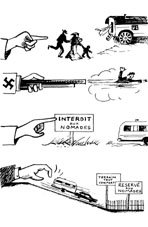
The Half-breed in Injun & Gypsy Society

While the half-breed in the societies of the Native Americans, the Injuns, was - apparently - and still is always fully accepted as a "paid up" member of the Tribe and People, the same, it seems, unfortunately, cannot be said as regards the standing and the acceptance of the Poshrat or Didikai within the Romani-Gypsy Society. That, I think, personally, is a shame in general and a shame on us as a People. While I understand the mistrust towards anything that is Gohja because of the way we have been treated by them thru the ages the poshrat or didikai should be made welcome, however, and given a place at the yag.

It also appears that the half-breed more often than not donned war paint and took up arms in the defense of his Injun tribe, and this sometimes even if and when they lived very much like whites in cabins and were trappers and traders. Fair enough, there were also half-breeds that worked for the whites and even those that "betrayed" other Injuns but often those were members of an enemy tribe, theoretically. When, however, really pushed by the white man and the Indians came together the Injun half-breed in the main stood side-by-side with his full-blooded Injun brothers and also died alongside them. In the same way as the Injun half-breed suffered prejudice from the whites, despite the fact that he was half-white the Gypsy and poshrat does, more often than not, if he announces his Gypsy ancestry to the world and therefore he should be accepted by us as one of us. The poshrat, especially if his ancestry is known, should never be, unless for reasons of having misbehaved towards the People, shunned by us just for the fact that he is poshrat. However, to our great shame this is very often done. I know personally of some young Sinti mushes in Germany, who are half-Sinti, and, aside from the fact that the clans know their Sinti ancestry to be tatcho, are not being accepted, mainly, because they have not been raised well in the Culture and they do not rokker the Chib or because it was the mother who was Sintizza and the father either Jenisch or Gohjo. No such distinction was made by the Nazis when people who were but 1/16th Gypsy were dragged to the concentration camps and ultimately to the deaths in the gas chambers. If it was good enough for those to be murdered as Zigeuner, as Gypsies, then we have no right whatsoever to deny them.

© M Veshengro Smith, April 2006
The Settled Modern Gypsy

Does it make me more a Gypsy if I live in a trailer, best still a wooden vardo, as the romantics would like to see, with the blazing yog outside? Does it make me less a Gypsy if I live in a house? The answer to both is NO.

Does it make me less a Gypsy if I work an ordinary job? Does it make me more a Gypsy if I live by the old ways and trades? Again the answer has to be and is, NO. Neither living in a kenna or in a trailer makes one more or less a Gypsy, a Romani, nor does it matter little what kind of occupation one follows. Being Romani, being Gypsy, has nothing to do with traveling, with an itinerant way of life (I hate the illogical and false use of the word 'nomadic' as we are NOT nomadic) but has everything to do with out ethnicity based on our ancestry and our Racial Origins.

While the Romanichals in the UK and Sinti and Roma in some other countries may, until recently, have traveled all the year or for most of the year in pursuit of work on farms, in the hop fields in Kent or for other work, many Sinti and Roma on the European mainland have been living in houses and flats, even their own farms, for generations, and only traveled, maybe, during the summer months. Many still had door-to-door trades such as knifegrinder or sales person with cutlery, linen, basket ware, etc. and some where horse traders but they all had a fixed base, be this a house, an apartment, or even farm, while some had just their own land where they stationed the caravans for when they did not travel and where they resided.

The East European Roma & Sinti, in the main, have been settled for many, many years, some in slavery, in Romani, for instance. In many cases they settled in wholly Gypsy settlements, whether they were of the Sinti groups that make up the Rom Polska, often falsely and deliberately thus, called Polska Roma, such as the Veshtike, Feldtike, Bergtike and Fortike Rom, who settled in small Gypsy enclaves in villages in Poland such as in Silesia, Galicia, the Carpathians, etc. and many of them never traveled far from their settlements in pursuit of trade. Many of the knifemakers, basket weavers, etc. made use of middlemen to sell their wares or did a circuit of fairs and markets during the seasons. Others in fact worked as farm laborers, forest workers, as outworkers for the cutlery manufacturing companies in the various Silesian towns, and various other tasks. Even rat catching is being mentioned as a profession amongst those in Poland. None, whoever, because gadjekane for being settled or shunned by other Rom (generally) and all retained their Traditions and their Culture, as well as Language. This shows that it makes not an iota of difference whether one travels or whether one is settled as to being Gypsy.

© M Veshengro Smith, April 2006

"My country is the world, and my religion is to do good" - Ralph Waldo Emerson


We are just a normal family...

...says 15-year-old mother of two who had her fist child at age 12. She either does not know who the father is of either of her children or does not want to disclose the name or names.

They go on about Gypsy child marriages and while personally I think that our People should discard the idea of child marriages when one sees Gohja like that then how can they even dare to talk. At least Gypsy girls do not get pregnant at twelve, generally, without knowing who the father of the child is. If a 12-year-old Gypsy girl would get pregnant then she would be a bride and would have a husband and all that. But it is Gypsies who are always portrayed as being in the wrong and without morals. Without wishing to sound pompous things like that do not happen amongst our People and it is therefore no wonder that the Gypsy People regard non-Gypsies, which they call Gohja, as being less then them. We only need to look around us in general and see the deterioration of Gohja society - not that that leaves Gypsy society unaffected; far from it - with respect for anyone older having gone out of the window, and I have to admit that the influence from the outside society is having and adverse effect also on the Romani-Gypsy, with all the other problems going on to see that there is nothing to aspire to for Gypsies in Gohja society and that we must remain apart, as a People and Nation separate.

While we, as a People, will need to learn to integrate we must never allow ourselves to become like them by assimilating. Too many of ours in some countries are, unfortunately, headed that way however. We must show the Gohja that we are proud of what we are and who we are and that we are different to them and showing them the better ways of our Culture.

© M V Smith, March 2006

The Vatican and the Roma politician

In an article in the Dzeno Association website yet again an author, in this instance Valeriu Nicolae, is trying to tell the world that the word "Gypsy" is basically a dirty and politically incorrect word for the Romani People, who he insists, like so many other professional Roma politicians, to lump together into "Roma", which they are not. While those outside the realm of the Roma, such as Sinti and others, wish not to be called Roma and rather, in some places, refer to themselves as Cygany, for instance, or as Gypsies, thereby making it acceptable terms. Why do some Roma politicians think that they have to lord it over the People with their paternalistic attitudes, not unlike the Holy See in Rome, and in many aspects even worse. Not all Romani are Roma; is that so difficult to understand and yes, and maybe the author has not noticed, in many parts of Western Europe, the Gypsy People, are still quite a mobile population.

While I rather do disagree with the term of the Vatican that states "Gypsies are also known as Roma…" because this, yet again, makes the false claims that all Gypsies, all Romani, are Roma, I do not disagree one bit with the use of the all-embracing title of "Gypsy" or "Gypsies" for our People. I also have to say that while I am not very keen on the idea of the Vatican and the Roman Church having a evangelization drive aimed at the Gypsy People in Europe, I rather have the Catholic Church involve themselves in such a manner than the holy roller kind of tent missions and the like who destroy the very Culture and fabric of our Society by targeting our People.

However, the reason our People fall prey to such missions is the fact that we have lost the cohesion of society amongst us and the mutual support "organizations" (though they never were organizations per se) and it is for those reasons more than anything that so many of our People fall into the trap of the so-called Christian faith and believe themselves to be saved and born-again.

How, by the way, dare Roma politicians, like the author of the article on the Dzeno Association website, entitled "International Herald Tribune and Vatican 's paternalistic blunder" to claim that the term Gypsy has a strong pejorative connotation for Roma and non-Roma and is considered as politically incorrect when he, I am sure, has never asked the People themselves, and definitely not those that tare NOT of the Roma how they feel about it. The older Romanichals have used Gypsy always and most Romani in the USA, except maybe some of the Kalderash and such, also refer to themselves, especially when dealing with outsiders and being truthful as "Gypsy". So does the author of this article and he does it with pride. The term Gypsy is neutral in the same way as is the term Zigeuner and many German Sinti have no problem either with the latter if they'd be honest. In fact the same can be said for the N-word that, as politically incorrect as it is supposedly, the author of the article in the Dzeno pages uses. The American Blacks use it to address each other with. It is amazing though that, as soon as it is used by someone else, it immediately becomes a racist slur. But that is neither here nor there. The fact is that many of the People have no problem being called, as long as it is not with racists or other kind of undertones, Gypsy or Zigeuner. Also the spurious claims of the word "Zigeuner" do not hold any water whatsoever, whatever new ideas some "exerts" in Romani Studies wish to come up with. While, yes, we do know, Gypsy is derived from Egyptians it does not make it a word like the "N-word" the writer of the article used. It has not been assumed that Gypsies can from Egypt; it has something to do with the fact that our People upon being noticed in Europe denoted as their origins, or better as the place whence they had come, regardless of whether they may have called it "Little Egypt". That is why in English they were called "Egyptians" and then "Gyptians" and later simply "Gypsies" and they themselves ascribed this mane to themselves when talking amongst others not of their own groups or when talking to outsiders, while amongst themselves they may have used "Kale" or being "Black Bloods" or indeed, whence the term "Romanichal" comes, "Romane Chave" which, when spoken, to the untrained ear, especially with the "e" in chave being often silent and the "v" becoming a "u" sound at times, with the word then, reading "chau", sounding like "Romanichal". However, when using the English language the words "Gypsy" invariable has been used, while some, after interference from some self-styled experts came to use the term "Traveller" for themselves. The vast majority of the Romani in the UK and those hailing from the British Isles do not have problems with the word Gypsy so, therefore, dear Roma politicians and "experts", do not tell the world that we have. None of us have elected or appointed any of you to be our representatives therefore do not claim to be thus. Given a chance I am rather sure that the People can speak for themselves and do not need people whose only interest has been and still is not the People but how much political mileage they can get out of the People.

It also must be said that it makes no difference what word is being used when used in the wrong attitude. We now see the use of "Sinti & Roma" more and more when news media and police reports deal with supposedly Gypsy perpetrators of crimes, real or imagined (not the crimes but the ethnicity of the perpetrators) with statements such as "an olive complexion, as found amongst the peoples of the Sinti and Roma", and such like. The tone makes the music and in more ways than one. The words are all neutral, whether they are Gypsy, Zigeuner, Sinti & Roma, but the way they are being used and the context in which they are used are not.

I am Gypsy and proud of it!


© M V Smith, March 2006

World Gypsy Union - a new concept

The beginning of March 2006 saw the foundations being laid for the first ever organization for the worldwide Gypsy People with an individual membership policy and ensuing out of this the World Gypsy Union was born.

Now, for the first time in the history of their own political organizations do the Gypsy People of the world have a body where the ordinary grassroots Rom and Romni, and also the Chavale as well, have a voice, and a say, as individuals, by being represented directly by being members, instead of by spokespeople of this or that national Gypsy or Traveller organization insisting on speaking on their behalf whether or not they, the People, have had any say in the appointment as such a spokespeople.

The World Gypsy Union (WGU) will unite the Gypsies of the world as individuals, a prerequisite for nationhood, giving them a worldwide body where they can have a voice and a say where before they have had none.

The World Gypsy Union welcomes into membership all those that are ethnic Gypsies, including, amongst others, the Jenisch and the Domari; so often neglected by the other political Gypsy organizations (they do not like the name Gypsy though; those organizations, that is) but membership is not open, and no excuses are made for this, to people such as the Irish Travellers and others who are of a different culture entirely; most Irish Travellers being nothing else than Irish Gohja in trailers and are not ethnically Gypsy whatsoever.

The World Gypsy Union does not, unlike, as apparently some other Gypsy organizations do, play at being a Racial Hygiene Institute, and the WGU, therefore, accepts into membership all that do have a true Gypsy Bloodline regardless whether this comes from the father's or the mother's side as Blood is regarded to be thicker than water and if it was "good enough" for a small amount of Gypsy Blood to have one under the Nazis sentenced to the concentration camps and eventual death then it must be good enough for a political and cultural organization for the People. A didikai or a poshrat are as welcome as a member of the WGU as is the full-blooded Gypsy.

For further information contact:

churimengro1@yahoo.com

O NEVO DROM Blog - changes


Dear Readers,

Well, it's been a while. Some may have noticed that there has not been much updating happening with news and views as there used to be. This is due to two things. One that there has not been much interesting Gypsy news around really and two that I am moving the news and views from media sources and the like to our yahoo groups companion.
Therefore, if you wish to continue to receive and read all those news and views from the Gypsy world with comments by yours truly I urge you to subscribe to the O NEVO DROM @ yahoo groups. Please click on the box on the left hand side column and you will be taken to the correct area.
The O NEVO DROM Blog will from now on, in the same way as the ROMANI FIRST Blog, feature only articles written by us of the editorial staff. I believe this will give you all a much better service and it will allow me (and the other writers) to actually write informative articles for you all to read.

Veshengro (Editor-in-Chief)

Web to preserve Romani heritage


A delegation of Romani gypsy families are to attend the launch of the latest phase of a project to increase awareness of their culture.

The families will be visiting a team at the University of Manchester which is launching a website on Monday as part of research into the Romani language.

The project will codify the language to agree on how words are spelt, which should make it easier to teach.

Web visitors can find different dialects on a map and listen to them.

Romani is the second most commonly spoken minority language in the European Union.

Oral tradition

Professor Yaron Matras, who is heading the project team at the university, said: "Romani doesn't really have a literary tradition and is primarily an oral language.

"The codification of this language will be of great benefit to this community, who have suffered discrimination and misunderstanding across Europe.

"For the first time, this information will give the Roma (Gypsies) an easy way to find out about where they came from."

"The work will be of interest to linguists, historians and ethnographers."

The team has also been involved with drafting Romani language policy for the Council of Europe.

EDITORIAL COMMENT:
However nice the picture is being painted here it has nothing whatsoever to do with preserving the Romani Chib, the Romani language. That is a matter for the families and clans NOT the University of Manchester and Gohjo Professor Yaron Matras. All Professor Matras is interested in is gaining a "reputation" as a linguist and Gypsyologist and nothing more. Many Romani groups will think the fact that the Chib is being made available to all and sundry an abomination and it is a shame that some Romanichal families (I presume this "delegation of Romani gypsy families" referred to to be thus but then it could be those that have no link to the Romani whatsoever but are always being put forward as "Gypsies", e.g. Irish Trailer Trash, a.k.a. Irish Travellers) go along with such a farce and disgrace as the publicizing of the Romani Language in such a manner. Beware of wolves in sheep clothing is an old adage that is of great value here.
Romani People wake! You are being taken for a ride by people such as Prof. Matras and his ilk.

Poverty and fear dominate life for Iraq's Gypsies


By Deepa Babington

HADID, Iraq, Jan 4 (Reuters) - Among the millions of impoverished Iraqis, Jameel Mahmoud Hassan has the dubious distinction of being among the poorest of all.

One of a group of Iraqi Gypsies who have squatted for years on a fetid patch of land in a village north of Baghdad, he has spent his life in squalor, and now fear.

Home is nothing more than a leaky tent strung up with sticks and torn carpet on a plot strewn with dirty plastic bags, rusted cans and broken bottles.

A stack of kerosene cans with mud on top serves as a makeshift oven. Flies swirl everywhere -- on garbage, on the giggling children, on a dog tethered to a tree.

Inside the tent, his wife and five children, their ragged clothes caked with dirt, crowd on to carpets and a small cot. A kerosene lamp is the only source of warmth on a chilly winter morning.

A meal of tomatoes, cucumbers and beans is the typical fare for breakfast, lunch and dinner. Meat is a rare treat every few weeks.

More recently, Hassan has worried about being rounded up and forced to move elsewhere by religious militia.

"We have nothing," he says. "We are poor. We're just looking for a safe place to hide."

Scorned by religious Muslims and barely tolerated by the rest of society, Iraq's Gypsies have a precarious existence. Lacking education or skills, they form one of the lower rungs of Iraq's social system.

Yet the Gypsies of Hadid village near Baquba, 65 km (40 miles) northeast of Baghdad, may be among the luckier ones in Iraq. Other Gypsy tribes have been hunted down and attacked by increasingly powerful Islamist militias who see them as a blot on society.

Under the leadership of Saddam Hussein, Gypsies had some protection from persecution -- partly in exchange for supplying dancers, alcohol and prostitutes, Iraqis say. The safety net disappeared with Saddam's overthrow, leaving them open to the whims of religious militia groups contemptuous of their freewheeling ways.

VILLAGE ATTACKED

A tribe of about 250 Gypsy families living in a village near the southern city of Diwaniya was one of many that learned about the wrath of religious groups at first hand.

On New Year's Day last year, mortar rounds landed on their village of mud and reed huts, killing a woman and wounding three others.

Convinced they were being attacked by the powerful Shi'ite cleric Moqtada al-Sadr's Mehdi army, they fled at night before seeking help from religious leaders.

They returned after aides to Sadr and Iraq's most powerful Shi'ite cleric, Grand Ayatollah Ali al-Sistani, promised they would no longer be bothered, only to find their village had been ransacked.

The primary school and clinic built by Saddam's government had been rendered useless. Their houses were wrecked.

The poverty they believed was behind them had returned.

"The religious parties have tortured us," said Bizai al- Baroodi, the tribe's sheikh. "We had reached a decent stage of living but after the last attack, we've had to start from scratch."

The pain of the assault still rankles with Maiyada al-Tamimi, a 20-year old Gypsy woman. A mortar hit her house, killing her mother, and breaking her arm which she says has yet to be treated.

"If I get a clean and honest job, I will not hesitate to leave this tomb and live like any other girl my age," al-Tamimi said.

Like other Iraqi Gypsies, many in her tribe are angry they are being forced to live as fugitives in their own land.

The tribe says it traces its roots to Spain and made Iraq its home more than 150 years ago. Most of Iraq's Gypsies originated in India, while a few came from other Middle Eastern countries.

Although they speak Arabic and profess belief in Islam, their dark complexions and sharp facial features are distinctive and they complain of racial persecution:

"We are Muslims and humans; we have Iraqi citizenship," al-Baroodi said. "We just want to live in peace."

(Additional reporting by Imad al-Kuzai in Diwaniya and Aseel Kami in Baghdad)

EDITORIAL COMMENT:
Surprise, surprise - NOT! Oh, the West has helped the Iraqi people so much with that war against Saddam Hussein and they are now so free and all that. In the West's dreams, that's about all. Then again the powers that be with Pres. Bush in the lead know exactly what's what. It never had anything to do with liberating the Iraqi people from Saddam Hussein's oppression. Not one little bit. All it had to do with was removing the one obstacle that was there to getting their hands on the Iraqi oil. With Saddam Hussein out of the way - dead or alive - and a regime put in by the West, ideally a pliable one, the supply of Iraqi oil to the West was secure, as the sanctions are gone and trading in oil could resume. Strange that still there seems to be a price hike of oil and gas. The removal of Saddam Hussein and his clique has not liberated the poorest of the Iraqi people one bit and especially not minorities such as the Gypsy People in that country.

Cops: Robbery nets $100G


By JOE D'AQUILA
Staff Writer

HAMILTON -- A 99-year-old woman and her 82-year-old son were the victims of a home invasion-type robbery in the Yardville section of the township yesterday afternoon.

No one was injured and no weapons were used, but the attack turned out to be a big score for the robbers who made off with over $100,000, according to police.

The home-invasion occurred after 3 p.m. on the first block of Soden Drive. The names of the victims are being withheld for their protection.

Police said the mother and son, who live together in the home, were working with investigators last night. The victims described their attackers as three males, possibly Hispanic or gypsies, who arrived on the scene in a white pick-up truck with a yellow ladder in a rack.

Hamilton Det. Sgt. Anthony Recine was on the scene and recreated the events of the robbery according to the victims' account.

He said the thieves first approached the son, supposedly inquiring about three tires he had for sale on the front lawn. One of the men started talking to the son and brought him out into the backyard.

He said the thief told the son they were in the area because they were going to be doing some work along a neighbor's fence line there.

The robber-to-be then told the homeowner he noticed there was a problem with his air conditioning unit, acting as though he was looking for more work, while he actually had another motive in mind, Recine said.

And while the son was occupied in the backyard, Recine said, another man entered the house. This man began speaking to the mother, who was sitting on the couch.

While mother and son were distracted, a third man, Recine said, slipped in through the back and made his way into the bedrooms. The third man then found a safe in one of the rooms and dragged it out into the hallway.

He said the men in the house first told the mother to open the safe, but she said she didn't know the combination.

By this time the first robber came into the house bringing the son with him and ordered him to open the safe.

Recine said the victim told investigators that the thieves had no weapons but that there was an implied threat of violence throughout the ordeal.

"The one guy says to him (the son), 'you better do what he says, he's crazy,'" Recine said the victims told him.

The threat of violence was then realized as Recine said the men pushed the mother and shoved the son to the ground in their attempts to get them to open the safe.

But through all this, the quick-thinking 99-year-old, who neighbors described as "sharp," was the one who called 911 herself from an unlikely place.

"The mother stated she had to go to the bathroom, and says, 'I'm going to pee right here if you don't let me go to the bathroom,' because she knew there was phone in the bathroom," Recine said.

He said the robbers let the mother go into the bathroom, but her fight to call for help wasn't over.

"He wouldn't shut the door, and she says, 'I can't pee in front of you,' and then she forced the door shut," he said.

He said the mother was then able to call the police from inside the bathroom, but the safe had already been opened and the thieves were soon on their way out the door.

"The son opened it because he didn't want them to hurt the mother," he said.

Recine said the cash amount taken from the safe could possibly be over $100,000. An unknown value amount of jewelry was also taken and that the thieves took the three tires from the lawn that had given them access to the house in the first place.

While he said the case was still under investigation, Recine said the job looked professional and that he's seen it all before.

"They're probably more than likely gypsies, and they do this constantly," he said. "They have a set routine, they know what houses to look for."

He said professional thieves in a robbery like yesterday's will look for the simplest things to tip them off to an easier target.

And while no one was hurt in the incident, an ambulance was sent to the scene following the robbery.

EDITORIAL COMMENT:
This is yet another case about "gypsies" being accused of something of which, so far, there is no proof as to whether any Gypsy was involved at all. Furthermore, though not being a trained criminologist, something does not ring true with this story. The making of the 911 call from the lavatory is just a little strange.

Self-Proclaimed "Gypsies" Bilking Tucsonans


By Som Lisaius, KOLD News 13

We've all heard tales about gypsies and their mysterious ways, though there's a good chance, many of those stories aren't true. But these people really do exist. Historically, they date all the way back to 14th Century Europe. Now a group of self-proclaimed gypsies is in Tucson today.

Their faces look like anybody else's here, but police say these individuals, all Romanian citizens, are a modern take on notorious gypsies of old.

"They'll look for checkbooks, jewelry...anything that they think they can convert to money," says Sgt. Mark Robinson of the Tucson Police Department.

But in order to get these items, they have to get into your home first. And they do so by impersonating maintenance men, contractors...even somebody interested in buying a vehicle.

"Oftentimes when they make contact with their alleged victims, they have children with them," says Sgt. Robinson. "People drop their guards when there's children around. They think okay, here's a mother or a father with their child, and it brings out the best in people."

They'll use anything and everything to divert your attention. And all it takes is an unsuspecting victim who lets them in.

"I think it's a dirty shame," says an 89-year-old victim who wishes to remain anonymous. "I really do." Last November, the woman opened her door to three men who said they worked with the city water department. They noticed a leak in her backyard and offered to fix it.

"I said how much will that cost and he said, 'about four hundred dollars.'" Without any cash, the men bullied her into signing a check. Reluctantly she did, and later that day, her bank called inquiring about a suspicious amount. "How much did they try to cash it for?," KOLD asked her. "Seven thousand dollars," the woman said.

Due to insufficient funds, the check wasn't cashed. And no money was lost. But this woman is one of the lucky ones. Michael Cook and Steve John are currently in custody charged with fraud, theft and burglary. But these people are still out there, preying on anyone who'll answer an unsolicited knock.

Says Sgt. Robinson, "If somebody contacts you and wants to buy something that you're not advertising for sale, that's the red flag you should be looking for."

If you're a victim or have any information about these people, you're asked to call 911 or 88-Crime. A reward up to $1,000 will go to the person whose tip leads to an arrest.

You can remain anonymous. It isn't who you are, it's what you know that could help solve these cases.

EDITORIAL COMMENT:
This is yet another of those news reports appertaining to Romani-Gypsies that no one would dare to print is such a way would it be a group of Jews or other ethnicity, bar may be Hispanics, being involved. But, as per usual, it is OK when it is only "dirty Gyppos".

No monopoly on the misery of millions


Jan 19 2006

Daily Post Comment

IT comes to something when people start squabbling over genocide. Jewish people, renowned for their self-deprecating, world-weary humour, would undoubtedly find something here to chuckle about.

And there is certainly an exquisite irony in the claim that the planned contribution to Cardiff's Holocaust Memorial Day by the city's rabbi, Charles Middleburgh, was dropped because organisers were concerned the events were becoming a little "too Jewish" - wording they strongly deny.

What they do admit to being concerned about, however, is that Holocaust Memorial Day must reach "every section" of our society..

And we agree. No-one in this world has a monopoly on victimhood or extreme suffering - even though European Jewry bore the brunt of the Third Reich's crazed blood-lust, and the word "holocaust" has become synonymous with the premeditated extermination of their millions of innocents.

Holocaust Memorial Day is an annual service to honour the victims of the holocaust "and other genocides" - of which there are tragically all to many.

The European Holocaust alone included, apart from some six million Jews, hundreds of thousands of Roma and Sinti (sometimes known collectively as Gypsies), Russians and other Slavic peoples, Poles, Communists and political dissidents, the mentally or physically disabled, random intelligenzia, homosexuals, Jehovah's Witnesses, Lutherians and even Catholic clergy.

It is thought the total death toll reached anything from nine to 11 million, brutalised, enslaved and murdered in cold blood.

Since then the world has learnt little and the past three decades alone have witnessed genocides in Cambodia, North Korea, Ethiopia, Rwanda, East Timor, Kurdistan, Uganda and Bosnia - and the list is not nearly inclusive..

So many people in so many different countries, in fact, that a single day cannot begin to do them all justice. And if any young person today still thinks the destruction of the Jews in Europe in the first half of the 20th Century marked an end to man's inhumanity, they are very much mistaken. It had hardly started.

So let us all gather together in peace to reflect on these appalling statistics, and contemplate that every single one of these numberless tens of millions was not just a number but somebody's son or daughter, in all likelihood unarmed, whose only crime it was to have been born.

Wales' First Minister Rhodri Morgan says the controversy over the day only served to bring it to the public's attention.

He is right. For this day, any publicity is good.

EDITORIAL COMMENT:
About time someone stated it publicly that the Jews do not have a monopoly of the Holocaust but it should also be stated that while others such as homosexuals, communists, clergy, etc. were put to death in the camps only Jews, Gypsies and Slavs were thus for reasons of race despite the fact that the Jews keep claiming that it was only them that were persecuted and put in the camps for their race and the Gypsies were put there because they were (regarded as) asocial. Maybe they should read the documents and also the statement by Commander of Einsatzgruppe D, Otto Ohlendorf when he said at the Nuremberg trials: "There was no difference between the Gypsies and the Jews. At that time, the same order applied for both." But that is something that they do not wish to see.

State's Roma monitoring criticized


Groups worry about potential abuses against historically marginalized population

By Brandon Swanson
Staff Writer, The Prague Post

When the government watched young Arabs, Turks and blacks rioting in Paris late last year, it saw a city in flames over long-simmering racial and economic issues. Czech officials worried that a similar situation could arise domestically with Roma, or gypsies.

In response, the government implemented a Roma monitoring program Jan. 4 to gather information about the group ranging from employment to education.

"Unless we want to allow a similar conflict to happen in the Czech Republic, we have to take action immediately," said Katerina Beránková, Labor and Social Affairs Ministry spokeswoman. "And to introduce any permanent changes, we need to know their position and to what extent they are socially outcast."

Historically, Roma have been marginalized from society here, as they have been throughout Europe, but there has never in the nation's history been an incident of the group rioting.

Lacking reliable information

The announcement of the program immediately raised eyebrows in the Czech press, which questioned whether the government was trying to carry out a Roma-only census, something that has led to discrimination in the past.

"It is nothing of the kind," said Czeslaw Walek, director of the government's Office of Council for Roma Community Affairs.

Walek said the government will analyze living standards without taking down personal data, but the program has drawn criticism from Roma rights advocates, who say such data could be used for discriminating against Roma.

"The anonymity of such monitoring is just an illusion," said Ivan Veselý, chairman of the Dženo, a Prague-based Roma advocacy group - one of several that have spoken against the program.

"Even if there is no name or address given, there are still other social and economic data - a given location, and so on - and from these data it is not really all that difficult to figure out who the monitored people are," he said.

Walek said that Roma have complained that the government either does not contribute enough money to improving their lives or wastes the money it disburses. Indeed, internal government inspections have shown that many Roma programs and subsidies had no impact because they were originally based on poor information about the Roma.

"The aim is to improve the effect of measures already taken, to use available funding in a more effective way," he said.

Walek said his office has not received any complaints about the monitoring program outside of "traditional concern," and that all Roma Council members were informed of the project before its implementation.

But the very thing that makes the program necessary - the government's inability to collect reliable demographic information about Roma - may also be its biggest obstacle.

It could prove difficult for the government to gather information on an ethnic group that has historically been suspicious of its motives. Only 11,000 Czechs declared themselves Romany in the latest population census while an estimated 250,000 Roma live in the Czech Republic.

Unemployment of Roma in this country runs anywhere from 70 percent to 90 percent, depending on the region, and many depend heavily on welfare.

The monitoring is legal so long as it remains a sociological analysis, said David Strupek, a Prague lawyer who has experience with Roma issues.

"It becomes a legal problem only if the project amounts to collecting personal data of particular citizens," he said.

The program will cost about 1.5 million Kc ($62,630) per year. Initial data will be submitted to the government this summer and a full report will be released in 2008.

Lingering issues

The new year has already been a tumultuous one for Roma in the Czech Republic.
Romany families were evicted from municipal apartments in the Neštemice district of Ústí nad Labem, north Bohemia, this month for owing back rent.

That district became the epicenter of an international human rights controversy in the mid-1990s when city officials began building a concrete barrier to separate Romany municipal housing from private housing after residents complained about the Roma.

When the city refused to halt construction on the wall, the government sent 10 million Kc in aid to improve coexistence between the two groups. The city used part of the money to buy the private houses surrounding the Roma and the residents moved away.

Also in the Ústí region, 10 Romany women filed suit in criminal court over sterilizations that took place between 1979 and 2003.

One woman said that government officials asked her to be sterilized because she had seven children, and she signed an authorization form; later, she said she had trouble reading and writing.

More than 50 Romany women were sterilized in the Czech Republic during that period.

Meanwhile, Roma are now considering creating a human shield to prevent the right-wing National Party from building a memorial in Letý, south Bohemia, at the site of a former Nazi concentration camp for Roma.

On the existing plaque that commemorates the deaths of hundreds of Roma there, the Nationalist Party plans to erect another plaque that reads: "This place was a collection camp, not a concentration camp. History is a question of truth, not interpretation."

The party plans to erect the memorial Jan. 21.

Strupek said that the planned memorial appears to be legal, but police may interpret it as provoking Roma.

"The statement is politically incorrect, to say the least, and perhaps this is a far too mild way to put it," he said. "It is on the edge of expressing hostility toward Roma. It is on the edge of the law."

Petr Kašpar and Iva Skochová contributed to this report.

EDITORIAL COMMENT:
The entire situation of the forced registration of all Roma(ni) detail smacks of the Nazis of the Third Reich but then it does not surprise me one bit whether for the Czech Republic nor should it happen elsewhere. It is after all an E.U. country and no one says a word.

Czech government to have complete data on Romanies as of 2008


Prague, January 2006

The Czech Republic is expected to have regularly the latest data on the employment of Romanies, their qualification, incomes, housing conditions, debts and education as of 2008 due to the new monitoring system that will be discussed by the government on Wednesday.

Thanks to the precise information, the state, regions and municipalities will be able to better help Romanies to be adapted to society and could considerably and quickly improve their living conditions.

In the latest population census, 11,000 Czechs declared themselves Romanies, but according to estimates some one quarter of million of Romanies live in the Czech Republic.

Information on the number of Romany pupils and students or unemployed Romanies is also lacking since the institutions do not keep any statistics on the ethnic lines.
Studies and inspections in the past showed that many subsidies and financial programmes aimed at helping Romanies brought no results precisely due to insufficient knowledge of their environment and needs.

The information on "Romany census" provoked the wave of disagreement among representatives of some Romanies organisations in the past. They pointed out that such counts in the past only harmed Romanies and led to discrimination.

"The goal of the monitoring system is not the collection of personal data on individual Romanies, but the collection of anonymous information on the situation of Romany communities," members of the government's council for Romany issues who prepared the system said.

The government annually earmarks millions of crowns to finance the projects designed to help Romanies, but the situation in Romany communities is not changing much.

Although the situation is improving in the area of Romany education and Romany cultural activities their housing conditions are worsening and unemployment among Romanies is growing, according to the government council.

According to Romany organisations, more than 90 percent of Romanies are without jobs in some regions. Their families are still dependent on welfare benefits and their debts are growing and they often are moved to special flats without any facilities. New ghettoes for the poor are appearing on the outskirts of towns and villages, non-profit organisations warn.

Apart from the data collected during the latest census, information from institutions, regions and municipalities as well as finding of a sociological analysis that are to be known in June will serve as the basis for the monitoring. The analysis that is designed to study the living conditions in Romany communities is co-financed from the European Social Fund. It will be followed by a research that will concentrate on Romany education, school attendance, birth rate, migration, wages, unemployment and its length and the age of jobless people. Business and shadow business activities of Romanies, their housing conditions, the equipment of their households and debts are also to be monitored. As of 2008, 1.5 million crowns will be annually spent on the regular assessment of the results of this research.

CTK

Romanies' fears of their official census not groundless


Prague, 10. 1. 2006, 9:25 (CTK)

Romanies feel threatened by the planned government census of their population in the Czech Republic and they have good reasons to feel so, Karel Neuwirt, former head of the Personal Data Protection Office (UOOU), writes in the daily Pravo today.

The new monitoring system of the Romany community, planned to be effective as of 2008, generated a heated discussion. The supporters of the system are mainly defending its necessity. It is evident that the government needs better information on the community than that received in the latest population census in 2001. In the census, 11,000 Czechs declared themselves Romanies, but it is estimated that some 250,000 Romanies live in the Czech Republic.

The government declares that it will be able to better help Romanies to be adapted to society and improve their living conditions thanks to the precise information.
But the problem is that the government or the organisers of the system have not presented sufficient guarantees to Romanies that the data obtained will not be misused, the author says. The promoters of the system merely use the argument that the system will be anonymous. However, anonymity is not a sufficient guarantee. Moreover, it has not freed Romanies of their doubts. Even if data are anonymous, in other words, if the names and addresses are not included, people may be identified indirectly. Experts on the protection of privacy should therefore assess whether indirect identification of individuals is possible using the data from the planned monitoring system, Neuwirt concludes in Pravo.

CTK

New monitoring system to collect data on Roma community


The Czech Republic has a large Roma minority who live very much on the margins of society. But estimating the size of that minority is - and the effectiveness of government measures to lift them out of social exclusion - has always been a difficult task. The week the government announced plans for an anonymous monitoring scheme to make that picture clearer. Czeslaw Walek is the head of the Government Council for Roma Affairs; my colleague Rob Cameron asked him why the government had decided on the scheme.

"The answer is obvious I would say. It's to check how effective are the measures that government is implementing, in order to help socially excluded members of Roma communities, in order to check how effectively money is spent for these purposes in the field, and in order to check whether the situation of socially excluded Roma communities is improving."
Is it fair to assume then the system would work for example in a Labour Office when someone of apparently Roma origin comes in looking for a job, then the person working in the office would make a little tick next to his name? Is that how it's going to work?
"No, no, no. This is not how it is going to work. The only information which we will receive from the field are sociological surveys. It depends on the survey, but usually you do a field survey through questionnaires or interviews with people. Data from the Statistical Office is official, from the census. Information from other institutions, like the ministries, is mainly information about their grant schemes."
Nonetheless, seeing as in the last census only 11,000 people described themselves as Romany, are you not going to have trouble gathering accurate information when the country's 200,000 or 300,000 - nobody knows - Romanies will admit to being so?

"Yes, well, that's why we're combining those three sources. If we relied only on data from the Statistical Office, it's obviously not sufficient. That's why we want to combine it with sociological surveys, which will be done nationally."
It will still be seen some as a rather controversial scheme, perhaps bringing back rather unpleasant data from this country's past, such as the collection of data on Jewish inhabitants before the war.
"Yes, well it may, but the fact is that we need to monitor the effectiveness of those measures and the effectiveness of the money which we are spending on Roma communities, this is the first thing. Secondly, if we make a good information campaign, especially among Roma, to explain to them why we are doing it, I believe that it will cause less controversy than one would think."

http://www.radio.cz/en/article/74401

Travellers' site gets golf range go-ahead


A NEW travellers' site has been given the go-ahead - despite serious concerns.
Cambridge councillors voted six-to-one in favour of building a travellers' transit site on the golf driving range in Cowley Road.

The council will now submit a bid to the Office of the Deputy Prime Minister for a grant to build the emergency stopping place.

The 11.5 acre plot is on the north side of Cowley Road, Chesterton, near the park and ride site, bus company Stagecoach's depot and a sewage works. The site would contain 10 plots and would cost the council £250,000 to set up plus annual running costs of between £25,000 to £30,000.

The plan aims to stop the problem of travellers illegally setting-up camp within the city. If it goes ahead, it could be open by next summer. Once travellers move onto the land, they would be allowed to stay for up to three months.

Suzanne McBride, head of community services strategy said the site was aimed at a very small number of families who repeatedly return to the city for family or health reasons.The plan also has the support of the police.

Pc Nick Percival, community beat officer for Chesterton, said it would enable the police to move illegally camped travellers to an authorised site.

Ian Nimmo-Smith, leader of the council, said the council would foot the bill if a Government grant was not forthcoming. He admitted the rush to get the scheme through was, in part, due to hope of securing Government cash.

But Andy Campbell, managing director of bus company Stagecoach, said he had "grave concerns" over the safety of his staff.

And Stephen Terrell, managing director of Coulson Building Group, questioned why the site was to be built in the middle of a business park.

Tory Eric Barrett-Payton, the only member of the council's scrutiny committee to vote against the scheme, said the site would not solve the problem of illegally camped travellers.

Coun Nimmo-Smith said the Cowley Road site was the only suitable site available.
The council considered a total of 13 sites including King's Hedges Road, four sites on Fen Road, north of the A14, Foster Road, Howard Road, Whitehill Road, Fulbourn Road, Mallets Road and Peverel Road.

He stressed management of the site was crucial and pledged to address concerns of businesses at the site and of local residents.

¦ South Cambridgeshire District Council has succeeded in a High Court move to block the return of travellers to the controversial Smithy Fen site in Cottenham.
The Council went to the High Court in London on Monday to seek continuation of an emergency court order granted on November 11 which prevents anyone from moving onto the site off Setchel Drove, Smithy Fen, which is currently vacant.

In a brief hearing, judge Mr Justice McCombe granted the order. The injunction lists three names - Daniel Sheridan, Patrick Sheridan and John Sheridan - but is also made in respect of 'persons unknown'.

Bus chief hits out at 'absurd' gypsy site plan


A TRANSPORT chief has slammed controversial plans for a traveller and gypsy site which he says are being "railroaded" through by Cambridge City Council.

Andy Campbell, managing director of Stagecoach in Cambridgeshire, believes proposals to create the site, at the golf driving range in Cowley Road, near the park and ride site and Stagecoach's depot are "absurd."

He also criticised Wednesday's two-hour early-morning slot for the public to look at the proposed layout and design of the site, which will provide a place for gypsies and travellers to stop in the short-term.

His views on the two-hour window were echoed by Councillor Elizabeth Hughes, for the King's Hedges ward, who branded it "undemocratic" and "unfair."

Mr Campbell said: "I am mystified as to why this seems to be progressing at such a rate of knots. It seems the decision has already been taken and the plans will be railroaded through.

"I am concerned this will lead to a driver shortage in the city because we will lose drivers if this goes ahead.

"And I have told the council that, if the plan goes ahead, we will not invest in new technology at the Cowley Road Park and Ride, including optical guidance buses, because there will just not be the business there to warrant it."

Councillor Hughes said she had sympathy with the council which she said had a statutory duty to make provisions for gypsies and travellers, but said the time given to the public to look at the plans should be longer.

She said: "It may be that giving up the golf range is the most appropriate option.
"But I think that people should be given a reasonable amount of time to find out about the plans - and not giving them that time is undemocratic and unfair."

A spokesman from the golf driving range said: "The council seems to have organised this two-hour session on purpose because they have had one meeting already which was in the morning to which a lot of people couldn't go."

Council leader Ian Nimmo-Smith and council officers met members of the public between 8am and 10am on Wednesday at Orwell House, off Cowley Road.

Liz Bisset, director of community services at the council, said: "This particular session was aimed at people who use the Park and Ride provision. The timing has been made to coincide with the time people go onto the city from the Park and Ride.

"But it is not the only consultation. Tonight we have a consultation with local businesses. If people would like to look at the plans again, or contact us for more information, then we are very happy for them to do that.

"We would consider holding further sessions, depending on how many people raised objections."

Row erupts over travellers' site


A PETITION has been launched to oppose a new travellers' site at the Cambridge Golf Driving Range in Cowley Road.

Almost 1,000 signatures have been collected from golfers, park and ride users and businesses near the proposed site.

On Monday councillors voted in favour of a £250,000 10-plot encampment, despite serious concerns raised by nearby businesses and Andy Campbell, Stagecoach Cambridgeshire's managing director, about the safety of park and ride staff.

The council will now submit plans to the Office of the Deputy Prime Minister for a grant toward the cost of the work.

But the owners of the golf driving range said it is likely to close if the proposals go ahead.

A spokesman said: "The council is talking about putting up 30 metre high perimeter fencing, but the chances are it might still not stop a ball landing on top of their homes or on a person.

"If the travellers' site goes ahead, our driving range is doomed to failure.

"If we lost the range we would be very disappointed. What we would probably seek to do is relocate and we would look for support from Cambridge City Council.

"We like to try to get it to work out but if the customers don't come, we don't have a business. Whatever the council does for us, they can't bring us customers."

He said: "The range is used by a great number of people from Cambridge."

The shop at the driving range employs eight staff and they fear their jobs are under threat.

Council leader Ian Nimmo-Smith said the travellers' site, which could be open by next summer, would occupy just over half an acre of the 11.5 acre site and would be in the furthest corner from the driving bays.

He has offered to meet the owners of the driving range and representatives of other businesses in the Cowley Road business park to address their concerns.

He said: "This site was the only one from a list of 10 possibilities that matched criteria set down in the city's local plan. I wish there had been more choices, and indeed ones that were more clearly acceptable.

"Nonetheless I think the council owes it to residents and businesses across Cambridge to look very carefully to see if this one could be made to work.

"There will be no thanks if next summer brings a series of illegal encampments and we have not given this possibility our best shot."

EDITORIAL COMMENT:
What precisely are the concerns of the golfers, park and ride users and businesses near the proposed site? Another lot of people who see Gypsy and see Irish Trailer Trash. Obvious. The question is from this writer: who is the site for? Is it for genuine Gypsy People or for Irish Trailer Trash? If it were for the latter, primarily, then I would say the people do have valid concerns. Then again the Irish one would encamp there illegally anyway.

Underage Romany girl marries according to Romany customs


PRAGUE, Jan 12 (CTK) -
A 14-year-old Romany girl and a 15- year-old Romany boy get married according to the Romany customs on December 31, 2005, in Ostrava, north Moravia, the tabloid daily Sip writes today.

"The bride was chosen by the groom's parents when she was 13 and the families agreed that they will get married at the end of 2005," a person well informed of the Romany customs told Sip.

The wedding that is illegal according to Czech laws was attended by 300 guests from across the Czech Republic. The couple has already spent their wedding night, the daily says.

Romanies do not bother with the illegality of the marriage. The bride's mother has denied the marriage, saying that although the wedding took place, it was not the wedding of her daughter.

However, the witness told Sip" "She is lying because she knows that they did an illegal thing."

vv/dr/pv

EDITORIAL COMMENT:
This is indeed one practice that the Roma must abandon if they are to be considered to be getting more civilized. And the excuse that is it a tradition and was used because of slavery does not wash and also, in case they have not noticed as yet, slavery is over. Mind you, I guess for them it is not as they are still basically slaves of their baros and "kings".