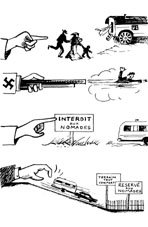
by Michael Smith (Veshengro)
Prague, Czech Republic - Czech Romany activists are deeply concerned about the Molotov cocktail attack on a Romany family in Vitkov, north Moravia, during the night in which a two-year-old girl was severely burnt, and called for Romany guards to be formed and for emigration to Canada.
Many of us in the Romany community worldwide will, I am sure, share the concern and the outrage as to the attacks that we see happening not just in the Czech Republic and Hungary but also in other places and which often go more or less unreported, bar in local media – if we are lucky.
While the idea of Romany guards has been suggested by this writer and some others before it has also inherent problems and that is that those on the outside will then blame the Rom for the problems. Not that they do not do so already.
A protection “force” should be considered, nevertheless, I think, but bow things are to be done must be considered very carefully here.
On the other hand to call for immigration to Canada is, certainly, not the way to go; or immigration to any foreign land. The only thing thins will do is create more problems, namely in the country to which the escape is being made. In many of those countries, the UK for example, there are people who would use such immigrations as a signal to start their own Anti-Gypsy actions, of that we can be sure.
"The movement of Romany Resistance calls on Romanies to be watchful against terrorist attacks by Czechs," the movement says in a press statement.
The statement was joined by the organisations Roma Realia - north Bohemia, Romani Alliance - west Bohemia and Futurum Roma - central Bohemia.
The movements says Romanies should not rely on the "failing state apparatus" and reminds that arson attacks on Romany homes are not unique in the Czech Republic.
We, the Rom, should have notices by now, in fact we should have notices long ago, that no state apparatus would ever protect us, despite all the laws that may state, on paper, that the Romany are a minority protected under this and that legislation, whether in the country, e.g. Czech Republic, or wherever, or in the EU as a whole.
Unknown perpetrators threw Molotov cocktails into a family house inhabited by a Romany family. Three people, including the child, were injured in the consequent fire.
The attack has been sharply denounced by outgoing Prime Minister Mirek Topolanek and President Vaclav Klaus.
While both the Czech Prime Minister and the President may have condemned this attack this is but rhetoric and for the media and the rest of the world; a fact that we have to face.
The movement has called on Romany communities to prepare possible escape routes from where they live or stay. They should not leave old people, women and children alone without "a strong Romany protection."
"This is the sole that Romanies can do within their possibilities, " the movement says.
The old way used to be “roving camp guards” and maybe those need to be considered, even if the place where one lives is not a camp. In addition to that what might be needed – and I know people will attack me for saying this – is to actually set up Romany communities, Gypsy settlements.
The movement also told possible critics of the call for emigration that no one has the right to keep Romanies at a place of danger where they are the possible targets of neo-Nazis, the statement says.
Kumar Vishwanathan, who has devoted himself to work with Romanies in north Moravia for many years, said that the attack was an expression of cowardice and that the the situation in the Czech Republic for the Romany starts to be intolerable.
He said that he could personally see Romany families having machetes and axes prepared at the door to defend themselves in case of an extremist attack.
"Unless our elected representatives and courts awake and unless they do something about the situation, disturbances will follow," Vishwanathan said.
The problem, as I have indicated already, is that if the Rom arm themselves they will get blamed. It is a vicious circle for our People and I know that only too well.
© 2009
<>

Gypsy child seriously hurt in alleged racist arson attack
The fascist attacks against Gypsies are continuing unabated
by Michael Smith (Veshengro)
European countries seem to become a dangerous place for Gypsies yet again
Prague, Czech Republic - A Romany toddler and her parents were seriously injured in an apparent petrol bomb attack on their house in north-eastern Czech Republic recently, according to police reports.
The victims said someone threw Molotov cocktails in their house in the town of Vitkov, setting it ablaze shortly before midnight, police spokeswoman Sona Stetinska said.
She said that police would not be able to confirm the cause of the fire until after examining the site, which has been complicated by the danger of the building's collapse.
Outgoing Czech Prime Minister Mirek Topolanek said he was 'seriously concerned by surging extremism', urging authorities to determine whether the incident had been racially motivated.
Police said the motive of the alleged attack was not immediately known. 'We cannot confirm that it was racially motivated but we also cannot rule it out,' the spokeswoman said.
The 22-month-old toddler girl, rescued from the burning home by her parents, was airlifted to a hospital in the regional capital of Ostrava in a critical condition, according to the medical rescue services.
She has suffered severe burns on 80 per cent of her body and inhaled fumes, spokesman Lukas Humpl said in a statement.
Her mother, 27, sustained burns on her legs and one arm, while the father, 33, had serious burns on his back and limbs, the statement said.
The incident took place amid rising political activity of far- right and neo-Nazi groups.
On the same night, far-right extremists had embarked on a highly- publicized march through north-western Czech town of Usti nad Labem, home to ghetto-like Roma communities 430 kilometres east of Vitkov.
Czech towns have struggled to ban extremist rallies as their organizers exploit laws that safeguard freedom of assembly.
'It is clear that there is a link between political activation of extremists and direct violence towards inhabitants, ' the premier said. He vowed that his outgoing cabinet would discuss the issue on April 20.
Despite such rhetoric, far-right groups have continued their activities unhampered. The government recently failed in its effort to ban one such organisation, the Worker's Party. Racist-tinged fire bomb attacks, some of them deadly, have also recently shaken Hungary and police torture of Gypsy boys occurred in the Slovak Republic.
Nothing, it would appear, is being done by the EU as regards to those happening, bar lots of talking, yet again, and even more talking.
Being more than a little concerned with the lack of action by the European Union and the Council of Europe, bar rhetoric, I am beginning to wonder as to whether there is more here than meets the eye and whether there is some kind of hidden agenda here by the EU and its member states against the Romany minority.
I leave the readers to make up their own minds on this...
© 2009
<>
by Michael Smith (Veshengro)
European countries seem to become a dangerous place for Gypsies yet again
Prague, Czech Republic - A Romany toddler and her parents were seriously injured in an apparent petrol bomb attack on their house in north-eastern Czech Republic recently, according to police reports.
The victims said someone threw Molotov cocktails in their house in the town of Vitkov, setting it ablaze shortly before midnight, police spokeswoman Sona Stetinska said.
She said that police would not be able to confirm the cause of the fire until after examining the site, which has been complicated by the danger of the building's collapse.
Outgoing Czech Prime Minister Mirek Topolanek said he was 'seriously concerned by surging extremism', urging authorities to determine whether the incident had been racially motivated.
Police said the motive of the alleged attack was not immediately known. 'We cannot confirm that it was racially motivated but we also cannot rule it out,' the spokeswoman said.
The 22-month-old toddler girl, rescued from the burning home by her parents, was airlifted to a hospital in the regional capital of Ostrava in a critical condition, according to the medical rescue services.
She has suffered severe burns on 80 per cent of her body and inhaled fumes, spokesman Lukas Humpl said in a statement.
Her mother, 27, sustained burns on her legs and one arm, while the father, 33, had serious burns on his back and limbs, the statement said.
The incident took place amid rising political activity of far- right and neo-Nazi groups.
On the same night, far-right extremists had embarked on a highly- publicized march through north-western Czech town of Usti nad Labem, home to ghetto-like Roma communities 430 kilometres east of Vitkov.
Czech towns have struggled to ban extremist rallies as their organizers exploit laws that safeguard freedom of assembly.
'It is clear that there is a link between political activation of extremists and direct violence towards inhabitants, ' the premier said. He vowed that his outgoing cabinet would discuss the issue on April 20.
Despite such rhetoric, far-right groups have continued their activities unhampered. The government recently failed in its effort to ban one such organisation, the Worker's Party. Racist-tinged fire bomb attacks, some of them deadly, have also recently shaken Hungary and police torture of Gypsy boys occurred in the Slovak Republic.
Nothing, it would appear, is being done by the EU as regards to those happening, bar lots of talking, yet again, and even more talking.
Being more than a little concerned with the lack of action by the European Union and the Council of Europe, bar rhetoric, I am beginning to wonder as to whether there is more here than meets the eye and whether there is some kind of hidden agenda here by the EU and its member states against the Romany minority.
I leave the readers to make up their own minds on this...
© 2009
<>


Russian Gypsies denied 'baby-money' to buy new caravan
by Michael Smith (Veshengro)
KALININGRAD, Russian Federation - A group of Gypsies in Russia's westernmost exclave of Kaliningrad has been denied a federal subsidy for a new caravan.
This happened already in February of 2009 but has only come to our attention as yet.
Russian Prime Minister Vladimir Putin announced at the end of 2008 that so-called 'baby-money,' a payment of 267,500 rubles ($7,700 at the current exchange rate) for families with two or more children could be used from the start of 2009 to help pay off mortgages or improve living conditions.
Before this, the payouts, which were introduced in 2007, could only be used after children reached the age of three.
The Gypsies filed a request for the sum saying that they needed it to buy a new caravan to house the group's many children. However, local authorities said the money could not be granted to them as a caravan was not recognized as official accommodation under Russian law.
So, unless you live in a house in Russia as a Gypsy you cannot get that money that is supposed to be due all citizens. Yet another way of discriminating against the Rom in Russia. Then again, what's new? As always, there is one law for the Gadje and one for the Rom.
Anti-Gypsyism in all forms is rampant in Europe, whether in the European Union member states or elsewhere. So, such minor incidents, I am sure, should not surprise us at all. Sooner or later the living in a caravan, for Rom, will be outlawed, it should not surprise me, in many countries once again.
Do I have far too dark view of things? I do not think so. I saw the writing on the wall where everyone was still trying to tell us how great the EU was supposed to be for all the Rom and how they were going to protect us and our Culture, etc. Yeah! Right! And pigs fly as well.
© 2009
<>
KALININGRAD, Russian Federation - A group of Gypsies in Russia's westernmost exclave of Kaliningrad has been denied a federal subsidy for a new caravan.
This happened already in February of 2009 but has only come to our attention as yet.
Russian Prime Minister Vladimir Putin announced at the end of 2008 that so-called 'baby-money,' a payment of 267,500 rubles ($7,700 at the current exchange rate) for families with two or more children could be used from the start of 2009 to help pay off mortgages or improve living conditions.
Before this, the payouts, which were introduced in 2007, could only be used after children reached the age of three.
The Gypsies filed a request for the sum saying that they needed it to buy a new caravan to house the group's many children. However, local authorities said the money could not be granted to them as a caravan was not recognized as official accommodation under Russian law.
So, unless you live in a house in Russia as a Gypsy you cannot get that money that is supposed to be due all citizens. Yet another way of discriminating against the Rom in Russia. Then again, what's new? As always, there is one law for the Gadje and one for the Rom.
Anti-Gypsyism in all forms is rampant in Europe, whether in the European Union member states or elsewhere. So, such minor incidents, I am sure, should not surprise us at all. Sooner or later the living in a caravan, for Rom, will be outlawed, it should not surprise me, in many countries once again.
Do I have far too dark view of things? I do not think so. I saw the writing on the wall where everyone was still trying to tell us how great the EU was supposed to be for all the Rom and how they were going to protect us and our Culture, etc. Yeah! Right! And pigs fly as well.
© 2009
<>
MOB ATTACKS GYPSY CAMP IN SOUTHERN CHILE
by Michael Smith (Veshengro)
Anti-Gypsyism now also in South America. The evil canker is spreading.
A mob of more than 100 people attacked a Gypsy encampment near southern Chile's Puerto Montt (Region X) last Friday. The attackers reportedly sought to avenge the death of a local resident, whom they wrongly believed was killed by a Gypsy.
The crowd of locals used fire and stones as weapons against what authorities called a peaceful Gypsy community that had been there since November 2008.
The crowd had been acting in the belief that a Gypsy was responsible for the recent hit-and run accident which killed a local man, Juan Alvarado, 29, but the police maintain there is no Gypsy connection to the accident.
Four cars were set on fire, and tents and other property were destroyed as the Gypsies fled to safety. During the assault, the mob tried to stop the Gypsies from escaping. The police tried to help the Gypsies, but the crowd turned on them.
When a local fire-fighting unit arrived at the site to put out the flames, it, too, was attacked by locals throwing stones.
This is very much akin to what has happened in both Italy and Hungary with the one difference; the police is not on the side of the perpetrators but on the side of the Rom. This makes a very welcome change.
District Attorney Sergio Coronado emphasized there was no connection between the gypsies and the car-death case. “The line of investigation does not lead to the Gypsies. They were ruled out at the very start. The investigation is leading in another direction, and the family of the victim is aware of this,” he said. Local officials said the Gypsy community was a victim of “prejudices” on the part of the locals who attacked them.
Francisco Estevez, the director of the Region X Division of Social Organizations, said he hoped to meet with Regional Governor Sergio Galilea in the next few days to discuss the matter. Estevez said the anti-discrimination initiative currently under discussion in a Senate committee will offer victims of discrimination special recourse in law and will provide special sanctions for those convicted of discrimination crimes.
The Gypsies did not formally complain to the police after the attack, but did abandon their site.
Gypsy camp spokesperson Juan Carlos Farias said his group will travel to Santiago to meet with the “King of the Gypsies” in order to discuss the matter and consider what legal action they might pursue.
Locals have asked that the Gypsies never be allowed back into Puerto Montt and one Octavio Alvarado, head of a local neighborhood association, asked for concrete measures to be taken against the Gypsies returning. “This place has been converted into a dump, full of waste and rats. The owner of the land should come and take a look,” he said.
Francisco Nicolich, a Gypsy who fled the site on Friday said, “Gypsies have never killed anyone. Every time that something happens, Gypsies are blamed.”
Sources: la Tercera, El Llanquihue and others
© 2009
<>
Anti-Gypsyism now also in South America. The evil canker is spreading.
A mob of more than 100 people attacked a Gypsy encampment near southern Chile's Puerto Montt (Region X) last Friday. The attackers reportedly sought to avenge the death of a local resident, whom they wrongly believed was killed by a Gypsy.
The crowd of locals used fire and stones as weapons against what authorities called a peaceful Gypsy community that had been there since November 2008.
The crowd had been acting in the belief that a Gypsy was responsible for the recent hit-and run accident which killed a local man, Juan Alvarado, 29, but the police maintain there is no Gypsy connection to the accident.
Four cars were set on fire, and tents and other property were destroyed as the Gypsies fled to safety. During the assault, the mob tried to stop the Gypsies from escaping. The police tried to help the Gypsies, but the crowd turned on them.
When a local fire-fighting unit arrived at the site to put out the flames, it, too, was attacked by locals throwing stones.
This is very much akin to what has happened in both Italy and Hungary with the one difference; the police is not on the side of the perpetrators but on the side of the Rom. This makes a very welcome change.
District Attorney Sergio Coronado emphasized there was no connection between the gypsies and the car-death case. “The line of investigation does not lead to the Gypsies. They were ruled out at the very start. The investigation is leading in another direction, and the family of the victim is aware of this,” he said. Local officials said the Gypsy community was a victim of “prejudices” on the part of the locals who attacked them.
Francisco Estevez, the director of the Region X Division of Social Organizations, said he hoped to meet with Regional Governor Sergio Galilea in the next few days to discuss the matter. Estevez said the anti-discrimination initiative currently under discussion in a Senate committee will offer victims of discrimination special recourse in law and will provide special sanctions for those convicted of discrimination crimes.
The Gypsies did not formally complain to the police after the attack, but did abandon their site.
Gypsy camp spokesperson Juan Carlos Farias said his group will travel to Santiago to meet with the “King of the Gypsies” in order to discuss the matter and consider what legal action they might pursue.
Locals have asked that the Gypsies never be allowed back into Puerto Montt and one Octavio Alvarado, head of a local neighborhood association, asked for concrete measures to be taken against the Gypsies returning. “This place has been converted into a dump, full of waste and rats. The owner of the land should come and take a look,” he said.
Francisco Nicolich, a Gypsy who fled the site on Friday said, “Gypsies have never killed anyone. Every time that something happens, Gypsies are blamed.”
Sources: la Tercera, El Llanquihue and others
© 2009
<>
Decent work opportunities for Romanies not just a matter of education
by Michael Smith
On March 11, 2009 the European Parliament (EP) adopted Magda Kósáné Kovács' report on improving the labour market accession for the Roma. And once again, unless they are only talking about the Roma, the word Roma is, falsely and purposely as such, used as an all-encompassing term for all Romanies, which is incorrect. It would, obviously, not surprise me either if they would be talking here as regards to this report solely about the Roma, in the same way as the decade of inclusion is only for the Roma and only for those in Eastern Europe.
However, access to the labour market is the key to overturn the conditions of deprivation and segregation the Romani-Gypsy minority is experiencing throughout Europe, in the European Union member states as well as in some of those that are not part of the Union.
Despite the strong message coming from the EP report, education alone is not the panacea for accessing decent jobs.
While it is indeed clear that education is an essential part and may be the most important field for programs and policies to focus the Romani-Gypsy, these policies must ensure effective continuation into the labor market by eliminating barriers based on prejudices and racist attitudes.
Many times education and schooling programs for Gypsies fall short of their objective because, at the end of long school and training years, Romanies find it very hard to find a job due to the continued discrimination based on their ethnicity.
That is the reason why education alone will not solve the problem of the extremely high unemployment that Gypsies face unless there is not also a change in the racist attitude toward the Romani minority per se.
Maybe one should also add that the Romani Community itself can be seen to be at fault at times in that they (1) do not encourage the children to attend school and to do well there and (2) in that they do not encourage the aspiration many Gypsy children have of becoming this or that.
One must asks that the European, national and local policy-makers to build a strong link between the education of the Rom and their effective access to the the labour market.
If poor Romani families invest time and money in the education of their children, and also time, money and effort in the education of themselves as adults, but this does not, in the end, result in employment, then the Romani community everywhere will continue considering sending children to school as a loss of precious resources. So the problem here is not just the access to education but fair access to jobs. This can be only achieved by fighting against discrimination and stereotyping of the Gypsy.
According to various surveys conducted by recognised research institutes, European institutions, and human rights organisations, the Romani People face great disadvantages in the labour markets and in self-employment opportunities.
Very high rates of unemployment and under-employment, as well as unqualified and low-paid jobs, characterise the situation of the Romanies in the labour markets in both Member States and the Candidate Countries.
This situation is greatly the result of the low levels of education prevalent amongst Rom and the discrimination they face in the labour market. Romani unemployment rates can vary from 25% to 65%, according to the UNDP data. Many Roma perceive that the reason of their unemployment is their ethnicity, and many of them certainly would not be wrong at all in assuming this. Unemployment is double in the younger group age and is strictly linked to education. Nevertheless, Romanies with secondary school studies still have a high 25% unemployment rate, and therefore education certainly is not the main reason for unemployment amongst Gypsies. Racist attitudes by the general public and employers on the other hand is. How this can be overcome, however, is another question.
© M Smith (Veshengro), 2009
<>
On March 11, 2009 the European Parliament (EP) adopted Magda Kósáné Kovács' report on improving the labour market accession for the Roma. And once again, unless they are only talking about the Roma, the word Roma is, falsely and purposely as such, used as an all-encompassing term for all Romanies, which is incorrect. It would, obviously, not surprise me either if they would be talking here as regards to this report solely about the Roma, in the same way as the decade of inclusion is only for the Roma and only for those in Eastern Europe.
However, access to the labour market is the key to overturn the conditions of deprivation and segregation the Romani-Gypsy minority is experiencing throughout Europe, in the European Union member states as well as in some of those that are not part of the Union.
Despite the strong message coming from the EP report, education alone is not the panacea for accessing decent jobs.
While it is indeed clear that education is an essential part and may be the most important field for programs and policies to focus the Romani-Gypsy, these policies must ensure effective continuation into the labor market by eliminating barriers based on prejudices and racist attitudes.
Many times education and schooling programs for Gypsies fall short of their objective because, at the end of long school and training years, Romanies find it very hard to find a job due to the continued discrimination based on their ethnicity.
That is the reason why education alone will not solve the problem of the extremely high unemployment that Gypsies face unless there is not also a change in the racist attitude toward the Romani minority per se.
Maybe one should also add that the Romani Community itself can be seen to be at fault at times in that they (1) do not encourage the children to attend school and to do well there and (2) in that they do not encourage the aspiration many Gypsy children have of becoming this or that.
One must asks that the European, national and local policy-makers to build a strong link between the education of the Rom and their effective access to the the labour market.
If poor Romani families invest time and money in the education of their children, and also time, money and effort in the education of themselves as adults, but this does not, in the end, result in employment, then the Romani community everywhere will continue considering sending children to school as a loss of precious resources. So the problem here is not just the access to education but fair access to jobs. This can be only achieved by fighting against discrimination and stereotyping of the Gypsy.
According to various surveys conducted by recognised research institutes, European institutions, and human rights organisations, the Romani People face great disadvantages in the labour markets and in self-employment opportunities.
Very high rates of unemployment and under-employment, as well as unqualified and low-paid jobs, characterise the situation of the Romanies in the labour markets in both Member States and the Candidate Countries.
This situation is greatly the result of the low levels of education prevalent amongst Rom and the discrimination they face in the labour market. Romani unemployment rates can vary from 25% to 65%, according to the UNDP data. Many Roma perceive that the reason of their unemployment is their ethnicity, and many of them certainly would not be wrong at all in assuming this. Unemployment is double in the younger group age and is strictly linked to education. Nevertheless, Romanies with secondary school studies still have a high 25% unemployment rate, and therefore education certainly is not the main reason for unemployment amongst Gypsies. Racist attitudes by the general public and employers on the other hand is. How this can be overcome, however, is another question.
© M Smith (Veshengro), 2009
<>
Hungary's Gypsies under attack
by Michael Smith
BUDAPEST, Hungary - Arsonists set fire Tuesday to a village apartment of a Romani official in eastern Hungary, a region known for recent killings of Gypsies, according to the police in that region.
Peter Papp, chief of the Pest county police department said nobody was injured when a block of apartments in Tatarszentgyorgy was set on fire by an unidentified person, so the Hungarian news agency MTI reported.
The fire was not caused by an incident such as an electric wire fault, according to Mr Papp. The apartment belonged to a deputy head of the Pest Romani self-government.
In February, a Romani man and his son were shot dead and two other children seriously injured when they tried to flee their village house that was in flames.
Hungarian health authorities and fire brigade officials insisted at that time and still do so today that the father and his son died of suffocation when the fire, allegedly caused by a faulty electric wire, swept the house.
The authorities said two died in an accidental fire even though it was obvious both died of firearm wounds, MTI said.
The Romani community and other national minorities in Hungary has been a target of hatred and terror by locals for years.
Hungary has seen basically a resurrection of the Arrow Cross bar under a different name and the target of those Nazi thugs are nowadays again the Gypsy as the primary ones. It was the same in the 1930s to 1945. Here too the Rom were the first that were targeted, despite other claims, and I am referring here not just to Hungary.
We are seeing a repeat, so it would appear to me, of the 1930s and no one is batting an eyelid. Many speeches are given at the occasion of the “International Roma Day” but those are all but empty words.
The European Union keeps saying this and that and how they are for the minorities and also and especially for the Romani but the truth shows a completely different side. The supposed representatives of the People, who draw much of their salaries and funding from the Council of Europe, in other words the coffers of the EU, say very little and do even less.
When there was another time the current president of one of the organizations was very vociferous and was very much for direct action and for defending the People. But that was only as long as that gave political ammunition, it would seem.
Again the question: “so kerena?”
© M Smith (Veshengro), 2009
<>
BUDAPEST, Hungary - Arsonists set fire Tuesday to a village apartment of a Romani official in eastern Hungary, a region known for recent killings of Gypsies, according to the police in that region.
Peter Papp, chief of the Pest county police department said nobody was injured when a block of apartments in Tatarszentgyorgy was set on fire by an unidentified person, so the Hungarian news agency MTI reported.
The fire was not caused by an incident such as an electric wire fault, according to Mr Papp. The apartment belonged to a deputy head of the Pest Romani self-government.
In February, a Romani man and his son were shot dead and two other children seriously injured when they tried to flee their village house that was in flames.
Hungarian health authorities and fire brigade officials insisted at that time and still do so today that the father and his son died of suffocation when the fire, allegedly caused by a faulty electric wire, swept the house.
The authorities said two died in an accidental fire even though it was obvious both died of firearm wounds, MTI said.
The Romani community and other national minorities in Hungary has been a target of hatred and terror by locals for years.
Hungary has seen basically a resurrection of the Arrow Cross bar under a different name and the target of those Nazi thugs are nowadays again the Gypsy as the primary ones. It was the same in the 1930s to 1945. Here too the Rom were the first that were targeted, despite other claims, and I am referring here not just to Hungary.
We are seeing a repeat, so it would appear to me, of the 1930s and no one is batting an eyelid. Many speeches are given at the occasion of the “International Roma Day” but those are all but empty words.
The European Union keeps saying this and that and how they are for the minorities and also and especially for the Romani but the truth shows a completely different side. The supposed representatives of the People, who draw much of their salaries and funding from the Council of Europe, in other words the coffers of the EU, say very little and do even less.
When there was another time the current president of one of the organizations was very vociferous and was very much for direct action and for defending the People. But that was only as long as that gave political ammunition, it would seem.
Again the question: “so kerena?”
© M Smith (Veshengro), 2009
<>
March through Czech town puts Roma community in fear
by Michael Smith
Just two days before the so-called “International Roma Day” (amazing that the Sinti are being left out again) far-right groups organized a march through the Roma-populated area in the Czech Republic.
Days before the rally, the organizations were calling through their websites on members and sympathizers to join the march against what they termed “Gypsy terrorism”, and referring to “Gypsy ethnicity” as “parasitic”.
The rally started with around 500 far-right demonstrators who had come from different cities of the Czech Republic. The route of the march was through the Roma neighborhood, where the demonstrators stopped a few times and chanted “Czechs come with us” as well as anti-Roma statements.
Some inhabitants of the town, who were not organized with the far-right groups, joined the rally as it marched through the streets of the town. Not very surprising this, however, knowing the sentiments of the general Czech population the majority of who would not wish to have Gypsies live in their neighborhood nor go to the same schools as their children nor work alongside them.
A few days before the International Roma Day, the Romani community of the town had to spend the day locked in their houses fearing for the security of their children instead of preparing for the celebration of the day.
"We are scared for our own life," said a Romani woman who has lived in the area for 16 years. I lived for 26 years together with the majority population and lived in harmony, before I moved to this part of town. At the beginning, the Roma and the majority population used to live integrated; now this part of town is 100% Romani."
Another woman added, “How do I explain to my children why they can’t go out to play on such a nice day?”
Around 700 law enforcement officials, including anti-conflict unit and riot police, were present and ready to intervene in case the situation escalated. A high concentration of police took position around the Roma neighborhood in order to prevent violence and direct attacks against the Romani community.
Around twenty counter-demonstrators were pushed back by the police in order not to clash with the far-right demonstrators. However, as the rally proceeded, the far-right demonstrators attacked the counter-demonstrators. The quick intervention by the police calmed down the situation and the rally continued its route.
At 3pm, the rally was officially closed at the train station, but violence broke out as far-right demonstrators attacked the riot police and mounted police with stones, petrol bombs, and firecrackers. The violence spread into the surrounding streets.
By that stage, the police had completely blocked the Roma-populated neighborhood with tanks, police vans and riot police, which ensured the safety of the community.
But the devious mind here might ask as to whether that high presence of police and the tanks were there to prevent the Gypsies from actually showing the Nazis where to get off? Remember that the 20 counter demonstrators were pushed back in order to allow the Nazi march to continue unencumbered.
The rally was originally called by the far-right Czech Worker’s party, which later distanced itself from it, but the organization of the rally was taken over by the far-right organizations Movement of Autonomous Nationalists and National Resistance.
What we are seeing here, in the same way as in Italy, Hungary, Romania and even Germany and Britain, is Anti-Gypsyism and if we, the Rom, were Jews this would not be allowed to happen and rightly so. But we are but seen as “Dirty Gyppos” by all and especially also the authorities and therefore those things are allowed to continue.
It is time that the People were prepared, methinks, to stand up and protect themselves. Jews have decided to do just that some while back and it seems to be working.
Mind you, then again: if we, the Rom, do that we will be considered the criminals and not those that actually are the perpetrator of the violence and hatred. So kerena?
© M Smith (Veshengro), 2009
<>
Just two days before the so-called “International Roma Day” (amazing that the Sinti are being left out again) far-right groups organized a march through the Roma-populated area in the Czech Republic.
Days before the rally, the organizations were calling through their websites on members and sympathizers to join the march against what they termed “Gypsy terrorism”, and referring to “Gypsy ethnicity” as “parasitic”.
The rally started with around 500 far-right demonstrators who had come from different cities of the Czech Republic. The route of the march was through the Roma neighborhood, where the demonstrators stopped a few times and chanted “Czechs come with us” as well as anti-Roma statements.
Some inhabitants of the town, who were not organized with the far-right groups, joined the rally as it marched through the streets of the town. Not very surprising this, however, knowing the sentiments of the general Czech population the majority of who would not wish to have Gypsies live in their neighborhood nor go to the same schools as their children nor work alongside them.
A few days before the International Roma Day, the Romani community of the town had to spend the day locked in their houses fearing for the security of their children instead of preparing for the celebration of the day.
"We are scared for our own life," said a Romani woman who has lived in the area for 16 years. I lived for 26 years together with the majority population and lived in harmony, before I moved to this part of town. At the beginning, the Roma and the majority population used to live integrated; now this part of town is 100% Romani."
Another woman added, “How do I explain to my children why they can’t go out to play on such a nice day?”
Around 700 law enforcement officials, including anti-conflict unit and riot police, were present and ready to intervene in case the situation escalated. A high concentration of police took position around the Roma neighborhood in order to prevent violence and direct attacks against the Romani community.
Around twenty counter-demonstrators were pushed back by the police in order not to clash with the far-right demonstrators. However, as the rally proceeded, the far-right demonstrators attacked the counter-demonstrators. The quick intervention by the police calmed down the situation and the rally continued its route.
At 3pm, the rally was officially closed at the train station, but violence broke out as far-right demonstrators attacked the riot police and mounted police with stones, petrol bombs, and firecrackers. The violence spread into the surrounding streets.
By that stage, the police had completely blocked the Roma-populated neighborhood with tanks, police vans and riot police, which ensured the safety of the community.
But the devious mind here might ask as to whether that high presence of police and the tanks were there to prevent the Gypsies from actually showing the Nazis where to get off? Remember that the 20 counter demonstrators were pushed back in order to allow the Nazi march to continue unencumbered.
The rally was originally called by the far-right Czech Worker’s party, which later distanced itself from it, but the organization of the rally was taken over by the far-right organizations Movement of Autonomous Nationalists and National Resistance.
What we are seeing here, in the same way as in Italy, Hungary, Romania and even Germany and Britain, is Anti-Gypsyism and if we, the Rom, were Jews this would not be allowed to happen and rightly so. But we are but seen as “Dirty Gyppos” by all and especially also the authorities and therefore those things are allowed to continue.
It is time that the People were prepared, methinks, to stand up and protect themselves. Jews have decided to do just that some while back and it seems to be working.
Mind you, then again: if we, the Rom, do that we will be considered the criminals and not those that actually are the perpetrator of the violence and hatred. So kerena?
© M Smith (Veshengro), 2009
<>
Joint statement on the occasion of the International Roma Day
Today, 8 April 2009, the European Union Agency for Fundamental Rights (FRA), the Council of Europe Commissioner for Human Rights, the OSCE Office for Democratic Institutions and Human Rights (ODIHR) and the OSCE High Commissioner on National Minorities (HCNM) issue the following joint call to governments, intergovernmental organisations and civil society to step up their efforts in tackling the human rights violations that the Roma continue to face in Europe.
As we celebrate the International Roma Day, our organisations are deeply concerned by the continuing discriminatory treatment and exclusion of the Roma, and particularly by the recent escalation in hate motivated incidents and racist rhetoric reported in a number of States. In times of economic crisis, communities such as the Roma, along with migrants and other vulnerable groups, tend to become easy ‘scapegoats’ for extremist movements and populist politicians. Such ‘scapegoating’ has already resulted in damaging inter-ethnic relations and an increase in the number of violent hate crimes in some countries. As the economic crisis deepens, political leaders in any State need to unequivocally and publicly condemn all forms of violence targeting the Roma. In order to avoid inciting ethnic tensions, politicians and other public figures must carefully consider their statements, and journalists must apply ethical reporting rules in their articles or radio/TV programmes. Together, we strongly condemn all forms of discrimination and violence against the Roma and call for concerted action from the responsible authorities at all levels in this regard.
In spite of the existence of strong anti-discrimination legislation and policies to promote the inclusion of the Roma in many countries, evidence shows that discrimination against the Roma persists, notably in education, employment, health care, housing, and access to justice and public services. Roma women and children are particularly vulnerable. Segregation in education, a particularly egregious type of discrimination violating the right of Roma children to access quality education and diminishing their employment prospects, endures in several states.
The continuing marginalisation and exclusion of the Roma represents a push-factor for recent migration movements, which have become one of the key challenges in Europe today. The biased portrayal of Roma migrants in the media and political misuse of the image of the Roma have contributed to discrimination and ill-treatment of the Roma in some countries. Roma with citizenship in an EU country have the right to move and reside freely within the EU, but nevertheless often face discriminatory treatment. We are particularly concerned about racial profiling of Roma in some States and the potential violation of their freedom of movement and human rights. The FRA, Council of Europe Commissioner for Human Rights, the OSCE/ODIHR and the OSCE HCNM will therefore pay increased attention to migration-related challenges and assist States in addressing migration while ensuring the effective protection of human rights and fundamental freedoms of the Roma.
Our institutions, based on their specific mandates, will continue to review Roma-related policies, measure their impact, identify good practices and assist States in developing and implementing sustainable integration policies. Partnership with the Roma communities must be one of the guiding principles for the design and implementation of such policies and programmes.
The designation of 8 April as International Roma Day dates back to the fourth congress of the International Romani Union in Warsaw in 1990. The International Roma Day serves as tribute to the first meeting of international Roma representatives on 8 April 1971, near London.
As we celebrate the International Roma Day, our organisations are deeply concerned by the continuing discriminatory treatment and exclusion of the Roma, and particularly by the recent escalation in hate motivated incidents and racist rhetoric reported in a number of States. In times of economic crisis, communities such as the Roma, along with migrants and other vulnerable groups, tend to become easy ‘scapegoats’ for extremist movements and populist politicians. Such ‘scapegoating’ has already resulted in damaging inter-ethnic relations and an increase in the number of violent hate crimes in some countries. As the economic crisis deepens, political leaders in any State need to unequivocally and publicly condemn all forms of violence targeting the Roma. In order to avoid inciting ethnic tensions, politicians and other public figures must carefully consider their statements, and journalists must apply ethical reporting rules in their articles or radio/TV programmes. Together, we strongly condemn all forms of discrimination and violence against the Roma and call for concerted action from the responsible authorities at all levels in this regard.
In spite of the existence of strong anti-discrimination legislation and policies to promote the inclusion of the Roma in many countries, evidence shows that discrimination against the Roma persists, notably in education, employment, health care, housing, and access to justice and public services. Roma women and children are particularly vulnerable. Segregation in education, a particularly egregious type of discrimination violating the right of Roma children to access quality education and diminishing their employment prospects, endures in several states.
The continuing marginalisation and exclusion of the Roma represents a push-factor for recent migration movements, which have become one of the key challenges in Europe today. The biased portrayal of Roma migrants in the media and political misuse of the image of the Roma have contributed to discrimination and ill-treatment of the Roma in some countries. Roma with citizenship in an EU country have the right to move and reside freely within the EU, but nevertheless often face discriminatory treatment. We are particularly concerned about racial profiling of Roma in some States and the potential violation of their freedom of movement and human rights. The FRA, Council of Europe Commissioner for Human Rights, the OSCE/ODIHR and the OSCE HCNM will therefore pay increased attention to migration-related challenges and assist States in addressing migration while ensuring the effective protection of human rights and fundamental freedoms of the Roma.
Our institutions, based on their specific mandates, will continue to review Roma-related policies, measure their impact, identify good practices and assist States in developing and implementing sustainable integration policies. Partnership with the Roma communities must be one of the guiding principles for the design and implementation of such policies and programmes.
The designation of 8 April as International Roma Day dates back to the fourth congress of the International Romani Union in Warsaw in 1990. The International Roma Day serves as tribute to the first meeting of international Roma representatives on 8 April 1971, near London.
INTERNATIONAL ROMA DAY – 8 APRIL
Strasbourg, 8 April 2009 – In his message on International Roma Day, the European Roma and Travellers Forum’s President, Mr. Rudko Kawczynski, called for “collective responsibility to end anti-Gypsyism in Europe’.
Unfortunately, we still see racial profiling in law, public officials and politicians able to make prejudiced remarks without risk of rebuke, the victimisation of Roma women through harassment, para-military attacks against members of the Roma community, strong anti-Roma feelings spreading throughout EU countries… These situations are not coincidental.
Mr. Kawczynski recalled that the struggle to eliminate these situations must confront the current economic and social policies that perpetuate the systematic barriers and racial injustice in our workplaces, educational and social institutions.
This means that we must redouble our efforts in eliminating the anti-Gypsyism and discrimination that are so deeply embedded in the roots of many conflicts and pose risks to international peace and security and in pushing for greater equality and justice for all.
Roma need to be able to find jobs and housing and to receive health, education and other services without discrimination and harassment, and they need to feel welcome in our communities. These are very much human rights concerns.
We take this opportunity to pay tribute to those who have fought, and continue to fight – despite the hardship and sacrifice involved – for equality and the right of all people to live with respect and dignity. The struggle to break down prejudice towards Roma and Travellers and to eliminate discrimination is integral to the struggle for social justice and a better world, which is the responsibility of us all.
There are enormous challenges ahead in the quest for equal opportunities for all - from achieving more effective coordination and mobilisation of resources at international level, to building better capacity at national and local levels. All of us can play a part in raising awareness of these challenges; all of us can play our part in overcoming them.
The European Roma and Travellers Forum (ERTF), which has a partnership agreement with the Council of Europe and a special status with this institution, is Europe’s largest and most inclusive Roma organisation. It brings together Europe’s main international Roma-NGOs and more than 1,500 national Roma organisations from most of the Council of Europe’s member states.
Unfortunately, we still see racial profiling in law, public officials and politicians able to make prejudiced remarks without risk of rebuke, the victimisation of Roma women through harassment, para-military attacks against members of the Roma community, strong anti-Roma feelings spreading throughout EU countries… These situations are not coincidental.
Mr. Kawczynski recalled that the struggle to eliminate these situations must confront the current economic and social policies that perpetuate the systematic barriers and racial injustice in our workplaces, educational and social institutions.
This means that we must redouble our efforts in eliminating the anti-Gypsyism and discrimination that are so deeply embedded in the roots of many conflicts and pose risks to international peace and security and in pushing for greater equality and justice for all.
Roma need to be able to find jobs and housing and to receive health, education and other services without discrimination and harassment, and they need to feel welcome in our communities. These are very much human rights concerns.
We take this opportunity to pay tribute to those who have fought, and continue to fight – despite the hardship and sacrifice involved – for equality and the right of all people to live with respect and dignity. The struggle to break down prejudice towards Roma and Travellers and to eliminate discrimination is integral to the struggle for social justice and a better world, which is the responsibility of us all.
There are enormous challenges ahead in the quest for equal opportunities for all - from achieving more effective coordination and mobilisation of resources at international level, to building better capacity at national and local levels. All of us can play a part in raising awareness of these challenges; all of us can play our part in overcoming them.
The European Roma and Travellers Forum (ERTF), which has a partnership agreement with the Council of Europe and a special status with this institution, is Europe’s largest and most inclusive Roma organisation. It brings together Europe’s main international Roma-NGOs and more than 1,500 national Roma organisations from most of the Council of Europe’s member states.
“Political participation is the way to Roma integration”
Brussels, 7 April 2009 - Almost 40 years after the first international Romani meeting in Orpington (UK) in 1971, living conditions for most of the Roma in Europe have not only failed to improve but have even gotten worse.
That first meeting in Orpington laid the foundations of the Romani international movement, when Roma people decided to come out of the ghetto to find their place in the society, being accepted for what they are, for their culture and their values. In that occasion, they agreed to call themselves Roma instead of Gypsies or other depreciative terms.
But nowadays, despite all the efforts made by the Roma community to see their rights respected, in many countries in Europe they still face the highest level of segregation and unacceptable racial prejudice. When celebrating the 8th April, International Roma Day, we cannot forget that we still are far away from the objectives of equality and integration established nearly four decades ago.
We ask the European institutions, Member States, regional and local authorities, politicians from all parties to commit themselves to this struggle for a society where anti-Gypsyism and racism are totally banned and where Roma are not held as scapegoats or seen as a dangerous and hostile minority. In recent times, European institutions and policy makers have become increasingly aware of the Roma issue and are showing political will for improvement of the minority’s conditions. We invite them to continue on this path towards a more inclusive society for Roma. This could be achieved through a comprehensive and strong European Roma policy.
ERIO believes that the most effective solution to this problem is active Romani political participation. Roma, parties and civil society should cooperate in order to develop approaches to concrete Roma participation in the public debate and in the decision-making. Only with a sound involvement in public and political life, Roma people can find a way out of their segregated situation.
During the congress in Orpington, the International Romani Union was founded, the Romani flag was accepted and the song “Gelem, Gelem” composed by Jarko Jovanovic was adopted as an anthem. As well, the delegates unanimously declared April 8th as the International Day of Roma.
The European Roma Information Office (ERIO) is a human rights advocacy organisation promoting the rights of Roma communities throughout Europe. ERIO lobbies European institutions, national governments and international organisations in order to bring about improvements in policies concerning Roma communities. ERIO cooperates intensively with Roma organisations and supports them in establishing their concerns and demands to European and national decision-makers. The ultimate goal of ERIO is to contribute to the eradication of racism, discrimination and social exclusion faced by the majority of Roma in Europe.
That first meeting in Orpington laid the foundations of the Romani international movement, when Roma people decided to come out of the ghetto to find their place in the society, being accepted for what they are, for their culture and their values. In that occasion, they agreed to call themselves Roma instead of Gypsies or other depreciative terms.
But nowadays, despite all the efforts made by the Roma community to see their rights respected, in many countries in Europe they still face the highest level of segregation and unacceptable racial prejudice. When celebrating the 8th April, International Roma Day, we cannot forget that we still are far away from the objectives of equality and integration established nearly four decades ago.
We ask the European institutions, Member States, regional and local authorities, politicians from all parties to commit themselves to this struggle for a society where anti-Gypsyism and racism are totally banned and where Roma are not held as scapegoats or seen as a dangerous and hostile minority. In recent times, European institutions and policy makers have become increasingly aware of the Roma issue and are showing political will for improvement of the minority’s conditions. We invite them to continue on this path towards a more inclusive society for Roma. This could be achieved through a comprehensive and strong European Roma policy.
ERIO believes that the most effective solution to this problem is active Romani political participation. Roma, parties and civil society should cooperate in order to develop approaches to concrete Roma participation in the public debate and in the decision-making. Only with a sound involvement in public and political life, Roma people can find a way out of their segregated situation.
During the congress in Orpington, the International Romani Union was founded, the Romani flag was accepted and the song “Gelem, Gelem” composed by Jarko Jovanovic was adopted as an anthem. As well, the delegates unanimously declared April 8th as the International Day of Roma.
The European Roma Information Office (ERIO) is a human rights advocacy organisation promoting the rights of Roma communities throughout Europe. ERIO lobbies European institutions, national governments and international organisations in order to bring about improvements in policies concerning Roma communities. ERIO cooperates intensively with Roma organisations and supports them in establishing their concerns and demands to European and national decision-makers. The ultimate goal of ERIO is to contribute to the eradication of racism, discrimination and social exclusion faced by the majority of Roma in Europe.
Gypsy families hit by the earthquake are being denied aid and shelter.
Pescara, April 7th, 2009. The citizens of Aquila and nearby municipalities hit by the earthquake are mourning their dead. Those left homeless are being offered shelter and aid in hotels and hostels. Many Roma families living in makeshift accommodation were also hit by the earthquake, with the same impartial cruelty, but no shelter is being offered to them and they are being turned away when they approach the civil protection units or the hotels for help.
The authorities have defined the Roma families “vultures” and the Carabinieri of the Provincial Commando of Pescara have set up ”checkpoints” near the assistance structures in order to prevent Roma families seeking shelter.
According to them, the Roma families “are trying to take advantage of the tragedy in order to sleep in hotels free of charge”.
Roberto Malini, EveryOne Group
<>
The authorities have defined the Roma families “vultures” and the Carabinieri of the Provincial Commando of Pescara have set up ”checkpoints” near the assistance structures in order to prevent Roma families seeking shelter.
According to them, the Roma families “are trying to take advantage of the tragedy in order to sleep in hotels free of charge”.
Roberto Malini, EveryOne Group
<>
65th anniversary on the 2nd of August – Auschwitz-Birkenau
by Michael Smith
This year, 2009, sees the 65th Anniversary of the liquidation of the Gypsy camp, the so-called “Zigeunerlager” at Auschwitz-Birkenau.
In reference to this the Central Council of German Sinti and Roma (Zentralrat der Deuschen Sinti und Roma) together with its partner association, the Stowarzyszenie Romów from Poland, is encouraging and inviting everyone to join them at the international memorial ceremony which will take place at the Auschwitz-Birkenau State Museum in Poland on the 2nd of August.
The 2nd of August has become the most important day of commemoration within the international community of the Holocaust victims of the Romani minority.
The last 2,900 Sinti and Roma, who the Nazis had deported to the extermination camp of Auschwitz-Birkenau in Poland, from all over Europe, were gassed on this day in 1944, not very long before the liberation of this notorious death camps by the victorious forces of the Soviet Army.
For the most part those that were gassed were the old and sick and mothers with their children.
Against this background the anniversary not only has a fundamental meaning for those directly affected, i.e. the victims and their relatives, but also for the European culture of memory as a whole.
In addition to high political and diplomatic representatives from a large number of states, delegations from national Sinti and Roma organizations from the whole of Europe are expected to attend the memorial ceremony on the 2nd of August 2009 at the former site of the camp – one of the largest burial sites of Sinti and Roma.
In accepting this invitation by the Central Council of German Sinti and Roma, extended to you by its president, Mr. Romani Rose, and by your participation you would not only pay tribute to the last survivors of the Romani Holocaust – whose number is rapidly shrinking day by day – but also show your support for overcoming the racism and social disadvantage which Europe 's largest minority is still subjected to.
Let us use this as a loud cry to the world of “never again!” We must also not forget and we must remind the world that even after the liberation of the camps the survivors of our People were still not treated with any kind of dignity. In fact they were still, basically, treated as before. Many of them had to stay in camps even after because they had their German citizenship taken away by the Nazis and the new administration in the Federal Republic of Germany had no intention of making things any easier for our People.
Let us never forget!
© M Smith (Veshengro), 2009
<>
This year, 2009, sees the 65th Anniversary of the liquidation of the Gypsy camp, the so-called “Zigeunerlager” at Auschwitz-Birkenau.
In reference to this the Central Council of German Sinti and Roma (Zentralrat der Deuschen Sinti und Roma) together with its partner association, the Stowarzyszenie Romów from Poland, is encouraging and inviting everyone to join them at the international memorial ceremony which will take place at the Auschwitz-Birkenau State Museum in Poland on the 2nd of August.
The 2nd of August has become the most important day of commemoration within the international community of the Holocaust victims of the Romani minority.
The last 2,900 Sinti and Roma, who the Nazis had deported to the extermination camp of Auschwitz-Birkenau in Poland, from all over Europe, were gassed on this day in 1944, not very long before the liberation of this notorious death camps by the victorious forces of the Soviet Army.
For the most part those that were gassed were the old and sick and mothers with their children.
Against this background the anniversary not only has a fundamental meaning for those directly affected, i.e. the victims and their relatives, but also for the European culture of memory as a whole.
In addition to high political and diplomatic representatives from a large number of states, delegations from national Sinti and Roma organizations from the whole of Europe are expected to attend the memorial ceremony on the 2nd of August 2009 at the former site of the camp – one of the largest burial sites of Sinti and Roma.
In accepting this invitation by the Central Council of German Sinti and Roma, extended to you by its president, Mr. Romani Rose, and by your participation you would not only pay tribute to the last survivors of the Romani Holocaust – whose number is rapidly shrinking day by day – but also show your support for overcoming the racism and social disadvantage which Europe 's largest minority is still subjected to.
Let us use this as a loud cry to the world of “never again!” We must also not forget and we must remind the world that even after the liberation of the camps the survivors of our People were still not treated with any kind of dignity. In fact they were still, basically, treated as before. Many of them had to stay in camps even after because they had their German citizenship taken away by the Nazis and the new administration in the Federal Republic of Germany had no intention of making things any easier for our People.
Let us never forget!
© M Smith (Veshengro), 2009
<>
Gypsies and Travellers experience racism, discrimination and inequality
by Michael Smith
A new research review that came out on March 18, 2009 shows that Gypsy and Traveller communities in Britain experience extensive inequalities, including pervasive racism and discrimination.
They are not, are they? I do not think it would have needed an expensive research to notice that. All one needs to do is open the red tops and there the anti-Gypsyism of the UK public comes to the forefront again and again. Worse still when one goes and has a look at those very same red tops' websites and at the comments that sare left there by readers.
It would have hardly required lots of research but nevertheless if this can highlight the problems and bring them to the attention of everyone it might get us somewhere. On the other hand, however, I can already hear the comments of the same kind of people that comment on the red tops' websites “another load of taxpayers money wasted on them dirty Gyppos” and such like. This always is a two-edged sword.
Some of the key findings of the report by Sarah Cemlyn from the University's School for Policy Studies, Margaret Greenfields from Buckinghamshire New University and the Friends, Families and Travellers organisation are that:
· The lack of suitable secure accommodation underpins many of the inequalities that Gypsy and Traveller communities experience
· Gypsies and Travellers die earlier than the rest of the population
· Gypsies and Travellers experience worse health, yet are less likely to receive effective, continuous healthcare
· Children's educational achievements are worse and declining (contrary to the national trend)
· Participation in secondary education is extremely low, with discrimination and abusive behaviour on the part of staff and students frequently cited as reasons for leaving education early
· Employment rates are low, and poverty high
· There is an increasing problem of substance abuse among unemployed and disaffected young people
· There are high suicide rates among the communities
· Children suffer psychological damage from repeated brutal evictions, tensions associated with insecure lifestyles, and hostility from the wider population
· Gypsies and Travellers who are forced to move into bricks-and-mortar housing can experience the worst housing conditions, combined with racist hostility from neighbours and isolation from their communities
· For some particularly excluded groups of young Gypsies and Travellers, there is a process of accelerated criminalisation, reflecting racism within the criminal justice system, and leading rapidly to custody
· Within prisons, the perpetuation of discrimination, disadvantage and cultural dislocation can lead to acute distress and frequently suicide
· There is a lack of access to culturally appropriate support services for people in the most vulnerable situations, such as women experiencing domestic violence
According to Sarah Cemlyn, the report's lead author:
'This review reveals severe and far-reaching inequalities and discrimination affecting Gypsies and Travellers. Underpinning many of these is the lack of appropriate accommodation for between a fifth and a quarter of caravan-dwelling Gypsies and Travellers, resulting in lack of basic facilities of water and sanitation, lack of security, and frequent and sometimes brutal evictions.
'However the report goes well beyond this in reviewing inequalities across multiple policy areas including education, health, social care, employment, criminal justice and community cohesion. It found that stereotyping and racism is pervasive and often overt, frequently fuelled by misleading media reporting. Children are particularly vulnerable to racism from people in authority, members of the public and other children.'
Margaret Greenfields added that:
'The review explores a range of issues which have so far been overshadowed by the necessity of providing adequate accommodation for marginalised members of these minority communities. We have welcomed the opportunity afforded by the Equality and Human Rights Commission (EHRC) commissioning this review to move beyond this and consider not only the prejudice and inequalities experienced by Gypsies and Travellers, but also good practice, especially that developed by Gypsies and Travellers themselves despite being faced with almost over-whelming odds.'
The research team highlighted that the review contains detailed recommendations for each policy area investigated, while highlighting the urgency of providing sufficient sites, the necessity for service providers to fulfil race equality duties under the Race Relations (Amendment) Act 2000 in providing culturally appropriate services, and the importance of developing solutions in consultation with Gypsy, Traveller and Showman communities.
The report, entitled Inequalities experienced by Gypsy and Traveller communities: a review, by Sarah Cemlyn et al, which reviewed existing research across a wide range of policy areas, was published by the EHRC.
© M Smith (Veshengro), 2009
<>
A new research review that came out on March 18, 2009 shows that Gypsy and Traveller communities in Britain experience extensive inequalities, including pervasive racism and discrimination.
They are not, are they? I do not think it would have needed an expensive research to notice that. All one needs to do is open the red tops and there the anti-Gypsyism of the UK public comes to the forefront again and again. Worse still when one goes and has a look at those very same red tops' websites and at the comments that sare left there by readers.
It would have hardly required lots of research but nevertheless if this can highlight the problems and bring them to the attention of everyone it might get us somewhere. On the other hand, however, I can already hear the comments of the same kind of people that comment on the red tops' websites “another load of taxpayers money wasted on them dirty Gyppos” and such like. This always is a two-edged sword.
Some of the key findings of the report by Sarah Cemlyn from the University's School for Policy Studies, Margaret Greenfields from Buckinghamshire New University and the Friends, Families and Travellers organisation are that:
· The lack of suitable secure accommodation underpins many of the inequalities that Gypsy and Traveller communities experience
· Gypsies and Travellers die earlier than the rest of the population
· Gypsies and Travellers experience worse health, yet are less likely to receive effective, continuous healthcare
· Children's educational achievements are worse and declining (contrary to the national trend)
· Participation in secondary education is extremely low, with discrimination and abusive behaviour on the part of staff and students frequently cited as reasons for leaving education early
· Employment rates are low, and poverty high
· There is an increasing problem of substance abuse among unemployed and disaffected young people
· There are high suicide rates among the communities
· Children suffer psychological damage from repeated brutal evictions, tensions associated with insecure lifestyles, and hostility from the wider population
· Gypsies and Travellers who are forced to move into bricks-and-mortar housing can experience the worst housing conditions, combined with racist hostility from neighbours and isolation from their communities
· For some particularly excluded groups of young Gypsies and Travellers, there is a process of accelerated criminalisation, reflecting racism within the criminal justice system, and leading rapidly to custody
· Within prisons, the perpetuation of discrimination, disadvantage and cultural dislocation can lead to acute distress and frequently suicide
· There is a lack of access to culturally appropriate support services for people in the most vulnerable situations, such as women experiencing domestic violence
According to Sarah Cemlyn, the report's lead author:
'This review reveals severe and far-reaching inequalities and discrimination affecting Gypsies and Travellers. Underpinning many of these is the lack of appropriate accommodation for between a fifth and a quarter of caravan-dwelling Gypsies and Travellers, resulting in lack of basic facilities of water and sanitation, lack of security, and frequent and sometimes brutal evictions.
'However the report goes well beyond this in reviewing inequalities across multiple policy areas including education, health, social care, employment, criminal justice and community cohesion. It found that stereotyping and racism is pervasive and often overt, frequently fuelled by misleading media reporting. Children are particularly vulnerable to racism from people in authority, members of the public and other children.'
Margaret Greenfields added that:
'The review explores a range of issues which have so far been overshadowed by the necessity of providing adequate accommodation for marginalised members of these minority communities. We have welcomed the opportunity afforded by the Equality and Human Rights Commission (EHRC) commissioning this review to move beyond this and consider not only the prejudice and inequalities experienced by Gypsies and Travellers, but also good practice, especially that developed by Gypsies and Travellers themselves despite being faced with almost over-whelming odds.'
The research team highlighted that the review contains detailed recommendations for each policy area investigated, while highlighting the urgency of providing sufficient sites, the necessity for service providers to fulfil race equality duties under the Race Relations (Amendment) Act 2000 in providing culturally appropriate services, and the importance of developing solutions in consultation with Gypsy, Traveller and Showman communities.
The report, entitled Inequalities experienced by Gypsy and Traveller communities: a review, by Sarah Cemlyn et al, which reviewed existing research across a wide range of policy areas, was published by the EHRC.
© M Smith (Veshengro), 2009
<>
Romani People in Italy - When Racism Kills!
The persecution of the Roma and Sinti in Italy has led to the deaths of four thousand innocent people over the last two years. A figure that greatly exceeds the statistics from the years of the racial laws and the Holocaust.
by EveryOne Group
April 7th, 2009. Before the long sequence of unjust camp clearances - carried out without the offer of alternative lodgings and assistance - there were about 160,000 Roma and Sinti living in Italy. Today, despite the reports and declarations dictated by political and other interests, only about 50-60,000 Roma and Sinti remain in our country. We recently read a report, compiled by an Italian association, according to which - in the city of Rome alone - there are 20,000 Roma, including 16,000 “beggars” and 2,000 “criminals”. These figures are greatly exaggerated, because not even in Bucharest are there this many mendicants. This number, on the other hand, can be found in Dakar, the city in Senegal known as “The City of Beggars”. We will not even comment on the “2,000 Roma criminals”: this is totally unfounded data that stems from atavistic prejudices.
The figures that leave us stunned and horrified, on the other hand, are those linked to the victims of the institutional persecution of the Roma and Sinti in Italy. If we consider the population of 160,000 individuals, before, during and after the tragic diaspora, it is estimated – and backed up by statistics – that the number of deaths due to social exclusion; camp clearances followed by “marches to nowhere”; by hardship and sanitary conditions; disease; child mortality; accidents in the settlements (particularly fires); and episodes of violence; we are talking about 2,000 deaths per year. The figure was calculated by taking into account the average life expectancy of the Roma and Sinti; (which is about 40 years old, compared to an average age of 75/80 for other citizens) the child mortality; and the known cases of violent death. These figures (that do not take into account the number of miscarriages due to camp clearances and purges) must not be underestimated, because they are far higher than the number of Roma and Sinti deaths in Italy during the years of Nazi-Fascism - with the racial laws and the Holocaust. It is an annual figure that compares with those of the horror that hit the Jewish people (again in Italy) during the years of the Shoah.
<>
by EveryOne Group
April 7th, 2009. Before the long sequence of unjust camp clearances - carried out without the offer of alternative lodgings and assistance - there were about 160,000 Roma and Sinti living in Italy. Today, despite the reports and declarations dictated by political and other interests, only about 50-60,000 Roma and Sinti remain in our country. We recently read a report, compiled by an Italian association, according to which - in the city of Rome alone - there are 20,000 Roma, including 16,000 “beggars” and 2,000 “criminals”. These figures are greatly exaggerated, because not even in Bucharest are there this many mendicants. This number, on the other hand, can be found in Dakar, the city in Senegal known as “The City of Beggars”. We will not even comment on the “2,000 Roma criminals”: this is totally unfounded data that stems from atavistic prejudices.
The figures that leave us stunned and horrified, on the other hand, are those linked to the victims of the institutional persecution of the Roma and Sinti in Italy. If we consider the population of 160,000 individuals, before, during and after the tragic diaspora, it is estimated – and backed up by statistics – that the number of deaths due to social exclusion; camp clearances followed by “marches to nowhere”; by hardship and sanitary conditions; disease; child mortality; accidents in the settlements (particularly fires); and episodes of violence; we are talking about 2,000 deaths per year. The figure was calculated by taking into account the average life expectancy of the Roma and Sinti; (which is about 40 years old, compared to an average age of 75/80 for other citizens) the child mortality; and the known cases of violent death. These figures (that do not take into account the number of miscarriages due to camp clearances and purges) must not be underestimated, because they are far higher than the number of Roma and Sinti deaths in Italy during the years of Nazi-Fascism - with the racial laws and the Holocaust. It is an annual figure that compares with those of the horror that hit the Jewish people (again in Italy) during the years of the Shoah.
<>
Italy and the Rom
by Michael Smith
The period of 2008-2009 will be remembered by Romani rights and human rights activists for the extremely troublesome situation of Romani-Gypsy communities in Italy.
Increasing racism and anti-Romani sentiment erupted in Naples and Milan in May 2008, culminating in firebomb attacks on Gypsy camps in the area. The camps were allowed to burn while the Carabinieri, so it is understood, even prevent firefighters from entering.
In addition to that, various legal measures and policies have been adopted by the public authorities, such as the ongoing “census” of the Romani population and the transportation of Roma to special camps even further from city centres in order to “sanitise” urban areas, are outright abuses of individual freedoms and rights. Those so-called “Solidarity Villages” are being guarded by special anti-terrorist units of the Carabinieri which, we must not forget, are not ordinari police but military police.
Growing fear and hatred of Gypsies among the general population on the one hand and the hostile approach of the national government and some local administrations on the other created a witch hunt atmosphere directed against even long-established Roma and Sinti Italian citizens as well as newly arriving Romani migrants.
Reports had it that even Roma and Sinti of Italian citizenship were fleeing from the Tyrolean areas into Austria. Not that they will be accepted as refugees now.
It is true that the problems of the Rom are not limited to Italy only. The Romani People are struggling to cope with physical violence, segregation and other forms of discrimination all over Europe. The uniqueness of the Italian case is that the Government at its highest levels has made a policy of promoting racial animosity and xenophobia, and even children have been indoctrinated against Gypsies in that they do not want to have them as classmates in schools and children as young as eight have been making comments to the media that Gypsies should be removed from Italy. Welcome to the New Europe!
And what are the Council of Europe and European Commission, who are basically the controllers of the European Union and the European Parliament, doing about this? Nothing, to be precise and as a Gypsy one can be but left wondering as to whether this is in fact a policy if the New Europe, namely to ethnically cleanse Europe of the Gypsy.
© M Smith (Veshengro), 2009
<>
The period of 2008-2009 will be remembered by Romani rights and human rights activists for the extremely troublesome situation of Romani-Gypsy communities in Italy.
Increasing racism and anti-Romani sentiment erupted in Naples and Milan in May 2008, culminating in firebomb attacks on Gypsy camps in the area. The camps were allowed to burn while the Carabinieri, so it is understood, even prevent firefighters from entering.
In addition to that, various legal measures and policies have been adopted by the public authorities, such as the ongoing “census” of the Romani population and the transportation of Roma to special camps even further from city centres in order to “sanitise” urban areas, are outright abuses of individual freedoms and rights. Those so-called “Solidarity Villages” are being guarded by special anti-terrorist units of the Carabinieri which, we must not forget, are not ordinari police but military police.
Growing fear and hatred of Gypsies among the general population on the one hand and the hostile approach of the national government and some local administrations on the other created a witch hunt atmosphere directed against even long-established Roma and Sinti Italian citizens as well as newly arriving Romani migrants.
Reports had it that even Roma and Sinti of Italian citizenship were fleeing from the Tyrolean areas into Austria. Not that they will be accepted as refugees now.
It is true that the problems of the Rom are not limited to Italy only. The Romani People are struggling to cope with physical violence, segregation and other forms of discrimination all over Europe. The uniqueness of the Italian case is that the Government at its highest levels has made a policy of promoting racial animosity and xenophobia, and even children have been indoctrinated against Gypsies in that they do not want to have them as classmates in schools and children as young as eight have been making comments to the media that Gypsies should be removed from Italy. Welcome to the New Europe!
And what are the Council of Europe and European Commission, who are basically the controllers of the European Union and the European Parliament, doing about this? Nothing, to be precise and as a Gypsy one can be but left wondering as to whether this is in fact a policy if the New Europe, namely to ethnically cleanse Europe of the Gypsy.
© M Smith (Veshengro), 2009
<>
Fascist extremists march through Romani community
by Michael Smith
On Sunday, March 15, 2009 some 60 supporters and representatives of the Czech extreme right Workers' Party (DS) marched through the Janov housing estate which is predominantly inhabited by Romanies. No incidents have been reported, according to the police, who monitored the action and who detained two persons. One of them was unlawfully sticking up posters before the event.
The march was intended to intimidate the Romanies living in the housing estate and toi this extent the DS definitely succeeded for Rom resident there were afraid to set foot into the street, so we have ben told, on that very Sunday.
The extremists also presented their shadow mayor of the town. His appointment is an expression of the DS's disagreement with how the Litvinov town hall deals with the situation in Janov, the party says. This shadow mayor is Vladan Renak, 33, a secondary school language teacher, who is not a DS member. He says he believes that nothing would change in the town without the DS. The town is ill, he said, the treatment will be long, but radical and effective.
That can, I am sure, only mean one thing and that is that the DS and this shadow mayor want to remove and expel the Romanies from Janov.
Litvinov's mayor Milan Stovicek said the that DS sponges on the housing estate's problems that the town hall has been solving for some time already.
According to its web page, the DS espouses national socialism and rejects capitalism and communism.
After one of the DS's actions in Litvinov last year, its participants marched to Janov. The event ended in hard clashes between hundreds of rightist radicals and police officers, leaving behind several injured people on both sides.
Some 6000 people live at Janov, where socially weak people were moved to from various parts of the country. Many are unemployed and indebted.
The government wanted the DS to be banned, but the Supreme Administrative Court decided early this month that the evidence the government presented was inconclusive and dismissed the proposal.
We must not forget that this is the supreme court in the very country that also was advocating the creation of Gypsy ghettos with police guards at the only way in or out, claimed to be “in order to protect the Rom from Nazis”.
And, just like in Italy and Hungary, both EU countries, the EU sits idly by and does absolutely nothing. Why is that, one can but wonder.
© M Smith (Veshengro), 2009
<>
On Sunday, March 15, 2009 some 60 supporters and representatives of the Czech extreme right Workers' Party (DS) marched through the Janov housing estate which is predominantly inhabited by Romanies. No incidents have been reported, according to the police, who monitored the action and who detained two persons. One of them was unlawfully sticking up posters before the event.
The march was intended to intimidate the Romanies living in the housing estate and toi this extent the DS definitely succeeded for Rom resident there were afraid to set foot into the street, so we have ben told, on that very Sunday.
The extremists also presented their shadow mayor of the town. His appointment is an expression of the DS's disagreement with how the Litvinov town hall deals with the situation in Janov, the party says. This shadow mayor is Vladan Renak, 33, a secondary school language teacher, who is not a DS member. He says he believes that nothing would change in the town without the DS. The town is ill, he said, the treatment will be long, but radical and effective.
That can, I am sure, only mean one thing and that is that the DS and this shadow mayor want to remove and expel the Romanies from Janov.
Litvinov's mayor Milan Stovicek said the that DS sponges on the housing estate's problems that the town hall has been solving for some time already.
According to its web page, the DS espouses national socialism and rejects capitalism and communism.
After one of the DS's actions in Litvinov last year, its participants marched to Janov. The event ended in hard clashes between hundreds of rightist radicals and police officers, leaving behind several injured people on both sides.
Some 6000 people live at Janov, where socially weak people were moved to from various parts of the country. Many are unemployed and indebted.
The government wanted the DS to be banned, but the Supreme Administrative Court decided early this month that the evidence the government presented was inconclusive and dismissed the proposal.
We must not forget that this is the supreme court in the very country that also was advocating the creation of Gypsy ghettos with police guards at the only way in or out, claimed to be “in order to protect the Rom from Nazis”.
And, just like in Italy and Hungary, both EU countries, the EU sits idly by and does absolutely nothing. Why is that, one can but wonder.
© M Smith (Veshengro), 2009
<>
Lampedusa: Jacques Barrot the European Commissioner takes part in a sham inspection and exonerates the Italian Government for its xenophobic policies.
Lampedusa, Italy, March 17th, 2009: When Maurice Rossel, representing the Red Cross, inspected the Theresienstadt ghetto on June 23rd, 1944 he did not see the appalling persecution of the Jews taking place in the camp because the Nazis had prepared a deceiving welcome for him. Rossel saw flower beds in bloom; kindergartens and schools; theatres and a pavilion for concerts; medical assistance for the women and elderly.
After his visit, which had been announced well in advance, the recreation and health structures were dismantled after the deception had achieved the result Hitler’s assassins had hoped for. A similar inspection took place on March 13th, 2009. Jacques Barrot, the European Commissioner responsible for Justice, Freedom and Security (again with ample warning and arranged with the Italian Interior Minister) carried out an inspection of the Immigration Centre of Lampedusa and the former Loran base - now the new Centre of Identification and Expulsion. The horrors of the ill-treatment of the immigrants, the unjust repatriation of refugees, the violations of human rights were carefully hidden from view. More than 300 immigrants (most of them asylum seekers who had arrived on Lampedusa in recent weeks and were being held in tragic conditions in the old Loran base) had been transferred to temporary holding centres elsewhere, their location still unknown. Mr Barrot, like Rossel, witnessed the staging of a reception centre in full respect of the Charter of Fundamental Rights of the European Union, a centre carefully prepared for his visit. We ask ourselves whether this is what Mr Barrot really wants to see in order to avoid taking responsibility for lifting the lid off the pot of rancid, stinking stew that European human rights once again risks becoming. Taking responsibility would risk revealing the horrors taking place in Italy and other Member States to the entire EU. Today’s Italy (aided by the inadequacy of these inspections) shows itself to the European Union the way Nazi Germany wanted to appear to the world: “hard, but right” - to use the words of Heinrich Himmler.
EveryOne Group
<>
After his visit, which had been announced well in advance, the recreation and health structures were dismantled after the deception had achieved the result Hitler’s assassins had hoped for. A similar inspection took place on March 13th, 2009. Jacques Barrot, the European Commissioner responsible for Justice, Freedom and Security (again with ample warning and arranged with the Italian Interior Minister) carried out an inspection of the Immigration Centre of Lampedusa and the former Loran base - now the new Centre of Identification and Expulsion. The horrors of the ill-treatment of the immigrants, the unjust repatriation of refugees, the violations of human rights were carefully hidden from view. More than 300 immigrants (most of them asylum seekers who had arrived on Lampedusa in recent weeks and were being held in tragic conditions in the old Loran base) had been transferred to temporary holding centres elsewhere, their location still unknown. Mr Barrot, like Rossel, witnessed the staging of a reception centre in full respect of the Charter of Fundamental Rights of the European Union, a centre carefully prepared for his visit. We ask ourselves whether this is what Mr Barrot really wants to see in order to avoid taking responsibility for lifting the lid off the pot of rancid, stinking stew that European human rights once again risks becoming. Taking responsibility would risk revealing the horrors taking place in Italy and other Member States to the entire EU. Today’s Italy (aided by the inadequacy of these inspections) shows itself to the European Union the way Nazi Germany wanted to appear to the world: “hard, but right” - to use the words of Heinrich Himmler.
EveryOne Group
<>
Bathrooms and showers for Gypsy pupils
by Michael Smith
Rome, March 2009: A school in Milan, northern Italy, is considering making bathrooms and showers available to Gypsy children who attend local schools to allow them to wash before entering class.
The project, entitled 'Water and Soap', is an initiative by the Riccardo Massa public school, located in Milan's western outskirts.
Giovanna Foglia, the school's principal, apparently told the Italian daily 'Il Giornale' that Gypsy children come to school 'unwashed' making their classmates unwilling to sit next to them.
"Children from the camp”, she said, arrived at school very dirty: this made them feel embarrassed and the other pupils shared school desks with them reluctantly” and she claimed that many Gypsy families "are in favor of the initiative."
Asked about dirty Italian pupils at the school, Foglia said in her experience, they always come from socially inadequate families.
"In these cases, I speak to the families and if necessary, the social services are brought in," she said. "It's not a cultural issue."
So, it would appear that, according to the school's principal quoted, being dirty is part of the Romani-Gypsy Culture, Pfui! And such racism is permitted in Italian schools, a country that is part of the European Union
There are an estimated 160,000 Roma Gypsies in Italy, nearly half of whom were born in Italy and have Italian citizenship.
Others come from European Union countries such as Romania and the countries of the former Yugoslavia.
The Italian government claims it wants to give those who are in Italy legally better access to schools, medical and social services.
This all smacks of the same attitude that existed in some British schools some years back when in some cases Gypsy children were forced to have a wash at school.
One of those cases that I fully know of was of a Romany boy, aged then about seven, who was forced by the teacher at the primary school he attended to strip in front of the class and his classmates and was then washed by the teacher.
However, knowing the family it was knows that the child would not be sent to school unwashed. It was the teacher's assumption though that, being a Gyppo, he needed a wash it was assumed by her that he would not get one at home.
The truth, however, is that the family of this boy made sure that he left each and every morning washed and combed for school. That he had to travel a path that was often muddy and hence he might get a little dirty no one took into consideration. As far as the teacher was concerned he was a Gyppo kid and Gypsies are simply dirty.
We had hoped that such attitudes had become a thing of the past but, alas this does not seem to be the case and, in fact, things seem to be getting worse rather than better.
While the so-called watchdogs may bark and condemn this or that anti-Gypsy action in Italy or other countries those dogs just simply do not have teeth or are afraid to bite. Nothing gets done and the likes of Italy thumb b their noses at the folks in the Council of Europe, the European Commission and the European Union and its parliament. What a farce.
© M Smith (Veshengro), 2009
<>
Rome, March 2009: A school in Milan, northern Italy, is considering making bathrooms and showers available to Gypsy children who attend local schools to allow them to wash before entering class.
The project, entitled 'Water and Soap', is an initiative by the Riccardo Massa public school, located in Milan's western outskirts.
Giovanna Foglia, the school's principal, apparently told the Italian daily 'Il Giornale' that Gypsy children come to school 'unwashed' making their classmates unwilling to sit next to them.
"Children from the camp”, she said, arrived at school very dirty: this made them feel embarrassed and the other pupils shared school desks with them reluctantly” and she claimed that many Gypsy families "are in favor of the initiative."
Asked about dirty Italian pupils at the school, Foglia said in her experience, they always come from socially inadequate families.
"In these cases, I speak to the families and if necessary, the social services are brought in," she said. "It's not a cultural issue."
So, it would appear that, according to the school's principal quoted, being dirty is part of the Romani-Gypsy Culture, Pfui! And such racism is permitted in Italian schools, a country that is part of the European Union
There are an estimated 160,000 Roma Gypsies in Italy, nearly half of whom were born in Italy and have Italian citizenship.
Others come from European Union countries such as Romania and the countries of the former Yugoslavia.
The Italian government claims it wants to give those who are in Italy legally better access to schools, medical and social services.
This all smacks of the same attitude that existed in some British schools some years back when in some cases Gypsy children were forced to have a wash at school.
One of those cases that I fully know of was of a Romany boy, aged then about seven, who was forced by the teacher at the primary school he attended to strip in front of the class and his classmates and was then washed by the teacher.
However, knowing the family it was knows that the child would not be sent to school unwashed. It was the teacher's assumption though that, being a Gyppo, he needed a wash it was assumed by her that he would not get one at home.
The truth, however, is that the family of this boy made sure that he left each and every morning washed and combed for school. That he had to travel a path that was often muddy and hence he might get a little dirty no one took into consideration. As far as the teacher was concerned he was a Gyppo kid and Gypsies are simply dirty.
We had hoped that such attitudes had become a thing of the past but, alas this does not seem to be the case and, in fact, things seem to be getting worse rather than better.
While the so-called watchdogs may bark and condemn this or that anti-Gypsy action in Italy or other countries those dogs just simply do not have teeth or are afraid to bite. Nothing gets done and the likes of Italy thumb b their noses at the folks in the Council of Europe, the European Commission and the European Union and its parliament. What a farce.
© M Smith (Veshengro), 2009
<>
PESARO (ITALY) HAS BROKEN UP THE LOCAL ROMA COMMUNITY
THE AUTHORITIES GAVE THE ORDER TO CLEAR THE ABANDONED FACTORY WHERE THE ROMA WERE LIVING AND DISPERSED THE FAMILIES.
EveryOne Group: “It was a terrible experience. One woman collapsed to the floor. Mothers and fathers in tears threatened to set fire to themselves if the authorities took their children from them. Our activists were not allowed to offer any humanitarian mediation and no assistance was offered the sick. The action by the police was totally unexpected, because the Mayor of Pesaro and authorities had officially promised to carry out an integration programme with jobs and housing.
At about 7 a.m. on the morning of February 25th in Pesaro, about 20 officers, (regular police and municipal police) entered the abandoned factory situated in Via Fermo, 49, where 30 Romanian Roma have been living for the last year. Among them patients being treated at San Salvatore Hospital for heart problems and tumours; many women and nine minors, including a few-month-old baby. The intention was to clear the factory and separate all the children from their parents. “We rushed to the factory and witnessed a heart-rending sight”, say the EveryOne activists. Mothers and fathers in tears, the children terrified. The police officers had announced that the children would be put in the care of the social services and taken to an institute. Only the mothers would be allowed to stay with them, the men would be thrown out into the street”. Nico Grancea, one of the most well-known international Roma activists is a member of this “nomad” community living in Pesaro. “The police told us the owner of the factory had reported our occupation of the premises. However, they knew that the Mayor of Pesaro and all the local authorities were well aware of our presence in the building we had taken refuge in after fleeing from poverty and racism in Romania. Many of the people involved in the clearance are under the protection of the European Parliament as they have been subjected to attacks, beatings, and intimidation in Italy in the past - both from members of the police force and groups of racists”. The authorities, though, did not listen to reason, in spite of Roberto Malini and Dario Picciau from EveryOne explaining how delicate the situation was, seeing the community are witnesses for the European Union to the camp clearances being carried out throughout Italy. “Our group had obtained a formal commitment from the Pesaro local authorities promising a housing-employment programme”, say the activists. The programme was supposed to have begun in early September 2008, but it has been kept on being postponed. ‘Il Messaggero’ and other local newspapers published the statements issued by the mayor and some councillors concerning the commitment taken up by the local authorities”. EveryOne had already supplied the social services and local authorities with the full names and details of the Roma community. The local San Salvatore Hospital, after hearing about the presence of children, pregnant women and seriously ill persons in the community, initiated a health and assistance programme for the families. Still awaiting the integration programme, exhausted from poverty and the hardships of winter, the Roma community now finds itself facing another humanitarian tragedy against which the EU Commission, CERD and the international organizations for Roma rights are fighting: the removal of minors from their parents by local authorities. “Roma families consider the family unit their whole reason for living,” explain the experts from EveryOne, “and in many cases separation from their loved ones can lead the adults to attempt suicide. In the years of the Holocaust, the Nazis were aware of this aspect of Roma culture. In fact in Auschwitz, unlike for Jewish families, the “gypsy” families were kept all together in the “Zigeunerlager”. When fathers, mothers and children are separated it leads to situations of great suffering and uncontrolled panic. During the police operation, a young woman threw herself to the ground, others shouted desperately, while one mother hid a kitchen knife in the folds of her skirt and murmured that she would slit her own throat if she was separated from her husband. In spite of the police cordon, we were able to communicate with the Roma community and prevent the worst happening”. Free movement and communication with the activists was not even granted to Nico Grancea, the young activist and protagonist of many actions in defence of the persecuted Roma, a witness and consultant for the European Parliament and international human rights organizations. “My wife was holding our four-month-old baby,” Nico told us, “while the other mothers were terrified at what might happen. The police officers would not listen to us, they didn’t see families standing before them, just a job to be over and done with as quickly as possible. They are unaware of the Roma people’s spirit of sacrifice. They don’t know that many of us were very close to carrying out acts of irreparable self-harm. Some were considering setting fire to themselves if the authorities had split their families up. They would not have separated us, we would have protested by sacrificing our own lives. My friends from EveryOne understood perfectly how serious the situation was and they helped us with their past experiences of dramatic situations. The police officers, however, refused to acknowledge their role as official mediators working on behalf of the European Parliament”. Fortunately the Roma mothers got together and made a courageous escape with their young children.
“I have been studying the Holocaust and the dynamics of the persecutions for the last thirty years”, says Roberto Malini, “I have published books and held conferences on the subject. It is undeniable that there are precise similarities between the years of the racist laws and the present. The flight of the Roma mothers in Pesaro reminded me of the famous operation carried out by the Westerweel Group in Holland, led by Mirjam Pinkhof – a dear friend of mine and survivor of the Holocaust – and other activists who saved the lives of countless Jewish children”. Some members of the EU Commission and Parliament, who are in contact with EveryOne, followed the events taking place in Pesaro with trepidation. “While all this was happening, we were constantly in touch with a number of Italian MPs and senators, as well as the Pesaro and Urbino Public Prosecutor’s Office”, says Matteo Pegoraro. “We all feared the police operation would end in tragedy. Malini, Picciau and Grancea, however, have a lot of experience and it is not the first time EveryOne has found itself in these difficult and delicate situations. However, now the operation is over, it is necessary for those involved in politics to take a stand, and some MPs from the Radical Party have confirmed their intention of bringing up a parliamentary question on the episode”.
“I don’t understand why the authorities did not contact us before carrying out such an operation” Dario Picciau says. “While all this was taking place I was on the phone to Viktoria Mohacsi, the Euro MP, while the principal European NGOs were about to organize a task force in support of the Roma community. We cannot criticise the police officers, who were only obeying orders. They did not take into account, because it was not part of their job, the vulnerability of the families, as well as their precarious health, and their great fear, the result of many episodes of racism. However, we are unable to understand the reason for sending 20 armed officers with patrol cars and a police van to the factory, instead of trying to solve the problem around a table with politicians, local authorities and activists present. Viktoria Mohacsi, other Euro MPs and some of the leading experts in Roma life and culture were ready and willing to take part in a round-table conference”.
On Sunday 22nd February, Canale 5 sent a film crew (led by the journalist Mimmo Lombezzi) to the abandoned factory in Via Fermo to do a piece on the conditions of the Roma people in Italy - which should have been shown on Tuesday February 24th. Grancea and several Roma had spoken before the cameras about the persecution they are forced to undergo every day; the attitude of the police force towards them; the segregation they are kept in; and the actions of the “ethnic cleansing patrols” who are using violence towards the Roma exploiting the present climate of intolerance. One man had shown the Canale 5 cameras the bruises still visible on his body after he was beaten up in Ancona on February 15th, when xenophobic violence broke out in Italy following the brutal rape of a young girl in Caffarella Park in Rome the previous day.
A dossier on the episode has been sent to the European Parliament; the EU Commission and Council; the International Criminal Court of the Hague; CERD (the UN’s Committee on the Elimination of Racial Discrimination); and the Legal Office of the European Roma Rights Center (ERRC) concerning the serious damage the lack of assistance and failure to carry out the integration programme promised by the Pesaro authorities has had on the Roma community.
Source: EveryOne Group
www.everyonegroup.com
<>
EveryOne Group: “It was a terrible experience. One woman collapsed to the floor. Mothers and fathers in tears threatened to set fire to themselves if the authorities took their children from them. Our activists were not allowed to offer any humanitarian mediation and no assistance was offered the sick. The action by the police was totally unexpected, because the Mayor of Pesaro and authorities had officially promised to carry out an integration programme with jobs and housing.
At about 7 a.m. on the morning of February 25th in Pesaro, about 20 officers, (regular police and municipal police) entered the abandoned factory situated in Via Fermo, 49, where 30 Romanian Roma have been living for the last year. Among them patients being treated at San Salvatore Hospital for heart problems and tumours; many women and nine minors, including a few-month-old baby. The intention was to clear the factory and separate all the children from their parents. “We rushed to the factory and witnessed a heart-rending sight”, say the EveryOne activists. Mothers and fathers in tears, the children terrified. The police officers had announced that the children would be put in the care of the social services and taken to an institute. Only the mothers would be allowed to stay with them, the men would be thrown out into the street”. Nico Grancea, one of the most well-known international Roma activists is a member of this “nomad” community living in Pesaro. “The police told us the owner of the factory had reported our occupation of the premises. However, they knew that the Mayor of Pesaro and all the local authorities were well aware of our presence in the building we had taken refuge in after fleeing from poverty and racism in Romania. Many of the people involved in the clearance are under the protection of the European Parliament as they have been subjected to attacks, beatings, and intimidation in Italy in the past - both from members of the police force and groups of racists”. The authorities, though, did not listen to reason, in spite of Roberto Malini and Dario Picciau from EveryOne explaining how delicate the situation was, seeing the community are witnesses for the European Union to the camp clearances being carried out throughout Italy. “Our group had obtained a formal commitment from the Pesaro local authorities promising a housing-employment programme”, say the activists. The programme was supposed to have begun in early September 2008, but it has been kept on being postponed. ‘Il Messaggero’ and other local newspapers published the statements issued by the mayor and some councillors concerning the commitment taken up by the local authorities”. EveryOne had already supplied the social services and local authorities with the full names and details of the Roma community. The local San Salvatore Hospital, after hearing about the presence of children, pregnant women and seriously ill persons in the community, initiated a health and assistance programme for the families. Still awaiting the integration programme, exhausted from poverty and the hardships of winter, the Roma community now finds itself facing another humanitarian tragedy against which the EU Commission, CERD and the international organizations for Roma rights are fighting: the removal of minors from their parents by local authorities. “Roma families consider the family unit their whole reason for living,” explain the experts from EveryOne, “and in many cases separation from their loved ones can lead the adults to attempt suicide. In the years of the Holocaust, the Nazis were aware of this aspect of Roma culture. In fact in Auschwitz, unlike for Jewish families, the “gypsy” families were kept all together in the “Zigeunerlager”. When fathers, mothers and children are separated it leads to situations of great suffering and uncontrolled panic. During the police operation, a young woman threw herself to the ground, others shouted desperately, while one mother hid a kitchen knife in the folds of her skirt and murmured that she would slit her own throat if she was separated from her husband. In spite of the police cordon, we were able to communicate with the Roma community and prevent the worst happening”. Free movement and communication with the activists was not even granted to Nico Grancea, the young activist and protagonist of many actions in defence of the persecuted Roma, a witness and consultant for the European Parliament and international human rights organizations. “My wife was holding our four-month-old baby,” Nico told us, “while the other mothers were terrified at what might happen. The police officers would not listen to us, they didn’t see families standing before them, just a job to be over and done with as quickly as possible. They are unaware of the Roma people’s spirit of sacrifice. They don’t know that many of us were very close to carrying out acts of irreparable self-harm. Some were considering setting fire to themselves if the authorities had split their families up. They would not have separated us, we would have protested by sacrificing our own lives. My friends from EveryOne understood perfectly how serious the situation was and they helped us with their past experiences of dramatic situations. The police officers, however, refused to acknowledge their role as official mediators working on behalf of the European Parliament”. Fortunately the Roma mothers got together and made a courageous escape with their young children.
“I have been studying the Holocaust and the dynamics of the persecutions for the last thirty years”, says Roberto Malini, “I have published books and held conferences on the subject. It is undeniable that there are precise similarities between the years of the racist laws and the present. The flight of the Roma mothers in Pesaro reminded me of the famous operation carried out by the Westerweel Group in Holland, led by Mirjam Pinkhof – a dear friend of mine and survivor of the Holocaust – and other activists who saved the lives of countless Jewish children”. Some members of the EU Commission and Parliament, who are in contact with EveryOne, followed the events taking place in Pesaro with trepidation. “While all this was happening, we were constantly in touch with a number of Italian MPs and senators, as well as the Pesaro and Urbino Public Prosecutor’s Office”, says Matteo Pegoraro. “We all feared the police operation would end in tragedy. Malini, Picciau and Grancea, however, have a lot of experience and it is not the first time EveryOne has found itself in these difficult and delicate situations. However, now the operation is over, it is necessary for those involved in politics to take a stand, and some MPs from the Radical Party have confirmed their intention of bringing up a parliamentary question on the episode”.
“I don’t understand why the authorities did not contact us before carrying out such an operation” Dario Picciau says. “While all this was taking place I was on the phone to Viktoria Mohacsi, the Euro MP, while the principal European NGOs were about to organize a task force in support of the Roma community. We cannot criticise the police officers, who were only obeying orders. They did not take into account, because it was not part of their job, the vulnerability of the families, as well as their precarious health, and their great fear, the result of many episodes of racism. However, we are unable to understand the reason for sending 20 armed officers with patrol cars and a police van to the factory, instead of trying to solve the problem around a table with politicians, local authorities and activists present. Viktoria Mohacsi, other Euro MPs and some of the leading experts in Roma life and culture were ready and willing to take part in a round-table conference”.
On Sunday 22nd February, Canale 5 sent a film crew (led by the journalist Mimmo Lombezzi) to the abandoned factory in Via Fermo to do a piece on the conditions of the Roma people in Italy - which should have been shown on Tuesday February 24th. Grancea and several Roma had spoken before the cameras about the persecution they are forced to undergo every day; the attitude of the police force towards them; the segregation they are kept in; and the actions of the “ethnic cleansing patrols” who are using violence towards the Roma exploiting the present climate of intolerance. One man had shown the Canale 5 cameras the bruises still visible on his body after he was beaten up in Ancona on February 15th, when xenophobic violence broke out in Italy following the brutal rape of a young girl in Caffarella Park in Rome the previous day.
A dossier on the episode has been sent to the European Parliament; the EU Commission and Council; the International Criminal Court of the Hague; CERD (the UN’s Committee on the Elimination of Racial Discrimination); and the Legal Office of the European Roma Rights Center (ERRC) concerning the serious damage the lack of assistance and failure to carry out the integration programme promised by the Pesaro authorities has had on the Roma community.
Source: EveryOne Group
www.everyonegroup.com
<>
Concerns over private Gypsy site
A special planning meeting is to be held in Carleton Rode to determine a controversial application for a private Gypsy and Traveller site, so reported the Wymondham & Attleborough Mercury on Wednesday, February 25, 2009.
The district council has received more than 120 letters from residents giving their views on Romany John Leveridge's proposal to create a permanent home for his extended family on farmland at The Turnpike.
Many have voiced concerns about highways dangers as the site is beside a busy stretch of road, regarded locally as an accident black spot where speeding is a problem. Objectors also claim the land was sold for agricultural use and is unsuitable for residential development.
Cllr Beverley Spratt, who represents Carleton Rode, said: “Many local residents have called me expressing their opposition to these plans and they were geared-up for the full planning committee meeting on March 4.
“Now that the county highways information is taking longer than expected to arrive, I have arranged for a special planning committee to be held in Carleton Rode village hall when the data is available.”
Mr Spratt said it is hoped to hold the meeting in mid-April. He added: “Local people can be reassured that not only are their concerns being listened to but I have made sure that the planning committee will be coming into Carleton Rode to see for themselves the strength of local opinion.”
A Romany gipsy, currently living in a bungalow at Great Melton, Mr Leveridge restores traditional horse-drawn gipsy wagons and plans to repair existing buildings on his land at The Turnpike.
But, it is really amazing, in my view, that every time that a Romany (Romani or Rom to be correct) wishes to set up his own site concerns from the public over closeness to a main road, or, on other occasions the fact that it is away from shops and schools, are raised.
No one seems to have a problem, however, when a government sites puts Romany Gypsies and/or Travellers slap bang next to a sewage works, a municipal rubbish tip, or even on top of an old, disused tip and often those places are also far away from shops and schools. No one seems to then have those concerns then.
But when it is a Romany (or Travellers) wishing to make their own provisions such "concerns" are raised by the public.
Let's face it. Those residents know full well that such "concerns" may stop the development and that is all. Not in our backyard, is the message, loud and clear, as ever, in those cases. It has nothing whatsoever to do with concern for the people and the children, for instance, but everything with anti-Gypsyism.
The fact is that this is not a Gypsy and Traveller site but a private site for a Romany's extended family, so people really have no need to worry about an influx of “pikies” into the area.
Nevertheless, they still have those fears. Mr. Leveridge has been living, as it has been said, in a bungalow at Great Melton and I wonder as to whether anyone has asked the locals there with regards to his standing and that of his family.
Each and every time, as I have indicated already, when a Rom wishes to make private provisions for himself and his extended family, for this is how we Roms live, in extended families and we love to have all generations near us, preferably on the same piece of land, then people make noises against it and often aided and abetted, if not even riled, by local Councillors who should be representing all people.
It would appear, however, that, as far as they be concerned, Gypsies do not fall under “people”.
I rest my case...
M Smith (Veshengro), February 2009
The district council has received more than 120 letters from residents giving their views on Romany John Leveridge's proposal to create a permanent home for his extended family on farmland at The Turnpike.
Many have voiced concerns about highways dangers as the site is beside a busy stretch of road, regarded locally as an accident black spot where speeding is a problem. Objectors also claim the land was sold for agricultural use and is unsuitable for residential development.
Cllr Beverley Spratt, who represents Carleton Rode, said: “Many local residents have called me expressing their opposition to these plans and they were geared-up for the full planning committee meeting on March 4.
“Now that the county highways information is taking longer than expected to arrive, I have arranged for a special planning committee to be held in Carleton Rode village hall when the data is available.”
Mr Spratt said it is hoped to hold the meeting in mid-April. He added: “Local people can be reassured that not only are their concerns being listened to but I have made sure that the planning committee will be coming into Carleton Rode to see for themselves the strength of local opinion.”
A Romany gipsy, currently living in a bungalow at Great Melton, Mr Leveridge restores traditional horse-drawn gipsy wagons and plans to repair existing buildings on his land at The Turnpike.
But, it is really amazing, in my view, that every time that a Romany (Romani or Rom to be correct) wishes to set up his own site concerns from the public over closeness to a main road, or, on other occasions the fact that it is away from shops and schools, are raised.
No one seems to have a problem, however, when a government sites puts Romany Gypsies and/or Travellers slap bang next to a sewage works, a municipal rubbish tip, or even on top of an old, disused tip and often those places are also far away from shops and schools. No one seems to then have those concerns then.
But when it is a Romany (or Travellers) wishing to make their own provisions such "concerns" are raised by the public.
Let's face it. Those residents know full well that such "concerns" may stop the development and that is all. Not in our backyard, is the message, loud and clear, as ever, in those cases. It has nothing whatsoever to do with concern for the people and the children, for instance, but everything with anti-Gypsyism.
The fact is that this is not a Gypsy and Traveller site but a private site for a Romany's extended family, so people really have no need to worry about an influx of “pikies” into the area.
Nevertheless, they still have those fears. Mr. Leveridge has been living, as it has been said, in a bungalow at Great Melton and I wonder as to whether anyone has asked the locals there with regards to his standing and that of his family.
Each and every time, as I have indicated already, when a Rom wishes to make private provisions for himself and his extended family, for this is how we Roms live, in extended families and we love to have all generations near us, preferably on the same piece of land, then people make noises against it and often aided and abetted, if not even riled, by local Councillors who should be representing all people.
It would appear, however, that, as far as they be concerned, Gypsies do not fall under “people”.
I rest my case...
M Smith (Veshengro), February 2009
Lords issue warning regarding the 'surveillance state'
by Michael Smith
Electronic surveillance and collection of personal data are "pervasive" in British society and threaten to undermine democracy, Members of the House of Lords have warned. And rightly so, one can but hasten to add.
The proliferation of CCTV cameras and the growth of the DNA database were two examples of threats to privacy, so the Lords constitution committee said.
Those subject to unlawful surveillance should be compensated while the policy of DNA retention should be rethought.
Too many times local authorities also have been making use of RIPA, the Regulation of Investigatory Powers Act 2000, which was never intended to be used in the way that so many councils are employing it, such as spying on people as to what rubbish is put out when incorrectly and by who, and such like.
The government said CCTV and DNA were "essential crime fighting tools", but this has, in fact, been disproved by senior police officers who have stated not so long ago that CCTV is useless in most cases. So why the continuation of the lie to the people.
The only answer here can and must be that the government of the UK is hellbent on “people control” and nothing else.
'Orwellian'
Surveillance and data collection, so the Lords' committee says, must be proportionate.
What, however, is proportionate in this instance and who decides this and who monitors this on behalf of the people?
Civil liberties campaigners have warned about the risks of a "surveillance society" in which the state acquires ever-greater powers to track people's movements and retain personal data.
Controversial government plans for a database to store details of people's phone calls and e-mails were put on hold late last year after they were branded "Orwellian".
Ministers are currently consulting on the plan, which would involve the details but not the content of calls and internet traffic being logged, saying it is essential to fighting terrorism.
While we are being told that this database will not contain the details of phone calls and emails who is to say that this is going to be thus and, yet again, who, on behalf of the people is going to monitor this.
None of these methods will aid in the fight against crime nor in the fight against terrorism. Only one things will: proper policing; one that is NOT target driven but one that uses the old-fashioned ways of investigations of officers with common sense and a nose for spotting things that are wrong.
In its report, the Lords constitution committee said growth in surveillance by both the state and the private sector risked threatening people's right to privacy, which it said was "an essential pre-requisite to the exercise of individual freedom".
The public were often unaware of the scale of personal information held and exchanged by public bodies, it said.
He only reason I can see for all those intrusive measures is that the governments are, in fact, frightened of the people and of the power the people have nowadays with the Internet. For the very same reason that they, in Italy, are trying to outlaw the citizen journalist, the Blogger and Blogs.
Instead of alienating the people by such measures the governments should empower the people to take part in the enforcement of the laws that there are and to be the eyes and ears as far as crime and terrorism is concerned and empower the people also the properly, as individuals, to hold the police to account when they do not deal with crime in the proper way.
Target-driven policing is leaving people frustrated and worse. You cannot tell a crime victim that they must book an appointment with an officer to take a statement or too tell Park Rangers when there are hoodlums rampaging through a park, threatening people, that local officers will be made aware and will attend to take a statement in a couple of days.
The reason for such replies is the target culture and the wish to appear to solve everything to which officers are being dispatched. So, if you don't send a response vehicle then that is not logged as such an incident and hence the possible lack of a result in an investigation does not reflect (badly) in the league tables. This is what it is all about and, as far as the government is concerned, “people control”
here is so much misuse of the powers under the Regulation of Investigatory Powers Act 2000, for instance, that it is hardly surprising that people, and especially organizations that try to protect the civil liberties in the UK, are getting concerned.
Orwell was right only a little too early in the date.
There are and estimated 4,000,000 (in words: four million) CCTV cameras in the UK and often they are used by local councils to simply spy on people over issues such as littering and such like.
The Conservatives said the government's approach to personal privacy was "reckless".
"Ministers have sanctioned a massive increase in surveillance over the last decade, at great cost to the taxpayer, without properly assessing either its effectiveness or taking adequate steps to protect the privacy of perfectly innocent people," said shadow justice secretary Dominic Grieve.
The government and the police, as said previously, are alienating rather than making friends out of the public but then they do not seem to care. They rather see anyone and everyone as a criminal and terrorist until proven otherwise. It used to be “innocent until proven guilty” but that was a long time ago.
When the “Miranda” warning in the UK was changed from “you have the right to remain silent but anything you may say will be taken down and given in evidence” to “you have the right to remain silent but it may harm your defense if you do not mention when questioned something you later rely on in court”, the goalpost was moved and it became a “guilty until proven innocent”. In the same way as anyone carrying a knife may be considered automatically to carry it will ill intentions, for instance. A knife is a tool and not a weapon, primarily, and while there are people who carry a knife as a weapon the emphasis should still be, also with children and young people in the possession of a knife, that there is another purpose there for that knife than as a weapon of offense or defense. Guilty until proven innocent, and in the knife instance often it simply is guilty, whether guilty or not. You do not solve crime that way.
I sincerely think our People, the Rom, were right never to trust the state.
© M Smith (Veshengro), February 2009
<>
Electronic surveillance and collection of personal data are "pervasive" in British society and threaten to undermine democracy, Members of the House of Lords have warned. And rightly so, one can but hasten to add.
The proliferation of CCTV cameras and the growth of the DNA database were two examples of threats to privacy, so the Lords constitution committee said.
Those subject to unlawful surveillance should be compensated while the policy of DNA retention should be rethought.
Too many times local authorities also have been making use of RIPA, the Regulation of Investigatory Powers Act 2000, which was never intended to be used in the way that so many councils are employing it, such as spying on people as to what rubbish is put out when incorrectly and by who, and such like.
The government said CCTV and DNA were "essential crime fighting tools", but this has, in fact, been disproved by senior police officers who have stated not so long ago that CCTV is useless in most cases. So why the continuation of the lie to the people.
The only answer here can and must be that the government of the UK is hellbent on “people control” and nothing else.
'Orwellian'
Surveillance and data collection, so the Lords' committee says, must be proportionate.
What, however, is proportionate in this instance and who decides this and who monitors this on behalf of the people?
Civil liberties campaigners have warned about the risks of a "surveillance society" in which the state acquires ever-greater powers to track people's movements and retain personal data.
Controversial government plans for a database to store details of people's phone calls and e-mails were put on hold late last year after they were branded "Orwellian".
Ministers are currently consulting on the plan, which would involve the details but not the content of calls and internet traffic being logged, saying it is essential to fighting terrorism.
While we are being told that this database will not contain the details of phone calls and emails who is to say that this is going to be thus and, yet again, who, on behalf of the people is going to monitor this.
None of these methods will aid in the fight against crime nor in the fight against terrorism. Only one things will: proper policing; one that is NOT target driven but one that uses the old-fashioned ways of investigations of officers with common sense and a nose for spotting things that are wrong.
In its report, the Lords constitution committee said growth in surveillance by both the state and the private sector risked threatening people's right to privacy, which it said was "an essential pre-requisite to the exercise of individual freedom".
The public were often unaware of the scale of personal information held and exchanged by public bodies, it said.
He only reason I can see for all those intrusive measures is that the governments are, in fact, frightened of the people and of the power the people have nowadays with the Internet. For the very same reason that they, in Italy, are trying to outlaw the citizen journalist, the Blogger and Blogs.
Instead of alienating the people by such measures the governments should empower the people to take part in the enforcement of the laws that there are and to be the eyes and ears as far as crime and terrorism is concerned and empower the people also the properly, as individuals, to hold the police to account when they do not deal with crime in the proper way.
Target-driven policing is leaving people frustrated and worse. You cannot tell a crime victim that they must book an appointment with an officer to take a statement or too tell Park Rangers when there are hoodlums rampaging through a park, threatening people, that local officers will be made aware and will attend to take a statement in a couple of days.
The reason for such replies is the target culture and the wish to appear to solve everything to which officers are being dispatched. So, if you don't send a response vehicle then that is not logged as such an incident and hence the possible lack of a result in an investigation does not reflect (badly) in the league tables. This is what it is all about and, as far as the government is concerned, “people control”
here is so much misuse of the powers under the Regulation of Investigatory Powers Act 2000, for instance, that it is hardly surprising that people, and especially organizations that try to protect the civil liberties in the UK, are getting concerned.
Orwell was right only a little too early in the date.
There are and estimated 4,000,000 (in words: four million) CCTV cameras in the UK and often they are used by local councils to simply spy on people over issues such as littering and such like.
The Conservatives said the government's approach to personal privacy was "reckless".
"Ministers have sanctioned a massive increase in surveillance over the last decade, at great cost to the taxpayer, without properly assessing either its effectiveness or taking adequate steps to protect the privacy of perfectly innocent people," said shadow justice secretary Dominic Grieve.
The government and the police, as said previously, are alienating rather than making friends out of the public but then they do not seem to care. They rather see anyone and everyone as a criminal and terrorist until proven otherwise. It used to be “innocent until proven guilty” but that was a long time ago.
When the “Miranda” warning in the UK was changed from “you have the right to remain silent but anything you may say will be taken down and given in evidence” to “you have the right to remain silent but it may harm your defense if you do not mention when questioned something you later rely on in court”, the goalpost was moved and it became a “guilty until proven innocent”. In the same way as anyone carrying a knife may be considered automatically to carry it will ill intentions, for instance. A knife is a tool and not a weapon, primarily, and while there are people who carry a knife as a weapon the emphasis should still be, also with children and young people in the possession of a knife, that there is another purpose there for that knife than as a weapon of offense or defense. Guilty until proven innocent, and in the knife instance often it simply is guilty, whether guilty or not. You do not solve crime that way.
I sincerely think our People, the Rom, were right never to trust the state.
© M Smith (Veshengro), February 2009
<>
Gypsy and Traveller sites set to double
by Michael Smith
North West England will have to more than double the number of sites it provides for Gypsies and Travellers under a new draft policy for the region.
The forum for local authority leaders from the region, 4NW, has begun consulting on the plan, which would compel north west councils to find another 1,250 permanent and 270 temporary pitches by 2016, on top of the 950 sites that existed in 2007.
The new draft policy, part of 4NW’s partial review of regional strategy the North West Plan, is open for wide consultation until 18 March and the final version will be submitted to central government in July.
Michael Gallagher, 4NW’s director of planning, transport and housing, said there was ‘widespread support’ for a more strategic distribution of sites – placing them according to need rather than a simple formula for each council.
He added there was an ‘urgent need’ for more suitable accommodation for Gypsies and Travellers to provide better quality of life and access to services from legal pitches.
He said: ‘It is very important to address the issue. It is part of the homelessness agenda, and why should one section of the community not have somewhere to live?’
The fact that the number of those sites or shall we better say pitches will have to more than double shows that the counties and boroughs in that region never complied with the original policies under the Caravans Sites Act prior to Thatcher abolishing it. Not that really any council ever did.
When Mr. Gallagher said “... why should one section of the community not have somewhere to live?” he should also consider as to why it is every time that when Gypsies and Travellers wish to make their own provisions for sites they get turned down. Often on silly issues such as that were they have chosen to live is too far away from schools and shops and such. Is that not irrelevant when the people want to live there?
The fact is that when Gypsies want to do their own thing that does not fit into the scheme; that is the truth. They cannot be controlled on their own sites now, could they.
No one could come up and suggest to put CCTV cameras on their sites, as is being suggested for the council run sites now, in a great number of places. Obviously there are terrorist activities being planned on those Gyppos on those sites.
© M Smith (Veshengro), February 2009
<>
North West England will have to more than double the number of sites it provides for Gypsies and Travellers under a new draft policy for the region.
The forum for local authority leaders from the region, 4NW, has begun consulting on the plan, which would compel north west councils to find another 1,250 permanent and 270 temporary pitches by 2016, on top of the 950 sites that existed in 2007.
The new draft policy, part of 4NW’s partial review of regional strategy the North West Plan, is open for wide consultation until 18 March and the final version will be submitted to central government in July.
Michael Gallagher, 4NW’s director of planning, transport and housing, said there was ‘widespread support’ for a more strategic distribution of sites – placing them according to need rather than a simple formula for each council.
He added there was an ‘urgent need’ for more suitable accommodation for Gypsies and Travellers to provide better quality of life and access to services from legal pitches.
He said: ‘It is very important to address the issue. It is part of the homelessness agenda, and why should one section of the community not have somewhere to live?’
The fact that the number of those sites or shall we better say pitches will have to more than double shows that the counties and boroughs in that region never complied with the original policies under the Caravans Sites Act prior to Thatcher abolishing it. Not that really any council ever did.
When Mr. Gallagher said “... why should one section of the community not have somewhere to live?” he should also consider as to why it is every time that when Gypsies and Travellers wish to make their own provisions for sites they get turned down. Often on silly issues such as that were they have chosen to live is too far away from schools and shops and such. Is that not irrelevant when the people want to live there?
The fact is that when Gypsies want to do their own thing that does not fit into the scheme; that is the truth. They cannot be controlled on their own sites now, could they.
No one could come up and suggest to put CCTV cameras on their sites, as is being suggested for the council run sites now, in a great number of places. Obviously there are terrorist activities being planned on those Gyppos on those sites.
© M Smith (Veshengro), February 2009
<>
Extremist group calls for expulsion of Gypsies from Italy
by Michael Smith
Rome, Italy, February 22, 2009: An extreme right-wing organisation has taken to the streets of Rome calling for the expulsion from Italy of the entire Romani or Gypsy population of the country.
While there seems to have been little little public support for the Forza Nuova group which is pressing for the end of the Schengen agreement which allows passport – free travel in much of the EU – the situation for the Gypsy population, indigenous and immigrant, in Italy is becoming more and more precarious.
Protest organizer Roberto Fiore said: “This is a situation that requires political will. We want to suspend the Schengen agreement, which is one of the main reasons for the disaster and we want to start all the expulsions of the gypsies and at the same time we think that all the people who have committed crimes in Italy. They should be sent back to their own countries.”
A series of sex attacks in Italy is being blamed on foreigners living in the country and three rapes last weekend triggered a media frenzy and a diplomatic row with Romania.
Italy’s conservative government rushed through a law toughening penalties for sex offenders and permitting neighborhood citizen patrols.
No doubt we can imagine against who those patrols will be used and, having seen the pictures of the camps into which many Gypsies have been moved by the authorities and the special police units guarding them, I do not think we have to ask.
In addition to this Hungary is ablaze with anti-Gypsyism right now with the right-wing also calling, basically, for the expulsion of all Gypsies from that country. And this all in countries that are members of the European Union.
I mean not that it surprises me in the least. I have seen this coming for years now, only no one wanted to believe it. I hate to be the one to say “I told you so”, but such it is. The writing was on the wall but everyone wanted to be blind to it.
As far as we, the Gypsy, are concerned nothing will ever change and all the EU does is talk nice words but that is about it. When it comes down to it the Gypsy will remain their whipping boy and be held responsible for all ills of their society.
© M Smith (Veshengro), February 2009
<>
Rome, Italy, February 22, 2009: An extreme right-wing organisation has taken to the streets of Rome calling for the expulsion from Italy of the entire Romani or Gypsy population of the country.
While there seems to have been little little public support for the Forza Nuova group which is pressing for the end of the Schengen agreement which allows passport – free travel in much of the EU – the situation for the Gypsy population, indigenous and immigrant, in Italy is becoming more and more precarious.
Protest organizer Roberto Fiore said: “This is a situation that requires political will. We want to suspend the Schengen agreement, which is one of the main reasons for the disaster and we want to start all the expulsions of the gypsies and at the same time we think that all the people who have committed crimes in Italy. They should be sent back to their own countries.”
A series of sex attacks in Italy is being blamed on foreigners living in the country and three rapes last weekend triggered a media frenzy and a diplomatic row with Romania.
Italy’s conservative government rushed through a law toughening penalties for sex offenders and permitting neighborhood citizen patrols.
No doubt we can imagine against who those patrols will be used and, having seen the pictures of the camps into which many Gypsies have been moved by the authorities and the special police units guarding them, I do not think we have to ask.
In addition to this Hungary is ablaze with anti-Gypsyism right now with the right-wing also calling, basically, for the expulsion of all Gypsies from that country. And this all in countries that are members of the European Union.
I mean not that it surprises me in the least. I have seen this coming for years now, only no one wanted to believe it. I hate to be the one to say “I told you so”, but such it is. The writing was on the wall but everyone wanted to be blind to it.
As far as we, the Gypsy, are concerned nothing will ever change and all the EU does is talk nice words but that is about it. When it comes down to it the Gypsy will remain their whipping boy and be held responsible for all ills of their society.
© M Smith (Veshengro), February 2009
<>
Cost of Gypsy Sites revamp causes outrage
by Michael Smith
This kind of headline and even worse we are seeing on an almost weekly basis in Britain when local authorities mention that this or that Gypsy Site in their area is being refurbished or such.
The local residents end up in arms, often aided and abetted by one or the other local councilor or even Member of Parliament, as to the cost of the revamps of those sites.
It is strange though that when a “normal” housing estate gets a multi-million Pound Sterling revamp no one says a word against it and everyone, generally, says how necessary such a refurbishment was of this or that estate.
When it comes to the Gypsy (and the Travelers) then there is one law and rule for the Gadje, for the non-Gypsy population, and one for the Gypsy. This is not just so in the case of housing but housing appears to be one of those areas where it is very much pronounced.
No one wants to have a Gypsy Site anywhere in a locality and this regardless as to whether this is a government site or a private Gypsy development.
In the latter case the things look even worse. Very rare, if ever, will Gypsies get the permission to create their own sites or settlements – as they would like to have them – on their own land; on land that they have bought fairly and squarely.
More often than not the excuse for not granting planning rights given is “green belt land” and such.
However, often, as soon as the land is sold, say, by the Gypsy owners to someone else, planning permission is granted for the building of housing units for profit.
We have seen this more than just a few times by now.
In other cases the lands was taken off the Gypsy owners by the municipalities, were a little more revamped and then the original Gypsy owners of the land were told they could rent plots on this now official Gypsy Site.
While Gypsies owned the land it could not possibly become a Gypsy-owned and -run Caravan Site or Gypsy settlement but as soon as the councils took over such properties, with the hard-standings in place and all that, laid by the Gypsies, it could be turned into an official government Gypsy Caravan Site. Suddenly there was no longer a problem with “agricultural ties” or “green belt land”.
Similar things also happen when Gypsies try to move into houses even, especially when they try too live in extended family. They are being hounded by the locals who make all manner of claims, including the one that having Gypsies live nearby reduces the values of heir homes.
This is something that is found in many countries of Europe but Britain, I think, tops the list in this league. While one might have thought different as there does not appear to be so much anti-Gypsyism in Britain, being a country that appear to value the freedom of people, this same freedom does not, however, extend to the Gyppo, and never has.
While hate crimes and racial discrimination against any other group will immediately be dealt with the the authorities, when it comes to us, the Rom, the answer always is that nothing can be done for this or that clause and such. One law and rule everyone else and one discriminatory one for the Gyppo and always applied against him.
Time for a change!
© M Smith (Veshengro), February 2009
<>
This kind of headline and even worse we are seeing on an almost weekly basis in Britain when local authorities mention that this or that Gypsy Site in their area is being refurbished or such.
The local residents end up in arms, often aided and abetted by one or the other local councilor or even Member of Parliament, as to the cost of the revamps of those sites.
It is strange though that when a “normal” housing estate gets a multi-million Pound Sterling revamp no one says a word against it and everyone, generally, says how necessary such a refurbishment was of this or that estate.
When it comes to the Gypsy (and the Travelers) then there is one law and rule for the Gadje, for the non-Gypsy population, and one for the Gypsy. This is not just so in the case of housing but housing appears to be one of those areas where it is very much pronounced.
No one wants to have a Gypsy Site anywhere in a locality and this regardless as to whether this is a government site or a private Gypsy development.
In the latter case the things look even worse. Very rare, if ever, will Gypsies get the permission to create their own sites or settlements – as they would like to have them – on their own land; on land that they have bought fairly and squarely.
More often than not the excuse for not granting planning rights given is “green belt land” and such.
However, often, as soon as the land is sold, say, by the Gypsy owners to someone else, planning permission is granted for the building of housing units for profit.
We have seen this more than just a few times by now.
In other cases the lands was taken off the Gypsy owners by the municipalities, were a little more revamped and then the original Gypsy owners of the land were told they could rent plots on this now official Gypsy Site.
While Gypsies owned the land it could not possibly become a Gypsy-owned and -run Caravan Site or Gypsy settlement but as soon as the councils took over such properties, with the hard-standings in place and all that, laid by the Gypsies, it could be turned into an official government Gypsy Caravan Site. Suddenly there was no longer a problem with “agricultural ties” or “green belt land”.
Similar things also happen when Gypsies try to move into houses even, especially when they try too live in extended family. They are being hounded by the locals who make all manner of claims, including the one that having Gypsies live nearby reduces the values of heir homes.
This is something that is found in many countries of Europe but Britain, I think, tops the list in this league. While one might have thought different as there does not appear to be so much anti-Gypsyism in Britain, being a country that appear to value the freedom of people, this same freedom does not, however, extend to the Gyppo, and never has.
While hate crimes and racial discrimination against any other group will immediately be dealt with the the authorities, when it comes to us, the Rom, the answer always is that nothing can be done for this or that clause and such. One law and rule everyone else and one discriminatory one for the Gyppo and always applied against him.
Time for a change!
© M Smith (Veshengro), February 2009
<>
With an emergency decree Italy authorizes racism, spying and ethnic persecution
With an emergency decree Italy authorizes racism, spying and ethnic persecution
by EveryOne Group
Rome, February 9th, 2009: The Italian institutions have approved with an emergency decree the presence of anti-Roma and anti-foreigner patrols, the filing of the homeless and ghetto-camps. The “security package” encourages doctors to report “illegal” immigrants. In the meantime ten Tunisian refugees awaiting deportation have attempted suicide on Lampedusa. EveryOne Group: “The “Padane” patrols are the equivalent of the Blackshirts whose aim is racial persecution. Extreme Right ideology prompted by racial hatred triumphs, while we are amazed at the insubstantiality of the protests coming from the democratic parties against such injustice. It is no longer a matter of politics, it is endless horror that mainly affects women, children and the most vulnerable. Urgent and determined intervention from the international institutions has now become necessary”.
Racist and xenophobic actions and policies have established themselves in Italy at all levels, and it is to be pointed out that the Italian institutions are now ignoring all the international laws against discrimination and in defence of human rights when issuing laws and decrees. On Friday 6th February, 2009 the Italian Senate approved the new emergency decree known as the “security package”. We are talking about a series of discriminatory and persecutory measures that will affect the Roma people, immigrants and the homeless. After the protests last year from all over the world against the ethnic filing of the Roma put forward by Minister Maroni, (a member of the anti-immigration Northern League Party) the same measure has returned again in a different form. The security package foresees, in fact, the filing of all citizens without a fixed address, with details of their ethnic group. The records of the homeless will be kept at the Interior Ministry and according to reliable sources it will also foresee the taking of fingerprints and maybe even the person’s DNA. We must remember that during the years of the racist laws, the Nazi party set up a register of “asocial” citizens, including the “gypsies” and the homeless.
What is more, the security package also authorizes the presence of “Padane” patrols. Like the Arrowed Cross in Hungary, the Brownshirts in Germany and the Blackshirts in Italy, we are talking about voluntary militia legally authorized to work alongside the police force in the operations of hunting out and reporting people who are considered a security problem. Even before they were authorized, the Padana patrols were the protagonists of violent actions against the Roma people and immigrants, including the arson attack on the Roma settlement in Opera (Milan) in2007. Between November 2005 and June 2007 the so-called “Black Panda Gang” made up of private citizens and members of the police force, were guilty of many cases of beatings, violence and kidnapping carried out against illegal immigrants. Many of those violent police officers are still on duty, others have been sentenced. Many cases of ill-treatment have been reported in Monza, Lecco, Varese and in other cities in northern Italy: cases of torture, rape and the stealing from young Roma of money obtained from begging. Two “patrols” who carry out these crimes are known as the “Company of Death” (who wear green shirts) and the “Barboso Gang” (who according to the victims wear police uniforms). Officially founded in 1990, the Padane patrols follow the philosophy contained in the slogan coined by the Leghista Mario Borghezio: “Sticks against immigration”. Three years later Gianfranco Miglio, the ideologist of the Northern League and supporter of the anti-immigrant patrols, stated that “Lynching is the highest form of justice”.The associations defending the rights of the Roma people and immigrants have received dozens of reports of abuse carried out by these patrols. Often these patrols are copied by groups of racists – such as GAPE in Tuscany – who have been the protagonists of attacks in which Roma citizens have died a terrible death: we remember the fire of Livorno in which four young children perished.Since the emergency decree was approved, parties and racist groups have started to recruit members. There is a real danger that the 176,000 Italian racists active with violent slogans and statements against the Roma people on Facebook – only a part of the Italian xenophobic and Neo-Nazi movement – will join the patrols in order to carry out these “authorized” ethnic purges.Before the accusations of the victims, the militia will be covered by the institutions, and their testimonies will be considered on the same level as those of “public officials”. The decree has also cancelled out the law that says doctors do not have to report the immigrants who turn to them for health treatment, and it asks hospitals and clinics to report “illegal” immigrants - in violation of the Hippocratic Oath. The renewal of the foreigners’ residence permit will now cost up to 200 euros: an exorbitant sum that will hit already discriminated against immigrants, people who are often already reduced to slavery by the power Italian law grants their employers. While the Senate was approving the racist package, in Lampedusa a group of Tunisian refugees faced with deportation attempted suicide by hanging themselves with their own clothes. As for the running of the Roma settlements, Milan has officialized the new “security package” which transforms every camp into an authentic “closed” ghetto with 24-hour police surveillance, and where Roma citizens are deprived of any rights. Deputy mayor, De Corato, after confirming with satisfaction the responsibility of the Milanese authorities in the humanitarian tragedy of the “clearance of over 100 camps, some of which of large dimensions” has announced for 2009 “the demolition of squatter buildings and settlements in private areas” and “more rigid regulations” against the Roma community. We must emphasise that in the city of Milan alone, there have been hundreds of episodes of violence against women from the Roma ethnic group. They have often been thrown out onto the street on their own (or with small children) following camp clearances while their men, who could have protected them, were taken off to police HQ to have their documents checked. “We are asking the EU and UN institutions, the democratic nations and the human rights organizations to join us in our campaign against the persecution of the Roma people and immigrants in Italy”, say the worried leaders of EveryOne Group, Roberto Malini, Matteo Pegoraro and Dario Picciau. “After the ethnic purge that wiped out or forced the majority of Roma to flee Italy, after the countless violations of human rights and tragic violence, Italy is now taking the European Union back to the times of the Brownshirts, the ghettoes and collaborationism. It has become necessary to take up a position of responsibility and intervene with determination to prevent these intolerant and uncivil measures being spread in the form of ideologies and “infecting” other Members States. The recent past has taught us that resolutions and warnings have had no effect, while the directives have been constantly sidestepped or ignored, and gone unpunished. Inertia is dangerous, and the presence of racist and xenophobic leaders in the European Parliament itself (even on the Civil Liberties Committee), and the re-emergence of intolerant and anti-Semitic ideologies, is symptomatic of a phenomenon that causes anguish and offers, instead of a Europe of human rights, the most sinister of ghosts”.
Contact: info@everyonegroup.com
www.everyonegroup.com
<>
by EveryOne Group
Rome, February 9th, 2009: The Italian institutions have approved with an emergency decree the presence of anti-Roma and anti-foreigner patrols, the filing of the homeless and ghetto-camps. The “security package” encourages doctors to report “illegal” immigrants. In the meantime ten Tunisian refugees awaiting deportation have attempted suicide on Lampedusa. EveryOne Group: “The “Padane” patrols are the equivalent of the Blackshirts whose aim is racial persecution. Extreme Right ideology prompted by racial hatred triumphs, while we are amazed at the insubstantiality of the protests coming from the democratic parties against such injustice. It is no longer a matter of politics, it is endless horror that mainly affects women, children and the most vulnerable. Urgent and determined intervention from the international institutions has now become necessary”.
Racist and xenophobic actions and policies have established themselves in Italy at all levels, and it is to be pointed out that the Italian institutions are now ignoring all the international laws against discrimination and in defence of human rights when issuing laws and decrees. On Friday 6th February, 2009 the Italian Senate approved the new emergency decree known as the “security package”. We are talking about a series of discriminatory and persecutory measures that will affect the Roma people, immigrants and the homeless. After the protests last year from all over the world against the ethnic filing of the Roma put forward by Minister Maroni, (a member of the anti-immigration Northern League Party) the same measure has returned again in a different form. The security package foresees, in fact, the filing of all citizens without a fixed address, with details of their ethnic group. The records of the homeless will be kept at the Interior Ministry and according to reliable sources it will also foresee the taking of fingerprints and maybe even the person’s DNA. We must remember that during the years of the racist laws, the Nazi party set up a register of “asocial” citizens, including the “gypsies” and the homeless.
What is more, the security package also authorizes the presence of “Padane” patrols. Like the Arrowed Cross in Hungary, the Brownshirts in Germany and the Blackshirts in Italy, we are talking about voluntary militia legally authorized to work alongside the police force in the operations of hunting out and reporting people who are considered a security problem. Even before they were authorized, the Padana patrols were the protagonists of violent actions against the Roma people and immigrants, including the arson attack on the Roma settlement in Opera (Milan) in2007. Between November 2005 and June 2007 the so-called “Black Panda Gang” made up of private citizens and members of the police force, were guilty of many cases of beatings, violence and kidnapping carried out against illegal immigrants. Many of those violent police officers are still on duty, others have been sentenced. Many cases of ill-treatment have been reported in Monza, Lecco, Varese and in other cities in northern Italy: cases of torture, rape and the stealing from young Roma of money obtained from begging. Two “patrols” who carry out these crimes are known as the “Company of Death” (who wear green shirts) and the “Barboso Gang” (who according to the victims wear police uniforms). Officially founded in 1990, the Padane patrols follow the philosophy contained in the slogan coined by the Leghista Mario Borghezio: “Sticks against immigration”. Three years later Gianfranco Miglio, the ideologist of the Northern League and supporter of the anti-immigrant patrols, stated that “Lynching is the highest form of justice”.The associations defending the rights of the Roma people and immigrants have received dozens of reports of abuse carried out by these patrols. Often these patrols are copied by groups of racists – such as GAPE in Tuscany – who have been the protagonists of attacks in which Roma citizens have died a terrible death: we remember the fire of Livorno in which four young children perished.Since the emergency decree was approved, parties and racist groups have started to recruit members. There is a real danger that the 176,000 Italian racists active with violent slogans and statements against the Roma people on Facebook – only a part of the Italian xenophobic and Neo-Nazi movement – will join the patrols in order to carry out these “authorized” ethnic purges.Before the accusations of the victims, the militia will be covered by the institutions, and their testimonies will be considered on the same level as those of “public officials”. The decree has also cancelled out the law that says doctors do not have to report the immigrants who turn to them for health treatment, and it asks hospitals and clinics to report “illegal” immigrants - in violation of the Hippocratic Oath. The renewal of the foreigners’ residence permit will now cost up to 200 euros: an exorbitant sum that will hit already discriminated against immigrants, people who are often already reduced to slavery by the power Italian law grants their employers. While the Senate was approving the racist package, in Lampedusa a group of Tunisian refugees faced with deportation attempted suicide by hanging themselves with their own clothes. As for the running of the Roma settlements, Milan has officialized the new “security package” which transforms every camp into an authentic “closed” ghetto with 24-hour police surveillance, and where Roma citizens are deprived of any rights. Deputy mayor, De Corato, after confirming with satisfaction the responsibility of the Milanese authorities in the humanitarian tragedy of the “clearance of over 100 camps, some of which of large dimensions” has announced for 2009 “the demolition of squatter buildings and settlements in private areas” and “more rigid regulations” against the Roma community. We must emphasise that in the city of Milan alone, there have been hundreds of episodes of violence against women from the Roma ethnic group. They have often been thrown out onto the street on their own (or with small children) following camp clearances while their men, who could have protected them, were taken off to police HQ to have their documents checked. “We are asking the EU and UN institutions, the democratic nations and the human rights organizations to join us in our campaign against the persecution of the Roma people and immigrants in Italy”, say the worried leaders of EveryOne Group, Roberto Malini, Matteo Pegoraro and Dario Picciau. “After the ethnic purge that wiped out or forced the majority of Roma to flee Italy, after the countless violations of human rights and tragic violence, Italy is now taking the European Union back to the times of the Brownshirts, the ghettoes and collaborationism. It has become necessary to take up a position of responsibility and intervene with determination to prevent these intolerant and uncivil measures being spread in the form of ideologies and “infecting” other Members States. The recent past has taught us that resolutions and warnings have had no effect, while the directives have been constantly sidestepped or ignored, and gone unpunished. Inertia is dangerous, and the presence of racist and xenophobic leaders in the European Parliament itself (even on the Civil Liberties Committee), and the re-emergence of intolerant and anti-Semitic ideologies, is symptomatic of a phenomenon that causes anguish and offers, instead of a Europe of human rights, the most sinister of ghosts”.
Contact: info@everyonegroup.com
www.everyonegroup.com
<>
Do we need a “Sinti Federation”?
By Michael Smith
Now that the International Romani Union has shown its true face and has become – officially and publicly – the International Roma Union, it is, I believe, time for the non-Roma amongst the Romani People, such as Sinti, Romanichals, Rom Polska, Russka Rom, Cale, Romane Chave, and others, to form an organization of their own to represent us.
I know for a fact that there are some that think along the same line as myself and maybe there are still others out there that think like that but have been or are too afraid to say so because of fear of being laughed at or worse.
It has become obvious for some years now that all the IRU has been interested in have been the Roma and that they wanted everyone by force too accept also the term Roma, regardless of whether or not the people actually would ascribe to that title.
So-called “leaders” of the Sinti even went as far as to accept this and referring to the Sinti, for instance, as a tribe – or even sub-tribe – of the Roma. Romanichals in Britain and from Britain began the same, calling themselves, in the UK, for instance, British Roma. There are no British Roma, and there are also only a few Roma in Britain.
The point is that first of all the Roma will never accept Sinti and related groups as Romani even, always referring to us as “Gadje”; even in our presence some do this while others are more subtle with this. The fact remains that to the Roma, in the main, with one or two exceptions, Sinto, Romanichals, etc. are not Romani, are not Gypsy, regardless of the fact that we are and that we, probably, have been in Europe well before the Roma and are, in fact, the higher caste.
I am well aware that there will be attacks on me for writing this here – and elsewhere away from our eyes – and the misguided souls will call me – and those that stand with me on this – divisive and worse but the truth is that the Sinti and related are NOT Roma (which part of the word NOT do those people not understand?) and that there is no way that the Roma will ever accept the fact that Sinti are Romani like them but not Roma. To them, in the main, we will always be the “Gadje”.
Only with our own federation, like that of the Mohawk Nations, can we create a level playing field in Romani politics. Everything that is being done from the EU and other bodies is but aimed at the Eastern European Roma (in Eastern Europe) with those Romani People in the West not getting even a looking in. This is a form of discrimination that cannot be permitted to exist any longer.
I do not care which “leader” of which organization has declared that Sinti, Romanichals, etc. are Roma. They do not represent most of us for we were never given a voice in their choices nor in their claims of representation and this goes, as far as I am concerned, for all of them.
It is high time that all of us looked a little closer at those that claim to represent us and stopped following them blindly. Many were never meant to be judges and leaders. They assumed a mantle that does not fit and that they were never meant to wear.
There seem to be a lot of organizations out there that are rather self-serving and when then someone who once worked for them exposes them and their shenanigans they are upset and get riled and claim that the person has no right to say what they did. Same with the IRWN as it was when someone wrote about the shenanigans of the Roma Parliament and the Congress.
The truth hurts, I guess!
© M Smith (Veshengro), February 2009
<>
P.S. You do not have to agree with me. If you don't don't flame. Flames will be most gleefully deleted. If you do agree with me you can comment anonymous, if you like, or you can write to me direct. Again flames per emails will be deleted and the sender blocked, LOL.
Now that the International Romani Union has shown its true face and has become – officially and publicly – the International Roma Union, it is, I believe, time for the non-Roma amongst the Romani People, such as Sinti, Romanichals, Rom Polska, Russka Rom, Cale, Romane Chave, and others, to form an organization of their own to represent us.
I know for a fact that there are some that think along the same line as myself and maybe there are still others out there that think like that but have been or are too afraid to say so because of fear of being laughed at or worse.
It has become obvious for some years now that all the IRU has been interested in have been the Roma and that they wanted everyone by force too accept also the term Roma, regardless of whether or not the people actually would ascribe to that title.
So-called “leaders” of the Sinti even went as far as to accept this and referring to the Sinti, for instance, as a tribe – or even sub-tribe – of the Roma. Romanichals in Britain and from Britain began the same, calling themselves, in the UK, for instance, British Roma. There are no British Roma, and there are also only a few Roma in Britain.
The point is that first of all the Roma will never accept Sinti and related groups as Romani even, always referring to us as “Gadje”; even in our presence some do this while others are more subtle with this. The fact remains that to the Roma, in the main, with one or two exceptions, Sinto, Romanichals, etc. are not Romani, are not Gypsy, regardless of the fact that we are and that we, probably, have been in Europe well before the Roma and are, in fact, the higher caste.
I am well aware that there will be attacks on me for writing this here – and elsewhere away from our eyes – and the misguided souls will call me – and those that stand with me on this – divisive and worse but the truth is that the Sinti and related are NOT Roma (which part of the word NOT do those people not understand?) and that there is no way that the Roma will ever accept the fact that Sinti are Romani like them but not Roma. To them, in the main, we will always be the “Gadje”.
Only with our own federation, like that of the Mohawk Nations, can we create a level playing field in Romani politics. Everything that is being done from the EU and other bodies is but aimed at the Eastern European Roma (in Eastern Europe) with those Romani People in the West not getting even a looking in. This is a form of discrimination that cannot be permitted to exist any longer.
I do not care which “leader” of which organization has declared that Sinti, Romanichals, etc. are Roma. They do not represent most of us for we were never given a voice in their choices nor in their claims of representation and this goes, as far as I am concerned, for all of them.
It is high time that all of us looked a little closer at those that claim to represent us and stopped following them blindly. Many were never meant to be judges and leaders. They assumed a mantle that does not fit and that they were never meant to wear.
There seem to be a lot of organizations out there that are rather self-serving and when then someone who once worked for them exposes them and their shenanigans they are upset and get riled and claim that the person has no right to say what they did. Same with the IRWN as it was when someone wrote about the shenanigans of the Roma Parliament and the Congress.
The truth hurts, I guess!
© M Smith (Veshengro), February 2009
<>
P.S. You do not have to agree with me. If you don't don't flame. Flames will be most gleefully deleted. If you do agree with me you can comment anonymous, if you like, or you can write to me direct. Again flames per emails will be deleted and the sender blocked, LOL.
Subscribe to:
Posts (Atom)