Romanies attack town hall employees at culture festival


Prague, 4. 9. 2005, 20:00 (CTK)

Police had to intervene against participants in the "We Can Communicate" minority festival in Olomouc during which a large group of Romanies attacked Olomouc town hall employees on Saturday, the tabloid Nedelni Blesk writes today. Several police cars arrived on the sport to put an end to a large brawl that broke out between Romanies and the town hall employees with whom they played a soccer match. The organisers say, however, that nothing serious has happened.

According to one of the civil servants, his colleague pushed a Romany player who had previously kicked him in the neck with his fist. About 50 Romanies then ran onto the playing field and a brawl broke out.

The Romanies shouted at the civil servants that they would kill their families, a member of the town hall said. Two the most aggressive assailants were identified by the police, but the case will probably be solved as a misdemeanour, a police spokeswoman said.

The organisers of the festival said that no drama occurred at the playing field.

Regional coordinator for ethnic minorities Renata Koettnerova told CTK today that according to some participants in the event, it was members of the town hall who provoked the clash.

"The chairwoman of the Society of Romanies in Moravia pointed out during the game that a member of the civil servants' team injured one player and attacked an underage player. She voiced the suspicion that the team of the civil servants was under alcohol. But she did not want the organisers to enter the playing field, however," Koettnerova said.

She said that when the police arrived the chairwoman proposed that members of both teams were subjected to alcohol tests. The town hall team then left the field prematurely.

"The case should be thoroughly investigated. Romanies were leaving the event with a feeling of injustice that no one will believe them. It is very difficult to build confidence between the majority society and Romanies and the established fragile relations can be completely frustrated during several minutes," Koettnerova said.

"It is an absolutely marginal incident, no one has noticed any hell that allegedly broke loose," Dusan Dvorak, one of the organisers of the festival, said.

CTK

EDITORIAL COMMENT:
This is yet another incident that does not make for good relations and a good name of our People. We must get away from things like that. Yes, Gohja also do those things but… when it happens to be Romani People it is, "the bad Gypsies" and such, and, very much like the way the Jews used to be vilified so are we. Theoretically it is illegal to use the ethnic description but it is being done and when people see Gypsies/Romani as the culprits they will see us as being a problem (as usual). Therefore we - all of us - have to be especially careful as to how we behave, especially in public view.

Racist youths attack people on the streets of Prague


Prague, 13. 9. 2005, 12:03 (CTK)

Attacks by young skinheads in Prague do not have to be aimed "merely" at people of a different skin colour but also at those that simply happen to be at the wrong place at the wrong time, writes the daily Mlada fronta Dnes in its Prague regional supplement today. What may seem particularly horrifying is the young age and brutality of the offenders.

A man from Prague whose appearance does not seem to make him an obvious skinhead target was hospitalised with serious injuries after he was attacked by a young skinhead. The man became the object of the skinhead's ire when he objected to the young brute's racist slurs. The man has since acquired a handgun for self-defence.

Only last weekend three skinheads, aged between nineteen and twenty-four, attacked a Romany man and his pregnant wife in the Narodni trida subway station in downtown Prague. Prior to that, the three skinheads had been almost incessantly shouting the Nazi salute on the streets. Soon dozens of Romany men appeared on the scene and a wider clash was avoided only thanks to a timely intervention by the police.

"The trio was accused of harming the health of others and of supporting and promoting a movement aimed at suppressing the rights and freedoms of an individual. They are criminally prosecuted without apprehension," police spokeswoman Iva Knolova told MfD.

A mere day later an eighteen-year-old youth sprayed gas into the face of a dark-skinned foreigner and stabbed him with a knife. The incident occurred in broad daylight in Ciglerova street in Prague 9.

"The eighteen-year-old youth faces a prison sentence of up to ten years," said police spokeswoman Daniela Razimova. Psychotherapist Michal Kolar told MfD that some parents tolerate the pastime of their skinhead children because they are under the impression it helps bring order.

"They may then covertly or even overtly support their child in its attitude. More commonly, the families simply resign to the fact or don't even know what their child does in its spare time," Kolar told MfD.

Skinheads also benefit from the fact that they all look alike, sporting shaved heads, similar clothes and heavy boots. "It is hard to prove who specifically was kicking somebody, who lashed out strikes with his fist. Only few of them end up in court," Prague state attorney Martin Omelka has said earlier. Omelka prosecuted skinhead Petr Zbornik for stabbing a Sudanese student to death in 1997. Zbornik received a thirteen- and-a-half year jail sentence for his deed.

Another factor working in the skinheads' favour is human indifference combined with the fear of witnesses. Psychologist Karel Blaha, an expert on crisis situations, told MfD that it is not always advisable for witnesses of verbal assaults to directly intervene.

"You have to take into account that few people will come to your aid. The provoking groups often just need someone to come forward for them to pick a fight," warns Blaha. He instead advises monitoring the incident from a distance and in time discreetly calling the 158 police hotline.

CTK

Three youths attack Romany couple in Prague centre


Prague, 4. 9. 2005, 17:54 (CTK)

Three young people attacked a Romany couple in the centre of Prague on Saturday night, the iDnes server has informed. The youths, probably skinheads, first assaulted the couple verbally and then physically attacked an 18-year-old pregnant young woman and her 21-year-old boyfriend. Both suffered light injuries. Police have detained the assailants, iDnes said.

The men aged 24, 21 and 19, have been charged with inflicting bodily harm and support and propaganda of movements aimed at suppressing the people's rights and freedoms, Prague police spokeswoman Iva Knolova told i-Dnes.

The couple was attacked near a refreshment stall. The perpetrators first assaulted the young man and when his girlfriend started to defend him, turned against her. The attacked were taken to hospital where they received a treatment and were released afterwards.

CTK

Romany band Kale ends cooperation with signer Bila

Prague, 9. 9. 2005, 11:17 (CTK)

Kale, a well-known Czech Romany folk band, will terminate its cooperation with signer Vera Bila as she is no longer striving for art but seeking money, and her qualities as a singer have declined as well, Kale manager Jiri Smetana says in today's issue of Mlada fronta Dnes. When he established Kale, a five-member band, nine years ago, Smetana based it mainly on Bila. Many critics welcomed their first CD, Rom Pop, as one of the best achievements of the year. In 1999, when Kale's second CD appeared, the band had already completed several successful tours abroad.

"She started to organise concerts of her own. She did not mind that we had planned a concert [for the same date] long in advance," Smetana told the paper, referring to Bila. This reportedly happened before Kale's concerts in Madrid and Freiburg, among others.

"Freigurg was flooded with posters [advertising a Kale concert], but she preferred going to perform in Slovakia," Smetana said.

He said that Bila had issued her own CD in Slovakia without Kale's knowledge. She reportedly sent a message to her colleagues and friends that she would never return to the Czech Lands. Bila, 51, is known as a passionate gambler, who often allows gambling machines to swallow up her pay.

Kale had also more and more often to cope with Bila's imbalanced performance as a singer. "The most recently, she remained our mascot rather than an efficient member of Kale," Smetana said.

In 1996, Bila was given conditional sentence of eight months for drawing social allowances worth 80,000 crowns which she was not eligible for. In December 1998, she received another, 12- month conditional sentence for unauthorisedly drawing further 47,000 crowns in social allowances.

CTK

Romany Children in the Schools still Problems


15. 9. 2005

The Czech Press Agency (CTK) reported today that Romany children will be separated into a new 'special class' in the elementary school Maj II in Ceske Budejovice, a city in Southern Bohemia.

The decision to create a separate class for first year students of Romany ethnic origin was taken by deputy mayor Vlasta Bohdalova, and the new class was formed five days ago, nine days after the official beginning of the Czech school year. So far, 19 Roma children have been enrolled in the class. The new class is supposed to help alleviate the so-called 'maturity gap' between Romany children and ethnic Czech children. However, according to CTK, the reasons for the change might have more to do with the fact that parents of non-Romany children had threatened to remove their children from the elementary school after they discovered that there were Romany children in the same classes.

Such segregation on the basis of ethnicity appears to be a violation of Education Act No. 561 of the 24 September 2004, which states that education in Czech schools 'shall be based on the principles of equal access of all citizens of the Czech Republic or nationals of any other European Union Member State to education without any discrimination based on any ground such as race, color, sex, language, belief or religion, nationality, ethnic or social origin, property, kith or kin, or the health condition or any other status of a citizen.'

Moreover, segregated schools constitute a direct violation of the right to education guaranteed under such international human rights agreements as the European Convention on Human Rights and Fundamental Freedoms Protocol I, Art. 2 , and the European Social Charter.

Roma children in schools are considered 'problematic' not only in the Czech Republic but also in Italy. A similar incident occurred this school year in the small village of Villanova Marchesana, in the north east of Italy, when several parents decided to remove their kids from the local elementary school after they discovered that 18 Romany students would also be attending the school. Children of both foreign and Italian parents have already pulled out, and have re-registered at other schools in the area.

(Dzeno Association)

EDITORIAL COMMENT:
Surprise, surprise - NOT. It is rather common for Romani children to be separated, and not just in that particular place in the Czech Republic but it is common practice, so we understand, in Germany and Austria, as well as, I understand, in France. It should not be, we all know that, but it is being done and being done wholesale. The answer? In my view there is only one: schooling our children ourselves.

ERRC: Children's Rights Concerns in Hungary


Budapest, 13. 9. 2005, 12:58 (ERRC)

Today, the European Roma Right Centre submitted a shadow report to the United Nations Committee on the Rights of the Child (CRC) concerning Romani children's rights issues in Hungary. The CRC will formally review Hungary's compliance with the International Convention on the Rights of the Child in January 2006. Prior to that, in October 2005, a pre-sessional working group of the Committee will meet to assess preliminary issues and main areas of focus with respect to Hungary. The ERRC's comments are intended to provide information on the situation of Romani children in Hungary, to supplement the Hungarian government's report to the Committee.

The ERRC comments focus on the following issues:

Anti-discrimination law: Hungary adopted a comprehensive anti-discrimination law in December 2003. The ERRC shadow report addresses areas of concern with respect to the scope of the law, as well as its implementation.

Ethnic statistical data: The ERRC submission also addresses issues related to the lack of adequate statistical data on the situation of Roma including Romani children in Hungary.

Child protection: In its discussion of issues related to the best interests of Romani children in Hungary, the ERRC describes the worrying phenomenon of high rates of removal of children from Romani families. The shadow report also notes problematic features of the child protection system in Hungary. The ERRC notes imprecision in the definition of key terms operative in the child protection system, as well as the influence of arbitrary criteria in decisions to remove Romani children from families. The ERRC also calls the attention of the Committee to reports of racial discrimination in adoption and related matters.

Racial segregation in schools: The ERRC submission notes very high rates of racial segregation in schooling. The ERRC also provides the Committee with statistical data on rates of advancement to secondary education by Romani children, noting differences in rates of advancement between children coming from schools with greater or lesser percentages of Romani children.

In addition, the ERRC notes a number of areas of concern in which problematic policies and practices in Hungary with respect to Roma generally have pernicious effects on Romani children. These include:

Health care: According to some studies, approximately 17% of the total Romani population in Hungary lives in settlements where there is no general practitioner. The ERRC shadow report also presents data about discrimination experienced in hospitals and other health care institutions or by general practicioners, as well as worrying statistics concerning the refusal of provision of ambulance service.

Housing: Forced evictions, racial segregation and refusal to allocate social housing for Roma are practices that dramatically worsen the housing situation of Roma, as well as hindering the ability of Roma to realize a range of other fundamental human rights. In its shadow report to the Committee, the ERRC notes concrete cases concerning the above phenomena, as well as surveys concluding that many Romani settlements in Hungary are manifestly inadequate for living. According to the World Bank, 54.9% of Romani households in Hungary do not have access to hot running water, 34.7% do not have access to cold running water. More than half of the houses do not have indoor toilets and 13.2% have one or more members sleeping on earthen floors in their homes.

ERRC

A Report on Romany Children Submitted to the UN


14. 9. 2005

On September 13, the European Roma Rights (ERRC) submitted a report to the United Nations Committee on the Rights of the Child (CRC) concerning Roma children's rights in Hungary. The CRC will formally review Hungary's compliance with the International Convention on the Rights of the Child in January 2006.

The ERRC comments focus on several general issues: the 2003 Hungarian anti-discrimination law, the lack of precise data on Roma population in the country, forced evictions and racial discriminations against Roma.

Concerning Romany children, the ERRC focuses its attention on the worrying phenomenon of high rates of removal of children from their families. For example in 2002, the number of children in the special state care was 17,813, large part of them are Roma.

As the education is an issue very often mentioned in the context of Roma, also this ERRC's latest report calls to attention for the rate of racial segregation in schools is very high as well as the differences in rates of advancement between children coming from schools with greater or lesser percentages of Romany children.

The summary of the ERRC on Hungarian Roma children is available at http://www.errc.org/cikk.php?cikk=2385.

(Dzeno Association)

Chad Wyatt remembers Milena


Washington, 14. 9. 2005, 18:30 (Chad Evans Wyatt)

Dr Milena Hübschmannová came to my photo-portraiture project, RomaRising/Romské obrození very early in the effort, only months after its start. My good friend the celebrated photographer, Ivan Pinkava, had suggested that I contact this legendary figure in letters and in the emancipation of the Roma of the Czech Republic. I presented her with my hopes for this project, and she readily offered help, indeed, put me in contact with some of the work's eventual subjects.

One cannot describe adequately the broad heart and deep compassion of this person. Through self-sacrifice and tenacity, she was responsible for the codification and lettering of the Romany language, previously only an oral tradition. Then urged those she found to write the stories and histories that were its part.

And she served as eminence grise to the giant of a photographer, Josef Koudelka, in his history-bending work on "Gypies" and "Exiles" of the late 1960's and early 1970's. It was my humble gratitude that she also considered the RR/RO work worthy. Her last written words to me, just six days before her tragic death, were "I went to see the exhibition (at the Prague Castle's Belveder) - it is excellent.."

Thank you, dear Milena. Many more than I can ever know mourn your untimely passing, as they celebrate your passage within our lifetimes.

Chad Evans Wyatt

Huebschmannova taught Romanies to be proud of their roots


Prague, 13. 9. 2005, 12:37 (CTK)

The founder of Romany studies in the Czech Republic, Milena Huebschmannova, who tragically died in South Africa last week aged 72, supported Romanies' self- confidence and taught them to be proud of their ethnicity, the daily Lidove noviny (LN) writes today. "As a highly educated and above all wise woman, she knew that only those people who are aware of their own value can be satisfied," Jana Horvathova, director of the Museum of Romany Culture in Brno, south Moravia, writes in LN.

She recalls Hubschmannova's contribution to the studies of the Romany language and culture and her sincere interest in the life of ordinary Romanies in the country.

From her childhood, Huebschmannova had a dream to learn Indian languages. At the age of 14 she started to learn Bengali, and a year later the Hindi and Urdu languages. Later she studied these three languages at Charles University's Faculty of Arts in Prague.

As a 20-year-old student, she started to visit Romany settlements where she uncovered another fascinating Indian language. And since then she has devoted her time to Romanies. "...all of a sudden I saw that Romanies looked like Indians. This was one thing which fascinated me. The other one was that I recognised Hindi words in Romanies' conversation. So I started, with great enthusiasm, to learn the Indian language...spoken all around me," Huebschmannova recollected in an interview from 2004. Her deep knowledge of Romanies' mother tongue opened her the gates to their relatively closed community in then Czechoslovakia. She decided not only to research into the Romanies' unknown culture, but primarily to understand their life and practically help Romanies at the edge of society. Huebschmannova was one of the first Czech experts pointing to the negative effects of the Communist integration policy which was to completely assimilate Romanies and thereby liquidate their roots.

After the failed reform movement in 1968, crushed by the Warsaw Pact troops' invasion of Czechoslovakia, Huebschmannova started to work in the first Romany organisation in the country, The Association of Gypsies-Romanies (1969-73), where she headed the social-scientific commission, Horvathova writes in LN. In a couple of years, the Communist regime, however, officially terminated the organisation's activities out of fear of Romany emancipation which was at variance with the assimilation efforts. Communists view Romanies only as a social group, or possibly as "a dying ethnicity," a stance which Huebschmannova opposed throughout her life.

She could not cope with the regime efforts to uproot the basis of Romanies' culture - their language, being convinced that "no nation can be understood without its language, in which the nation's soul rests," Horvathova says.

Huebschmannova focused on Romany language and traditions in a number of articles and studies. In 1993 she published a book We Can Communicate, disclosing the sources of conflicts between Romanies and the majority society.

"I was lucky to experience the Romany culture and language still integrated, working as harmonic, classified and comprehensive systems...Romany culture is inspiring for it goes beyond to other worlds. The civilisation under the sway of technology, rationalism and material values cannot find satisfaction. Only recently it started to search for and uncover these worlds again," Huebschmannova wrote in her book. In 1994, Huebschmannova founded the magazine of Romany studies, Romano Dzaniben, which has kept its high professional level ever since and enjoys respect abroad. She is also a co- author of the so far only one Romany-Czech and Czech-Romany dictionary.

Huebschmannova's work has been appreciated by many awards. In 1996, she received the Charter 77 Award of Frantisek Kriegel. In 2002, then Czech President Vaclav Havel presented her with the medal of merit, 3rd grade, and a year later she was awarded the medal of merit, 1st grade, by the Education Ministry.

However, Horvathova adds, no medals could fully express Huebschmannova's contribution to the reawakening of the "humiliated Romany self-confidence." She spent her time with ordinary Romanies and thanks to her support a number of them uncovered their hidden talent for writing, art and other intellectual activities.

"Huebschmannova is the real founder of the literature in Romany language," Horvathova says.

For over 24 years Huebschmannova was also teaching and inspiring hundreds of students. In 1975-91 she worked as a teacher at a language school in Prague. From 1991, following the collapse of Communism, she became a lecturer in Romany studies opened at the Indological Institute of Prague's Faculty of Arts where she educated a new generation of Romany scholars. Exactly Hubschmannova's enthusiastic students, devoted to her legacy, can guarantee that her work will continue in the future, Horvathova points out in the paper.

CTK

Milena Hübschmannová died


9. 9. 2005

Senior lecturer Milena Hübschmannová, a woman of outstanding human qualities and the founder of Czech Romany Studies died, aged 72, in a car accident in South Africa. The sad news was broken to Dženo Association by fellow students from the Romany Studies department.

Milena Hübschmannová was born in Prague on June 10, 1933. She first became interested in Romany language after she had graduated from the Faculty of Arts, Charles University, where she had majored in Urdu, Hindu and Bengali. Since Romany was not taught anywhere in those times for political reasons, she mastered it among the native speakers with whom she became close friends.

She played a major part in the running of the Association of Gipsy-Roma (1969-1971), in which she chaired the social science committee. Thanks to her unyielding effort, the first course of Romany was opened at the School of Languages in Prague in 1976. Later, in 1991, a separate department solely for Romany Studies was established at the Charles University. She had been the head and the very heart of the department until her tragic death.

To say that she dedicated her life to Romany people and their culture entirely is hardly an overstatement. During the communist era, she fought against the assimilation practises of the regime and against the violation of the rights of Roma. Throughout her life, she collected Romany folklore, assembled materials documenting Romany cultural heritage, encouraged the use of Romany as a language and helped develop Romany literature.

In spite of her scientific ambitions, she always preserved a primarily human attitude to Romany people. She was well loved for her modesty and her willingness to help among Roma both in the Czech Republic and abroad. We knew her as a loving, good-hearted woman and we will remember her as such.

Mi del o Del amara Milenake loki phuv! Amen na bisteraha!

EDITORIAL COMMENT:
Personally I have to admit that I did not have much time for her and neither do I for any other Gohja Gypsyologists and those researching our Language and Culture. This should be done by Romani, and only by Romani, for Romani.

MP criticised in gypsy grant row


A row has broken out after a Conservative MP criticised a £48,000 lottery award for a project for schools on gypsy and travelling communities.

Monmouth MP David Davies has written to the Heritage Lottery Fund asking for the same amount to make a film about the "settled community".

The fund has given a grant to Hampshire Council for a project on the traditions of travelling communities.

A spokesman for the Gypsy Council said Mr Davies' comments were "distasteful."

'Raise awareness'

Mr Davies, who is Assembly Member as well as MP for Monmouth, said on his personal website that he made his comments after reading a national newspaper report about the award to Hampshire Council to fund a project on "gypsy travellers".

The Heritage Lottery Fund award of £48,800 was made to the project called "Living Album-Gypsy Heritage" which aims to produce a DVD, touring exhibition and website for schools and aims to "raise awareness...of the gypsy community and culture".

(He's) making a mockery of attempts to build bridges between gypsies and non-gypsies
Ann Bagehot, Gypsy Council

In his letter to the lottery fund, Mr Davies said: "Following the £48,000 you gave for the production of a video aimed at giving schoolchildren a greater understanding of the culture and traditions of "gypsy travellers," I am very keen to commission an equally "useful" and "informative" piece of film that will serve to educate said "gypsy travellers" on some of the ancient traditions and communal practices of another group of people, who we might called "settled folk".

"I use the term to describe that large group of people in Britain who opt to live their lives in houses or flats.

"I should like my film to focus on such issues as the importance which the "settled community" place on property rights, their rigid adherence to an ancient code which they refer to as "planning regulations," and the time honoured custom of clearing up one's rubbish.

"Should time allow we could also include a section about the cardboard circle which settled folk purchase annually from post offices and use to adorn their vehicles - known as a tax disc."

'Playing games'

A spokesman for the Gypsy Council described Mr Davies' comments as "distasteful," while the council's secretary, Ann Bagehot, said she considered them to be "just schoolboy thoughtlessness".

She added that Mr Davies was "making a mockery of attempts to build bridges between gypsies and non-gypsies".

Chris Myant, director for the Commission for Racial Equality Wales, added: "He's trying to play on people's prejudices. He's playing games which isn't really the way serious politicians should engage in public debate."

A Heritage Lottery Fund (HLF) spokesperson said it was not prejudiced in its allocation of grants.

'Much to learn'

The spokesperson said: "Of more than 16,000 projects supported by the HLF in the last 11 years, so far we have funded some 11 which focus on the heritage and history of traveller communities - often working with local organisations to bring communities together.

"It's a nonsense to suggest that there is any kind of prejudice against settled communities in our grant giving - we simply reflect the vast range of heritage in the UK."

Responding to the criticisms of his website article, David Davies told the BBC Wales news website: "Gypsy travellers seem to have the view they are different.

"If that's the case, then surely they have as much to learn from the settled community.

"I haven't said anything unreasonable - this highlights the double standards."

Published: 2005/09/07 © BBC MMV

LOTTO CASH BOOST FOR GYPSY PROJECT


By Ben Pindar, Community Newswire

A major new project which aims to promote a better understanding of gypsy and traveller culture amongst schoolchildren in Hampshire has today been handed a £50,000 Lottery cash boost.

Charity chiefs at the Heritage Lottery Fund have backed the scheme which will see a learning pack and DVD sent to schools throughout the county.

The project aims to help raise esteem among gypsy children in schools by introducing activities which incorporate their culture.

The Living Album initiative, which is being spearheaded by Hampshire County Council, will also invite gypsies and travellers in the county to visit museum and archive collections to gather information which will help to raise awareness of their own heritage.

"These resources will be used as part of an educational programme of activities in schools, particularly those which are attended by gypsy children - helping pupils to develop a greater understanding of gypsy and traveller lifestyles," the council said.

The council's executive member for recreation and heritage, Margaret Snaith, said: "Everybody who is involved in this project is enthused by this opportunity to highlight the many positive aspects of the history of the gypsy community in Hampshire.

"This initiative is an excellent example of how the archives can be used to reach out to ethnic minority groups in the county and encourage these communities to make the most of learning environments such as libraries and museums - which are available for everyone in the county to use."

EDITORIAL COMMENT:
About the project it says "aims to promote a better understanding of gypsy and traveller culture amongst schoolchildren" claiming, yet again, a single Gypsy and traveler Culture. There is NO such thing as a single Gypy and traveller Culture. There is the Gypsy/Romani Culture and then the whatever of the Irish travellers, a.k.a. Irish trailer trash.

No Gypsies Allowed: the Scandal against Romany

7. 9. 2005

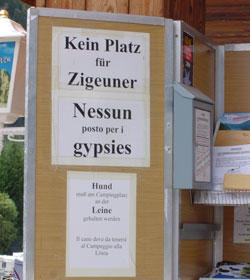
Although racial discrimination is a crime in Austria, the owner of the tourist campsite in Tassenbach posted a sign last August reading "No Gypsies Allowed". This sign was intended to inform his customers that Roma people are not welcomed at his campsite.

Camp owner Johann Weiser justified his actions by explaining that if he accepts Roma in his campsite, his camp will be rated poorly by camping guidebooks. Mr. Weiser alleged that the guidebooks Duch Publishing House and German Club for Motorists have previously degraded his camp for accepting campers who are in fact not campers at all.

Mr. Weiser has recently removed the sign from his camp and is in danger of receiving a penalty for racial discrimination. The Zara association for fighting racism was informed about the case at the beginning of this week.

The case in Tassenbach is the most recent in a series of similar instances of discrimination against Roma by accommodation providers throughout Europe.

Further evidence of racial discrimination against Roma in Europe is stated by Sweden's English Newspaper, The Local. An investigation by Swedish Radio's Ekot program has revealed that Roma people with Swedish citizenship face discrimination at the country's campsites. Of 20 campsites called by Ekot, 10 said they did not allow Roma guests.

The program called a couple of campsites to establish whether or not there were places free. Ten minutes later, the producers sent a Roma family to the site. In both cases they were refused entry.

Sweden's Ombudsman against Ethnic Discrimination, known as (DO), has already identified people of Roma origins as common targets of discrimination in Swedish society. Indeed, DO is already investigating five cases where Roma Swedes have reported campsites.

"It makes me sad and concerned," Keith Palmroth told The Local, himself of Roma origin, at the anti-discrimination office in Gothenburg. "Now you see the truth in black and white, that it is actually the case that Roma do not have a place in society on the same terms as everyone else." Keith Palmroth concisely states the contemporary condition of Roma throughout Europe.

(Dzeno Association, Trever Hagen)

EDITORIAL COMMENT:
And the same occurs regularly in Germany, France, Holland, etc. - in a number of countries that pride themselves to be non-discriminating. So they may be when it comes to coloreds and such but NOT when it comes to "dirty Gyppos".

Quote of the Week


"Of all the things you wear, your expression is the most important" - Janet Lane

A Brave Phena Passed Away


We all know the loss that one feels when a brave and upright person leaves this world, and this is definitely something that I am feeling while writing this even though I never knew the person concerned here personally but only by reputation.

On August 28, 2005 the film authoress, civil rights champion and holder of the Otto-Pankow-Price, Melani Spitta, passed away after a long, difficult illness in Frankfurt-am-Main, Germany. She was known to many Sinti as "die Einzige", which could be translated as "the only one", because she was the sole survivor of a Sinti family, which, like so many others, was exterminated at Auschwitz. Melanie's illness was a result of the traumas suffered in the camps.

The funeral will be held on Monday, September 5, 2005 in Dueren (b. Aachen). The Mass will be read at 11.00 hours in the St. Marienkirche and the interment will be held at 12.00 hours at the cemetery chapel.

Let us accompany her together on this
her last journey in person, or, if that is not possible, then, simply in our hearts wherever we may be.
Let us take on her legacy and create out of our grief the force for a life for which she has been fighting all her life: a life where evil will never be permitted to be forgotten and which also cannot be made good, as so many seem to believe, in which we do have a duty and a possibility to learn from the past and to ensure that there will never be again a suffering like that of "the only one" - whether amongst Sinti, nor Roma, nor other peoples in the world.

Let us remember Melani Spitta with pride as being a Sintizza who fought all her life for the right of the People.

May she rest in peace.

Atch Develesa amari Phena!

Quote of the Week


"Each day comes bearing its own gifts. Untie the ribbons." - Ruth Ann Schabacker

Kosovo's Roma Women Await Emancipation


Mostly chained to the stove and the cradle, some women dare to dream of education and paid employment.

By Hajrudin Skenderi in Laplje Selo and Zana Limani in Pristina (BCR no 570, 10-Aug-05)

Merita, a Roma woman from Laplje Selo, starts her long day at around 5am, the first job being to cut wood for the stove to prepare meals. From that point, she will be kept busy until late into the night.

"I am employed but work at home," she said. "I wash, cook and babysit. After this I have no time for anything else."

Her routine is normal for most Roma women, who are brought up to do housework and look after their husbands and children.

Hatixhe, aged 46, from the village of Preoce, doubts she could do much now with a formal education.

She never had a chance to go to school. "I had to take care of all my brothers and sisters and was always expected to work at home," she said. "How can a woman find a job if she's never even attended a class?

"I wanted to enrol my daughter in primary medical school so she would have more opportunities than I had, but her father wouldn't agree to it. He said the only thing her husband will ask of her is to cook, clean and give birth."

With such attitudes prevailing, it is not surprising that few Roma girls even enter a classroom.

"Statistics are hard to find because it's difficult to keep track of how many women drop out of school," says Gjyzele Sheljoni, a Roma woman biologist who runs Foleja, a non-government organisation, NGO, that combats illiteracy.

Among the 5,500 Roma community in Prizren, Sheljoni believes only three women have university degrees and only seven girls attend high school.

Roma tradition dictates that girls should start to learn how to bake at the age of five or six.

By 12 they will be looking for husbands, and will be taught to seek nothing more than what the men will offer them. Their principal duties from then on are to bear children and to pass on their household skills to the next generation of daughters.

If anything, Roma women have fewer chances now than before to obtain salaried work outside the home.

Since the war ended in Kosovo, many Roma have been driven from their homes and even those who have remained have often lost their jobs.

The dismal state of the economy has resulted in Albanians taking over menial occupations that were once left to Roma, such as cleaning the streets.

Sheljoni says Roma women seeking education encounter prejudice from several angles.

On the one hand, their own menfolk see it as a waste of time. On the other, Kosovo Albanian society tends to be dismissive of all Roma.

"Even those [Roma] women who manage to fight their way into education run into prejudice in society at large," said Sheljoni. "We are seen as good enough only to clean their homes."

Maksut, a 45-year-old Roma from Laplje Selo, is a typical Roma traditionalist. "I am the boss at home and everything has to be as I say," he said proudly.

"My wife has to take care of my children. There's nothing wrong with that. I treat her the way that my father and grandfather treated their wives."

Maksut's wife is expected to carry out many tasks that would appear very old-fashioned in other communities, including washing her husband's hands and even his feet when he comes in to eat his dinner.

He says that is as it should be, although he is open to the idea that life might turn out differently for his daughter's generation.

"My wife and I could take care of my daughter's children, so that she could work," he says. "But what would people say if she spent more time outside than at home?"

Although Merita is interested in the prospect of finding a job outside the home, she says traditions are slow to change.

"Change requires time and struggle and this situation has existed for centuries," she says. "The most important thing is that they [the men] understand that we too have needs and are not made out of stone."

Gradual changes in the position of Roma women are occurring, however, mostly as a result of pressure from internationally supported NGOs.

Emsal Merhaxholli, who runs the Roma Women's Centre in Prizren, is helping Roma women become more active.

"Roma women are as capable as other women," she says. "One of them [in Prizren] runs her own internet cafe. Another runs a factory and employs 16 other women," she adds.

"These are just some examples that show change has begun. But a lot more has to be done to improve the situation." Merhaxholli says the lack of education is the biggest obstacle blocking the further emancipation of Roma women.

"Mothers have to support the education of their daughters," she says. "And women have to follow their dreams in spite of the traditions mainly imposed by men. Roma women don't exist only to give birth to children."

Saskia Marsh, who coordinates "catch-up" classes for Roma children for the Organisation for Cooperation and Security in Europe, OSCE, agrees that attitudes are shifting, albeit slowly.

"Traditional views and early marriage keep most Roma girls out of school," she said. "But there is far more interest now for them to attend catch-up classes than there was before," she adds.

Hajrudin Skenderi is a trainee attending IWPR's Primary Level Journalism Course. Zana Limani is a project coordinator for the Balkan Investigative Reporting Network, IWPR's partner in the Balkans.

Enisa Eminova
RWI consultant
e-mail: rwi@romawomensinitiatives.org

Gypsy culture in Russia


26/08/2005 14:23

MOSCOW. (RIA Novosti political commentator Anatoly Korolev). -- A special course for gifted young gypsies is to start at the Shchukin Theater School in Moscow in September.

The man behind the project is actor, producer and singer Nikolai Slichenko, art director of the world's only national gypsy theater, the Romen Theater.

Slichenko set up the course for a number of reasons: firstly, the theater, which opened in 1931, will soon mark its centenary; secondly, the theatre troupe desperately needs new recruits; and thirdly, there are concerns about the general state of gypsy culture in Russia today.

No one knows exactly when gypsies first came to Russia. However, it is known that the Russians received the nomadic people with warmth and curiosity. The passionate gypsy temperament melted the wintry Russian soul. Count Orlov-Chesmensky, a music lover, was the first to halt the nomads' eternal roaming when 227 years ago he set up a gypsy serf chorus, headed by a russified gypsy, Ivan Sokolov. The chorus's repertoire consisted mainly of folk songs, but they sang with such passion and emotion that they quickly became popular in Russia.

Alexander Pushkin was the first to popularize gypsy culture among the educated public. His poem The Gypsies instilled the spirit of gypsy freedom in the Russian mind, and made gypsy culture an integral part of Russia.

The greatness of gypsy culture lies in their interpretation of various art forms.

No one in Turkey performs the belly dance better than gypsies. No one in Spain dances flamenco better than the gypsies and no one sings the Russian brutal romance (a popular genre of Russian song) better than the gypsies.

In fact, gypsy songs are based on traditional Russian melodies. Even if romances are sung in the gypsy (Romani) language, they use the compositions of Alyabyev, Varlamov and Gurilev, and the lyrics of Derzhavin, Fet, Koltsov, Apukhtin and Pushkin. Pushkin's famous Black Shawl is a particularly striking example.

At the same time, the extremely dramatic style of performance made the traditional Russian melodies part of the gypsy world. This is the world of an ancient nomadic nation of magicians and horsemen. Unfortunately, gypsy traditions are largely oral, as strictly speaking they do not have their own written language. Gypsies mostly use the written languages of the peoples in whose midst they live. Their equivalent of the Bible has not been written so far, unless you count the magnificent collection of gypsy fairytales.

One of the few successful decisions made by the Soviet government was the decision to set up an Indo-Roman Theater Studio. An order to this effect was issued in January 1931. This was conceived as a purely political step, but had an unexpected outcome: the aristocrats of the Russian theater, and the leading actors and directors of the Moscow Art Theater - Vasily Kachalov, Ivan Moskvin, Alla Tarasova - took "the barbarians" under their wing, while Stalin's favorite, Alexei Khmelev, married the great gypsy actress Lyalya Chornaya. However, Mikhail Yanshin, an outstanding actor of the Moscow Art Theater and pupil of Stanislavsky, was particularly instrumental in promoting gypsy culture. He staged The Blood Wedding and The Shoemaker's Wonderful Wife by Federico Garcia Lorca at the Romen Theater.

Something quite remarkable happened: the gypsies took to the Stanislavsky System (method of acting). They were quick to learn his method of representation and emotional recall and demonstrated the organic nature of their scenic life. In this way, a unique theater with its own artistic identity appeared in one of the theater capitals of the world.

The Romen Theatre is now in a critical state. It is no longer fashionable, and needs "fresh blood."

At a press-conference, Slichenko bitterly recalled a recent incident when one of his leading actors told him he would be unable to attend a dress rehearsal because he could not afford to buy a subway ticket.

The theater has, however, made its first steps toward revival. The first twenty students have been admitted to the studio. These steps reflect general changes in the life of Russian gypsies. The Foundation for the Support and Development of Gypsy Culture under the Russian President was set up a number of years ago. The 2002 census showed that there were 180,000 gypsies in Russia, although according to the Federal National-Cultural Autonomy of the Russian Roma (FNCA), there are more than a million of them. Polls conducted by the VTsIOM public opinion research center show that Russians' attitudes to gypsies are four times better than their attitudes to Chechens. To a certain extent gypsies are still shunned and subject to prejudice in Russia. There are still a lot of people who do not like the semi-nomadic people's colorful, bold and passionate way of life.

The gypsies have finally got their own flag: it consists of two equal horizontal bands - blue and green. In the center, there is a red wheel with eight spokes, which is both a symbol of roaming and a Hinduist chakra sign - the symbol of the Sun.

Finland is setting an example for all countries where gypsies live. Under Finnish law, if at least two or three gypsy children attend one school, several classes a week must be conducted in their native language.

Oiriginal Internet Souce

Library that's having a lend of us


By David Rennie in Brussels

August 27, 2005

A public library in the Netherlands has been swamped with queries after unveiling plans to "lend out" living people, including homosexuals, drug addicts, asylum seekers, Gypsies and the physically handicapped.

The volunteers will be borrowed by users of the library, in Almelo, who can take them to a cafeteria, and ask them any questions they like for up to an hour, in a scheme designed to break down barriers and combat prejudice.

The library's director, Jan Krol, said he had been flooded with requests after his project was reported in the media.

Almelo, a prosperous town of 72,000 people in the Twente region of east Holland, is not known as a hotbed of Amsterdam-style liberalism.

The people-lending scheme was conceived as a local project, designed to encourage the solid burghers of Almelo to make contact with members of ethnic minorities and other marginalised members of society. But it has caught the imagination of the press.

"It has caused a lot of interest, a lot of people have already called with questions like: 'Do I need a library card?"' Mr Krol said.

People borrowers will not need a card, he said - and there will be no fines for returning people late.

"Most meetings will last 45 minutes, we imagine. You can ask anything you like, but racist or strong language is not allowed."

Mr Krol, who said he was inspired by a similar scheme in Sweden, hopes to begin the project next month.

"I've got several gay men, a couple of lesbian women, a couple of Islamic volunteers. I've got a physically handicapped woman, and a woman who has been living on social security benefits for many years in real poverty."

Mr Krol said he was especially keen to find members of the Netherlands' small Roma population after a recent attack on two Gypsy families.

Mr Krol said he had not cleared the scheme with his municipal bosses.

"Oh, I never ask the council before I do anything," he said. "And there are no costs at all, only two cups of coffee."

Telegraph, London

EDITORIAL COMMENT:
What next? Gypsies in a Zoo, so we can be studied better?
I won't even say anything about the "Netherland's small Roma community" as the author says... the majority of Gypsies in the Netherlands are NOT Roma but Sinti and the Roma community is indeed very small...

Toxic camp angers Kosovo Roma


By Matt Prodger

-"It's what we would call a child environmental health disaster area"

Other health experts are more critical. After visiting the camps one world authority on environmental health described them as "shameful" and "a disgrace" that "would not be tolerated anywhere else in Europe".

Mitrovica - Roma rights groups are preparing legal action against the United Nations Mission in Kosovo (Unmik) over its failure to evacuate several hundred refugees from camps contaminated with extremely high levels of poisonous lead.

Ever since their homes were destroyed during the war six years ago, more than 500 Roma (Gypsies) have been living in makeshift camps set up by the UN next to a
disused - but contaminated - lead smelter in Mitrovica, northern Kosovo.

The World Health Organization (WHO) describes the situation as an environmental disaster, but the refugees have yet to be moved.

The worst affected is Zitkovac, one of three camps mostly containing children, which is located close to the old smelter. Wooden huts lie within a few hundred metres of a toxic slag heap. The wind whips contaminated dust through the camp.

Rukije Mustafa is eight months pregnant and worried about her unborn baby; her four-year-old daughter Cassandra suffers from blackouts, lethargy and like most of the children born in this camp, her teeth are etched with the telltale grey lines of lead deposits.

"When I look at my child I feel like dying," her mother says. "The dust is killing her, she can hardly walk; she's only got the strength to crawl."

The United Nations created this camp and two others in 1999 to house Roma who, in the wake of the war, had been driven from their homes in neighbouring Mitrovica
by ethnic Albanians who saw them as collaborators with the Serbs.

It was a makeshift arrangement meant to last only weeks, but they have been here ever since.

When the WHO tested the Roma's blood for lead in 2004, the readings for 90% of the children were off the scale - higher than the medical equipment was capable of measuring.

'Shameful'

According to internationally-accepted benchmarks drawn up by the United States Centre for Disease Control, such children fall into the category of "acute medical
emergency" and require immediate hospitalisation.

Gerry McWeeney, a British epidemiologist working in the three camps - Zitkovac, Cesmin Lug and Kablar - says the situation is "critical".

"It's what we would call a child environmental health disaster area," he said.

"We don't have any literature or documentation anywhere that has shown this kind of situation before. They need to be moved."

Other health experts are more critical. After visiting the camps one world authority on environmental health described them as "shameful" and "a disgrace" that "would not be tolerated anywhere else in Europe".

In fact Unmik, the organisation in overall charge of the province, has known about the lead poisoning for at least five years. An Unmik report commissioned in 2000 recommended relocation of the camps because of it, but was never acted upon.

A WHO report published in June 2004 said the same, describing the situation as "urgent".

Opinions vary as to how many people the lead has killed.

Most of those who have fallen ill have been treated in hospitals in Serbia, and human rights groups have had difficulty obtaining their medical records.

The WHO believes at least one child has died from lead poisoning, but others put the figure higher. Paul Polansky, an American who heads the Kosovo Roma Refugee Foundation, counts 27 dead.

Several kilometres from Zitkovac is the settlement where the Roma once lived. It used to be home to 9,000 - one of the biggest Romany settlements in the Balkans.

It has been a ruin since ethnic Albanians destroyed it after the war. After months of prevarication there are now plans to return the refugees (or Internally Displaced Persons - IDPs) to this area. But at the moment there's nowhere for them to live.

Unmik officials say the Roma have been offered temporary accommodation in less contaminated areas but turned it down.

'Difficult group'

But the man in overall charge of Kosovo, Unmik head Soren Jessen-Petersen, says he thinks "we all have a share of the responsibility" - the local authorities, the international community, Unmik and all the agencies, "all those who have been involved".

"There might have been - let's be very clear - there might have been a lack of co-operation on the ground. We are dealing with what we all know is a particularly
difficult group. But that would not serve as an excuse for not addressing an acute health problem."

The European Roma Rights Centre (ERRC) in Budapest is in the process of preparing a lawsuit against the United Nations Mission in Kosovo.

Claude Cahn from the ERRC said: "This is an extremely grave situation which the authorities have been aware of since 2000. We are in the process of taking legal
action against both Unmik and the local authorities in the area."

BBC News, Mitrovica, by By Matt Prodger

EDITORIAL COMMENT:
The author writes: "Other health experts are more critical. After visiting the camps one world authority on environmental health described them as "shameful" and "a disgrace" that "would not be tolerated anywhere else in Europe". The truth is that as far as the siteing of Gypsy sites, for instance, in the UK are concerned they are also, more often than not, in such dangerous areas, such as the official council Gypsy site that is under the Westway in London where Traveler children have been affected by lead poisoning and such from the fumes of the vehicles traveling above them. Other sites are located near refuse tips, near sewerage works, and the like; and this in an E.U. member state. Maybe writers like this one should take a look at their own doorstep prior to making mention of things in foreign countries.

Popular Budapest Club Fined for Affront to Dignity of Roma


Budapest, 26 August 2005. In a case brought by the ERRC together with local counsel, a Budapest court has awarded damages to two Romani men after they were barred from entrance to the discotheque Zold Pardon, a popular local nightclub. The decision is final and binding.

The facts of the case are as follows:

On 14 September 2002, two Romani men, Balint Vadaszi and Istvan Vadaszi, accompanied by two women tried to enter a popular open air club called Zold Pardon in Budapest. The two women -- one of them Romani, both had white skin - entered the club easily, whereas the two men with dark skin were asked to provide identity documents. The two men asked for an explanation as to why they were being refused entrance, because in the meanwhile, they saw many young people entering the place without being asked for identity papers. However, even after one of the men had identified himself, the two plaintiffs were not allowed to enter the club and they ultimately left the premises.

On the basis of the witness testimonies and the recorded video evidence, a lawsuit was filed in which violations of personal rights were alleged, based on the infringement of the right to equal treatment, as regulated i.e. by Article 76 of the Hungarian Civil Code, as well as by Articles 2(1) of Convention for Elimination of All Forms Of Racial Discrimination. The case was brought prior to the adoption by the Hungarian legislature, in December 2003 of a comprehensive anti-discrimination law.

A first instance court refused the complaint on 16 September 2004. However, on appeal, on 25 August 2005, the Budapest City Court held that the Zold Pardon Ltd. and the Doorman-Sec Ltd. operating the Zold Pardon Club in Budapest, violated the plaintiffs' right to dignity. The court did not find an infringement of the requirement of equal treatment based on racial discrimination, apparently because Hungary's anti-discrimination law had not yet been adopted at the time the incident took place. The judge however stated that security guards are not entitled to check the identity documents of prospective guests, a key finding with implications for future cases.

The court awarded 100,000 Hungarian forints (approximately 400 EUR) in non-pecuniary damages to each of the victims. Zold Pardon Ltd. and Doorman-Sec Ltd. were further ordered to refrain from further violations, and were ordered to send a letter of apology to the two Romani men within 15 days. The decision is legally binding. The plaintiffs were represented by local counsel Bea Bodrogi as part of the European Roma Rights Centre Legal Defence program.

EDITORIAL COMMENT:
All one can say to that is that it is about time things were done in this regard and they should be done automatically in the same way as it would as regards to Jews, Blacks or Asians.

Cafes in Skopje Don't Admit Roma Customers


by Elena Simonoska

The Mesecina Roma Humanitarian organization from Gostivar, complains about the increasing number of cases of discrimination and racist incidents directed against Roma in Macedonia.

The latest incident involved three young roma, Senad, Senaj and Birdzan, who sat at a cafe on the Vardar River quay in Skopje. The waitress came and asked them to leave, under the excuse that the table was for regular patrons only. When they demanded explanation, the owner of the establishment told them "the rules are from yesterday, boy, its a new law since yesterday".

"Mesecina" has collected and documented many cases of similar discriminatory actions, through its six centres in different cities and municipalities in Macedonia.

Muhamed Toci, Coordinator at "Mesecina", says that they couldn't bring up charges against the owners of the cafes, because of the fact that there is no legislation that they could invoke. They are waiting for the Law on Anti-Discrimination, prepared by several MPs and the Helsinki Committee.

"A number of cases of discrimination were registered in Kocani, Vinica and Delcevo, but racism is on the rise in other cities, such as Prilep and Ohrid. The Roma are not served in cafes under a variety of excuses", says Toci, and adds that in Vinica, there was even an organized group, under the name "Black Rose" that attacked the Roma. Similar group also existed in Bitola, but it has stopped its attacks because its leader is in jail for another offense.

According to Toci, the Roma rarely decide to bring up charges, because of their mistrust of the Police, which holds the same prejudice about the Roma and often abuses its authority.

There has been only one court conviction for insulting a Roma person (it was Toci in fact that bore the brunt of the abuse) was Dafina Naumoska from the Social Care Centre in Gostivar. In January 1999, Toci went to the Centre to get some documents, when Naumoska pushed him out of the office, yelling abuse. Naumoska was sentenced to one month in prison and one year on probation. (Dnevnik)

Education Ministry to support poor Romany students


Prague, 17. 8. 2005, 19:26 (CTK)

The Romany secondary school students whose families could not bear the cost of the studies, the ministry press department told CTK today. Education facilities can apply for a contribution for Romany students' studies, meals, travel expenses and accommodation for September to December till the end of September. Only students who regularly attend school and have no greater discipline problems can be included in the "Support to Romany secondary school pupils" programme, the ministry said.

The title of a student is considered by an Education Ministry commission, which also comprises representatives of regional offices, the Interior Ministry, the Labour and Social Affairs Ministry and the Government Council for Romany Affairs. The ministry has earmarked 10 million crowns for the programme.

CTK

EDITORIAL COMMENT:
Well, I do hope the readers can understand what they are trying to say. I was having a little difficult with the first sentence for sure. But the lova is only for students who regularly attend brainwashing classes and who are brainwashed enough not to stand out as different, the ministry say, in so many words. We have to be able to read between the lines when it comes to governments saying things and I sure hope that Amare Fohki are capable of doing that.

Critics say government does not protect Romany interests


(PDM staff with CTK) 25 July - After joining the European Union last May, the Czech Republic did not take steps to protect Romanies, chairman of the Dzeno Romany association Ivan Vesely said Friday.

The government failed to sufficiently protect the nation's labour market and did not seek to preserve jobs in construction, for instance, for Romanies, Vesely said. Foreigners have thus been able to replace Romany employees who did less-skilled work, Vesely said in a statement published on the Dzeno website www.dzeno.cz.

According to estimates by Romany organisations, in some regions up to 90 percent of Romanies suffer long-term unemployment. Most of them have low education and it is difficult for them to find jobs. They often do unskilled work.

"The Czech Republic has failed to adopt measures that would protect these jobs for Romanies and socially weak groups of the population in the way the old EU countries did," Vesely said.

Most old EU member countries banned workers from the new members from working at their territory after EU enlargement in 2004. Only Ireland and Britain have opened their markets. Sweden has not put up big obstacles either. Some countries offer jobs in certain professions for which they lack a sufficient number of their own employees. The restrictions could be in force up to 2011.

Vesely said that Romanies in the Czech Republic were worse off after 15 years of democracy than in the past. The Czech Republic's EU membership did not fulfil their hopes. Some of them hoped that they would be able to travel to the West and find jobs there.

Romany leaders believed that thanks to the EU it would be easier for them to enter politics, Vesely said. Romany non-profit organisations expected the EU to help them and to ensure "really effective work for them and future integration of Romanies," he added.

There should be more Romany members of the European Parliament so that the interests of Romanies as the largest minority in Europe be "represented correspondingly," he said.

The Czech state leaves the solution to Romany problems to non-profit organisations. It does not even control whether national subsidies or European money really end up with the needy, Vesely said.

The state is not seeking to help Romanies actively participate in their integration with society, he added.

CTK news edited by the staff of the Prague Daily Monitor, a Monitor CE service.

Original Internet Source

EDITORIAL COMMENT:
Why am I surprised - NOT. The reason the Czech Republic and the Slovak Republic are doing kek to improve the situation of the Romani People in their lands, despite the fact that they are now in the E.U., if the fact that the E.U. does not care one iota about our People. Greece, I believe, has been an E.U. member for quite some time now, as is Spain, and still in both countries, not even counting the U.K. forced evictions of Romani People from their homes is a matter of routine so that developments can be put in that bring mucho dinero to developers and politicians in cahoots with the former. I am talking here about Spain and Greece though corruption such as that would not surprise me in the UK either. What I cannot understand is that Ivan Vesely is so surprised about this all. Maybe he needs to learn reality of Romani life and the fact that Gohja do not care about our People, despite what they may profess publicly.

Ground staff furious over field damage


Aug 16 2005

By The Huddersfield Daily Examiner

TRAVELLERS have been blamed for damaging sports fields in Huddersfield.

At least 35 families have set up camp on the playing fields off Leeds Road.

And they have been accused of damaging football and cricket pitches, with vehicles including quad bikes being driven across the fields.

There are now at least 35 caravans plus many cars and vans on the big sporting complex.

Their caravans meant that a training session planned by Huddersfield Giants had to be moved, as did coaching for youngsters in the Huddersfield Town Academy.

Ground maintenance staff based at the playing fields have seen their hard work damaged. They had spent hours working on the pitches after the Yorkshire Cup soccer tournament earlier this month, ready for the start of the new soccer season.

One soccer official who visited the complex said: "It is a disgrace.

"They have driven caravans, vans and lorries right across the sports fields and there are tyre tracks everywhere.

"It is a real shame after all the hard work the ground staff have put in."

It is the latest in a series of issues involving gypsies at the site.

Some weeks ago, Kirklees Council was left with a bill of thousands of pounds to clean up the mess left behind by the travellers.

A spokesman for Kirklees Council said: "We are aware of the situation and have started the necessary legal proceedings to evict the travellers at the earliest opportunity."

EDITORIAL COMMENT:
I could bet my bottom dollar that those "gypsies" are not Gypsies but are in fact Irish tinks. But use the two words, gypsies and travellers in one article together and in the mind of the sheeple it will, yet again, be all Gypsies that do those things. At the risk of flogging a dead horse I shall make it clear once again that the Irish Travellers are NOT Gypsy as they are not part of the ethnic group of the Romani. Period! Dosta!

Quote of the Week


"Youth is a gift of nature; age is a work of art." - Garson Kanin


First Romany library in Czech Republic to open in Ostrava


Ostrava, 6. 8. 2005, 15:41 (CTK)


The Ostrava City Library will open a branch focusing on Romany readers, Romani kereka (Romany Circle), the first such facility in the country, next year, Moravskoslezsky denik daily writes today. The library, which will start to be built this year, will also provide space for meetings of Romanies and access to the internet.

The branch will be situated in the Vitkovice district where Romanies form a big part of inhabitants.

"Mainly Romany children have already participated in programmes which we prepared for them," city library director Miroslava Sabelova told the paper.

The library will acquaint Romanies with their history and culture. "The Romany language, literature and habits will have their own space here," Sabelova said.

"We will focus on Romanies' everyday life and we will point out the positive examples of those who have succeeded in the majority society," she added.

Original Internet Source

Two Romany families clash, threaten to kill, rape


NOVY BOR (PDM staff with CTK) 1 August -

A dispute between two large Romany families erupted in the North Bohemian town of Novy Bor, the local edition of Mlada fronta Dnes (MfD) reported Saturday.

MfD writes that two Romany businessmen in construction have clashed: Dusan Gorol and Miroslav Tancos. They own construction businesses which compete. Moreover, both of them have political ambitions.

Gorol is active in the Czech Romany Civic Association, while Tancos established the Romany Democratic Social Party this year, but he did not accept members of Gorol's family in it.

Novy Bor mayor Radek Nastic has summoned both of them in the presence of police. "Both families have started a great conflict. We want to keep in order in the town and I have asked Gorol and Tancos to calm down the hotheads and try and settle their dispute," Nastic said.

The feud of the Romany families is accompanied with the statements such as "Today you will be blown up. If not, we have weapons and we will shoot dead all of you. You'd better protect your women and children," the daily wrote. Family members have reportedly aimed firearms and each other and thrown pitchforks.

"I live in fear. When I am at work, I constantly look around whether someone is approaching me. I do not know how to protect my three small children," said Josef Tancos, who sides with the Gorols. He is afraid that the Tancos family will take revenge on him.

The Tancos family say that the Gorols envy their activity in the new party. The Romany Democratic Social Party want to place Romanies in Parliament. But its leader, Miroslav Tancos, does not have a clean criminal record, MfD writes, adding that in the past he was sentenced for fraud and investigated for rape.

The provocations started four years ago when one of the Tancos family threatened some Gorols with an automatic rifle. This year, the situation came to a head again. Gorol and Tancos are cousins.

In the past days, Gorol had to find shelter for his children among relatives outside Novy Bor. He was afraid to return home and preferred to stay in a hotel in a different town, the daily wroted.

CTK news edited by the staff of the Prague Daily Monitor, a Monitor CE service.

Original Internet Source

EDITORIAL COMMENT:
Another sad case of where the behavior of some Roma is not very conducive to giving the Gohja world a good picture of ourselves. Feuds like this, though at different levels, are not uncommon, I know that, but do we really have to behave like the Mob? No wonder some people speak of a Gypsy Mafia. There is, however, a problem also with the headline. Nowhere, as far as I can see from this article, has the aggressor mentioned that he or they would initiate the "r"-word. He may have, once, been investigated for that crime but it does not say either whether he was found guilty.

Anti-Gypsy Persecution in Russia


Moscow, 29. 7. 2005 (by Mara Vladimirova for Antifa-Net in Moscow)

Nobody knows exactly how many Gypsies live in the Russian Federation. Some estimates say 150,000 people while others other give an approximate figure of one million (Russia's population as a whole is 144 million). In both cases, the count is probably inaccurate because, traditionally, Gypsies are nomadic tribes that do not have a permanent place of residence and do not pay much attention to state census demands.

Although, the Gypsies are nominally citizens of the Russian Federation, they remain social "outlaws" as in the past and opt not to conform to a society that oppresses them and discriminates against them. Russian Gypsies can be divided into two big groups, the Roma and Luli. Historically, the Roma first appeared in Russia in the 16th century but it was only at the beginning of the 19th century that they came to Moscow and St. Petersburg. Classic Russian literature of the 19th century painted a romantic image of Roma people as vivacious musicians, dancers and actors very popular with Russian aristocrats. This abstract idealised image still exists in heads of countless people but the sight of real Gypsies in the streets seems to provoke feelings of hostility, anger and fear of being robbed. The Roma are often regarded as "home Gypsies" with a more regular and fixed way of life but few have higher education and few are integrated in contemporary society. During the Soviet era, considerable energy was spent on spreading Communist ideas among the Gypsies to try to restrict their nomadic life and to involve them more in the process of collectivisation of society. During the Second World War, of course, Gypsies fought against Hitler fascism as soldiers of the Red Army. After the collapse of the USSR, however, the Gypsies returned to their traditional way of live as outsiders.

Though the economic and social situation of the Gypsies in Russia in general is poor, the worst situation is faced by the Luli. Luli is a common name for numerous groups of Gypsies from Tajikistan, or those associated with them, who came to Russia en masse after the economic crises and civil wars in the Asian Republics during the period from 1992 to 1997. Now, they are frequently seen, mothers with several children, sitting in the streets of the big cities and begging at the same time as enduring the rigours of the rainy Russian autumn and cold Russian winter. Many Russians mistake them for Tajiks because the Luli dress more like Asians and have an Asian appearance. Every facet of social, political and economic difficulty accompanies the life of Gypsies in Russia. According to research by the European Centre for the Rights of Roma People, Roma communities all over Russia live in deep poverty, deprived of the possibility of obtaining education, jobs, housing and medical help. In practice, this means, for example, that ordinary schools try to find ways not to accept Gypsy children. Even if they are accepted, their attendance is rarely encouraged or enforced. Prejudice is so widespread that Russian pupils refuse to share tables with Gypsy children and that a school textbook could contain a warning not to touch Gypsies because they "spread maladies". The educational problems are compounded by the fact that most Roma, and especially Luli, do not speak Russian. Nevertheless, there are no special classes, schools or textbooks for them in their own languages. Discrimination in the health sector is rampant. In one case a Gypsy woman had to give birth to a child in a field after being rejected by a hospital's emergency department.

Oleg Gusev, a candidate for major of Yekaterinburg, proposed to close down Roma settlements and recently, in the Archangel region, Gypsies were forced to take to court a city government that wanted to drive them out of the region. Gypsies have even threatened to burn themselves with their houses if the authorities try to destroy their buildings. The mass media plays a big part in inciting hostility to gypsies. A TV documentary about beggars in Moscow, for instance, stated that "it is Roma and Luli who control the begging business in the Russian capital and get much more money from this than those who run the petroleum business" before adding that, for the purpose of this business, "Gypsies steal children, buy people as slaves, mutilate them and kill them when they cannot work any more". One Russian person on the programme even suggested using napalm against Gypsy settlements The mass media also claims that Gypsies are heavily involved in drug trafficking. As a result, the words "Gypsy" and "drug dealer" have become virtually synonymous. The police can - and do - make round-the clock drugs raids on Roma and Luli settlements. If they are unable to find drugs, policemen demand money or arrest them on trumped-up charges for several days. When arrested, a Gypsy is generally detained longer than others arrested for the same crime. Arrested Gypsies are often badly beaten, and sometimes even killed, by the police. For example, in 2001 a Gypsy was killed in the police station at Khimki in the Moscow region. The resulting court case has been delayed six times.

In the list of those to whom Russians show xenophobic feelings, Gypsies come second place only to Caucasians but for Gypsies, and those who help them, it is quite difficult to defend their rights against the state. Many Gypsies are illiterate and have little legal knowledge. The easiest way for them deal with police is to give them cash. When extremists like nazi skinheads attack them or other discrimination occurs, the Gypsies rarely go to the court because they know they will not win and can easily be turned into the accused. According to official figures, Gypsies commit 3% of all crimes in Russia. Many Gypsies do not deny being involved in the drugs business as couriers nor that they practice thieving. However, so-called "civilized" society leaves them with few options. Without proper papers, Gypsies who want to start working conventionally and legally seldom get jobs. It is claimed that police officers are reluctant to provide proper papers because they might lose their "pocket money". Even with valid documents, Gypsies can hardly ever find jobs because prejudice against them is so strong. There are other forms of discrimination. Regional governments, for example, refuse to sell land or apartments to Gypsies who want a settled existence. More and more often, the newspapers and observers of human rights organisations publish information about pogroms at Gypsy settlements, like the one that happened in Iskitim in the Novosibirsk region in April. Several organizations, including the Union of Roma Social Organizations and the International Romani Union, monitor the situation of the Roma people in Russia and try to help them preserve their specific culture and language and to resist discrimination. The state envisages only two possibilities for the Gypsies: integrate into society and, effectively, stop being Gypsies or be constantly put into circumstances that are almost impossible to survive and, thus, disappear as an ethnic group. Faced with this arbitrary choice, Gypsies invariably choose to keep their freedom from the state and willingly take the risk of remaining outsiders. This leaves them in the position of outlaws… a large nation without a country of the their own, the last such nation in Europe.

© Searchlight
http://www.searchlightmagazine.com

Children Forced to Work


Vrsaljka Matijevic, the Croatian Children Ombudswoman, asked the Social Welfare Centre and the Police to investigate the child abuse cases involving children, between seven and ten years of age, being forced to work in inhuman high-temperature conditions.


The children from the Roma settlement near Orehovica, according to the media, have collected potatoes in the field for minimal wages. The media got interested in the case in the first place after one child drowned in the Orehovica Lake, after the children went for a swim to refresh themselves.

The Criminal Code prescribes a sentence of up to three years of prison for "parents, adopted parents, caretaker or other persons that forced children and/or minors to a work not suited to their gentle age, or force them, for purpose of personal gains, to behavious harmful for their normal development".

EDITORIAL COMMENT:
The question here is whether this is, indeed, as case of the children having been forced to work in the fields. If they have been forced to work in the fields then probably by nothing else but poverty. Gypsy children have always been working in the fields, in the UK, in the USA, and elsewhere, as a means of helping to earn a crust for the families. The picture that accompanies the article from Oneworld.net would not concur with the children being "small" children but look like about 10-12 years of age. Then again the age given was the age at which we all used to do field labor. The drowning of the child, as horrible as it may be, is nothing but an accident. Going into a lake can cause that to happen, especially if one is not a great swimmer and one encounters undercurrents and the like.

A Tragedy of Errors


by Gergely Fahidi
27 July 2005

A Hungarian father and son have had their convictions for murder lifted in a case that shows how police and courts can mishandle Romani defendants. But the acquittal may yet be reversed.

Like the Pusoma case, the Burka case is likely to enter the law-school curriculum in Hungary. Here is an illustration of how the quick arrest of Romani "perpetrators" can send an investigation and a trial onto the wrong track, not to mention ruining the lives of families. Overturning an earlier ruling, the Hajdu-Bihar County Court on 6 July acquitted Ferenc Burka Sr. and Ferenc Burka Jr. of murder for gain, due to a lack of evidence. The verdict was appealed by the prosecution, so it is possible that the father and son will be found guilty in the end.

Denes Pusoma, an uneducated, simple Romani boy from the village of Ivad, was charged in March 1994 with murdering an elderly woman; the key piece of evidence against him was his identification by police dogs. Defended by a not very efficient appointed counsel, the young man was found guilty a year later, partly based on the provocation of a cellmate who spied on him, and sentenced to six years in prison. A year after that, police arrested the real perpetrator, but Pusoma was released from prison only three months later, having spent a total of 26 months there - innocently. He sued for 2.6 million forints [now about $13,000] in compensation, but before that case came to an end, he committed suicide. The only positive result of his tragedy was that the case led the Constitutional Court to annul several parts of the law on criminal procedure.

The case of the Burka family looks conspicuously like Pusoma's. The police were also led to them by police dogs, the key statement against them also came from a police informant (though it was later retracted); and the police ignored information that implicated a local power-broker in the murder. Without knowing the final verdict, it is already can be stated that the police officers, prosecutors, and judges dealing with the case have made serious professional mistakes, and they are responsible for the two Romani men spending an unacceptably long time, almost six years, in detention. If their acquittal becomes legally binding - the final verdict is expected no earlier than the autumn - their six years' imprisonment is clearly scandalous.

The story started in the pub in the village of Ujszentmargita on 4 March 1999. The impoverished, but "Hungarian," victim used his fresh state welfare payment to play the slot machines - and he won twice in a row. He left the pub to go home, or more precisely to the place he was house-sitting. The two Burkas, both with previous convictions, stayed in the pub for an hour longer. According to the prosecution, they first went home to put on some rubber boots, then broke into the house guarded by the victim, beat him to death, and took the antenna from the roof. The charges were flimsy to begin with: for instance, there was no explanation why the perpetrators, who, according to investigators spent almost an hour at the scene, wasted time getting the antenna instead of taking the more easily transportable valuables from the house - they even left some cash on the table. However, there were circumstances fitting the stereotype of a "typical Roma crime." For instance, according to investigators, it was revealing that Burka Jr.'s wife washed his clothes just at that time (although no traces of blood were found on them), and that a neighbor claimed to have smelled burning rubber, perhaps indicating that the perpetrators were getting rid of their boots.

Two committed lawyers, whose fees were paid in part by the Hungarian Helsinki Committee, defended the two Burkas: Laszlo Zeke and Peter Margitics, the latter having some experience as a prosecutor and also having worked on the most notorious Hungarian "mafia case," against a Ukrainian criminal Leonid Stecura. The lawyers appealed the extremely strict first verdict, reached on 29 March 2002, where the father was sentenced to 15 years in prison, his son to 13 years, and their wives received suspended prison sentences for complicity. Following the appeal, on 2 September 2003, the High Court of Appeal in Szeged annulled the previous verdict as "unsubstantiated and unsuitable for substantial revision" and ordered a new trial. This led to the defendants' acquittal in Hajdu-Bihar County Court.

Now the prosecution itself will appeal, taking the case to the next level - not to the High Court of Appeal in Szeged as before, but to the newly formed High Court of Appeal in Debrecen [in whose jurisdiction Ujszentmargita lies]. It is interesting to note that the chief county prosecutor who indicted the Burkas, Kalman Nagy, has since become the head of the Debrecen Appeals Prosecution Office, and the prosecutor in court during the first verdict, Istvan Toth, has also since been promoted to work for the same office. Furthermore, the judge who found the men guilty in the first instance has since joined the new High Court of Appeal in Debrecen [which began work in January 2005.]

In the course of the retrial, it came to light that two men - not Roma - had earlier contacted police headquarters in Debrecen claiming that a local potentate had committed the murder, not the two Burkas. "There was no officially recorded statement that I was heard by police or of my testimony as a witness," one of the men complained on 11 February 2004 at Budapest police headquarters, where he repeated the statement which had been set aside in Debrecen. According to this man, the real perpetrator, Laszlo T., "is on friendly terms with the investigators in the case; he feeds them and they go hunting together. He also has high contacts among the prosecutors involved; he does the [compulsory] technical inspection on the cars of some of the heads [of the prosecution office]." There is, then, one more lead to pursue, not only because of the murder case, but because either the new informants have made a false accusation, or at least one Debrecen police officer is responsible for serious crimes. It is typical, though, that while witnesses against the Burka family were allowed to testify anonymously, the new witnesses against Laszlo T. were, despite the defence's request, identified by name by the prosecutor in the public hearing.

This article originally appeared in the Hungarian weekly HVG on 16 July 2005.

Translated by Judit Szakacs.

Quote of the Week


"Let yourself be open and life will be easier. A spoon of salt in a glass of water makes the water undrinkable. A spoon of salt in a lake is almost unnoticed" - Buddha

Quote of the Week

"The wealthiest people on earth are the ones who know they have enough." - Michael Levy

Roma Swedes turned away from campsites


An investigation by Swedish Radio's Ekot programme has revealed that Roma people with Swedish citizenship face discrimination at the country's campsites. Of 20 camp sites called by Ekot, 10 said they did not allow Roma guests.

"We don't accept them," said one campsite manager.

"Experience says that we should say no," she added.

The programme called a couple of campsites to establish whether or not there were places free. Ten minutes later, the producers sent a Roma family to the site. In both cases they were refused entry.

Another owner admitted that all campsite managers discussed the issue and that emails circulate in which certain sites are warned to be on their guard.

According to the law against discrimination introduced in Sweden in 2003, "nobody shall be treated differently or unequally [on the grounds of ethnic origin] when it comes to buying goods, services or housing".

Sweden's Ombudsman against Ethnic Discrimination (DO) has already identified people of Roma origins as common targets of discrimination in Swedish society. Indeed, DO is already investigating five cases where Roma Swedes have reported camp sites.

"It makes me sad and concerned," said Keith Palmroth, himself of Roma origin, at the anti-discrimination office in Gothenburg.

"Now you see the truth in black and white, that it is actually the case that Roma do not have a place in society on the same terms as everyone else."

Palmroth said that Ekot's findings must be reported to DO and followed up. But as one man running a campsite contacted by Ekot commented, it is not ignorance of the 2003 law that is behind the discrimination.

Acknowledging the law, the man said that he does not "completely ban them".

"But we're not glad that they come - we try to avoid letting them in."

Original Internet Source

EDITORIAL COMMENT:
I have to say that, with what I have heard years ago from people such as Hans Calderas about the way the Romani (not just Roma) in Sweden were treated then, it does not surprise me. It would appear, and I do not think that I am wrong there, that things like this are again on the increase in the EU countries (and elsewhere) and not just simple refusal to be let onto campsites. However, that issue is also one for Germany and Switzerland, I believe, as there the same thing is happening, just like in Sweden. Then there are instances when a Sinto and his family are refused when trying to book into hotels with such comments as that they are listed in the computer as "Gypsies" and we will have Gypsies here. We must also not forget that in liberal Sweden, until the late 1970's it actually was illegal for Romani to stop anywhere for longer than 24 hours and the same is now - apparently - so tumor has it - happening in the Netherlands as well.