A Tragedy of Errors


by Gergely Fahidi
27 July 2005

A Hungarian father and son have had their convictions for murder lifted in a case that shows how police and courts can mishandle Romani defendants. But the acquittal may yet be reversed.

Like the Pusoma case, the Burka case is likely to enter the law-school curriculum in Hungary. Here is an illustration of how the quick arrest of Romani "perpetrators" can send an investigation and a trial onto the wrong track, not to mention ruining the lives of families. Overturning an earlier ruling, the Hajdu-Bihar County Court on 6 July acquitted Ferenc Burka Sr. and Ferenc Burka Jr. of murder for gain, due to a lack of evidence. The verdict was appealed by the prosecution, so it is possible that the father and son will be found guilty in the end.

Denes Pusoma, an uneducated, simple Romani boy from the village of Ivad, was charged in March 1994 with murdering an elderly woman; the key piece of evidence against him was his identification by police dogs. Defended by a not very efficient appointed counsel, the young man was found guilty a year later, partly based on the provocation of a cellmate who spied on him, and sentenced to six years in prison. A year after that, police arrested the real perpetrator, but Pusoma was released from prison only three months later, having spent a total of 26 months there - innocently. He sued for 2.6 million forints [now about $13,000] in compensation, but before that case came to an end, he committed suicide. The only positive result of his tragedy was that the case led the Constitutional Court to annul several parts of the law on criminal procedure.

The case of the Burka family looks conspicuously like Pusoma's. The police were also led to them by police dogs, the key statement against them also came from a police informant (though it was later retracted); and the police ignored information that implicated a local power-broker in the murder. Without knowing the final verdict, it is already can be stated that the police officers, prosecutors, and judges dealing with the case have made serious professional mistakes, and they are responsible for the two Romani men spending an unacceptably long time, almost six years, in detention. If their acquittal becomes legally binding - the final verdict is expected no earlier than the autumn - their six years' imprisonment is clearly scandalous.

The story started in the pub in the village of Ujszentmargita on 4 March 1999. The impoverished, but "Hungarian," victim used his fresh state welfare payment to play the slot machines - and he won twice in a row. He left the pub to go home, or more precisely to the place he was house-sitting. The two Burkas, both with previous convictions, stayed in the pub for an hour longer. According to the prosecution, they first went home to put on some rubber boots, then broke into the house guarded by the victim, beat him to death, and took the antenna from the roof. The charges were flimsy to begin with: for instance, there was no explanation why the perpetrators, who, according to investigators spent almost an hour at the scene, wasted time getting the antenna instead of taking the more easily transportable valuables from the house - they even left some cash on the table. However, there were circumstances fitting the stereotype of a "typical Roma crime." For instance, according to investigators, it was revealing that Burka Jr.'s wife washed his clothes just at that time (although no traces of blood were found on them), and that a neighbor claimed to have smelled burning rubber, perhaps indicating that the perpetrators were getting rid of their boots.

Two committed lawyers, whose fees were paid in part by the Hungarian Helsinki Committee, defended the two Burkas: Laszlo Zeke and Peter Margitics, the latter having some experience as a prosecutor and also having worked on the most notorious Hungarian "mafia case," against a Ukrainian criminal Leonid Stecura. The lawyers appealed the extremely strict first verdict, reached on 29 March 2002, where the father was sentenced to 15 years in prison, his son to 13 years, and their wives received suspended prison sentences for complicity. Following the appeal, on 2 September 2003, the High Court of Appeal in Szeged annulled the previous verdict as "unsubstantiated and unsuitable for substantial revision" and ordered a new trial. This led to the defendants' acquittal in Hajdu-Bihar County Court.

Now the prosecution itself will appeal, taking the case to the next level - not to the High Court of Appeal in Szeged as before, but to the newly formed High Court of Appeal in Debrecen [in whose jurisdiction Ujszentmargita lies]. It is interesting to note that the chief county prosecutor who indicted the Burkas, Kalman Nagy, has since become the head of the Debrecen Appeals Prosecution Office, and the prosecutor in court during the first verdict, Istvan Toth, has also since been promoted to work for the same office. Furthermore, the judge who found the men guilty in the first instance has since joined the new High Court of Appeal in Debrecen [which began work in January 2005.]

In the course of the retrial, it came to light that two men - not Roma - had earlier contacted police headquarters in Debrecen claiming that a local potentate had committed the murder, not the two Burkas. "There was no officially recorded statement that I was heard by police or of my testimony as a witness," one of the men complained on 11 February 2004 at Budapest police headquarters, where he repeated the statement which had been set aside in Debrecen. According to this man, the real perpetrator, Laszlo T., "is on friendly terms with the investigators in the case; he feeds them and they go hunting together. He also has high contacts among the prosecutors involved; he does the [compulsory] technical inspection on the cars of some of the heads [of the prosecution office]." There is, then, one more lead to pursue, not only because of the murder case, but because either the new informants have made a false accusation, or at least one Debrecen police officer is responsible for serious crimes. It is typical, though, that while witnesses against the Burka family were allowed to testify anonymously, the new witnesses against Laszlo T. were, despite the defence's request, identified by name by the prosecutor in the public hearing.

This article originally appeared in the Hungarian weekly HVG on 16 July 2005.

Translated by Judit Szakacs.

Quote of the Week


"Let yourself be open and life will be easier. A spoon of salt in a glass of water makes the water undrinkable. A spoon of salt in a lake is almost unnoticed" - Buddha

Quote of the Week

"The wealthiest people on earth are the ones who know they have enough." - Michael Levy

Roma Swedes turned away from campsites


An investigation by Swedish Radio's Ekot programme has revealed that Roma people with Swedish citizenship face discrimination at the country's campsites. Of 20 camp sites called by Ekot, 10 said they did not allow Roma guests.

"We don't accept them," said one campsite manager.

"Experience says that we should say no," she added.

The programme called a couple of campsites to establish whether or not there were places free. Ten minutes later, the producers sent a Roma family to the site. In both cases they were refused entry.

Another owner admitted that all campsite managers discussed the issue and that emails circulate in which certain sites are warned to be on their guard.

According to the law against discrimination introduced in Sweden in 2003, "nobody shall be treated differently or unequally [on the grounds of ethnic origin] when it comes to buying goods, services or housing".

Sweden's Ombudsman against Ethnic Discrimination (DO) has already identified people of Roma origins as common targets of discrimination in Swedish society. Indeed, DO is already investigating five cases where Roma Swedes have reported camp sites.

"It makes me sad and concerned," said Keith Palmroth, himself of Roma origin, at the anti-discrimination office in Gothenburg.

"Now you see the truth in black and white, that it is actually the case that Roma do not have a place in society on the same terms as everyone else."

Palmroth said that Ekot's findings must be reported to DO and followed up. But as one man running a campsite contacted by Ekot commented, it is not ignorance of the 2003 law that is behind the discrimination.

Acknowledging the law, the man said that he does not "completely ban them".

"But we're not glad that they come - we try to avoid letting them in."

Original Internet Source

EDITORIAL COMMENT:
I have to say that, with what I have heard years ago from people such as Hans Calderas about the way the Romani (not just Roma) in Sweden were treated then, it does not surprise me. It would appear, and I do not think that I am wrong there, that things like this are again on the increase in the EU countries (and elsewhere) and not just simple refusal to be let onto campsites. However, that issue is also one for Germany and Switzerland, I believe, as there the same thing is happening, just like in Sweden. Then there are instances when a Sinto and his family are refused when trying to book into hotels with such comments as that they are listed in the computer as "Gypsies" and we will have Gypsies here. We must also not forget that in liberal Sweden, until the late 1970's it actually was illegal for Romani to stop anywhere for longer than 24 hours and the same is now - apparently - so tumor has it - happening in the Netherlands as well.

Sintis and Romas Gain Minority Status


Sintis and Romas in Europe have long been two ethnic groups persecuted by governments and those in the "majority" alike. Now, one German state is recognizing them as a national "minority."

Rhineland-Palatinate is the first state in Germany to recognize as a national minority the roughly 8,000 Romas and Sintis who live there. In 1997, the federal government recognized the 50,000 Danish in the north and the 60,000 Sorbs who reside in the southeast as national minorities.

Rhineland-Palatinate's premier, Kurt Beck, and the head of the state's Sintis and Roma association, Jacques Delfeld, signed the agreement on Monday.

"We want to send a signal with this agreement against the discrimination and for the rights of Sinti and Roma in our society," Beck said after the signing.
Protection of minorities

Recognition of European minorities on a continent-wide basis dates back only to the EU's Framework Agreement, passed in the 1990s. Germany ratified it in 1997.

With it come certain responsibilities towards minorities. In Rhineland-Palatinate, the state will promote special support for Sintis and Romas in kindergartens, schools and colleges. This measure is supposed to level the playing field for the two groups in the educational system.

Stereotypes perpetuated

The Central Committee of German Sintis and Romas, in Heidelberg, has been demanding for over a decade that an end be brought to what it believes to be discriminatory reporting against the people it represents. This comes primarily in the form of arrest warrants and reports.

Police sometimes include the terms "Sinti," "Roma" or even "Gypsy" in their reports, which are frequently published in the media. The Central Committee says the procedure helps to propagate negative stereotypes.

The new agreement in Rhineland-Palatinate will prohibit police from mentioning the ethnic identity of Sinti or Roma when publishing criminal reports in the state.
The Sinti and Roma languages will also be promoted.

No national recognition -- yet

Whether Berlin will take up the matter and put the recognition of the two groups on the legislative agenda remains to be seen. So far, the government describes the Sinti and Roma as an "ethnic group," which allow them some special protection.

But the federal government has not yet taken the final step, saying that the Sintis and Romas do not meet one of the five criteria set up in the EU framework -- namely that they do not have a permanent region they reside in.

Over 500,000 Sintis and Romas were killed by the Nazis in the 1930s and 1940s. Countries around Europe still systematically persecute and discriminate against the ethnic group that many do not understand.

Author DW staff (jdk)

Original Internet Source

EDITORIAL COMMENT:

The fist comment one would have to make, and maybe someone will have to contact Deutsche Welle in this matter, is the fact that there is no "s" in the plural for neither Sinti nor Roma but that is remain Sinti / Roma and not Sintis & Romas. It is a shame that so many journalists the world over seem to be rather ignorant when it comes to the Romani People and get things wrong, accidentally and/or deliberately.

Now to the rest of the article though:

While the government of the German Federal State of Rheinland-Pfalz (to give it its German name) seems to have no problem in recognizing Sinti and Roma as a "national minority" the Federal Government does seem to have a problem and they hide behind the EU framework, while giving Sinti and Roma the "ethnic minority" status only.

The Sinti and Roma languages will also be promoted. This is something that the Sinti do not wish to happen, however, because in this case that would mean that the language would have to be taught in schools and everyone would have access to the language and this brings us back to the issue of the "Language Charta" as well. Why is it that no one of those who think they are doing us all a favor wants to actually listen to the wishes of the grassroots People? Or is that just asking too much?


Ma Bister


This coming week, on August 1-2, we mark the 61st anniversary of the
destruction of the Auschwitz Gypsy Camp. Let us never forget our martyrs and in their honor wear a brown ribbon during this week, and, maybe, not just during this week alone but as a permanent reminder to ourselves and the world around us.

Veshengro

Quote of the Week


"Flow with whatever is happening and let your mind be free. Stay centered by accepting whatever you are doing. This is the ultimate." - Chuang Tzu


Gypsies Target of Racist Attack in Kent, UK

21. 7. 2005

A Gypsy family in West Kingsdown has suffered a brutal attack with menaces poisoning their horses' food, damaging their home and daubing offensive slogans on their property.

George Harbour, 41, of Kingsingfield Road believes the incident was racially motivated in a bid to get himself and his family to move away.

He said: "I feel very angry and they have targeted me to try and get me to move. I have had abuse in the past.

"My family has lived in this area for over 100 years. This is my home. I have had to move all my horses to a different field because they poisoned the grass with creosote."

Despite numerous phone calls by the Chronicle, North Kent Police was unable to confirm a record of the incident, which occurred on Sunday, June 3.
(Sevenoaks Chronicle)

EDITORIAL COMMENT:
Amazing... Kent Police aappears to have no knowledge of this attack. Then again that is not surprising especially when one knows of Kent Police's anti-Gypsy sentiments in the past. And we can be certain that (a) it will not be investigated, if it will ever, as a racist crime and (b) the Commission for racial Equality, if contacted, will, like in the Firle Bonfire incident, deny that they have the powers to act. All it always boils down to is the fact that we, the Romani (Romany) Gypsies are not the right color and right kind of ethnic group. Ed.

Gypsies use McAlpine logo


Alfred McAlpine has been alerted to gypsies using its logo on fleet vans as part of a resurfacing service they are offering to residents in the Hull area.

The contractor was made aware of the practice by the local police and was told that its logo had been spotted on vans used by the Romany workers.

McAlpine is now working with the police to track down the perpetrators. A company spokesman told CJ: "We have been made aware that gangs are using our logo on their vans. None of the vans described belong to our registered fleet.

"We are taking this very seriously and will be launching a full investigation."

20 Jul 2005 10:14

Original Internet Source

EDITORIAL COMMENT:
I have to say that I have come across this scam of using the McAlpine Logo and even forged McAlpine documentation before but it has never been carried out by Romanichals (Romany) in the UK but by Irish Travellers. Either the people reporting it do not know the difference and most do not, as they see the Irish Travellers, thanks to the government, the media and many Gypsy support organizations, as Gypsy and therefore as Romany, or this are Irish Travellers pretending to be Romani. This, at least, is the way that I see this unless someone can prove me different. Ed.

Quote of the Week


"Consider the day wasted if you learn nothing new." - Unkown

Settled travellers are not gypsies - council


OCCUPANTS of an unauthorised travellers' site in Cottenham cannot call themselves gypsies because they no longer travel for a living, a council has claimed.

South Cambridgeshire District Council's enforcement officer John Koch gave evidence yesterday (Friday, 15 July) at the public inquiry into 22 illegal pitches on Victoria View in Smithy Fen.

He said the occupants of the plots - who had given up travelling for health reasons or to bring up children - were no longer officially considered to be gypsies under planning law.

The council's legal team says this should weigh against them being given planning permission.

One of the travellers, 69-year-old Patrick McCarthy, previously told the inquiry he had given up travelling because he had had several heart bypass operations and his wife had a heart murmur and arthritis. More...

EDITORIAL COMMENT:
This is exactly as predicted by some of us as regards to the playing around with the word "Gypsy" and by "doctoring" ethnicity to mean "lifestyle" rather than race and I have been expecting this to happen sooner or later in that the authorities, no longer wanting to grant our People the protection of an ethnic minority/group would "reclassify" the meaning of "Gypsy" and thereby making all settled Romani-Gypsies no longer "Gypsy" under the law and therefore washing their hands of any need to make provisions for us and also removing any and all legal protection as regards to attacks on racial grounds, etc.
It has not taken long since the day that measures were being put in place to "doctor" the term to the day the first actions have arrived, as we can now see with this planning ruling for Smithy Fen.
From the names I do assume that, theoretically and in all truth, the people concerned on that illegal encampment are Irish Travellers, seeing the name McCarthy, however, it is the changing of the term "Gypsy" that should and must concern the Romani very much in this.

Traveling Thieves

WTAP News
Katie Sabatino

Bob Sanes of Parkersburg has been a Wood County builder job years.

He prides himself on his work and was shocked to learn Tuesday that a couple of thieves have been in this Cypress Street neighborhood passing themselves off as craftsmen.

"It's sad to say. It takes all kinds you know...especially on older people like her over there," says Sanes.

He's talking about the 85 year old woman that lives across the way, who was victimized by two suspected gypsies Monday.

Police say it was around 6:00 that two men approached the home wanting to install linoleum floors.

Even though the woman said no thanks..she continued chatting with one of the men, not noticing the other had sneaked behind the house... Stealing her cash and jewelry.
"They're very good at what they do. They pray upon the elderly," says Parkersburg Detective Greg Nangle.

Nangle warns that the troubling scenario has all the characteristics of a group known as Irish travelers...Or Gypsies.

"It's a group of people out of South Carolina and Georgia...their life long ambition is to scam people out of money," says Nangle.

According to Parkersburg officials, these Irish travelers are nothing new to Wood County.

In fact this is becoming a yearly occurrence...When these so called gypsies begin traveling the country looking for an easy scam.

"My advice to the citizens of Wood County would be if you have not solicited someone to come to your home and they come unannounced, you need to get rid of them quickly, observe what they are driving and what they look like and go ahead and call 911," says Nangle.

Original Internet Source

EDITORIAL COMMENT:
He's talking about the 85-year-old woman that lives across the way, who was victimized by two suspected Gypsies on Monday.

One can only wonder what would happen if the word Gypsies were substituted by the Jews or Muslims. Mind you, I don't think we have to wonder what would happen should any journalist dared to use the word "Jews" in such a context. He would be out of a job and probably charged with some felony to boot. But when it has to do with Gypsies (suspected even only) then there is no problem. It is not only in the USA that we find this. Similar statements have been in the press and on police information websites in Germany (no surprise there, I guess) and even the UK. It has to be said, if one reads carefully, that they are talking about Irish Travelers, as it says, "Nangle warns that the troubling scenario has all the characteristics of a group known as Irish travelers... Or Gypsies." While the Irish Traveler part does not surprise me and the statement is correct when Parkersburg Detective Greg Nangle goes on to say "or Gypsies" then he is in the wrong because he equates in his mind, and the minds of all others, Irish Travelers with Gypsies, while the term Gypsy should only be applied to Romani. And, because it is equated with out People, the Romani-Gypsy, it is defaming our People as a Race.

Quote of the Week


"Learning is a treasure, which accompanies its owner everywhere." - Chinese proverb.

Gypsy caravan sites - fresh rows loom


Gypsies are once again on a collision course with Chichester district planners, after two separate applications for individual caravan sites were refused.

Both sites, in Clayton Lane, Bracklesham Bay, have been in existence for years, and have been the subject of previous refusals and unsuccessful appeals.

The southern area development control committee was warned of growing pressure because of a shortage of gypsy sites in the area, and planning officers recommended approval of both applications. More...

EDITORIAL COMMENT:
I do find it rather funny that the "not convenient for local facilities" issue is still being used to this very day. It always was when Gypsies were being asked - yes, it happened once - where they would like to have sites located. When they chose places well away from the villages the same was always used to not putting the sites there but rather locating them next to refuse tips, sewerage plants, and other such unsuitable locations. Apparently, because they were closer to facilities (well, I have seen some that were not very close to facilities when placed in such locations) so it was claimed.

The new ethnic vote: the Roma vote


Sofia, 6. 7. 2005, 16:45 (Amalipe)

During the campaign for Parliamentary elections 2005 Roma kept being one of the most "courted" and manipulated groups. Nothing new: the situation was not different during the previous campaigns (both parliamentary and local). These elections however showed a new specific of the "Roma vote". And the parties would have to take it into consideration from now on. Roma are already inclined to have a united vote in favor of their own formal and informal local leaders. A new consolidates ethnic electorate is being formed. The major obstacle in front of its complete establishment is the political immaturity of the same local leaders and their inability to turn the thousands of Roma votes into Roma deputy seats. Several facts speak strongly about the establishing of a new ethnic electorate: More...

Quote of the Week - yes, I know this one is late


"If people concentrated on the really important things in life, there'd be a shortage of fishing poles." - Doug Larson

Make Poverty History


"Make Poverty History" is the hue and cry that goes out all over the place currently, especially in the UK, as regards to the UK presidency of the G8, etc. but it is ONLY, it would appear, aimed at alleviating poverty in Africa. Yikes! There is poverty right at their own doorsteps in the EU, primarily amongst the Romani-Gypsy population in the new member states such as the Czech and Slovak Republics, in Hungary, in Poland but not only there but also closer to home, such as Greece, and even the UK. We do not even want talk about those states that are going to be admitted to the EU the next time round, such as Romania and Bulgaria. More...

Forced Evictions of Romani Gypsies


While the media all over the Western world concentrates on the evictions of squatters in the towns and cities of Zimbabwe, such as Bulawayo, Harare, etc. nothing whatsoever is heard about the evictions, also by force and with the use of bulldozers to flatten homes, of Romani-Gypsies throughout the European Union. More...

Gypsies demand special attention in health and education


17:38
Juliana Cézar Nunes
Reporter - Agência Brasil

Brasília - The Association for the Preservation of Gypsy Culture estimates that there are around one million gypsies in Brazil. 300 thousand of them are nomads. The gypsies, who are still viewed by society through the eyes of prejudice, are present at the 1st National Conference to Promote Racial Equality. They are demanding that the government adapt the country's health and educational systems to guarantee their communities adequate services.

Yaskara Guelpa, who is a representative of the Association for the Preservation of Gypsy Culture, says that government officials are only now beginning to recognize the special characteristics of the gypsy people and showing willingness to discuss government policies.

According to Guelpa, in the health area the gypsies want a greater understanding of the fact that women only accept the gynecological services of female physicians. Resistance on the part of health posts and hospitals to this cultural precept is causing many women to die of complications when giving birth or to develop diseases that could be prevented.

In the area of education, the big problem is enrolling school-age children. The nomadic groups have a habit of moving their camps every three months. With the delays in the enrollment process, many children are left out of school. And many of those who manage to enroll suffer discrimination in the classroom, because teachers lack understanding of gypsy habits, Guelpa observes.

"We still face incredible prejudice in hospitals and public schools. Employees grab their wallets when we walk by," Guelpa protests. "People still believe in myths like the one that gypsies steal children. This is not true. It was a myth that developed over time, based on the period when many women gave unwanted children to gypsy women to rear."

Translation: David Silberstein

01/07/2005
------

Brazilian gypsies want to be recognized as citizens


13:38
Irene Lôbo
Reporter - Agência Brasil

Brasília - Gypsies form a group which is little known but present in the imagination of Brazilians. According to Cláudio Iovanovitchi, who represents the gypsy people on the National Council for the Promotion of Racial Equality, there are around 600 thousand gypsies in Brazil without access to government social welfare services.

"When people refer to gypsies, they have in mind people who steal little children and know nothing except telling fortunes, and that is not so. They [gypsies] hold ancestral values, embody culture and musicality, and have their own ways to treat illness," says the executive coordinator of the 1st National Conference for the Promotion of Racial Equality, Jorge Carneiro.

The main demand of the group is the right to receive birth certificates. This and other demands will be presented at the conference. The right to receive birth certificates represents the first step in acquiring other documents necessary for gypsies to exercise their rights as citizens, which will be even more difficult, since they have no permanent address.

According to Carneiro, statistics indicate that 90% of the gypsy population is illiterate. They also want to have access to the government's social programs.

The 1st National Conference for the Promotion of Racial Equality begins tomorrow (30) and runs through July 2, in Brasília.

Translation: David Silberstein


29/06/2005

EDITORIAL COMMENT:
There is another way of advancing our brethren in Brazil and that is our own ID cards, passports, and documents, issued by our own institutions.

14 carat gold vest for Romanian bandoleer


Wednesday, June 29, 2005

ANKARA - Turkish Daily News

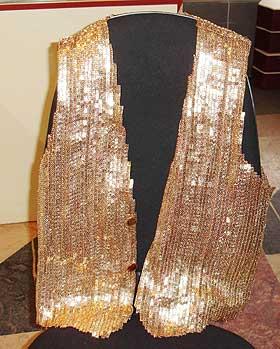
Goldsmith Erdogan Selamet of Gebze crafted a 14 carat gold vest for a customer in Romania.

Selamet says his Romanian customer, who was referred to him through relatives in Romania, is a "bandoleer" -- a leader of a single Romany clan. Selamet created the four-kilogram vest in 58 days at a cost of $85,000. I went to Romania and met the wealthy bandoleer. I learned about the vest he wanted and did it in 58 days. They loved it in Romania. The bandoleer told me he'll wear it on special days and weddings, said the gregarious goldsmith.

He worked for a long time as a goldsmith in the Covered Bazaar of Istanbul and says he could even make a golden dress if asked, I knit it with my own special golden yarn. Some customers have ordered golden belts. I'm going to Romania to take some more work orders from there.

EDITORIAL COMMENTS:
Please look for a more in depth study of this phenomena of the "leaders" living in the lap of luxury while their People starve in the ROMANI FIRST Blog and also, in due course in the newsletters.

Psni Gets Powers to Move Travellers

By Andrew Evans, PA Lords Staff

Peers backed new powers for the Police Service of Northern Ireland to move gypsies and travellers.

Similar measures are in force for England and Wales.

But the Unauthorised Encampments (Northern Ireland) Order will not come into force until there are an adequate number of transit sites, provided by the province's housing executive, said Northern Ireland minister Lord Rooker.

Lord Glentoran, for Tories, said the problem of travellers in the province and on the UK mainland had increased since the Republic of Ireland had launched a crackdown.

Original Internet Source

EDITORIAL COMMENT:
More and more anti-Gypsy measures are put in place in the UK, whether in Ulster, which personally to me is part of Eire and not Britain, but that is not at issue here, intending to give the authorities powers to move on illegally encamped Irish Travellers but should Romani-Gypsies, a protected ethnic minority in the United Kingdom, try to stop when traveling they too will be treated under the same methods. Similar moves are, it would appear, afoot in the Netherlands where now traveling Sinti are no longer permitted to stop, even at camping places, for longer than 24 hours, so I have been told.


Brno clinic denies closing display out of fears of Romanies


Brno, 13. 6. 2005, 19:15 (CTK)

The Oncological Clinic in Brno today denied that the hospital gallery had dismantled an art exhibition out of fears of Romanies visiting a hospitalised woman, hospital spokeswoman Zuzana Joukalova has told CTK. Joukalova thereby dismissed the information published in the latest issue of the political weekly Tyden, saying that hospital staff along with the Zluty kopec (Yellow Hill) gallery hid the paintings since they were afraid that they could be stolen by people coming to see the Romany woman.

"The display was only interrupted for two days due to technical reasons, and now it is open to the public again," Joukalova said.

However, Tyden reported that even gallery owner Miroslav Vanacek confirmed that the exhibition of artist Ivana Baraziova had been closed.

"A Romany woman was admitted as a patient to the clinic and we have decided that we would rather dismantle the exhibition for the period of her stay," the weekly quotes Vanecek as saying. CTK has not succeeded in contacting Vanecek by phone for comments.

Tyden wrote that the closure of the art exhibition was proposed by the hospital spokeswoman. "I saw several times how they [Romanies] were looking at the pictures when they should not have been there any longer," Tyden quotes her as saying.

According to Joukalova, the paintings by Baraziova were not insured and their value exceeded 300,000 crowns. "It was my duty to warn the gallery owner of the risk," Joukalova said in Tyden.

EDITORIAL COMMENT:
Well, Gypsies are thieves, are they not, and would run off with the art display. Sure. Yes folks, I am sarcastic.

Media cultivating 'climate of hostility' towards gypsies and Muslims


15th June, 2005

The British media is encouraging a "climate of hostility" towards asylum seekers, refugees, Muslims, Roma/Gypsies and Travellers, a new report says.

Published by the European Commission against Racism and Intolerance (ECRI) yesterday, it said that organisations active in combating racism placed media reporting on asylum, immigration and terrorism at the centre of their concerns.

"In the asylum and immigration field, the media are, for instance, reported to have continued to use provocative, sensationalist and sometimes outright racist language, present facts and statistics in a biased way, and accompany articles with threatening images," it says.

The ECRI was established by the Strasbourg based Council of Europe to be an independent human rights monitoring body that specialises in issues relating to racism and intolerance.

The report states that newspapers continue to unfairly villified Muslims: "Members of the Muslim communities also experience prejudice and discrimination, especially in connection with the implementation of legislation and policies against terrorism.

"As concerns terrorism, it has been pointed out, inter alia, that the media tend to give extensive coverage to arrests of suspects of terrorism, who are predominantly Muslims, but fail to report on their release, which has reportedly followed almost each of such arrests."

It is the ECRI's third report on the racial integration in the UK. The organisation noted that some progress had been made since its last report in 2002, notably that the Press Complaints Commission (PCC) issued guidelines in October 2003 on the correct terminology to be used when reporting on asylum and refugees.

However the PCC has no statuatory power to enforce the guidelines and has consistently seen them being flouted.

"In spite of initiatives taken, members of ethnic and religious minority groups continue to experience racism and discrimination," the report states in its summary.

It called upon the government to ensure that "reporting does not contribute to creating an atmosphere of hostility and rejection" towards minority groups and play a more proactive role in countering such an atmosphere.

"ECRI recommends that the authorities of the United Kingdom engage in a debate with the media and members of other relevant civil society groups on how this could best be achieved," it added.

Original Internet Source

Are Czech racists and why they resent Romanies - press


Prague, 13. 6. 2005, 08:59 (CTK)

The ""Czech Idols" television contest, from which Romany Vlastimil Horvath emerged as the winner last night, has refuted sociological studies according to which the Romany minority is one to which the Czech majority society has the worst possible attitude, Hospodarske noviny writes today. It were the votes by television viewers from generations that link Romanies to all possible bad human qualities that brought Horvath the victory, the author says.

"The contest has confirmed something I have been saying for many years. Czechs - with the exception of skinheads - are not racists in a sense of the word that they resent a different skin colour. Problems with Romanies, as public opinion polls show, are of the social and not ethnic nature," expert for Romany problems Roman Kristof says.
"The enormous resentment towards Romanies mainly stems from people's bad experiences, including housing problems and Romanies' attitude to work," he says.

The Centre for Public Opinion Research (CVVM), which has studied Czechs' attitude to ethnic minorities on a sample of more than 1,000 respondents for many years, confirmed his opinion. In the polls, at least three-quarters of respondents have been sying for a long time that they do not want to live near Romanies, heavy alcoholics and people with a criminal past, while people with a different skin colour are only resented by two in ten respondents.

People do not connect the question about a different skin colour with Romanies because they connect Romanies with something else and that it their bad experience with them.

According to the majority of respondents in a poll taken in 1970, in which the Public Opinion Research Institute (UVVM, the CVVM's predecessor) analysed in detail Czechs' attitude to Romanies, Romanies are noisy, aggressive, primitive, selfish, troublemakers, lazy, false and dirty.

It is just the generation of the major group of respondents from 1970 who voted in the "Czech Idols" television contest in great numbers. Peoplemeters show that it is people over 45 (and children from four to 15) who prevailed in front of television screens during the contest. They made up more than one-half of the viewers.

These people could have hardly changed their attitude to Romanies. The reason of the success of Romany Horvath is different, according to sociologist and a CVVM analyst Jan Cervenka, who has studied Czechs' tolerance towards Romanies for a long time.

He asked people in 2003 how they thought Romanies could contribute to good co-existence with the majority population. "The answers showed that Czechs believe that Romanies should change their behaviour and life-style and better adapt themselves to the norms of the majority, observe laws, work and study," Cervenka said.

This is a precise portrait of Horvath pictured by the contest and by himself. In the only interview which touched upon his nationality, Horvath said that he considered "the behaviour demanded from Romanies" the only acceptable one. "Sometime I say if I have had to prove for my entire life that it is possible to live a decent life why other Romanies could not do the same," Horvath says.

Messages exchanged by contest fans on its website show that his statement did not go unnoticed. Those who attack Horvath because he is a Romany receive various answers from his supporters.

"Yes, Vlastik is a Romany, but he is decent. Why should this bother you, you racist," a girl who called herself Magdalena wrote, for instance.

CTK

Referendum call on scrapping horse fair


20/06/2005

Changed days: 'Real Romany people are well-liked but are now fewer in numbers'

By Dave Gudgeon

A FORMER Eden councillor has called for Appleby Horse Fair to be scrapped.

Eric Fleming says the behaviour of some of the young people who turn up at Fair Hill is barbaric. And he has rubbished claims that the event brings millions of pounds into the economy of the Eden Valley town.

Mr Fleming, of Belgravia, Appleby, wants a referendum to determine whether townsfolk want it to continue.

He said: "The real Romany people are well-liked but they are now fewer in numbers or are staying away.

"Most of the young people who do attend the fair are not real Gypsies but riff-raff who come to Appleby for a booze-up.

"They foul our streets with their litter and pollute the air with their foul language.

"I have travelled to most parts of the world but I have never seen such barbaric behaviour."

Mr Fleming, who made a film about the fair almost 20 years ago, feels the situation is getting worse each year.

And he described reports that the fair, which attracts thousands of Travellers and visitors to Appleby, generates £3 million turnover as rubbish.

Keith Morgan, chairman of the Appleby New Fair joint committee, said it could only be halted if the Travellers themselves decided against coming.

He felt that the town as a whole was not opposed to the principle of the fair and said the £3 million figure came from a consultants' report.

Three teenage girls alleged they were sexually assaulted and RSPCA inspectors were shot with BB guns during this year's event.

Original Internet Source

Announcing O NEVO DROM NL #2


The latest issue of the O NEVO DROM Newletter in PDF is available. I had tried to upload it to our Yahoo groups mirror but with 450KB it appears to be too large to be uploaded in one go. Therefore anyone not as yet subscribed to the newsletter/magazine wishing a copy and/or wishing to subscribe please contact me via churimengro1@yahoo.com mentioning that you wish to receive a copy of O NEVO DROM #2. It will then be sent to you as a PDF file, delievered as an email attachment.

Latcho drom,
Veshengro

IRU Parliament meeting in Belgrade


Belgrade, 17. 6. 2005, 10:30 (ROMEA/Roma Network)

There will be IRU Parliament meeting in Belgrade, the capital of Serbia and Montenegro on 1-2 July 2005. The IRU Parliament meeting will be attended by the IRU Parliament members and by the President of the International Romani Union Stachiro Stankievicz, by the Vice Presidents: Nadja Demeter, Florin Cioaba, Normund Rudevic and Zlatko Mladenov; by the High Commissioner Orhan Galjus; by IRU General Secretary Zoran Dimov; by the Commissioner of foreign policy Heredia Ramirez and by the Commissioner for Holocaust Affairs Roman Chojnacki.
The following topics will be featured on a meeting: domestic and international policy of the IRU, reports on a present situation of Roma in the courtiers of the Parliament members, especially in Serbia; Roma Inclusion Decade; Cooperation with World Bank, Open Society Institute, United Nations, etc.; coordination of media and information.

ROMEA, Roma Network

EDITORIAL COMMENT:
Oh, how very lovely - yet another IRU gabfest, another gathering of Romani intellectuals that have, in the main, lost the plot and the contact with the grassroots.
I cannot, for the life of me, see why, in the age of easy international communications money has to be spent on such gabfests that do not achieve anything whatsoever with the exception of wasting time and resources. The same could be achieved using computer-based communications such as messenger conferencing - with video even. Maybe by actually doing the work in such online conferences instead of sitting about looking pretty and loving ones own voice and feeling important on a platform some things might actually get done and many more people who have to go begging for money in order to attend these meetings could actually participate. Then again, that would threaten the status quo.

Muted respose to gypsies' land defeat


25 June 2005 07:47

A Norfolk community won a major planning victory when an inspector decided that gipsies could not stay on land close to their homes even though they owned it. But with two communities completely divided, there was still a muted response.

On the face of it, they won what may come to be seen as a major victory -but getting anyone in Denton to talk about successfully challenging the gipsy settlement in their midst proved almost impossible.

It is two years since a gipsy family, long associated with north Suffolk, settled at the South Norfolk village. Residents have fought to have them moved on - firstly challenging their arrival and then arguing that the setting-up of a caravan site was against planning rules.

The planning inspector found against the gipsies, who now have a November deadline to leave the village of 352 people that appears in fear of reprisals.

Most people questioned about how they feel now the case has been won offer a similar response: "I do have an opinion, but I would really rather not say anything." Even those with no objection to the site refused to comment.

The well-organised, clean and tidy site on two water meadows, off Middle Road in the village, gives the impression of being totally inoffensive.

But an EDP reporter and photographer, asking if those living on the site wanted to comment on the planning decision, found themselves on the receiving end of aggressive language and threats. They were told to get off the site immediately or their cars and a camera would be "smashed up".

When someone from the village did eventually respond, Clare Valori said the feelings of Middle Road residents were "very low key". "As a group, we are very pleased that the appeal has been dismissed on planning grounds and really would like to stress that there is no personal animosity between us and the occupants," she said. "And we would like to keep it that way for the time that they are still here."

Another resident, who wanted to remain anonymous, said no one would be sorry to see the group go. "No one wants this in their own back yard," he said. "The place will be a lot better off once they have gone, but no one will ever admit to saying so."

But while other communities in the region might be hoping this decision will prove a turning point in the way travellers are dealt with, Jon Blunkell, travellers' liaison officer for Norfolk County Council, said he did not expect it to make a big difference.

"In discussions with my colleagues, what is being said is that you can't now expect a similar case to necessarily go the same way," he said.

Mr Blunkell said he did not believe the Denton situation would lead to fewer planning applications being made retrospectively. "Every case is still going to be considered on its own merits," he said.

It seems the clash of cultures seen in Denton is likely to recur wherever gipsies settle for the time being.

Original Internet Source


EDITORIAL COMMENT:
I am having a hard time, generally, to believe anything negative that this newspaper reports as regards to the Romani in that area seeing their general anti-Gypsy bias that they espouse.

Gypsies lose fight for meadowland homes


23 June 2005 20:59

Romany gipsies have lost their fight for permission to stay on meadowland in a Norfolk village - and have now got until November 11 to leave.

A public inquiry that finished on June 9 heard their case to put down hard-standing and keep caravans at the Middle Road site they own at Denton, near Harleston.

But now the inspector, Lucy Drake, has dismissed the appeal.

Stuart Shortman, solicitor for South Norfolk Council which turned down their planning application, said it would carry on talking to the gipsies.

"There are dates that have been set and extended by the authority and, as things stand, the date when we would expect the gipsies to leave is November 11. We will liaise closely with the local residents and the gipsies."

He did not expect any problems when it came to the gipsies moving on.

The inquiry at Long Stratton considered an appeal by Clifford Jay, Stephen Coates and Robert Smith on the council's refusal to allow retro-spective consent for hard-standing. They argued their human rights would be violated by a decision that forced the 30 adults and children back on the road, having arrived in October 2003.

Philip Brown, for the gipsies, argued that four children were now benefiting from a settled education for the first time in their lives, and allowing the settlement was preferable to an extended "return to itinerant roadside camping".

Denton Parish Council chairman Edwin Winter said villagers no longer felt confident walking their dogs or riding along Middle Road and there was genuine fear of repercussions that prevented people voicing their concerns. Other residents said the peaceful village atmosphere had been shattered.

Original Internet Source

EDITORIAL COMMENT:
Amazing that, while everyone seems to fighting for Irish Gohjas in trailer on an illegal encampment in Essex no one seems to do anything to help Romanichal families that are being evicted or under threat of eviction.

Basildon: Bulldozer Law Puts Tony Blair on Trial


London, 17. 6. 2005, 10:52 (Ustiben)

A dramatic legal victory this month has highlighted the possibility that the UK government would face international condemnation should threats to bulldoze Britain's largest Gypsy settlement be carried out. The proposed raising of a hundred homes at Dale Farm would trigger damages claims totalling anything up to eight million euro. But in addition the Labour Government itself could be challenged under European law.

Lawyers representing residents at Dale Farm and nearby Hovefield, both threatened with destruction by Basildon district council, have been alerted by the news that 300,000 Roma in Greece have won an unprecedented case against their own government.

Dale Farm representative Kathy McCarthy plans to deliver a warning to Prime Minister Tony Blair next week stating that eviction by Basildon would violate Article l6 of the European Social Charter.

"The law is on our side," she said. "We intend to get a hearing before a judge as soon this is possible."

It is Article l6, guaranteeing protection of family life and accommodation for all EU citizens, which has been broken by Greece, according to a ruling on 8 June from the European Committee on Social Rights.

The European Roma Rights Centre, which brought the complaint, says it marks a turning point in legal efforts to end systematic human rights abuse of Roma from the Ukraine to the United Kingdom. In Britain, more than 300 private plots owned by Gypsies have been flattened and closed down in the past l8 months.

However, one family has this week reoccupied a closed plot at Bulkington, scene of two violent evictions by Constant. Legal proceedings have been initiated.

"Evictions are illegal," says Claude Cahn, the EERC acting director. "Any country that allows such a policy to continue is now exposing itself to a similar conviction."

As to the intention of Basildon to evict ten Gypsy families at Hoverfield, preparations are being made to seek a judicial review of that decision. Dale Farm residents are already suing under the Human Rights Act in respect of earlier evictions they suffered in neighbouring Hertfordshire.

Strengthening the case against Britain is the recent report by the Council of Europe's Commissioner for Human Rights, Alvaro Gil-Robles. He says present policy fails to meet accommodation and other basic needs and that racism against Gypsies is rampant.

JEWISH APPEAL
Meanwhile, an appeal is being made to Basildon councillors by members of the Jewish community not to go ahead with evictions. Ruth Barnett, who escaped the Nazi persecution in Germany, says she is concerned both for the families involved and for the reputation of Britain.

She is asking members of the council committee which meets on Tuesday (21 June) to think again about the families at Dale Farm, in particular the children, and not to make a decision they could later regret.

A Jewish human rights monitoring team is being formed to witness the direct action operation by Constant & Co., a company which styles itself as Gypsy eviction specialists. The firm has submitted a blueprint for the demolition of what is virtually a village at Crays Hill, Essex. It carries a price-tag of three million euro.

Others preparing to observe the mass-demolition include Liberal Democrat MP Nick Harvey. Some members of Basildon council have expressed their opposition to the operation and a petition signed by local residents is to be presented soon.

Roma representatives will be reporting on the crisis to the Romani union parliament meeting in Belgrade on 1 July. The planned destruction of Dale Farm has been condemned by Romani organisations in France, Germany and Serbia, as well as the US, Canada and Australia.

Ustiben report, By Grattan Puxon

EDITORIAL COMMENT:
For a Romani-Gypsy, like myself, I am sure it is hard to understand how the Irish Travellers, when in Eire, refuse to be called Gypsies and vehemently demand the term "Traveller" but as soon as the hit the sores of the UK they are, all of a sudden "Gypsies". Amazing how they are "Gypsies", which in fact they are not, when it suits them and demand protection under the ethnic minority laws, to which they are not entitles because they are not a recognized ethnic minority in the UK while the Romani-Gypsies are, but in Eire, where nothing can be gained from the use of the term "Gypsy" but everything from the term "Traveller", they refuse to be "Gypsies" (and they then speak the truth, as they are NOT "Gypsies"). What is even more disconcerting to a Rom, like myself, is the fact that Romani from this country, and elsewhere, demand they be allowed to stay at this site there in Essex, while they same people, such as the IRU Parliament, for instance, will say a single word when it comes to Romanichals being refused planning and being moved on. There must be political mileage in there somewhere.

Romany gipsies ignored stop notice


CELIA WIGG


08 June 2005

Gipsies continued developing an unauthorised caravan site despite being served with a stop notice, a public inquiry heard yesterday.

The illegal encampment on two water meadows in the Waveney Valley, at Denton, near Harleston, started in October 2003 when the site was cleared, trees felled and hardcore put down.

This led to complaints from villagers, and the following month South Norfolk Council took enforcement requiring that development halted. But it was claimed yesterday that the encampment continued to expand, with sheds and a field shelter for ponies among the most recent additions.

More than 30 adults and children now live at the caravan site, and the inquiry is hearing an appeal by Clifford Jay, Stephen Coates and Robert Smith, against the council's refusal to grant retrospective planning consent.

Mr Coates, who lives at Plot 6 with his wife and three young children, said they wanted to settle down when they started a family and had paid £2500 for their property.

Two of the youngsters have health problems requiring hospital treatment, and the oldest boy will soon be starting at Earsham Primary School. His wife is also expecting their fourth child.

Mr Coates said if the appeal was rejected they would simply have to go back on the road, although they intended staying in the area.

"I have never lived in a house. I was born a gipsy and I will die a gipsy in a caravan. That's a tradition and a way of life," he said.

"It is very important that we stay as a community." More...

Romany associations will not establish umbrella organisation

Prague, 9. 6. 2005, 16:53 (CTK)

Representatives of Romany associations in the Czech Republic agreed that they would not seek the establishment of the umbrella organisation which would represent all Romanies, Gabriela Hrabanova from the Athinganoi society told CTK today. The decision was made by representatives of seven Romany associations and the central Bohemian Romany coordinator at a recent meeting in Prague, Hrabanova said.

Certain Romany organisations have been calling for the establishment of one umbrella Romany organisation for several years. Last April, the Parliament of Czech Romanies was established and it had the ambition to be the representative of all Romanies in the Czech Republic. However, some Romany organisations have had objections to it from the very beginning and refused to join it.

"The participants at the meeting stated that absolute independence of existing Romany organisations is the only possible reality at present," Hrabanova said.

They agreed, however, that their organisations would cooperate and act together mainly in the implementation of the Decade of Romany Integration, the international project launched by the World Bank in eight central and east European countries. It mainly concentrates on the improvement of housing, health care, education and employment of Romanies.

The meeting was attended by representatives of the Romany Parliament, the Association of Romanies from the Plzen region, west Bohemia, the Romany association of citizens of Lysa nad Labem, north Bohemia, the Romea organisation, Athinganoi and Dzeno, the Association of Romany Regional Representatives and the Association of Romanies in Moravia together with the central Bohemian regional coordinator.

The participants called on Deputy Prime Minister Pavel Nemec, the government commissioner for human rights and the government Council for Romany Issues to organise a national meeting of Romany organisations, advisers and activists.

The implementation of the Decade tasks and the inclusion of Romanies in the project should be the main topic of the meeting. The Romanies also want representatives of certain ministries and institutions to attend the meeting.

CTK

EDITORIAL COMMENT:
Maybe it is better so that all the individual Romani organizations in the Czech Republic continue to remain independent seeing the vast amount of corruption that always seems to go hand-in-hand, it would appear, with such "umbrella" organizations.

Karasek to discuss removal of Lety pig farm with owners


(PDM staff with CTK) 10 June - Government human rights commissioner Svatopluk Karasek will meet the owners of a pig farm situated on the site of a former Romany concentration camp in Lety today to discuss its removal, according to the website www.euro.cz.

The meeting will be the first between a government representative and the managers of AGPI, the company that owns the pig farm, after eight years, Karasek told CTK.
"We need a calm atmosphere for these sensitive talks. I am looking for a reconciliatory solution which would not be only a repetition of a situation eight years ago," Karasek said.

It does not help the matter that the case is being permanently watched by the public, he said, adding that he was afraid that the media interest and the consistent fuelling of the problem could lead to the increasing of the costs of a possible removal of the pig farm.

The removal has been demanded by representatives of Romany organisations for a long time. They point out that the location of the pig farm on the site of the former camp in which 326 people died and 600 were transported to Auschwitz is undignified and insulting to the memory of the victims.

In 2000, a memorial with the names of Lety victims was unveiled at the cemetery in nearby Mirovice.

AGPI management made it clear previously that it is willing to remove the farm to another site which will be fully prepared for operation.

"We are not expecting any concrete results from the meeting. It is the first meeting and I do not want to anticipate its outcome," AGPI director Jan Cech told CTK.
According to certain estimates, the removal could cost the state CZK 1 billion.
Karasek told CTK today that "such an enormous sum is absolutely unacceptable to the government." He said that he would therefore try to find such a solution that would be feasible for all sides.

The company management has not yet named any sum.

Prime Minister Jiri Paroubek said previously that he would prefer to spend money on the education of Romanies rather than to build a memorial to Romany victims of Nazism.

He added, however, that the government was prepared to discuss the establishment of a dignified memorial with Romany organisations.

(USD 1=CZK 24.405)

Paroubek wants to fund Romany education instead of Lety memorial


Prague, 6. 6. 2005, 20:52 (CTK)

Prime Minister Jiri Paroubek would like to finance education of young Romanies instead of a memorial to Romany victims from WW2, he said at the opening of the photographic exhibition "Lety - the Story of Concealed Genocide" in the Chamber of Deputies today. He, however, noted that the cabinet is prepared to negotiate with Romany organisations about the establishment of a respectful memorial in Lety, south Bohemia, at the place of the former Nazi concentration camp for Romanies.

"In my opinion, I would prefer investing the money in the education of young Romanies to building a memorial," Paroubek (Social Democrats, CSSD) told CTK.
He said that he would pay attention to the solution of Romany problems and thereby commemorate Romanies who perished in the concentration camps in Lety near Pisek and Hodonin near Kunstat, east Bohemia. More...

Gypsy group defends village site


Gypsies fighting to stay near a village in Somerset have told a public inquiry they moved on to the site to get a base for health and education services.

A total of 16 families of Romany Gypsies moved on to the site in North Curry last October.

They bought the land in Oxen Lane in an auction and have erected fences and built a road on the site.

Some villagers have since been arguing with the local council to have the families evicted from the site.

Taunton Deane Borough Council issued the Gypsies with an enforcement order denying them permission to stay.

A public inquiry is being held in which a government planning inspector is considering the Gypsies' appeal against this.

John Holland, 38, a self-employed gardener, told the hearing he was fed-up with "living in road verges".

The council's barrister Richard Langham said Mr Holland and the other families had arrived at the site on the same weekend.

He said: "You knew it was important to establish the camp quickly, giving the council no opportunity to be warned."

'Off the highways'

Margaret Smith-Bendell, a spokeswoman for the Romany Gypsy Council, said that government had done "nothing for the Gypsies of this country" since the 1960s.

She said that once Gypsies were allowed to occupy land they co-existed very well with the local community.

"All I'm interested in is getting my people and their children off the highways," she said.

"Prejudice towards Gypsies arises from a lack of knowledge of our ways. As a race we are no different to house dwellers.

"Romany Gypsies want access to education and health facilities in the same way as house dwellers."

Planning inspector Roger Priestley will present his report to the Office of the Deputy Prime Minister who will then have the final say on the appeal.

Original Source

Inquiry over Gypsy site under way


A three-day inquiry has begun to determine whether Gypsies who set up camp in a Somerset village should be allowed to stay.

Several residents in North Curry have been fighting to get the 16 families evicted since they arrived last autumn.

The group, who bought the field in Oxen Lane at an auction, have put up fences and built roads.

A government inspector is to conduct a planning inquiry after Taunton Deane council denied them permission to stay.

After hearing both sides of the argument, the inspector will make a recommendation to the Deputy Prime Minister John Prescott, who will make the final decision.

About 150 residents turned up for the first day's hearing on Tuesday.

Julia Tibbs said: "I would like to think this is the beginning of the end."

But Brian Cox, solicitor for the Gypsy families, said: "There are more than 4,000 Gypsies on unauthorised sites.

"They have nowhere to live and they have children with health and education needs and they have to live somewhere."

Last month, following a similar inquiry in Wiltshire, a group of Gypsies were allowed to stay on a site in Minety near Chippenham for a further 18 months.

Original Source


Court confirms probation for Romany activist Gina


Plzen, 8. 6. 2005, 12:26 (CTK)

The Regional Court in Plzen today confirmed a ten-month sentence with two-year probation imposed on Romany activist Ondrej Gina, accused of embezzlement, fraud and tax evasion. The Plzen court thereby rejected Gina's appeal and confirmed the original sentence by the district court. This verdict cannot be appealed, Gina can only lodge a recourse with the Supreme Court.

According to the verdict, Gina had several private cars repaired for the money from the Fund of Understanding and Hope and the Romany Cultural Unity, which he headed. He thereby caused a total damage of 70,000 crowns. Gina also fraudulently gained social allowances of 20,000 crowns. More...

Chav has made it into the dictionary


Chavtastic words and 'brand Nazis' make it to the dictionary


by Lisa Burn Brand Republic 9 Jun 2005

LONDON - Language is living and constantly evolving, demonstrated today by the inclusion of a host of new words in the latest edition of the Collins English Dictionary.

"Brand Nazi" makes it into the book, meaning a person who insists on buying one particular brand of clothing or other item, as does that leader of designer fashion "chav". This Burberry-clad phenomenon is defined as "a young working class person who dresses in casual sports clothing", possibly coming from the Romany term "chavi" meaning child. The word also gets its female equivalent, "chavette" included as well as adjectives "chavish" and "chavtastic", meaning suitable for chavs. More...

Celebrating travellers' role

08 June 2005

A FESTIVAL celebrating travellers' and Gypsy communities was launched on Wednesday.

The festival will see pupils treated to storytelling, music and workshops by a Polish Romany dance group and the Snap theatre group.

It will also feature exhibitions of photographs depicting circus, fairground and traveller families and works by borough pupils telling the story of Brent's travelling communities.

The festival has been organised by Brent Council's ethnic minority and traveller achievement service (Emtas).

Head of Emtas, Rocky Deans, said: "Brent is home to Irish travellers, Roma gypsies from eastern Europe and fairground and circus families, among others.

"It is important that we celebrate the culture of these communities and in doing so promote respect and understanding."

Queens Park Rangers football club will also be lending its support by hosting an under-12 soccer tournament for boys and girls from traveller and Gypsy communities on June 24.

The festival marking Travellers and Gypsies Cultural month is being launched at the Gwenneth Rickus building in Brentfield Road, Harlesden, at 5pm.

Speakers include Tom Sweeney, of the Traveller Law Reform Coalition, Romany journalist Jake Bowers and director of the Irish Traveller Movement Martin Collins.

For more details of events taking place call Denise Delalande on 0208 937 3329

The photographic exhibition is on at the Gwenneth Rickus building until June 24 and the one by borough pupils at Brent Town Hall, Forty Avenue, Wembley, until June 30. For details, call Brent Council on 020 8937 1200.

Internet Source

EDITORIAL COMMENT:
Although rather interesting and positive, this festival, and the launch of a Travellers and Gypsies Cultural month, it is again all ass-about-face in that firstly it talks about "Traveller culture" - there is no such thing - while there is a Romani Culture, yes, and then apparently, and I can prove them wrong there if need be, that Brent is home to "Irish travellers, Roma gypsies from eastern Europe and fairground and circus families, among others" to quote the "Emtas" spokesperson; but nothing of the Romanichal of this country who also happen to live in the Borough of Brent, though not, necessarily, visibly in trailers on official sites or, more like the Irish, on illegal encampments. And then it is always Roma from Eastern Europe, recent arrivals who often do not even have asylum given to them and are just still here while their cases are being dealt with and given mention while at the same time the local Romani People are being forgotten, deliberately, methinks. We are just not attractive enough in that we do not wear colorful costumes or sing the "traditional" Gypsy songs of the East and maybe the behavior of the traveling Irish who are but Gohja in trailers appeal to folks more as well.

Roma in Strasbourg

Written by David Ferguson in Brussels
Tuesday, 07 June 2005

"Prejudice towards Roma is not the manifestation of a phenomenon which is sporadic, occasional, or limited both geographically and in time. On the contrary, this is a recurrent phenomenon, which exists in all European countries in varying degrees and is even on the increase both in frequency and vehemence," said Maud De Boer-Buquicchio, Deputy Secretary General of the Council of Europe. As many as 6 to 8 million Roma live in Europe with the largest population concentrations found in the Balkan peninsula of southeastern Europe, central Europe, and in Russia and the other successor republics of the USSR.

EU enlargement has placed the issue of equal rights and improvement in economic and human conditions for Roma firmly on the European policy agenda. Countries where Roma populations exceed half a million are Romania, Bulgaria, Hungary, and the former Yugoslavia. Slovakia, with its estimated 320,000 Roma, has the highest proportion of Roma in the world.

Speaking yesterday at an event organised in Strasbourg by the Forum of European Roma Young People, De Boer-Buquicchio underlined the role of young Roma in overcoming racism and improving human conditions: "As young Roma, you have an important role to play to serve as mediators and promoters of communication channels between your communities, institutions and the rest of the population, to develop capacity-building of future generations of young Roma, to boost their drive for higher education, and to change through your success and personal achievements the negative prejudices still existing within a large part of our societies," she said.

De Boer-Buquicchio recalled the state-organised genocide perpetrated also on the Roma minority in Nazi-occupied Europe, claiming the lives of half a million Sinti and Roma. Often, though, when remembering the holocaust, the focus is on the methodic destruction of Europe's Jewish community with the loss of 6 million lives. "Racism and intolerance in all forms be it anti-Semitism, Islamophobia or prejudice against Roma, or xenophobia at large strike at the heart of the idea of a democratic society based on respect for the equal dignity of all human beings," said De Boer-Buquicchio.

Despite backing from European institutions and new major programmes in the enlarged EU and candidate countries, violence against Roma remains widespread. In January, for example, ten young Italians set ablaze a camp where five Romanian Roma families lived including a nine month old baby. The perpetrators justified their action as 'Saturday night fun'.

"Anti-Gypsyism is an aggressive, widespread and still acceptable form of racism in Europe," said Valeriu Nicolae, executive director at the European Roma Information Office. "Without strong reactions from European Institutions and leading European politicians, social cohesion and equal opportunities, which are both fundamental principles of a united Europe, run the risk of being seen as hypocrisy by the over 8 million European Roma."

Internet Source

EDITORIAL COMMENT:
Maybe one should also mention in this context that the Jewish Community has been actively working against the recognition of the Romani Holocaust by claiming and continuing to do so in books and by other means that "Gypsies were only sent to the camps because the were regarded as asocial and not for reasons of Race". It is amazing that this is done in the light of the fact that the same laws that were applied to the Jews were also applied to Zigeuner (Gypsies). But, well, the Holocaust just has to remain a uniquely Jewish event and "the Gypsies defile the memory of the Holocaust by wishing to be associated with it" - as some people in the Jewish community keep saying.

Nazi slaves and forced labourers get full payouts

Fri Jun 10, 2005 3:41 PM BST

By Stephanie Nebehay

GENEVA (Reuters) - Some 80,000 non-Jewish slaves and forced labourers under the Nazi regime have received up to 7,700 euros each under a recently-concluded compensation programme, officials said on Friday.

Surviving slave labourers or their heirs got a maximum of 7,669 euros each, while forced labourers in industry were paid 2,556 euros and those who had to work on farms 1,022 euros.

Rounded up in Eastern and Central Europe, they were deported and made to work as slaves in concentration camps or labour for German industry or agriculture during World War Two, the International Organisation for Migration (IOM) said.

"Although the payment is in one sense largely symbolic, it has also made a difference for many, many elderly and in some cases very needy people," IOM's director-general Brunson McKinley told a news briefing.

The successful claimants, traced to some 80 countries, shared total payments worth 405 million euros, according to IOM.

The IOM received 332,000 claims from non-Jewish claimants, mainly ethnic Roma and Sinti from Slavic countries. It is one of seven partner agencies of the German Foundation "Remembrance, Responsibility and Future", a four billion Euro fund set up by the government and industry to compensate Hitler's victims.

Hans-Otto Braeutigam, executive chairman of the German Foundation, said the "modest payments" were in recognition of Germany responsibility, but could never atone for the suffering.

"These old, former forced labourers have been waiting for this for more than 50 years. I am sorry to say that it comes very late but I hope it doesn't come too late," he said.
"There can be no full compensation for what these people have gone through...We have a responsibility to see this does not happen again," Braeutigam added.
Another 250,000 claimants, about half of them former Italian soldiers interned by the Nazis after 1942, were rejected as ineligible, according to IOM's Norbert Wuehler, director of IOM's claims programmes.

IOM handled claims from non-Jewish people living worldwide except those in five countries which have set up national compensation programmes -- Russia, Belarus, Ukraine, Czech Republic and Poland. Jewish claims are handled by a survivors' organisation known as the Jewish Claims Conference.

"The Nazis conducted raids in Eastern Europe where they regarded people as inferior so they used them as a labour pool. Most were from former Yugoslavia, Romania, Hungary and the Slovak Republic," Wuehler told Reuters.

The IOM also said it was winding up payments to 15,549 people who proved property losses due to the Nazi regime.

Most of the successful claimants under its global programme live in Poland, Czech Republic and Slovenia, but others were traced to Israel and the United States, a statement said.

Internet Source

EDITORIAL COMMENT:
Well, well, well, what can one say? First they made sure that most of the non-Jewish survivors of the forced labor schemes were dead and buried before they actually made an attempt to pay and then all those people get is such a miserly sum. For those not familiar with the Euro this equals about GBP 5,000 or USD 8,500 in the current rate of exchange. I do not care what Hans-Otto Braeutigam, executive chairman of the German Foundation, said in this respect. In my view as a Rom, some of whose relations suffered and died in the camps, this is an insult that is worse than anything so far thrown at people such as Sinti and Roma in respect of their suffering in the Holocaust. Germany as a people must do much better. I rest my case.

Corin Redgrave critical after collapse at meeting

Sam Jones
Thursday June 9, 2005
Guardian

The actor and political activist Corin Redgrave was critically ill in hospital last night after suffering a heart attack while defending a controversial Travellers' site at a public meeting.

Redgrave, 65, had just begun his speech to Basildon council's development control committee when he fell unconscious to the floor.

The meeting was cancelled and Redgrave was taken to Basildon hospital in Essex.
Just before he collapsed, Redgrave had revealed that he was being treated for cancer at the Royal Marsden hospital in London.

Ron Poulter, who was standing next to Redgrave when he collapsed, said: "He stopped talking [and] sank to his knees

"The police used their machines on him twice. The second time they seemed to get a pulse and then one of the Gypsies started giving him mouth to mouth."

Redgrave was at the meeting at Basildon's Townsgate Theatre to speak on behalf of the 500 Gypsies and Travellers who live at Crays Hill, near Billericay.

They arrived at the seven-acre greenfield site five years ago, and have campaigned to stay on the site despite fierce local opposition.

The issue has proved so divisive in the area that parents removed their children from the village primary school in protest, leaving Traveller children as the only pupils.

Two years ago, the deputy prime minister, John Prescott, turned down appeals for planning permission and gave the illegally camped travellers two years to find new sites.

When the deadline expired on May 13, Basildon council called a public meeting to decide whether to evict the 80 families still at the site. More than 300 villagers and Travellers packed the theatre last night to listen to the debate.

Redgrave had told the councillors: "I've been to Crays Hill primary school. I've witnessed the trauma that these children, whose families are refugees from previous evictions, are under.

"I think I know what it would do to them if you evict traumatised children."

Last night, Kathleen McCarthy, one of the Travellers who accompanied him to the hospital, said: "We are all feeling it. He is like a member of our family."

"He got so angry when he was talking because he had heard people telling lies about us."

The actor's second wife, Kika Markham, was last night being driven from London to the hospital by police.

Redgrave had written about the plight of the Gypsies and Travellers in yesterday's Guardian, describing them as "the most deprived community in the country".

Redgrave has starred in films and on TV since the early 1960s, with roles in The Charge of the Light Brigade, Oh! What a Lovely War, In the Name of the Father and, more recently, in Enduring Love.

Guardian Unlimited © Guardian Newspapers Limited 2005

Internet Source

EDITORIAL COMMENTS:
Please, folks at the Guardian and elsewhere, do not call those people at Dale Farm "Gypsies" - regardless of whether you spell it with a capital "G" or a small one. They are NOT Gypsies but Irish Travellers and therefore but Gohja who live in trailers; and not much different to American Redneck Trailer Trash (I do know that some people will highly oibject to this comparison but the truth does hurt at times), with the exception that the Irish Travellers tend to move about as well with those trailers. Irish Travellers are NOT, please let me reiterate that, Gypsies as per the dictionary proper, as Gypsy refers to, theoretically, only to the "ethnic group" of Romani (or Romany in the anglicized spelling) and NOT to other itinerant groups. The often used term "nomadic" is incorrect as well. Shame most journalists do not seem to know such finer points. Dosta!

Quote of the Week


"No we were not always slaves; see our brothers who live in the mountains. They know nothing of chains, neck irons, whippings and hunger and thirst...Let us go free!!" - Mateo Maximoff

Gypsies still accused of stealing children, especially in Italy


DENISE: ALL LEADS FALSE SO FAR

(AGI) - Trieste, Italy. June 4 - The numerous reports of sightings of Denise Pipitone that have been reported to the Carabinieri of Trieste, all appear to be false. The police forces have denied that attempts to locate the missing child are limited to just the city of Trieste. Denise Pipitone disappeared last September in Mazara del Vallo. The confirmation of this arrives from Colonel, Ivano Fraticelli, commander of the Trieste Carabinieri task force and from head of the city's flying squad, Mario Bo. "For some months" said Fraticelli, "our patrols, together with those all over Italy, have been going around with the photograph of the missing girl and the half dozen or so reports of sightings we have received recently have all been found to be false and unreliable." Of the same opinion is Bo, who adds, "These fake sightings are regrettable especially in light of the difficult situation Denise's family are living." In the face of this, yesterday the lawyer of the Pipitone family, Giacomo Frazzitta, expressed his feelings on the possibility of the child still being in Trieste, hypothesising that the child was taken by a gypsy family that had crossed the border from Slovenia. The Carabinieri refute the lawyer's claims, "All the indications we have, especially those of the last ten days, have been immediately investigated and have led to no success." One of the sightings that said that Denise was see in a Romany camp in Caros Triestino, near Aurisina, but even in this case it was not her, the child reported by the citizen was some 8 years older than Denise. (AGI)

Original Internet Source

Gypsies plan court fight to beat Asbos

Council may face test case over illegal camps

Martin Wainwright
Thursday June 2, 2005
The Guardian

A council's unprecedented attempt to use anti-social behaviour orders to close illegal Travellers' sites is likely to face a court challenge if any orders are served, the Gypsy Council warned yesterday.
Travellers will be encouraged to bring test cases against the Labour-run authority in West Yorkshire, which could halt the gradual spread of the orders, which are temptingly rapid, convenient and do not require criminal court standards of proof.
Wakefield is the first council in the country to announce a trial use of Asbos on five sites - school playing fields, a recreation ground and a cricket club ground - which have been plagued by illegal encampments. From today the council plans to serve orders on anyone moving on to the designated open spaces to set up camp. More...