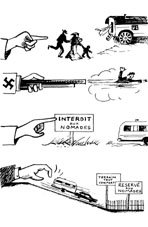
In a message addressed to the European Parliament Council of the EU, European Commission, Committee on the Elimination of Racial Discrimination (CERD, Office of the High Commissioner for Human Rights), United Nations Human Rights Council EveryOne Gropup in Italy stated:
EveryOne Group with its eminent scholars, many of them Roma citizens, and its experts and activists in the battle against racial discrimination are appealing to you once again not to underestimate the phenomenon of racism that Roma citizens are being subjected to in all Member States, and in Italy in particular, where the situation is very critical.
Wednesday, January 7, 2008. At the present time, in spite of all the EU directives, resolutions, warnings, conferences and the inspection carried out by a delegation from the European Commission, no measures, no projects, no real social integration programmes have been undertaken to help the Roma people. Unfortunately the right-wing and far-right wing Italian Government is finding no opposition in this critical field from their political opponents – opponents who in their turn are conducting (these days on a local level, but during the Prodi Government on a national level) racial policies aimed at driving EU citizens of Roma origin off Italian territory. These measures are also making life very difficult for the Roma with Italian citizenship or those who took refuge in Italy in the 1970s and 1990s. Measures include camp clearances (without the offer of alternative solutions); constant persecution from members of the police force and magistrates; violence from racist groups, along with press propaganda that has helped to spread racial hatred towards the Roma people. These factors have brought about a dramatic exodus of Roma citizens towards other countries, or a return to their countries of origin. It has caused a drastic fall in their average life expectancy and many tragic deaths (due to illness, malnutrition, cold, hardship, cases of arson and other acts of violence). It has led to the removal of hundreds of Roma children from their legitimate parents, actions justified by their inability to ensure them “decent living conditions”.
If in 2007 about 45,000 Roma people originating from Romania lived in Italy, (where human rights organizations had undertaken serious integration and schooling programmes) persecution from the institutions has now thwarted these programmes and triggered off an ethnic purge, the terrible policies of which have been taken up by the local authorities and organized and carried out by the police force, which has encouraged the local people to collaborate. Many police actions have been characterized by inhumane and brutal behaviour, while no support has been forthcoming from the social services. Today fewer than 3000 Romanian Roma live in Italy, in dreadful socio-sanitary conditions. Even the Roma with Italian citizenship and the refugees from the former Yugoslavia, (about 45,000 in all) after the flight of many Roma families to Spain, France and other Member States, are living in camps in pitiful conditions.
Criminalized, with no access to steady jobs, turned away from schools or, in a few cases, enrolled but discriminated against and underestimated; they survive without any hope of emancipation. The activists involved in fighting for their rights are regularly intimidated and controlled by the police; in some cases they have been subjected to serious violence from members of the police force during camp clearances and persecutory actions. The percentage of Roma men and women in prisons is very high: they are offered no real legal protection, besides formal defence. Asking for charity (often their only means of support) is banned in many cities through local laws, and the police force is fighting the practice of begging all over Italy.
Newspapers and TV channels spreading lies and prejudice are now totally out of control. Before the almost indifferent eyes of the European Union the Roma people are becoming the “untouchables” of the Western world due to the level of intolerance that has taken root in Italy, something which has no precedent (if we exclude the years of the racial laws) and which represents a temptation for other Member States. We are thinking of Spain, where a recent survey by the institutions revealed that one schoolchild in two would not like a Roma child sitting at the same desk; of France, where the local institutions are adopting the Italian model of obsessive police control; and most of all of Romania, where the Italian racist propaganda has reached the local press, causing further racial hatred against the Roma population, which in Romania numbers about two million people. It is no exaggeration to compare the discriminated-against Roma to the “untouchables” because there is no real difference between the Dalits of South Asia and the “gypsies” of Italy. In fact the Dalits, the untouchables, have access to jobs considered “impure; such as cleaning out toilets, work in the cemeteries and stables and the recovery of material from rubbish dumps; while the Roma people in Italy are kept at a distance by everyone. History and experience teaches us that when a “caste” is formed inside a civilization, at the same time prejudice is formed that takes centuries to eradicate. Not to mention that exclusion and racial hatred causes a deterioration of the health, hygiene and “presentability” of the victims, who in the eyes of the local citizens become automatically “ugly, dirty and wicked”. Our group believes that in Italy the limits of civilization have been greatly overstepped and in the present state of things precise laws are needed, not just suggestions. For example – and we are able to supply you with a structured project – the obligation of countries to include in the number of workers from another Member State a percentage of Roma citizens equal to their ethnic ratio in their country of origin. Thus, considering that in Romania the Roma make up 10% of the total population, the project would call on Italy (and other Member States) to include in its quota of Romanian workers 10% of Romanians of Roma origin. It would be advisable to apply the same law inside the Member States themselves. For example, Romania should include a Roma citizen every ten citizens employed in the public and private sectors. It is necessary for the European Union to undertake effective and urgent measures, consulting associations like our own that have considerable experience in the field, combined with historical and modern-day knowledge of the characteristics of the Roma people.
It is unacceptable that a civilization whose foundation is based on union, ethnic and racial equality, equal opportunities and human rights, watches on as a new category of human beings without rights takes shape - that of the new untouchables. We are available for any form of collaboration in the difficult procedures that are now necessary for fighting the plague of racial hatred and the denial of human rights for an entire people, and a culture of prejudice which conceals, in a perilous way, both the real history of the Roma people in Europe and the necessary measures that must be rapidly taken to lead them to their emancipation and a correct moral, legal, cultural and historical recognition.
Roberto Malini, Matteo Pegoraro, Dario Picciau - Gruppo EveryOne
<>

GYPSY – Die Geschichte einer grossen Sinti-Familie – Book Review

GYPSY – Die Geschichte einer grossen Sinti-Familie
Dotchy Reinhardt
Price € 18,90 in Germany, € 19,50 in Austria and SFR 33,80 in Switzerland
288 Seiten, Hardback with dust cover
ISBN 978-3-502-10190-1
Publisher: Scherz Verlag
Dotschy Reinhardt is a a Sintiza, that is to say a Gypsy woman from the Sinti groups of the Romani People, and of the famous Reinhardt family from whence also the most famous Jazz musician of all times sprang, namely Django Reinhardt, and was born 1975 in Ravensburg, Germany.
While the Sinti groups of Gypsies have been living in Western Europe, Germany, France, the Netherlands and Britain for many hundreds of years they still, whether in Germany or elsewhere, have to battle injustices and discrimination on a daily basis. In some places this is obviously worse than in others.
Dotchy Reinhardt not only has a great style of music, she also has a great style of writing and when she talks about her childhood, spent with her grandmother in Ummenwinkel it brought memories of my own childhood flooding back to me in a very vivid way, as I too am of a Gypsy family.
While I full agree with her explanation as to the word Zigeuner personally as a Sinto I have no problems with that word in the same way as i have no problem with the word Gypsy. I know many Romani, Sinti and Roma, who have use the word Zigeuner themselves and also in the English world Gypsy. If used by ourselves with pride then and and all bad connotations it may have from the Nazi era, I am referring here to the word Zigeuner, is banished. We have to deal with things like that in that way and not in a way of suppressing them and forcing others to use other terms. It is our pride in being what we are even to the extent of using those words that the Gadje may or may not have given us but that have been misused by them to have bad connotations with pride. Such actions will take the wind out of the sails of people that use the words in a negative manner.
We must face the fact that even today the term Sinti and Roma is being used in the same way as was Zigeuner before, such as in police reports, and in Romania the term “Roma” has also got negative meaning, same as Zigeuner.
The book is extremely well written with feelings and political insights direct from a Sintiza, though one that may have been influenced by some of those that may or may not have a hidden agenda, in that the author seems to accept that Sinti are part of the Roma, which, of course, they are not.
There will, no doubt, be and probably already have been some people that will say that Dotschy Reinhardt said too much in this book as far as the Sinti ways and cultural things are concerned though I think that she has done a great job of putting across some of the things without actually giving anything away.
Although the Holocaust is being touched in a small way only as, as Dotschy says, she has no direct experiences – obviously, she is too young for that – nor has she learned much from her direct ancestors directly, though her own family lost many in the camps and some are the survivors of camps as well.
However, in one chapter she describes the battle of her grandfather – though she did not actually get to know him properly – for recognition as a Nazi victim and for some compensation and the way this was fobbed off again and again by the authorities who then were still run by the same people, basically, who tried to exterminate the Gypsy People of Germany and the occupied Europe. Still in the late 1940s when it was already the “Federal Republic of Germany” - a supposedly democratic country – handbooks and guidelines were issued to police officers as to how to deal with the “Gypsy menace”. In addition to that, though not mentioned in the book, several offices of the police forces in Germany and even at Interpol existed – and probably still exist despite claims to the contrary – that were basically entitled as “Office to Combat the Gypsy Menace” and such.
In this regard the book give a great insight in the problems faced daily by Sinti and Roma in Germany (and elsewhere).
In her book Dotschy permits the reader a deep insight – as deep as permitted – into the life and soul of the Sinti, the life and importance of the family, and much more.
In the last pages of the chapter entitled “Borstenvieh und Schweinespeck” she shows exactly where Gypsy community is superior to that of the Gadje, namely in the clan government and clan living, where people support each other; not necessarily financially but in other ways. That kind of support is much more important often than finances. This is just the kind of support that all may need to rediscover in this uncertain time that the world is facing at this moment.
On page 196 of the book Dotschy cites an Uncle of hers, Hannes Pfisterer as saying that “Roma have a different history and that the Roma are a different people” and with the entire statement, as further discussed on page, I can but agree. He makes the same arguments here as to the German-speaking peoples, that is to say that no one would call the Swiss, Austrians, and Germans one people simply because of the fact that they speak a related language.
Some people might disagree with some of what Dotschy has said and written, simply because she has come close to what some people consider the Taboo or, some would say, may have even crossed the line. Especially here in regards to the mentioning of the fact that the eating of horse meat is against the Sinti law and one or the other aspect that also may have been mentioned.
However, in my opinion, and that is the opinion of an older Sinto, some of those things should be mentioned for people to understand who we are and even must be mentioned. Also in order to show the differences between us, the Sinti and related groups, and the Roma. The horse fact also point to the differences between us and the Jews and hence that we cannot be a lost tribe of Israel.
I found this book to be an extremely interesting and enlightening read, one that at times catapulted me back in memory to the very days of my own childhood, and the truth expressed by the authoress in this book makes it one that I can wholeheartedly recommend to the readers.
There are some parts of the book regarding Gypsy issue and Gypsy politics where I do not necessarily agree with the authoress but then that is Dotschy's own understanding of things and that's the way it has to be.
Personally, I have, for instance, have no problem with the word “Zigeuner” and I know many German Gypsies that have not either and then there are others that do, in the same way as I have no problem with the word “Gypsy”.
All in all this is a brilliant book that is not just the autobiography of a brilliant singer and musician who happens to be a Sintiza and of the Reinhardt clan of great renown; it is also and especially the story of the family from which Dotschy Reinhardt stems and of its history.
This is a book that should be read by all and a translation of it into the English language is needed sort of yesterday.
The book is well written and is very much down-to-earth, not that I had really expected anything else from a true Sintiza, though a modern one. Dotschy Reinhardt has done her People, our People, the Sinti, proud with that book. Well done!
I have immensely enjoyed this book and can most highly recommend it.
While this is a review in English the book itself, alas, is so far only available in German but those of that can read German would be well advised to get a-hold of a copy of this book. It is well worth the price and the read.
© M Smith (Veshengro), January 2009
<>


GYPSY – Die Geschichte einer grossen Sinti-Familie – Buch Rezension
 Rezension bei Michael Smith
GYPSY – Die Geschichte einer grossen Sinti-Familie
Dotchy Reinhardt
Price € 18,90 in Deutschland, € 19,50 in Oesterrich and SFR 33,80 in der Schweiz
288 Seiten, Gebunden, mit SU
ISBN 978-3-502-10190-1
Scherz Verlag
Dotschy Reinhardt ist ein Sintiza, das heisst sie ist eine Zigeunerfrau (obwohl sie das Wort “Zigeuner” als negativ empfindet) aus dem Volke der Sinti und sie stammt ab von der beruehmten Reinhardt Familie aus der auch der genioese Jazz-Gitarrist Django Reinhardt stammt. Sie wurde 1975 in Ravensburg geboren.
Waehrend die Sinti Gruppen der Zigeuner – schon seit vielen Jahrhunderten in westeuropaeischen Raum leben, in Deutschland, Frankreich, den Niederlanden und Grossbritannien, werden sie noch immer diskriminiert und misbehandelt, und das taeglich. Mancherorts ist das natuerlich schlimmer als an anderen Orten.
Nicht nur hat Dotchy Reinhardt einen tollen Musikstyle. Auch ihr Style es Schreibens ist grossartig und mit ihrer Beschreibung ihrer Kindheit, verlebt bei der Grossmutter in Ummenwinkel hat bei mir Erinnerungen an meine eigene Kindheit hervorgebracht, da ich auch von einer Zeigeunerfamilie abstamme.
Dies Buch ist sehr gut geschrieben with Gefuehl und politischer Einsicht direkt von einer Sintiza, jedoch erscheint diese von Einfluessen einiger Leute mit einer verstekten Agenda gefaerbt zu sein da sie zu akzeptieren scheint das die Sinti ein Teil der Roma sind, welhses sie jedoch nicht sind.
Es weren sicher Leute auftauchen von unserem Volk der Sinti die behaupten weren – und wahrscheinlich sind da schon einige da – das Dotschy Reinhardt zu viel hier gesagt hat in ihrem Buch ueber die Sachen der Sinti, die Kultur und auch Traditonen, jedoch denke ich das sie sehr gute Arbeit geleistet hat hier die Dinge zu erklaeren ohne eigentlich zu weit zu gehen.
Durch einige Rueckblicke in die Geschichte der Familie gibt Dotschy dem Leser auch eine tiefe Einsicht in die Probleme mit denen die Sinti (und Roma) vor der Nazi Zeit, waehrend dieser und selbst nach dieser Zeit bis in die heutige geplagt werden und die Diskriminisationen die sie ausgesetzt sind noch immer.
Ich habe dies Buch als eine sehr interssante und aufschliessende Lektuere empfunden und die Wahrheiten die von der Asutoring vermittelt werden macht dies ein Buch das ich ganzen herzens allen Lesern empfehlen kann.
In dem Buch gibt es Aspekte bezueglich Zigeuner Angelegenheiten und Zigeuner Politik wo ich nich unbedingt mit der Autorin ueberinstimme aber das ist wie Dotschy das sieht von ihrer Perspektive und so ist es halt.
Ich persoenlich habe kein Problem mit dem Wort “Zigeuner” und ich kenne viele Deutsche Zegeuner die da auch kein Problem mit zu haben tun aber ich weiss auch von anderen die ein Problem with dem Wort haben, oft aus falschem Grunde jedoch.
"Gypsy - Die Geschichte einer grossen Sinti Familie" ist keine Nostalgiegeschichte, auch keine Anklageschrift gegen alle, die Sinti und Roma durch die Jahunderte hinweg und besonders in Deutschland verfolgten. Es ist ein fluessig geschriebenes, sehr gut lesbares Buch über eine junge Sintiza von heute, aber auch über die Vorurteile, die es gegenüber "den Zigeuenern" heute noch massenweise gibt, über die Schwierigkeit, eine Balance zwischen der eigenen Tradition und der totalen Assimilierung zu finden.
Dies is ein brilliantes Buch das nicht nur die Autobiographie einer grossen Saengerin und Musikerin die Sintiza ist und aus der Reinhardt Sipper stammt; es ist auch und besonders die Geschichte der Familie von welcher Dotschy Reinhardt stammt und deren Historie.
Was wir jetzt dringendst benoetigen jetzt ist die Uebersetzung dieses Buches in Englisch und andere Sprachen damit das Buch noch viel weiter als im deutschen Sprachraum gelesen werden kann.
© M Smith (Veshengro), January 2009
<>
Social welfare programme for Alhaurin Gypsies receives 15,000 Euro in funding
by Michael Smith
Andalusia, Spain: The Corales Gypsies Association with ALHAURIN el Grande Council continues to develop the ‘Programme to Promote the Gypsy People’ with an investment of 15,000 Euros, which is earmarked for the El Bajondillo neighbourhood.
The scheme has been introduced by the Centre for Social Affairs whose objective is to develop a series of initiatives to encourage the integration of and equality for the Gypsy community within Alhaurin el Grande’s society.
It also aims to improve the quality of life of local Gypsies as well as to provide them with education, vocational training so they can obtain work and health-care.
According to Social Welfare Councillor, Francisca Bonilla: “We shall continue to develop a social plan that began in the year 2000 and has so far borne fruit such as the creation of the Corales Association, the only association formed by ethnic Gypsies.”
This appears to be a very commendable set of projects that should and could be – probably – be seen and used as a model. However, where are there any such projects in other EU countries?
Britain certainly does not have anything like this and where there is anything then the government demands, through its rules, that non-Gypsy would have equal rights to be involved with such a Gypsy Council or Gypsy Union as do the ethnic Gypsies which, obviously, is a load of dung. But that is the way it goes here.
Other countries seem to have similar and related problems and no projects proper by Gypsies for Gypsies ever see funding and help. The only thing that seems to happen is that money is given to the projects of the Eastern European Roma and no one has a clue what has been done with the money.
When, however, Gypsies, such as those of the Sinti groups, including the Romanichals and the Cale, in Western Europe, and even Roma groups in Western Europe want to do anything the answer always is that those funds and such assistance is for the Decade of Roma Inclusion and that that is for those in the Eastern European EU states and those that wish to join the EU.
Surprise? Not really.
What is needed for Sinti and such to come together in confederation and do their own things and also fund their own things without dependence on the benevolence of benefactors whether they be called George Soros or the EU, the UN, or even a local government.
Ourselves alone must be the watchword and that's how things must be. Only that way will we get anywhere.
© M Smith (Veshengro), January 2009
<>
Andalusia, Spain: The Corales Gypsies Association with ALHAURIN el Grande Council continues to develop the ‘Programme to Promote the Gypsy People’ with an investment of 15,000 Euros, which is earmarked for the El Bajondillo neighbourhood.
The scheme has been introduced by the Centre for Social Affairs whose objective is to develop a series of initiatives to encourage the integration of and equality for the Gypsy community within Alhaurin el Grande’s society.
It also aims to improve the quality of life of local Gypsies as well as to provide them with education, vocational training so they can obtain work and health-care.
According to Social Welfare Councillor, Francisca Bonilla: “We shall continue to develop a social plan that began in the year 2000 and has so far borne fruit such as the creation of the Corales Association, the only association formed by ethnic Gypsies.”
This appears to be a very commendable set of projects that should and could be – probably – be seen and used as a model. However, where are there any such projects in other EU countries?
Britain certainly does not have anything like this and where there is anything then the government demands, through its rules, that non-Gypsy would have equal rights to be involved with such a Gypsy Council or Gypsy Union as do the ethnic Gypsies which, obviously, is a load of dung. But that is the way it goes here.
Other countries seem to have similar and related problems and no projects proper by Gypsies for Gypsies ever see funding and help. The only thing that seems to happen is that money is given to the projects of the Eastern European Roma and no one has a clue what has been done with the money.
When, however, Gypsies, such as those of the Sinti groups, including the Romanichals and the Cale, in Western Europe, and even Roma groups in Western Europe want to do anything the answer always is that those funds and such assistance is for the Decade of Roma Inclusion and that that is for those in the Eastern European EU states and those that wish to join the EU.
Surprise? Not really.
What is needed for Sinti and such to come together in confederation and do their own things and also fund their own things without dependence on the benevolence of benefactors whether they be called George Soros or the EU, the UN, or even a local government.
Ourselves alone must be the watchword and that's how things must be. Only that way will we get anywhere.
© M Smith (Veshengro), January 2009
<>
Parents in Warwickshire remove children from school after Gypsies set up camp nearby
by Michael Smith
According to reports angry Gohja parents removed their children from a Warwickshire school because they felt threatened after a group of Gypsies set up camp in their village. Will such attitudes never change? Obviously not.
The Travellers who, so it is claimed by them, are Romany-Gypsies, caused uproar when they arrived on the rural site at Darlingscott, near Shipston-on-Stour, next to the home of Olympic minister Tessa Jowell, during the Easter bank holiday.
After a nine-month battle by the local council to evict them, a three-day public enquiry into whether the camp can remain ended at Stratford-upon-Avon Town Hall recently.
The Gypsy families, who lodged an appeal against eviction, said they bought 16 plots on the site in October 2007 for £20,000 each. But Stratford-on-Avon District Council refused planning permission for the camp and secured an injunction to stop any more people going onto the site and halt building work.
Cllr Christopher Saint said: “There was a lot of local concern when the Gypsies arrived. They felt compromised by the sudden appearance and felt it created a negative impact on the community. Several parents removed children and transferred them to other schools.”
The problem though is that no one of the members of that council, nor any other council, as far as known to this writer, ever makes and attempt to bridge the gap between the Gypsies and the locals and tries to help the settled community understand the Gypsies, especially when it comes to the Romany.
Cllr Michael Hutchins, of Tredington Parish Council, added: “The junior school has had 11 children from the travelling community with potentially another 21 of school age and three pregnant mothers. If they have to take all these children in one go they would not be able to cope.”
The Councillor also raised concerns about pollution, flooding and dangerous driving. So, according to this member of the council it would appear that Gypsies also have a hand in flooding and they are the only ones that may drive dangerously. What pollution is he, one can but ask, be referring to.
As far as the majority of those well-to-do villagers and their elected representatives are concerned Gypsies bring all manner of ills, it would appear, including flooding.
Mind you, we should be used to that by now. In days gone by we were accused of spreading the plagues while ourselves unaffected by it.
Paul Cairnes, barrister for the local authority, said allowing the site to remain would be harmful to the rural area. He said Ernest Wilson, who lodged an appeal against the decision to remove the families resulting in the public inquiry, failed to demonstrate the site would meet a need in the district as identified in the Gypsy Travellers Accommodation Assessment.
The team acting for the Gypsies said they had a right to permanent residency.
Barrister Michael Rudd said: “What do you expect them to do? Move them down a mile then they move back a mile. It becomes a never ending problem. There is a clear and undisputed significant regional need for additional pitch provision. The personal need of the appellants is also recognised. The appellants perhaps unusually in such cases have attempted to engage in consultation and were ultimately forced to move onto the appeal site in a last resort.”
During the enquiry members of the gypsy community told of their desire to settle permanently on the site so they could educate their children.
It would appear that people still regards Gypsies as carrier of diseases and all manner of things for why would they otherwise behave in such a way.
Personally, I cannot see where a Gypsy camp, for lack of a better word, in more or less the middle of the countryside, does any harm in this case. Also, why should the site meet the council's need in the district as identified in the Gypsy Travellers Accommodation Assessment? It was never meant to be a site within that remit. It was one that the Gypsies themselves were buying and building.
Here, once again, the council tries to get such a privately created Gypsy site into its own portfolio. We have seen this done before several times, even to such an extent where the residents of the private site were evicted, the site slightly improved by the council and then the evicted families brought back in as rent-paying residents.
The machinations of politicians, local or otherwise, do not seem to have any end and Gypsies are always an easy target. I just guess that we have to be thankful in this country that we are not being attacked in other ways by the government, such as happens in other places. Great comfort that is – NOT!
© M Smith (Veshengro), January 2009
<>
According to reports angry Gohja parents removed their children from a Warwickshire school because they felt threatened after a group of Gypsies set up camp in their village. Will such attitudes never change? Obviously not.
The Travellers who, so it is claimed by them, are Romany-Gypsies, caused uproar when they arrived on the rural site at Darlingscott, near Shipston-on-Stour, next to the home of Olympic minister Tessa Jowell, during the Easter bank holiday.
After a nine-month battle by the local council to evict them, a three-day public enquiry into whether the camp can remain ended at Stratford-upon-Avon Town Hall recently.
The Gypsy families, who lodged an appeal against eviction, said they bought 16 plots on the site in October 2007 for £20,000 each. But Stratford-on-Avon District Council refused planning permission for the camp and secured an injunction to stop any more people going onto the site and halt building work.
Cllr Christopher Saint said: “There was a lot of local concern when the Gypsies arrived. They felt compromised by the sudden appearance and felt it created a negative impact on the community. Several parents removed children and transferred them to other schools.”
The problem though is that no one of the members of that council, nor any other council, as far as known to this writer, ever makes and attempt to bridge the gap between the Gypsies and the locals and tries to help the settled community understand the Gypsies, especially when it comes to the Romany.
Cllr Michael Hutchins, of Tredington Parish Council, added: “The junior school has had 11 children from the travelling community with potentially another 21 of school age and three pregnant mothers. If they have to take all these children in one go they would not be able to cope.”
The Councillor also raised concerns about pollution, flooding and dangerous driving. So, according to this member of the council it would appear that Gypsies also have a hand in flooding and they are the only ones that may drive dangerously. What pollution is he, one can but ask, be referring to.
As far as the majority of those well-to-do villagers and their elected representatives are concerned Gypsies bring all manner of ills, it would appear, including flooding.
Mind you, we should be used to that by now. In days gone by we were accused of spreading the plagues while ourselves unaffected by it.
Paul Cairnes, barrister for the local authority, said allowing the site to remain would be harmful to the rural area. He said Ernest Wilson, who lodged an appeal against the decision to remove the families resulting in the public inquiry, failed to demonstrate the site would meet a need in the district as identified in the Gypsy Travellers Accommodation Assessment.
The team acting for the Gypsies said they had a right to permanent residency.
Barrister Michael Rudd said: “What do you expect them to do? Move them down a mile then they move back a mile. It becomes a never ending problem. There is a clear and undisputed significant regional need for additional pitch provision. The personal need of the appellants is also recognised. The appellants perhaps unusually in such cases have attempted to engage in consultation and were ultimately forced to move onto the appeal site in a last resort.”
During the enquiry members of the gypsy community told of their desire to settle permanently on the site so they could educate their children.
It would appear that people still regards Gypsies as carrier of diseases and all manner of things for why would they otherwise behave in such a way.
Personally, I cannot see where a Gypsy camp, for lack of a better word, in more or less the middle of the countryside, does any harm in this case. Also, why should the site meet the council's need in the district as identified in the Gypsy Travellers Accommodation Assessment? It was never meant to be a site within that remit. It was one that the Gypsies themselves were buying and building.
Here, once again, the council tries to get such a privately created Gypsy site into its own portfolio. We have seen this done before several times, even to such an extent where the residents of the private site were evicted, the site slightly improved by the council and then the evicted families brought back in as rent-paying residents.
The machinations of politicians, local or otherwise, do not seem to have any end and Gypsies are always an easy target. I just guess that we have to be thankful in this country that we are not being attacked in other ways by the government, such as happens in other places. Great comfort that is – NOT!
© M Smith (Veshengro), January 2009
<>
The Scavolini Pesaro team invites the Roma people to the “anti-racism basketball game”
The players and managers will then visit the “nomad” families to take them a message of solidarity.
On Sunday December 28th, 2008 an unforgettable basketball game will take place.
The U.S. Victoria Libertas team, which is known throughout the world as the Scavolini Pesaro team, after taking its name from the long-time sponsor and president Valter Scavolini, will play Gmac Fortitudo Bologna at the Adriatic Arena. It is an important championship game for the Peasaro team, but Scavolini has already achieved its greatest triumph thanks to a courageous decision made by both the club and the players who have decided to promote an anti-racist message which our country and the European Union are in serious need of. Scavolini, in line with the project against racial discrimination it is promoting, and in support of the campaign for the rights of the Roma people promoted by EveryOne Group, has officially invited the Roma community of Pesaro (offering free tickets) to watch the game at the Adriatic Arena. The Roma living in Pesaro will cheer on the Scavolini champions and admire the skills of Curry, Hycks, Hurd, Myers Stanic and Zukauskas while displaying banners with the slogan “The Pesaro Roma support Scavolini against racism”.
Before the New Year, the Scavolini champions and some members of the board of directors will visit the abandoned factory in Pesaro where the Roma live, in a gesture of solidarity and fraternity. “The initiative taken by the Scavolini team is a fine example for Italy and the rest of Europe”, say Roberto Malini, Matteo Pegoraro and Dario Picciau, leaders of EveryOne, “because it emphasises one of the most current and tragic aspects of racism in the present day (both in Pesaro and in other Italian cities) and that is the intolerance shown towards people of the Roma ethnic group, the most vulnerable minority exposed to racist propaganda. It is easy to commemorate the persecution and genocides of other historical periods or other countries, but it takes courage to protest against the racial hatred that is poisoning the society and age we live in.” EveryOne Group has informed the European Commission of Scavolini’s initiative, asking for its example to be presented to the Member States as an educational project against racism, in line with the new Europe which places human rights among its priorities.
A short film will be made and photographs taken during the game and the players’ visit to the Roma camp. This dossier will then be presented to the institutions of the European Union early in 2009. “From the president to the man in charge of contacts with the schools, Rodolfo Filippini; from the champions to the younger players, Scavolini is marking out a new path,” continue the activists, “ a path of solidarity and respect for minorities which makes sport a life model for human society itself. “When we met the Scavolini board, we noticed how genuine their desire was to contribute to the elimination of racial hatred, which is one of the most horrendous crimes of human society.
“During the ‘game against racism’ and the meeting between the men from the Scavolini team and the Roma families,” say Malini, Pegoraro and Picciau, “the younger players and students will have the opportunity to understand the value of solidarity as they shake the hands of people (even youngsters their own age) who live surrounded by racial hatred; people who fight every day the “game of survival” - where what matters is keeping families united and teaching the youngest generations to preserve the gift of hope, even in extreme hardship, exclusion and persecution”.
Source: Gruppo EveryOne www.everyonegroup.com
<>
On Sunday December 28th, 2008 an unforgettable basketball game will take place.
The U.S. Victoria Libertas team, which is known throughout the world as the Scavolini Pesaro team, after taking its name from the long-time sponsor and president Valter Scavolini, will play Gmac Fortitudo Bologna at the Adriatic Arena. It is an important championship game for the Peasaro team, but Scavolini has already achieved its greatest triumph thanks to a courageous decision made by both the club and the players who have decided to promote an anti-racist message which our country and the European Union are in serious need of. Scavolini, in line with the project against racial discrimination it is promoting, and in support of the campaign for the rights of the Roma people promoted by EveryOne Group, has officially invited the Roma community of Pesaro (offering free tickets) to watch the game at the Adriatic Arena. The Roma living in Pesaro will cheer on the Scavolini champions and admire the skills of Curry, Hycks, Hurd, Myers Stanic and Zukauskas while displaying banners with the slogan “The Pesaro Roma support Scavolini against racism”.
Before the New Year, the Scavolini champions and some members of the board of directors will visit the abandoned factory in Pesaro where the Roma live, in a gesture of solidarity and fraternity. “The initiative taken by the Scavolini team is a fine example for Italy and the rest of Europe”, say Roberto Malini, Matteo Pegoraro and Dario Picciau, leaders of EveryOne, “because it emphasises one of the most current and tragic aspects of racism in the present day (both in Pesaro and in other Italian cities) and that is the intolerance shown towards people of the Roma ethnic group, the most vulnerable minority exposed to racist propaganda. It is easy to commemorate the persecution and genocides of other historical periods or other countries, but it takes courage to protest against the racial hatred that is poisoning the society and age we live in.” EveryOne Group has informed the European Commission of Scavolini’s initiative, asking for its example to be presented to the Member States as an educational project against racism, in line with the new Europe which places human rights among its priorities.
A short film will be made and photographs taken during the game and the players’ visit to the Roma camp. This dossier will then be presented to the institutions of the European Union early in 2009. “From the president to the man in charge of contacts with the schools, Rodolfo Filippini; from the champions to the younger players, Scavolini is marking out a new path,” continue the activists, “ a path of solidarity and respect for minorities which makes sport a life model for human society itself. “When we met the Scavolini board, we noticed how genuine their desire was to contribute to the elimination of racial hatred, which is one of the most horrendous crimes of human society.
“During the ‘game against racism’ and the meeting between the men from the Scavolini team and the Roma families,” say Malini, Pegoraro and Picciau, “the younger players and students will have the opportunity to understand the value of solidarity as they shake the hands of people (even youngsters their own age) who live surrounded by racial hatred; people who fight every day the “game of survival” - where what matters is keeping families united and teaching the youngest generations to preserve the gift of hope, even in extreme hardship, exclusion and persecution”.
Source: Gruppo EveryOne www.everyonegroup.com
<>
International Romani Union now International Roma Union – which is it to be?
Now we have the truth in a letter to the Pope – the name has been changed
by Michael Smith
Since the IRU, founded as the International Romani Union, resultant from the International Gypsy Congress in London in the early 1970s, has now chosen to term itself the “International Roma Union” it can, in my opinion, no longer be seen as representing the Sinti groups, which includes the Romanichals, the Cale of Spain, and other such like and it may be the time that those groups did something about this.
It was becoming obvious to me already for a while that apparent changes in name were afoot as regards the IRU with the General-Secretary, one Bajram Haliti stating, which I do not doubt, that he is the General-Secretary of the International Roma Union and not the International Romani Union, and I have made mention of that on occasions before.
Now, with a Christmas message sent from Stanislav Stachiro Stankiewitz to the Pope signing it International Roma Union, with the header now statting the very same, this has become more than obvious that this has become an official policy.
As a Sinto I am not a Roma and hence I cannot see this to be any organization that I could even ask to represent me and nor can anyone claiming to speak for the Sinti rightfully claim that we are part of them, for the Sinti are Sinti and the Romanichals, and some others, such as the Cale, are of the same groups, and we are NOT Roma and hence cannot be accommodated in a Roma organization. Period! Dosta!
Therefore, I believe, it has come the time that the Sinti – including its brother groups such as the Romanichals, etc – get their own representative body which may, or may not, work together with the Roma Union, but which is it own entity. I think that a Sinti Federation is called for and it needs to be done NOW.
I do know that this suggestion of mine will, more than likely, receive a lot of negative comments and publicity, I am sure that there are many Sinti and those from Sinti-related groups, such as the Romanichals, the latter who often also are much more happy to call themselves Gypsy rather than Roma – and Roma they are not anyway – may actually agree with this notion of a Sinti Federation. An organization that will then be able to meet the Roma Union on an equal level. The enemies of such a notion will claim that this is a divisive move and that it will play into the hands of the Gadje and their “divide and rule” tactic but it has nothing to do with that whatsoever. The truth is that the enemies of such a notion have a vested interest as regards to keeping the Roma Union issue and trying to claim that the Sinti are but a tribe, or even a sub-tribe, of the Roma, which is not the case. What part of the word “not” do those people not understand?
Presently, as all of us who are of the Sinti groups, are, mainly, referred to by the Roma as Gadje and even slow explanation still results in the comments from the Roma that we, those that are NOT of the Vlax Roma groups and related ones, are not Romani and hence not even proper Gypsy and hence the regard us and will call us Gadje.
I am as much a Romani as any Roma but I am not Roma. I am a Sinto. I am of the Sinti that refer to themselves often as Rom Polska (not Polska Roma, who are a different kettle of fish) and from another side of the Gitanos of Spain who also are part of the Sinti groups. The same is true for any Romanichal. He is she is also Romani, of a groups of the Sinti, whose probable original name as an entity was “Romane Chave”.
If the Roma have a problem with accepting us I want to ask the Sinti here why we should then b e prepared to be part of an organization that claims us to be a part of the Roma, which the Roma deny?
We can work with them, as, as far as I am concerned, they are fellow Romani, fellow Gypsy, but not by being forced to accept the status of a sub-tribe while the people, the Roma, deny that we are Romani and call us Gadje. Hence it is my firm belief and conviction that we must have something for the Sinti in order to be able to work with the others, even to the extent of being just a brother nation as the Austrians may be to the Germans.
The current situation, in my opinion, cannot be allowed to stand with the Sinti and others that, probably, form part of the original “Romane Chave”, including the Romanichals, being treated as second-class Gypsy, if not, as is more often than not the case, as Gadje, by the Roma in the international organizations. Therefore, the way I see it, the Sinti must do their own thing, apart from the Roma but together with them, as we are all, truly, the Romani People, while not all being the Roma.
The situation is, to a degree similar as to Romanichals in the UK and the Irish Travelers who are, again and again being referred to, the ITs that is, as Gypsies in the same breath as the Romanichals, though with Sinti groups and those of the Roma both, at least, are Romani.
There are significant cultural differences between the Sinti groups and the Roma, aside from the languages, and also significant differences in the DNA. This alone proves that we are NOT one homogeneous entity. But this is not so much the issue here as too the political things though it must be remembered.
The only way to do this in a proper way is for the Sinti groups to have their own confederation in which each group and even each clan and family down to the individual even would be represented. Such a confederation could that engage in dialog with the Roma organization(s), whether the IRU and/or others, to coordinate the work on behalf of all Romani People.
The work for the Sinti People, the Sinti Nation, however, should fall to such a Sinti Confederation.
What I am trying to present here is an idea and some food for thought to those of the Sinti especially that are disappointed and disillusioned by what has been done so far and by the fact that us Sinti are always referred to as Gadje by the Roma and that no amount of educating the Roma makes any difference in that field.
Let your voice be heard, finally, Sinteale and Romanichals, as Sinti and Romanichals, as what we are and not what some experts and those that promote the false agenda of all Romani being Roma claim that we are.
Dosta penauas! Now let's get down and do something proper.
© M Smith (Veshengro), December 2008
<>
by Michael Smith
Since the IRU, founded as the International Romani Union, resultant from the International Gypsy Congress in London in the early 1970s, has now chosen to term itself the “International Roma Union” it can, in my opinion, no longer be seen as representing the Sinti groups, which includes the Romanichals, the Cale of Spain, and other such like and it may be the time that those groups did something about this.
It was becoming obvious to me already for a while that apparent changes in name were afoot as regards the IRU with the General-Secretary, one Bajram Haliti stating, which I do not doubt, that he is the General-Secretary of the International Roma Union and not the International Romani Union, and I have made mention of that on occasions before.
Now, with a Christmas message sent from Stanislav Stachiro Stankiewitz to the Pope signing it International Roma Union, with the header now statting the very same, this has become more than obvious that this has become an official policy.
As a Sinto I am not a Roma and hence I cannot see this to be any organization that I could even ask to represent me and nor can anyone claiming to speak for the Sinti rightfully claim that we are part of them, for the Sinti are Sinti and the Romanichals, and some others, such as the Cale, are of the same groups, and we are NOT Roma and hence cannot be accommodated in a Roma organization. Period! Dosta!
Therefore, I believe, it has come the time that the Sinti – including its brother groups such as the Romanichals, etc – get their own representative body which may, or may not, work together with the Roma Union, but which is it own entity. I think that a Sinti Federation is called for and it needs to be done NOW.
I do know that this suggestion of mine will, more than likely, receive a lot of negative comments and publicity, I am sure that there are many Sinti and those from Sinti-related groups, such as the Romanichals, the latter who often also are much more happy to call themselves Gypsy rather than Roma – and Roma they are not anyway – may actually agree with this notion of a Sinti Federation. An organization that will then be able to meet the Roma Union on an equal level. The enemies of such a notion will claim that this is a divisive move and that it will play into the hands of the Gadje and their “divide and rule” tactic but it has nothing to do with that whatsoever. The truth is that the enemies of such a notion have a vested interest as regards to keeping the Roma Union issue and trying to claim that the Sinti are but a tribe, or even a sub-tribe, of the Roma, which is not the case. What part of the word “not” do those people not understand?
Presently, as all of us who are of the Sinti groups, are, mainly, referred to by the Roma as Gadje and even slow explanation still results in the comments from the Roma that we, those that are NOT of the Vlax Roma groups and related ones, are not Romani and hence not even proper Gypsy and hence the regard us and will call us Gadje.
I am as much a Romani as any Roma but I am not Roma. I am a Sinto. I am of the Sinti that refer to themselves often as Rom Polska (not Polska Roma, who are a different kettle of fish) and from another side of the Gitanos of Spain who also are part of the Sinti groups. The same is true for any Romanichal. He is she is also Romani, of a groups of the Sinti, whose probable original name as an entity was “Romane Chave”.
If the Roma have a problem with accepting us I want to ask the Sinti here why we should then b e prepared to be part of an organization that claims us to be a part of the Roma, which the Roma deny?
We can work with them, as, as far as I am concerned, they are fellow Romani, fellow Gypsy, but not by being forced to accept the status of a sub-tribe while the people, the Roma, deny that we are Romani and call us Gadje. Hence it is my firm belief and conviction that we must have something for the Sinti in order to be able to work with the others, even to the extent of being just a brother nation as the Austrians may be to the Germans.
The current situation, in my opinion, cannot be allowed to stand with the Sinti and others that, probably, form part of the original “Romane Chave”, including the Romanichals, being treated as second-class Gypsy, if not, as is more often than not the case, as Gadje, by the Roma in the international organizations. Therefore, the way I see it, the Sinti must do their own thing, apart from the Roma but together with them, as we are all, truly, the Romani People, while not all being the Roma.
The situation is, to a degree similar as to Romanichals in the UK and the Irish Travelers who are, again and again being referred to, the ITs that is, as Gypsies in the same breath as the Romanichals, though with Sinti groups and those of the Roma both, at least, are Romani.
There are significant cultural differences between the Sinti groups and the Roma, aside from the languages, and also significant differences in the DNA. This alone proves that we are NOT one homogeneous entity. But this is not so much the issue here as too the political things though it must be remembered.
The only way to do this in a proper way is for the Sinti groups to have their own confederation in which each group and even each clan and family down to the individual even would be represented. Such a confederation could that engage in dialog with the Roma organization(s), whether the IRU and/or others, to coordinate the work on behalf of all Romani People.
The work for the Sinti People, the Sinti Nation, however, should fall to such a Sinti Confederation.
What I am trying to present here is an idea and some food for thought to those of the Sinti especially that are disappointed and disillusioned by what has been done so far and by the fact that us Sinti are always referred to as Gadje by the Roma and that no amount of educating the Roma makes any difference in that field.
Let your voice be heard, finally, Sinteale and Romanichals, as Sinti and Romanichals, as what we are and not what some experts and those that promote the false agenda of all Romani being Roma claim that we are.
Dosta penauas! Now let's get down and do something proper.
© M Smith (Veshengro), December 2008
<>
German memorial for Gypsy victims of Nazis – building finally starts
by Michael Smith
BERLIN, Germany, December 2008 – Germany has finally begun the building a memorial to in honor of the approximately one to one-and-a-half million Gypsies persecuted by the Nazis.
Construction on the square well in Berlin's central Tiergarten Park follows 16 years of debate among leading groups representing Germany's Gypsies, or Sinti and Roma. It is due to be completed in 2009.
Romani Rose, leader of Germany's Central Council for Sinti and Roma, spoke at Friday's groundbreaking ceremony. Rose praised the government for "recognizing its historical responsibility for those Gypsies who were persecuted under the Nazis."
The German government, someone should tell Mr. Rose, had recognized the historical responsibility for those Gypsies who were persecuted under the Nazis already a number of years ago but it was Mr Rose's bickering as to the terms that caused the delay. While the majority of Romani in Germany had no qualms with the terminology of “als Zigeuner verfolgten” or the simple word “Zigeuner” (that is to say “Gypsy”) it was Rose and the Central Council for Sinti and Roma that fought tooth and nail against the term “Zigeuner”, insisting it had to be Sinti and Roma. In that same breath they also denied the fact that the Jenisch, another groups of Gypsies in Germany who may or may not be related to the Romani, the Sinti in this case, though at times are intermarried with the Sinti. Then again it is not surprising that the Central Council excluded the Sinti seeing that this very organization that is supposed to be representing the Gypsies of Germany is always trying to exclude the Jenisch from everything.
Depending on the estimates and calculations and the numbers game, and depending who one can and should believe, remembering the hidden agendas to diminish the suffering of the Gypsy People in the Holocaust, between 250,000 to 1.5 million – the high number comes from the Frankfurter Fachhochschule in Germany itself – Gypsies were killed during the Holocaust. Berlin already has memorials to Jews and gay victims killed by the Nazis, which shows, yet again, that Gypsies are only considered as “also ran” despite the very fact that it was Gypsies who were targeted for extermination well before Jews and others and that it was 250 Gypsy children on which Zyclon B gas was trialled.
© M Smith (Veshengro), December 2008
<>
BERLIN, Germany, December 2008 – Germany has finally begun the building a memorial to in honor of the approximately one to one-and-a-half million Gypsies persecuted by the Nazis.
Construction on the square well in Berlin's central Tiergarten Park follows 16 years of debate among leading groups representing Germany's Gypsies, or Sinti and Roma. It is due to be completed in 2009.
Romani Rose, leader of Germany's Central Council for Sinti and Roma, spoke at Friday's groundbreaking ceremony. Rose praised the government for "recognizing its historical responsibility for those Gypsies who were persecuted under the Nazis."
The German government, someone should tell Mr. Rose, had recognized the historical responsibility for those Gypsies who were persecuted under the Nazis already a number of years ago but it was Mr Rose's bickering as to the terms that caused the delay. While the majority of Romani in Germany had no qualms with the terminology of “als Zigeuner verfolgten” or the simple word “Zigeuner” (that is to say “Gypsy”) it was Rose and the Central Council for Sinti and Roma that fought tooth and nail against the term “Zigeuner”, insisting it had to be Sinti and Roma. In that same breath they also denied the fact that the Jenisch, another groups of Gypsies in Germany who may or may not be related to the Romani, the Sinti in this case, though at times are intermarried with the Sinti. Then again it is not surprising that the Central Council excluded the Sinti seeing that this very organization that is supposed to be representing the Gypsies of Germany is always trying to exclude the Jenisch from everything.
Depending on the estimates and calculations and the numbers game, and depending who one can and should believe, remembering the hidden agendas to diminish the suffering of the Gypsy People in the Holocaust, between 250,000 to 1.5 million – the high number comes from the Frankfurter Fachhochschule in Germany itself – Gypsies were killed during the Holocaust. Berlin already has memorials to Jews and gay victims killed by the Nazis, which shows, yet again, that Gypsies are only considered as “also ran” despite the very fact that it was Gypsies who were targeted for extermination well before Jews and others and that it was 250 Gypsy children on which Zyclon B gas was trialled.
© M Smith (Veshengro), December 2008
<>
Minister pledges more funds for Janov ghetto
by Michael Smith
Czech Republic: Minister for Human Rights and Minorities Džamila Stehlíková visited Litvínov, the north Bohemian town that recently witnessed two riots of right-wing radicals protesting against the local Romani community.
At the meeting with councilors and representatives of Janov inhabitants, Minister Stehlíková promised help in the near future. She said she would propose the cabinet to include Janov in the list of excluded localities that are entitled to get additional funding for crime prevention and social street workers.
"I apologized to the local people because two years ago I promised Janov would be the number one on the list of the excluded localities that are helped by the “Agency for social inclusion of Romany”. I see it has not happened and I admit it is a mistake," said Stehlíková to journalists. "I want to correct that," she added.
The atmosphere in Janov is currently extremely tense. The locals have been long complaining about the Roma community. Their voices of concern being unheard, they joined the ranks of the extremists on the ominous day of November 17.
But the Czechs in general all complain about the Romanies, whether recent arrivals or not. This has been borne out by studies where the majority of Czechs say that they would not want to have Gypsies as neighbors and that they'd rather have vermin (according to what has been said) than Roma living next to them and they would not want their children to go to the same school as Gypsy children.
The latter is not something that is only happening in the Czech Republic, obviously. It also is the same in Britain even where locals often have a problem, in their minds, with their children and children of the Romani community, being in the same school. Parents have known to have taken their children out of schools here when Gypsy children arrived in those schools.
The recent wave of Romany moving in Janov come allegedly from eastern Slovakia.
"The people that have come to Janov in the past few years are extremely socially deprived. They have entirely different values than the Romani that came to Janov four years ago," Miroslav Brož of the People in Need foundation said.
They are often in big debts, added Brož, they are unemployable owing to a low qualification, frustrated, deprived and aggressive.
So what went wrong? A few years ago, the Litvínov town hall sold flats to real estates that used them for moving in people from lucrative areas. These were mostly Romany who were often unemployed and incapable to pay rent.
"We used to live here quite peacefully with the first Roma people who came here a long time ago. But with the new ones, there are constantly some problems," says a former inhabitant of Janov.
Well, here we have it again. It is obviously the Gypsies that are at fault, as always. At least as far as the locals and the majority non-Gypsies, including the governments, are concerned.
Who, one can but wonder is going to get the funds the minister promised and what are those funds are going to be used for.
The way I perceive it is that the Czech Republic is doing its utmost to get the Romani to leave the country and many of those from Janov have already indicated that they may move to the West, to other EU countries.
Call me a cynic but I have a very strange feeling about all of this. Is this all a concerted effort to cause problems for the Rom community all over the EU in order for the authorities then to have a reason to act against the Rom in a manner similar to what has been done and proposed in Italy and elsewhere? One can but wonder, methinks.
© M Smith (Veshengro), November 2008
<>
Czech Republic: Minister for Human Rights and Minorities Džamila Stehlíková visited Litvínov, the north Bohemian town that recently witnessed two riots of right-wing radicals protesting against the local Romani community.
At the meeting with councilors and representatives of Janov inhabitants, Minister Stehlíková promised help in the near future. She said she would propose the cabinet to include Janov in the list of excluded localities that are entitled to get additional funding for crime prevention and social street workers.
"I apologized to the local people because two years ago I promised Janov would be the number one on the list of the excluded localities that are helped by the “Agency for social inclusion of Romany”. I see it has not happened and I admit it is a mistake," said Stehlíková to journalists. "I want to correct that," she added.
The atmosphere in Janov is currently extremely tense. The locals have been long complaining about the Roma community. Their voices of concern being unheard, they joined the ranks of the extremists on the ominous day of November 17.
But the Czechs in general all complain about the Romanies, whether recent arrivals or not. This has been borne out by studies where the majority of Czechs say that they would not want to have Gypsies as neighbors and that they'd rather have vermin (according to what has been said) than Roma living next to them and they would not want their children to go to the same school as Gypsy children.
The latter is not something that is only happening in the Czech Republic, obviously. It also is the same in Britain even where locals often have a problem, in their minds, with their children and children of the Romani community, being in the same school. Parents have known to have taken their children out of schools here when Gypsy children arrived in those schools.
The recent wave of Romany moving in Janov come allegedly from eastern Slovakia.
"The people that have come to Janov in the past few years are extremely socially deprived. They have entirely different values than the Romani that came to Janov four years ago," Miroslav Brož of the People in Need foundation said.
They are often in big debts, added Brož, they are unemployable owing to a low qualification, frustrated, deprived and aggressive.
So what went wrong? A few years ago, the Litvínov town hall sold flats to real estates that used them for moving in people from lucrative areas. These were mostly Romany who were often unemployed and incapable to pay rent.
"We used to live here quite peacefully with the first Roma people who came here a long time ago. But with the new ones, there are constantly some problems," says a former inhabitant of Janov.
Well, here we have it again. It is obviously the Gypsies that are at fault, as always. At least as far as the locals and the majority non-Gypsies, including the governments, are concerned.
Who, one can but wonder is going to get the funds the minister promised and what are those funds are going to be used for.
The way I perceive it is that the Czech Republic is doing its utmost to get the Romani to leave the country and many of those from Janov have already indicated that they may move to the West, to other EU countries.
Call me a cynic but I have a very strange feeling about all of this. Is this all a concerted effort to cause problems for the Rom community all over the EU in order for the authorities then to have a reason to act against the Rom in a manner similar to what has been done and proposed in Italy and elsewhere? One can but wonder, methinks.
© M Smith (Veshengro), November 2008
<>
Builder gets rid of Travellers by digging a moat around their camp
by Michael Smith
Travellers proved no match for a Bedford builder who forced them off his land by digging a moat around their camp.
Francis Shiner resorted to the measures when Travellers set up camp on the disused car park of a building site in Bedford and refused to leave.
The Travellers were asked to leave because they were hindering work on the site owned by SDC Construction, but they refused.
Workers, so it is said, then put 2.5m high metal fencing around the camp and left a 1.5m gap for the Gypsies to leave through.
When the Travellers still refused to leave, and actually hung their washing on the fence, Shiner sent in a digger to create a moat around the camp, telling them they could leave or be trapped.
They left that evening.
Shiner told the media: “We spoke to them and requested them to move on, but they said they could not do that.
“That is when we advised them that a digger would be around later in the day and if they were still there they would be trapped in – they could please themselves.”
A Bedfordshire police spokesman said if the Travellers had been trapped in the moat, the landowners would not have broken the law.
While one cannot and should not condone the actions of those Travellers the actions of the building company also was despicable. First of a 1.5m wide gap would not allow a trailer to get through, in my calculations, not even a standard car and in all honesty the company should have involved the law.
All things considered, and the police is at fault here, the builder Mr. Shiner has himself broken the law, of that I am sure. His actions would fall foul of a number of legislations and the police should really consider charging him with a number of felonies. In addition to this it was the builder more than the Travellers, in this instance that, according to common law, would have caused a “breach of the peace”.
But, no doubt, Mr Francis Shiner is seen as an upstanding member of the community unlike the dirty Gyppos that had the “audacity” to set up camp on that car park.
© M Smith (Veshengro), December 2008
<>
Travellers proved no match for a Bedford builder who forced them off his land by digging a moat around their camp.
Francis Shiner resorted to the measures when Travellers set up camp on the disused car park of a building site in Bedford and refused to leave.
The Travellers were asked to leave because they were hindering work on the site owned by SDC Construction, but they refused.
Workers, so it is said, then put 2.5m high metal fencing around the camp and left a 1.5m gap for the Gypsies to leave through.
When the Travellers still refused to leave, and actually hung their washing on the fence, Shiner sent in a digger to create a moat around the camp, telling them they could leave or be trapped.
They left that evening.
Shiner told the media: “We spoke to them and requested them to move on, but they said they could not do that.
“That is when we advised them that a digger would be around later in the day and if they were still there they would be trapped in – they could please themselves.”
A Bedfordshire police spokesman said if the Travellers had been trapped in the moat, the landowners would not have broken the law.
While one cannot and should not condone the actions of those Travellers the actions of the building company also was despicable. First of a 1.5m wide gap would not allow a trailer to get through, in my calculations, not even a standard car and in all honesty the company should have involved the law.
All things considered, and the police is at fault here, the builder Mr. Shiner has himself broken the law, of that I am sure. His actions would fall foul of a number of legislations and the police should really consider charging him with a number of felonies. In addition to this it was the builder more than the Travellers, in this instance that, according to common law, would have caused a “breach of the peace”.
But, no doubt, Mr Francis Shiner is seen as an upstanding member of the community unlike the dirty Gyppos that had the “audacity” to set up camp on that car park.
© M Smith (Veshengro), December 2008
<>
Pressure to ban Czech far-right group after rioting
by Michael Smith
The Czech government has come under pressure to ban extremist groups after more than 500 supporters of the far-right Workers’ Party fought running battles with police who blocked their attempt to march through an area populated predominately by Romanies.
At least 14 people were injured and 15 arrested when police confronted about 700 marchers in the northern Czech town of Litvinov on Monday, a public holiday marking both the 1939 Nazi clampdown on Czechoslovak universities and the 1989 student protest that sparked the Velvet Revolution, which ended decades of communist rule in the central European country.
About 1,000 police using tear gas and water cannon, and supported by armoured vehicles and a helicopter, clashed with Workers’ Party supporters wielding bricks, sticks and petrol bombs when they tried to enter a large Gypsy neighbourhood.
“The police tried to get the demonstrators back to the planned march route but they started throwing flaming bottles,” said police spokeswoman Jarmila Hrubesova.
Fighting spread through the back streets of Litvinov as police pursued small groups of far-right marchers and prevented them coming into contact with about 300 Roma men who had gathered to defend their part of town.
“We discovered weapons – sticks, guns, pitchforks, machetes and other things – in the cars of extremists and also Roma people,” said police spokesman Vladimir Danyluk, after what was the second confrontation in a month between right-wing demonstrators and police in the town.
Obviously, they had to mention that they found also weapons with the Romanies; maybe they can now claim that it is really the Gypsies that are at fault here and not the Fascists. It certainly would not surprise me.
A number of leading Czech newspapers called for a crackdown on far-right groups, criticised local authorities for authorising such rallies, and urged police to stop supporters of the Workers’ Party gathering in large groups. Under pressure from human rights groups, interior minister Ivan Langer has discussed banning the party.
This idea has, in the meantime, been forgotten again, however, and the ministers have claimed that in the interest of freedom of speech and freedom of expression a ban would be counterproductive.
Roma communities are a common target for far-right groups across eastern Europe and the Balkans, where they endure very poor levels of employment, housing, education and healthcare and are widely seen as a major source of crime. In Hungary in early November 2008, two Gypsies were shot dead and their home burned down in a what can only be described as a racist murder.
Now, in the last days of November 2008, a Romani couple was murdered by a hand grenade having been thrown into their modest home while they were sitting watching TV. The children, who were already in bed were unhurt.
But when Gypsies then flee to other countries asking for political asylum they are claimed to be economic migrants and not real refugees.
In Hungary, as well as in the former Czechoslovakia and even in Italy, police have been known to stand idly by while extremists have attacked Gypsy men, women and children. So, what are the Romanies to do?
© M Smith (Veshengro), November 2008
<>
The Czech government has come under pressure to ban extremist groups after more than 500 supporters of the far-right Workers’ Party fought running battles with police who blocked their attempt to march through an area populated predominately by Romanies.
At least 14 people were injured and 15 arrested when police confronted about 700 marchers in the northern Czech town of Litvinov on Monday, a public holiday marking both the 1939 Nazi clampdown on Czechoslovak universities and the 1989 student protest that sparked the Velvet Revolution, which ended decades of communist rule in the central European country.
About 1,000 police using tear gas and water cannon, and supported by armoured vehicles and a helicopter, clashed with Workers’ Party supporters wielding bricks, sticks and petrol bombs when they tried to enter a large Gypsy neighbourhood.
“The police tried to get the demonstrators back to the planned march route but they started throwing flaming bottles,” said police spokeswoman Jarmila Hrubesova.
Fighting spread through the back streets of Litvinov as police pursued small groups of far-right marchers and prevented them coming into contact with about 300 Roma men who had gathered to defend their part of town.
“We discovered weapons – sticks, guns, pitchforks, machetes and other things – in the cars of extremists and also Roma people,” said police spokesman Vladimir Danyluk, after what was the second confrontation in a month between right-wing demonstrators and police in the town.
Obviously, they had to mention that they found also weapons with the Romanies; maybe they can now claim that it is really the Gypsies that are at fault here and not the Fascists. It certainly would not surprise me.
A number of leading Czech newspapers called for a crackdown on far-right groups, criticised local authorities for authorising such rallies, and urged police to stop supporters of the Workers’ Party gathering in large groups. Under pressure from human rights groups, interior minister Ivan Langer has discussed banning the party.
This idea has, in the meantime, been forgotten again, however, and the ministers have claimed that in the interest of freedom of speech and freedom of expression a ban would be counterproductive.
Roma communities are a common target for far-right groups across eastern Europe and the Balkans, where they endure very poor levels of employment, housing, education and healthcare and are widely seen as a major source of crime. In Hungary in early November 2008, two Gypsies were shot dead and their home burned down in a what can only be described as a racist murder.
Now, in the last days of November 2008, a Romani couple was murdered by a hand grenade having been thrown into their modest home while they were sitting watching TV. The children, who were already in bed were unhurt.
But when Gypsies then flee to other countries asking for political asylum they are claimed to be economic migrants and not real refugees.
In Hungary, as well as in the former Czechoslovakia and even in Italy, police have been known to stand idly by while extremists have attacked Gypsy men, women and children. So, what are the Romanies to do?
© M Smith (Veshengro), November 2008
<>
Roma rights ... A message to the European institutions
A message to the European institutions concerning the need to urgently modify the policies on the Roma ethnic group
The European Union has demonstrated over the last few years that it possesses neither the experience nor adequate means for facing the "racism emergency". The situation in Italy, where every EU directive (starting from the 2000/43/EC of 29 June 2000) and every international charter for the rights of minorities have been systematically violated by the institutions in their policies involving the Roma and immigrants, is symbolic of how resolutions and warnings are not sufficient for obtaining results on a civil level.
The EU Parliament, Commission and Council of Europe have expressed themselves several times, through every political means; warning first the Prodi Government and then the Berlusconi Government to abandon the repressive actions and "de facto" expulsion of thousands of EU citizens belonging to the Roma ethnic group.
The camp clearances without the offer of alternative humanitarian solutions; the violence used, and threats from the institutions; the practise of taking children from families living in hardship and the denial of any socio-medical assistance for Roma citizens, has led to a mass exodus of Roma (particularly Romanian Roma) from Italy to Spain, France or back to Romania. Over the last few years, in spite of the Decade of Roma Inclusion (which began in 2005) and all the European directives and resolutions against racism and in favour of a policy for the Roma, the situation of the so-called "nomads" has gradually deteriorated and no projects for social integration, no local ordinances and no emergency laws have been initiated to protect this ethnic group. If in 2005 there were between 180 - 210,000 Roma in Italy, today there are – as confirmed by the census – only about 70,000 remaining, living in disastrous social and sanitary conditions. The exodus, the infant mortality, illnesses and acts of violence have drastically reduced the number of Roma in Italy and a new humanitarian tragedy is expected with the onset of the cold weather. We have already had the first victims, but unfortunately it is only the beginning of a terrible period for these troubled people, whose average life span has fallen to around 40, with an appalling infant mortality rate.
What could the European institutions have done to prevent and counteract this tragedy in an effective way? First of all, they could have listened to the witnesses and all those who possess great experience in the field, experts who are in contact with the reality of the Roma, and who are studying the spread of anti-Roma sentiments in Italy: Marcel Courthiade; Juan de Dios Ramírez Heredia and Union Romani; Saimir Mile and La Voix des Rroms; Roberto Malini and EveryOne Group; Nico Grancea and "The Red Wheel"; Santino Spinelli and the Coordinamento Nazionale Antirazzista (National Anti-Discrimination Coordination) "Sa Phrala"; the MEPs Viktoria Mohacsi and Els de Groen, to mention just a few.
It is also necessary to realise that it is impossible to solve such an important problem by simply setting aside funds and waiting for the Member States to dip into these resources. First of all, it is necessary to lay down solid foundations for integration, starting with the countries where the Roma population is the most numerous and where the problems to be solved are particularly complex: Romania, Bulgaria, Hungary, Serbia, Slovakia, Macedonia, the Czech Republic etc. In Romania, for example, there are about two million Roma: a generation that is the child of endless persecution, six centuries of slavery, the Holocaust and deep-rooted discrimination.
Centuries of precarious living conditions and hardship have undermined the health of this ethnic group, which reveals a high percentage of serious congenital diseases and illnesses connected to poverty. We have to urgently set up a social assistance programme for these people, who make up at least 20% of the Roma population in Romania. We cannot speak (for human beings suffering from serious illnesses) of an integration based solely on integration into the workforce. We will be able to do that for the next generation if the tragedy of this precarious lifestyle is overcome by contemporary Europe. Another crucial point is the education of Roma children. It is not possible to think of integrating them into the school system if we don't first remove from society the racism that marginalizes them and puts them at a disadvantage before their peers. Schools should make a special effort to offer Roma children (especially those born into families living in extreme poverty) an "oasis" where they can find the tranquillity necessary for private study. Support groups, made up of teachers, but also parents, should be present to guarantee educational and psychological support.
For this part of the programme, we would ask you to read the Frame Statute for Romani People in the European Union, a document which is the result of many years of experience and knowledge, a document that should be studied in depth by the European institutions and maybe adopted in their policies for the Roma people. And then, jobs. Silvio Berlusconi, who does not know the reality of the Roma in depth and who is the promoter of repressive policies towards them, recently stated during talks with the Romanian Prime Minister Călin Popescu Tăriceanu, that "the Roma entering Italy from Romania have no professional skills and are therefore forced to resort to criminal activities". This is not true, because Italian companies, after years of propaganda from politicians and the press filled with racial hatred refuse to offer Roma citizens jobs, even when they possess all the requirements, as they forejudge them as being unreliable.
EveryOne Group has begun a programme of integration for Roma workers with Italian companies, but with poor results due to this widespread prejudice. It is true, however, that not even in Romania do Roma citizens have equal opportunities compared to other citizens, and if finding a steady job is difficult for everyone there, it is even more difficult for the Roma, who are subjected to discrimination and hostility. It is therefore necessary that the European Union becomes the promoter and sponsor of professional integration programmes reserved for Roma citizens living in Romania (and other countries with large numbers of Roma and where integration programmes are few and far between) both in the usual factory jobs, in commerce, agriculture and handicrafts; and in the traditional Roma activities: cattle-farming, biological agriculture, metalwork, and the recycling of materials etc. At the same time it will be necessary to encourage access to all forms of study for Roma students.
In short, seeing the failure of the majority of projects - which remain only on paper – created for the integration of Roma citizens within the Member States (badly organized by some states and not even attempted by others, Italy among them) it is probably time to "reset" the programme where the EU's policies for the Roma are concerned and concentrate on improving their conditions and their ability to grow socially in Europe by carrying out projects at the source - in the countries they have lived in for centuries. It will probably be much easier for the Member States of the EU to overcome their racist, xenophobic qualms when their borders are crossed by people from the Roma ethnic group who are in possession of significant qualifications and skills, instead of families coming from situations of great hardship and in precarious health. In order to tackle all the points in this letter with a full knowledge of the facts, we repeat the invitation to read the Frame Statute of the Roma People in the European Union very carefully as it contains answers to many of the questions that cause anguish, when it comes to the subject of the Roma people, in the countries of modern Europe.
Source: Gruppo EveryOne
<>
The European Union has demonstrated over the last few years that it possesses neither the experience nor adequate means for facing the "racism emergency". The situation in Italy, where every EU directive (starting from the 2000/43/EC of 29 June 2000) and every international charter for the rights of minorities have been systematically violated by the institutions in their policies involving the Roma and immigrants, is symbolic of how resolutions and warnings are not sufficient for obtaining results on a civil level.
The EU Parliament, Commission and Council of Europe have expressed themselves several times, through every political means; warning first the Prodi Government and then the Berlusconi Government to abandon the repressive actions and "de facto" expulsion of thousands of EU citizens belonging to the Roma ethnic group.
The camp clearances without the offer of alternative humanitarian solutions; the violence used, and threats from the institutions; the practise of taking children from families living in hardship and the denial of any socio-medical assistance for Roma citizens, has led to a mass exodus of Roma (particularly Romanian Roma) from Italy to Spain, France or back to Romania. Over the last few years, in spite of the Decade of Roma Inclusion (which began in 2005) and all the European directives and resolutions against racism and in favour of a policy for the Roma, the situation of the so-called "nomads" has gradually deteriorated and no projects for social integration, no local ordinances and no emergency laws have been initiated to protect this ethnic group. If in 2005 there were between 180 - 210,000 Roma in Italy, today there are – as confirmed by the census – only about 70,000 remaining, living in disastrous social and sanitary conditions. The exodus, the infant mortality, illnesses and acts of violence have drastically reduced the number of Roma in Italy and a new humanitarian tragedy is expected with the onset of the cold weather. We have already had the first victims, but unfortunately it is only the beginning of a terrible period for these troubled people, whose average life span has fallen to around 40, with an appalling infant mortality rate.
What could the European institutions have done to prevent and counteract this tragedy in an effective way? First of all, they could have listened to the witnesses and all those who possess great experience in the field, experts who are in contact with the reality of the Roma, and who are studying the spread of anti-Roma sentiments in Italy: Marcel Courthiade; Juan de Dios Ramírez Heredia and Union Romani; Saimir Mile and La Voix des Rroms; Roberto Malini and EveryOne Group; Nico Grancea and "The Red Wheel"; Santino Spinelli and the Coordinamento Nazionale Antirazzista (National Anti-Discrimination Coordination) "Sa Phrala"; the MEPs Viktoria Mohacsi and Els de Groen, to mention just a few.
It is also necessary to realise that it is impossible to solve such an important problem by simply setting aside funds and waiting for the Member States to dip into these resources. First of all, it is necessary to lay down solid foundations for integration, starting with the countries where the Roma population is the most numerous and where the problems to be solved are particularly complex: Romania, Bulgaria, Hungary, Serbia, Slovakia, Macedonia, the Czech Republic etc. In Romania, for example, there are about two million Roma: a generation that is the child of endless persecution, six centuries of slavery, the Holocaust and deep-rooted discrimination.
Centuries of precarious living conditions and hardship have undermined the health of this ethnic group, which reveals a high percentage of serious congenital diseases and illnesses connected to poverty. We have to urgently set up a social assistance programme for these people, who make up at least 20% of the Roma population in Romania. We cannot speak (for human beings suffering from serious illnesses) of an integration based solely on integration into the workforce. We will be able to do that for the next generation if the tragedy of this precarious lifestyle is overcome by contemporary Europe. Another crucial point is the education of Roma children. It is not possible to think of integrating them into the school system if we don't first remove from society the racism that marginalizes them and puts them at a disadvantage before their peers. Schools should make a special effort to offer Roma children (especially those born into families living in extreme poverty) an "oasis" where they can find the tranquillity necessary for private study. Support groups, made up of teachers, but also parents, should be present to guarantee educational and psychological support.
For this part of the programme, we would ask you to read the Frame Statute for Romani People in the European Union, a document which is the result of many years of experience and knowledge, a document that should be studied in depth by the European institutions and maybe adopted in their policies for the Roma people. And then, jobs. Silvio Berlusconi, who does not know the reality of the Roma in depth and who is the promoter of repressive policies towards them, recently stated during talks with the Romanian Prime Minister Călin Popescu Tăriceanu, that "the Roma entering Italy from Romania have no professional skills and are therefore forced to resort to criminal activities". This is not true, because Italian companies, after years of propaganda from politicians and the press filled with racial hatred refuse to offer Roma citizens jobs, even when they possess all the requirements, as they forejudge them as being unreliable.
EveryOne Group has begun a programme of integration for Roma workers with Italian companies, but with poor results due to this widespread prejudice. It is true, however, that not even in Romania do Roma citizens have equal opportunities compared to other citizens, and if finding a steady job is difficult for everyone there, it is even more difficult for the Roma, who are subjected to discrimination and hostility. It is therefore necessary that the European Union becomes the promoter and sponsor of professional integration programmes reserved for Roma citizens living in Romania (and other countries with large numbers of Roma and where integration programmes are few and far between) both in the usual factory jobs, in commerce, agriculture and handicrafts; and in the traditional Roma activities: cattle-farming, biological agriculture, metalwork, and the recycling of materials etc. At the same time it will be necessary to encourage access to all forms of study for Roma students.
In short, seeing the failure of the majority of projects - which remain only on paper – created for the integration of Roma citizens within the Member States (badly organized by some states and not even attempted by others, Italy among them) it is probably time to "reset" the programme where the EU's policies for the Roma are concerned and concentrate on improving their conditions and their ability to grow socially in Europe by carrying out projects at the source - in the countries they have lived in for centuries. It will probably be much easier for the Member States of the EU to overcome their racist, xenophobic qualms when their borders are crossed by people from the Roma ethnic group who are in possession of significant qualifications and skills, instead of families coming from situations of great hardship and in precarious health. In order to tackle all the points in this letter with a full knowledge of the facts, we repeat the invitation to read the Frame Statute of the Roma People in the European Union very carefully as it contains answers to many of the questions that cause anguish, when it comes to the subject of the Roma people, in the countries of modern Europe.
Source: Gruppo EveryOne
<>
ENAR condemns racist violence against Roma in Hungary and the Czech Republic
The European Network Against Racism (ENAR) strongly condemns the recent violent attacks against Roma in the Czech Republic and Hungary and urges the Czech authorities to put an end to such attacks and take all the necessary measures to ensure the protection of their Roma community.
At a march organised in the town of Litvinov in the Czech Republic on 17 November, about 500 demonstrators linked to the far-right Czech Workers’ Party chanted anti-Roma slogans and threw stones, firecrackers and petrol bombs with the intention of attacking the Roma community. In a related development, two Roma were shot in Nagycsecs, Hungary a few weeks ago as they fled a house set ablaze in an arson attack.
These events are extremely worrying, especially as ENAR’s 2007 Shadow Report on racism in Europe reports an increase in extremism and racist violence in a number of Member States of the EU and the emergence of extremist, semi-military organisations in the Czech Republic, Hungary and Slovakia.
These events are a reminder of the urgent need to formalise the adoption of and implement the Framework Decision on combating certain forms and expressions of racism and xenophobia. This Framework Decision is a crucial European instrument to fight racist crime and was agreed by all 27 Member States at the Justice and Home Affairs Council on 20 April 2007. More than one year on, the adoption has still not been formalised.
ENAR President Mohammed Aziz said: “This is yet another sign of the worrying trend towards increasing racist violence and crime that can be noticed across the EU. The EU Member States must live up to their commitment on the Framework Decision on combating racism and xenophobia.”
ENAR Director Pascale Charhon said: “It is also urgent that all relevant EU institutions take action to curb anti-Gypsysm across Europe. The European Union must adopt a comprehensive and ambitious approach to the Roma that will secure real change in the lives of the ten million Roma in Europe.”
The European Network Against Racism (ENAR) is a network of European NGOs working to combat racism in all EU member states and represents more than 600 NGOs spread around the European Union. ENAR aims to fight racism, xenophobia, anti-Semitism and Islamophobia, to promote equality of treatment between EU citizens and third country nationals, and to link local/regional/national initiatives with European initiatives.
Soure: ENAR
<>
At a march organised in the town of Litvinov in the Czech Republic on 17 November, about 500 demonstrators linked to the far-right Czech Workers’ Party chanted anti-Roma slogans and threw stones, firecrackers and petrol bombs with the intention of attacking the Roma community. In a related development, two Roma were shot in Nagycsecs, Hungary a few weeks ago as they fled a house set ablaze in an arson attack.
These events are extremely worrying, especially as ENAR’s 2007 Shadow Report on racism in Europe reports an increase in extremism and racist violence in a number of Member States of the EU and the emergence of extremist, semi-military organisations in the Czech Republic, Hungary and Slovakia.
These events are a reminder of the urgent need to formalise the adoption of and implement the Framework Decision on combating certain forms and expressions of racism and xenophobia. This Framework Decision is a crucial European instrument to fight racist crime and was agreed by all 27 Member States at the Justice and Home Affairs Council on 20 April 2007. More than one year on, the adoption has still not been formalised.
ENAR President Mohammed Aziz said: “This is yet another sign of the worrying trend towards increasing racist violence and crime that can be noticed across the EU. The EU Member States must live up to their commitment on the Framework Decision on combating racism and xenophobia.”
ENAR Director Pascale Charhon said: “It is also urgent that all relevant EU institutions take action to curb anti-Gypsysm across Europe. The European Union must adopt a comprehensive and ambitious approach to the Roma that will secure real change in the lives of the ten million Roma in Europe.”
The European Network Against Racism (ENAR) is a network of European NGOs working to combat racism in all EU member states and represents more than 600 NGOs spread around the European Union. ENAR aims to fight racism, xenophobia, anti-Semitism and Islamophobia, to promote equality of treatment between EU citizens and third country nationals, and to link local/regional/national initiatives with European initiatives.
Soure: ENAR
<>
Intolerance against Romani-Gypsies in Europe is on the rise
by Michael Smith
The Council of Europe Secretary General said with regards to recent happenings: “70 years almost to the day after the Kristallnacht marked the beginning of the Holocaust, a stone throwing mob tried to attack a Roma suburb in the Czech city of Litvinov. The analogy only goes so far. In 1938 the attacks by the storm troopers were orchestrated by the Nazi regime, and it would be totally wrong to draw any parallels with the Czech Republic where the authorities are doing everything they can to prevent these attacks against the Roma.
“I congratulate the Czech authorities on their determination in stopping the violence and also express my solidarity with the policemen who were wounded by the mob. At the same time we must recognise that this incident took place against the background of increasing intolerance and violence against Roma people in Europe. All Governments across Europe also need to look urgently at the situation of the Roma communities in their countries and act decisively to protect them against discrimination, intolerance and violence.”
While the Council of Europe Secretary General may decide to congratulate the Czech authorities on their determination of stopping the violence we also know how often the authorities, in the Czech Republic, as well as in other EU member states, are complicit with the perpetrators of racially motivated crimes against the Romani-Gypsy. Italy is but one example when not only the authorities stood by and let burning happen. Nay, they criminalized the entire Gypsy population and forced them to give DNA samples and fingerprints, even small children.
The Council of Europe, who after all is the real EU command and control, is doing very little in practical term as to protect the Romani minority in the member countries of the European Union. There is lots of talk, like this address by the Council of Europe Secretary General but very little else and the authorities in member countries get away with murder, literally, on Gypsy citizens.
But, as someone from the Gypsy community in Germany said: “It has happened before, it is happening and will happen again – we must fight against it and defend ourselves”. He is right, you know. Ourselves Alone! We must do it. We cannot depend on others to do it for us. The problem is, though, that if we do it the authorities will claim that we are in the wrong.
Where does that leave us, yet again?
© M Smith (Veshengro), November 2008
<>
The Council of Europe Secretary General said with regards to recent happenings: “70 years almost to the day after the Kristallnacht marked the beginning of the Holocaust, a stone throwing mob tried to attack a Roma suburb in the Czech city of Litvinov. The analogy only goes so far. In 1938 the attacks by the storm troopers were orchestrated by the Nazi regime, and it would be totally wrong to draw any parallels with the Czech Republic where the authorities are doing everything they can to prevent these attacks against the Roma.
“I congratulate the Czech authorities on their determination in stopping the violence and also express my solidarity with the policemen who were wounded by the mob. At the same time we must recognise that this incident took place against the background of increasing intolerance and violence against Roma people in Europe. All Governments across Europe also need to look urgently at the situation of the Roma communities in their countries and act decisively to protect them against discrimination, intolerance and violence.”
While the Council of Europe Secretary General may decide to congratulate the Czech authorities on their determination of stopping the violence we also know how often the authorities, in the Czech Republic, as well as in other EU member states, are complicit with the perpetrators of racially motivated crimes against the Romani-Gypsy. Italy is but one example when not only the authorities stood by and let burning happen. Nay, they criminalized the entire Gypsy population and forced them to give DNA samples and fingerprints, even small children.
The Council of Europe, who after all is the real EU command and control, is doing very little in practical term as to protect the Romani minority in the member countries of the European Union. There is lots of talk, like this address by the Council of Europe Secretary General but very little else and the authorities in member countries get away with murder, literally, on Gypsy citizens.
But, as someone from the Gypsy community in Germany said: “It has happened before, it is happening and will happen again – we must fight against it and defend ourselves”. He is right, you know. Ourselves Alone! We must do it. We cannot depend on others to do it for us. The problem is, though, that if we do it the authorities will claim that we are in the wrong.
Where does that leave us, yet again?
© M Smith (Veshengro), November 2008
<>
Anti-racism demonstration 10.12 in Prague - demonstrace proti rasismu 10.12 v Praze
On 10 December at 18:00 there will be a march in Prague to commemorate International Human Rights Day and draw attention to the rise in violence, racism and xenophobia in this society. It is being organized by Tolerance.
The route: Náměstí Jana Palacha - Mánesův most - Klárov - Úřad Vlády - Pod Bruskou - Gogolova - Letenská pláň - Nad Štolou, ending at the Interior Ministry building.
The organizers are looking for volunteers to assist them, please contact them at mail@rasismus.cz to volunteer.
10.12.2008 - 18.00 hod
Náměstí Jana Palacha - Mánesův most - Klárov - Úřad Vlády - Pod Bruskou - Gogolova - Letenská pláň - Nad Štolou (Ministerstvo vnitra).
účel shromáždění:
Připomenutí vzniku Mezinárodního dne lidských práv - Upozornění na nárůst násilí, rasismu a xenofobie ve společnosti.
Momentálně sháníme dobrovolníky různých profesí - mohou se hlásit na naše maily mail@rasismus.cz.
<>
The route: Náměstí Jana Palacha - Mánesův most - Klárov - Úřad Vlády - Pod Bruskou - Gogolova - Letenská pláň - Nad Štolou, ending at the Interior Ministry building.
The organizers are looking for volunteers to assist them, please contact them at mail@rasismus.cz to volunteer.
10.12.2008 - 18.00 hod
Náměstí Jana Palacha - Mánesův most - Klárov - Úřad Vlády - Pod Bruskou - Gogolova - Letenská pláň - Nad Štolou (Ministerstvo vnitra).
účel shromáždění:
Připomenutí vzniku Mezinárodního dne lidských práv - Upozornění na nárůst násilí, rasismu a xenofobie ve společnosti.
Momentálně sháníme dobrovolníky různých profesí - mohou se hlásit na naše maily mail@rasismus.cz.
<>
GYPSIES STOP tHERE – Book Review
 Review by Michael Smith
GYPSIES STOP tHERE by Miriam Wakerly
ISBN: 978-0-9558432-0-4
Price: £7.99 (+ P&P)
Published in 2008
The book is available in the United Kingdom from Waterstone’s or from www.strongmanpublishing.com
This novel, set in Surrey/Hampshire 2007, is written from the viewpoint of a non-Gypsy woman who has her own intriguing tale to tell. It also brings us up to date with where Travellers are in the 21st century. This makes it topical, showing a balanced understanding of the problems they still face. Romany Gypsies, who have been with us for over 500 years, are an ethnic group that even today suffer open racist abuse and discrimination.
Will uprooting herself from London to live in the country help Kay escape guilt-ridden memories of her husband's death? Far from finding a quiet life, she is caught up in the age-old village conflict where passionate opinions on Romany Gypsy Travellers divide the local people.
A young Gypsy woman, Lena, and her two small sons, enter her life, unwittingly putting Kay's plans on hold. Kay struggles not only to come to terms with her emotional past but also to resolve Lena's problems, those of the village and the Gypsies. And another relationship blossoms that she would never have dreamed of ...
To find out whether or not and what and the rest you will have to read the book yourself. I am not going to give away anymore of the plot. Sorry folks, but you have to get the book and read it yourself.
GYPSIES STOP tHERE is a brilliant story that brings to life the issues that Gypsies face on a daily basis in this country, at each and every place that they stop or try to stop; all the prejudices and all the rest of discrimination without most of the non-Gypsies having ever known any Gypsy personally.
While I cannot, and neither does the author via this book, so no fear there, condone the recent acts of buying land by Gypsies and other Travellers, then moving onto that land and presenting the local councils with a fait acompli, with the attitude “we are here and here to stay”, in each and every case nearly, and then seeking retrospective planning consent, I do also make the call for Gypsies to be given adequate sites and also and especially the possibility to set up their own on their own land. In other words; a little bit more leeway in planning law to make it possible for Gypsies to set up and run their own sites. But, oh dear, I again digressed.
This book I think, will be a good vehicle to further some understanding amongst the non-Gypsy population, if they will but read it, as to the need of Gypsies for sites, whether local authority ones or their own, and aid, I hope, in lessening the NIMBY-ism concerned with Gypsies coming into an area to live. Only a small minority, as in other communities, do live by scamming and by fraud and theft, and I am always prepared and willing to admit that we have our rogues and our villains. But there are many more good Gypsies than there are the bad ones; as with all people.
GYPSIES STOP tHERE is definitely a great read that provides an entertaining way for people to understand more about Gypsies (and Travellers) in Britain and their life and their life's problems.
The story is one of a very few that I have read from this perspective that puts Gypsies in a real light. It neither vilifies nor romanticizes them.
I could not put this book down and only did so with great reluctance. The story is fast moving and you want to keep turning the pages to find out how is goes on. This is a real page-turner for sure. When I finally finished it was left feeling bereft. I hope a sequel of this story is in work and coming out soon. I cannot wait to find out how it continues.
GYPSIES STOP tHERE is a book that definitely should be read by all, adults and young people alike. Especially, however, those that are prejudiced towards the Gypsy People should take some time to read this book.
The author has created a story and characters that are believable and has presented the Romany-Gypsy community in a positive light without making them appear too perfect or too romantic.
Some of the words of the Romani used by the characters, especially by Lena, are Traveller slang and not Romani Chib. “Scan” for food, for instance is NOT Romani; it is Traveller slang. The Romani word used by the Romanichals in Britain (and elsewhere) is “hoben”. This is directly related to the Romanes word for food, that is to say “chabe” with the “ch” being pronounced like the “ch” in “loch”. I do know, however, that “scran” is also used by the Romanichal communities. The Romanichals are the Romany-Gypsy in Britain, by way of explanation to those that do not know this. And while they are Romany (Romani) they are not Roma. Oh, but I digressed again.
The sprinkling of Romany words within the book, even the Traveller slang, for those words also find themselves being used by the Romany at times, makes this story so good, aside from the brilliant story line and the writing style.
I think this is one of the fist novels of this kind that addresses this subject in the way that it does. Let's hope for lots of people reading it and taking the message to heart.
Miriam Wakerly has a BA Degree in Combined Studies – English, French, Sociology and Politics, from Leicester University. She has combined bringing up a family of a son and two daughters with writing and working. She lives with her husband in Surrey and is a member of the Society of Authors.
Copies of GYPSIES STOP tHERE should be in every public library, in every school and if you know someone who is anti-Gypsy for this or that reason maybe give him or her a copy for Christmas or just as a gift generally. The price of this book could make a lifetime of a difference as far as attitudes are concerned and from one reader the effects could snowball. I am certain this book has that potential.
I can definitely give this book full marks.
© M Smith (Veshengro), November 2008
<>
Daily Express commits incitement to racial hatred
by Michael Smith
On Monday, November 17, 2008 the British tabloid newspaper – though newspaper may be a far fetched term for this rag – published a piece entitled “FAMILIES MUST SELL LAND FOR GYPSY CAMPSITES” claiming that and I quote “THOUSANDS of homeowners across Britain could be forced to sell their land to make way for gypsy sites. Private gardens and fields could be taken by the Government in a “land grab” to create permanent campsites for 25,000 travellers”.
This may make for great headlines and for great incitement of racial hatred against an ethnic group, namely the Romani-Gypsy, but it is utterly false and based on lies. But, then again, it is such lies and half-truths that seem to sell newspapers of this ilk.
The Daily Express continues in its Editorial with the following: From DAILY EXPRESS Editorial: “GRABBING LAND TO SETTLE GYPSIES IS OUTRAGEOUS - The Left has a deluded view that gypsies live a romantic life, travelling the byways in gaily painted horse-drawn caravans. The reality is that many are Irish and East European tinkers, pulling monstrous mobile-homes behind gleaming 4X4s and making a good tax-free living from State handouts and the proceeds of crime.”
Firstly, while the Irish might be referred to as “Tinkers”, if the paper would like to do so, as they are Travellers and not Romani, the Eastern European are, in fact, Romanies of the Roma groups in the main and hence are not “tinkers”, as claimed by the Daily Express, but of the Romani Race, of the tribes belonging, as said, to the Roma. To use the term “tinker” in this instance is derogatory and could be regarded as a racial attack.
While it is true that the editorial and the article itself could be seen to constitute incitement to racial hatred and that newspaper should, theoretically, be prosecuted under the Race Relations Act we all know that that is never going to happen. We, the Romani, are simply the wrong color and the wrong religion. We are neither black, nor are we Muslims or Jews. Hence nothing is going to happen. There is but one way: we have to fight it in different ways. How? Well, I leave those thoughts to other forums.
Parliamentary Under Secretary of State for Communities and Local Government Sadiq Khan said: Let me deal with the hon. Lady's first point. Local authorities spend £18 million a year on enforcement action on unauthorised sites. If we can reduce the number of unauthorised sites by encouraging local authorities to provide authorised sites, that will reduce that bill.
Secondly, I know from a letter that I have been passed by the Under-Secretary of State for Communities and Local Government, my hon. Friend the Member for Hartlepool (Mr. Wright), that the hon. Lady has been involved in a campaign that some would characterise as scaremongering about compulsory purchase orders in her community. There is no truth in the headlines. There is no requirement for local authorities to compulsorily purchase land for Gypsy or Traveller sites. I would ask, caution and counsel hon. Members to use their words carefully and to temper them when it comes to spreading stories that are factually incorrect.
So here we can see from the statement of a member of the current Labor administration in this country that this member of parliament, the Hon. Lady that Sadiq Khan refers to in his statement would appear to be Epping Forest MP Eleanor Laing (Con), and it would further appear from the statement by the Parliamentary Under Secretary of State for Communities and Local Government that this MP has a record of bending the truth, especially when it comes to the issue, so it seems, of Gypsies and Travellers.
With all what is happening in mainland Europe, primarily in European Union countries, in atrocities committed against the Gypsy population there how long will it be before we have, in this country; similar demonstrations like recently in the Czech Republic and Hungary, if Members of Parliament and local politicians carry on rabble rousing and are inciting the people against the Gypsies in this country?
All across Europe the specter of anti-Gypsy pogroms – and no, pogroms are not predominately against the Jews and never have been – is rearing its ugly head again and in some countries they are, once again, ugly almost daily reality for Gypsies living there. No wonder many of them take the opportunity to come to the slightly better countries such as Britain, for instance.
While, maybe, we should not call for a newspaper, even though to call that rag thus is nauseous, to be banned and censored, the Daily Express should be held to account and it Editor should be fired from a cannon into the farthest away black hole.
However, in recent years this very same smut rag also told us that we were going to be faced by an invasion of Gypsies from Eastern Europe as soon as countries such as Romanian and such were going to be part of the European Union.
It is such a shame that the people still are still prepared to actually pay money for that rag full of lies.
This country has a bad enough record as far as the Romani-Gypsy goes and also, as regards the Irish Travellers – though my concern is with the Romani – throughout history and even in modern times, and not just the case of Gypsies fleeing Nazi persecution on the European Mainland during the Nazi rule in France and such having been sent back to whence they came while other refugees were welcomed with open arms. One set of rules for others and another set for those that are Gypsy. Not much has changed there, really, despite all the talk.
People, especially, still have the same attitudes and those are not helped by the likes of the Daily Express. If calling for a boycott of that rag and a boycott of their offices would have any effect I would do so but...
© M Smith (Veshengro), November 2008
<>
On Monday, November 17, 2008 the British tabloid newspaper – though newspaper may be a far fetched term for this rag – published a piece entitled “FAMILIES MUST SELL LAND FOR GYPSY CAMPSITES” claiming that and I quote “THOUSANDS of homeowners across Britain could be forced to sell their land to make way for gypsy sites. Private gardens and fields could be taken by the Government in a “land grab” to create permanent campsites for 25,000 travellers”.
This may make for great headlines and for great incitement of racial hatred against an ethnic group, namely the Romani-Gypsy, but it is utterly false and based on lies. But, then again, it is such lies and half-truths that seem to sell newspapers of this ilk.
The Daily Express continues in its Editorial with the following: From DAILY EXPRESS Editorial: “GRABBING LAND TO SETTLE GYPSIES IS OUTRAGEOUS - The Left has a deluded view that gypsies live a romantic life, travelling the byways in gaily painted horse-drawn caravans. The reality is that many are Irish and East European tinkers, pulling monstrous mobile-homes behind gleaming 4X4s and making a good tax-free living from State handouts and the proceeds of crime.”
Firstly, while the Irish might be referred to as “Tinkers”, if the paper would like to do so, as they are Travellers and not Romani, the Eastern European are, in fact, Romanies of the Roma groups in the main and hence are not “tinkers”, as claimed by the Daily Express, but of the Romani Race, of the tribes belonging, as said, to the Roma. To use the term “tinker” in this instance is derogatory and could be regarded as a racial attack.
While it is true that the editorial and the article itself could be seen to constitute incitement to racial hatred and that newspaper should, theoretically, be prosecuted under the Race Relations Act we all know that that is never going to happen. We, the Romani, are simply the wrong color and the wrong religion. We are neither black, nor are we Muslims or Jews. Hence nothing is going to happen. There is but one way: we have to fight it in different ways. How? Well, I leave those thoughts to other forums.
Parliamentary Under Secretary of State for Communities and Local Government Sadiq Khan said: Let me deal with the hon. Lady's first point. Local authorities spend £18 million a year on enforcement action on unauthorised sites. If we can reduce the number of unauthorised sites by encouraging local authorities to provide authorised sites, that will reduce that bill.
Secondly, I know from a letter that I have been passed by the Under-Secretary of State for Communities and Local Government, my hon. Friend the Member for Hartlepool (Mr. Wright), that the hon. Lady has been involved in a campaign that some would characterise as scaremongering about compulsory purchase orders in her community. There is no truth in the headlines. There is no requirement for local authorities to compulsorily purchase land for Gypsy or Traveller sites. I would ask, caution and counsel hon. Members to use their words carefully and to temper them when it comes to spreading stories that are factually incorrect.
So here we can see from the statement of a member of the current Labor administration in this country that this member of parliament, the Hon. Lady that Sadiq Khan refers to in his statement would appear to be Epping Forest MP Eleanor Laing (Con), and it would further appear from the statement by the Parliamentary Under Secretary of State for Communities and Local Government that this MP has a record of bending the truth, especially when it comes to the issue, so it seems, of Gypsies and Travellers.
With all what is happening in mainland Europe, primarily in European Union countries, in atrocities committed against the Gypsy population there how long will it be before we have, in this country; similar demonstrations like recently in the Czech Republic and Hungary, if Members of Parliament and local politicians carry on rabble rousing and are inciting the people against the Gypsies in this country?
All across Europe the specter of anti-Gypsy pogroms – and no, pogroms are not predominately against the Jews and never have been – is rearing its ugly head again and in some countries they are, once again, ugly almost daily reality for Gypsies living there. No wonder many of them take the opportunity to come to the slightly better countries such as Britain, for instance.
While, maybe, we should not call for a newspaper, even though to call that rag thus is nauseous, to be banned and censored, the Daily Express should be held to account and it Editor should be fired from a cannon into the farthest away black hole.
However, in recent years this very same smut rag also told us that we were going to be faced by an invasion of Gypsies from Eastern Europe as soon as countries such as Romanian and such were going to be part of the European Union.
It is such a shame that the people still are still prepared to actually pay money for that rag full of lies.
This country has a bad enough record as far as the Romani-Gypsy goes and also, as regards the Irish Travellers – though my concern is with the Romani – throughout history and even in modern times, and not just the case of Gypsies fleeing Nazi persecution on the European Mainland during the Nazi rule in France and such having been sent back to whence they came while other refugees were welcomed with open arms. One set of rules for others and another set for those that are Gypsy. Not much has changed there, really, despite all the talk.
People, especially, still have the same attitudes and those are not helped by the likes of the Daily Express. If calling for a boycott of that rag and a boycott of their offices would have any effect I would do so but...
© M Smith (Veshengro), November 2008
<>
Higher court overturns previous ruling in Gypsy sterilization case
by Michael Smith
PRAGUE, Czech Republic, November 2008: A hospital does not have to compensate a young Gypsy woman it sterilized without her consent, an appeals court ruled recently.
In overturning the Czech Republic's first monetary award for forced sterilization, the court said the statute of limitations had expired.
This is not surprising seeing the people are concerned are people without a real voice. They are not Jews or Muslims but they are simply poor downtrodden Romani-Gypsy.
While Anti-Semitism is immediately jumped upon and nowadays also anything that is said against Muslims, so it would appear, Anti-Gypsy-ism is alive and well and no one cares, especially no one in the various bodies of the EU and the UN.
While there would be, I am sure, no one mentioning “statutes of limitation” had this heinous crime of forcible sterilization been committed against a Jewess or a member of any other ethnic group and the outcry would be great, as it is only Gypsies no one cares.
Human rights groups believe hundreds of women from the Czech Republic's Gypsy minority of about 250,000 people were sterilized against their will.
Under communism, which ended in the Czech Republic in 1989, sterilization was a semiofficial tool to limit the population of Gypsies, whose large families were seen as a burden on the state. The practice, however, ended only recently.
In other words, Gypsy women were still forced or or otherwise sterilized without their consent even into the time of EU membership of the Czech Republic. So, at least, it appears.
How, pray, was the Czech Republic, in the same way as other newer EU member states, ever allowed to join the EU with such appalling records on human rights, as far as one of the largest ethnic minorities on its territory?
Iveta Cervenakova, now 32, was illegally sterilized without her consent in 1997 after she gave birth to her second daughter by Caesarean section.
She filed a lawsuit in 2005. A lower court ruled two years later that the hospital in the northeastern city of Ostrava had to pay compensation and apologize for violating her rights.
Court spokesman Petr Angyalossy said the 500,000 Krona ($26,330) judgment was overturned because the award came after the 3-year statute of limitations in the case had expired. He said the hospital needs only apologize.
Neither an apology nor financial compensation, in all honesty, can compensate any Gypsy woman for the loss of being able to bear any (more) children. Nor can anyone ever compensate the woman nor the People as a whole for such crimes. Neither money nor apology will cut any ice. Not until such a time that the Romani People will be given the same respect and consideration as other minorities.
The Czech League for Human Rights sharply criticized the ruling and said it would appeal it to the Supreme Court. A lawyer of the League for Human Rights, who consulted with Cervenakova's attorney, said she will argue that there should be no statute of limitation applied in sterilization cases.
Several other Czech Gypsy women are also seeking damages from hospitals for illegal sterilizations. Not that they will get anywhere with this, I am sure, seeing the recent outcome. The European Union also is not in the least interested as to what happens to the Romani People, and this is blatantly obvious as to the happenings in Italy – that are all being but kept very quiet now.
Any Rom who still believes that the EU and/or the UN have the interests of the Romani People also at heart need to wake up, finally.
No one will every have our People's interests at heart if we, the Romani People, do not do it for ourselves. Ourselves Alone.
Ava Ame Shai! Yes, We Can!
© M Smith (Veshengro), November 2008
<>
PRAGUE, Czech Republic, November 2008: A hospital does not have to compensate a young Gypsy woman it sterilized without her consent, an appeals court ruled recently.
In overturning the Czech Republic's first monetary award for forced sterilization, the court said the statute of limitations had expired.
This is not surprising seeing the people are concerned are people without a real voice. They are not Jews or Muslims but they are simply poor downtrodden Romani-Gypsy.
While Anti-Semitism is immediately jumped upon and nowadays also anything that is said against Muslims, so it would appear, Anti-Gypsy-ism is alive and well and no one cares, especially no one in the various bodies of the EU and the UN.
While there would be, I am sure, no one mentioning “statutes of limitation” had this heinous crime of forcible sterilization been committed against a Jewess or a member of any other ethnic group and the outcry would be great, as it is only Gypsies no one cares.
Human rights groups believe hundreds of women from the Czech Republic's Gypsy minority of about 250,000 people were sterilized against their will.
Under communism, which ended in the Czech Republic in 1989, sterilization was a semiofficial tool to limit the population of Gypsies, whose large families were seen as a burden on the state. The practice, however, ended only recently.
In other words, Gypsy women were still forced or or otherwise sterilized without their consent even into the time of EU membership of the Czech Republic. So, at least, it appears.
How, pray, was the Czech Republic, in the same way as other newer EU member states, ever allowed to join the EU with such appalling records on human rights, as far as one of the largest ethnic minorities on its territory?
Iveta Cervenakova, now 32, was illegally sterilized without her consent in 1997 after she gave birth to her second daughter by Caesarean section.
She filed a lawsuit in 2005. A lower court ruled two years later that the hospital in the northeastern city of Ostrava had to pay compensation and apologize for violating her rights.
Court spokesman Petr Angyalossy said the 500,000 Krona ($26,330) judgment was overturned because the award came after the 3-year statute of limitations in the case had expired. He said the hospital needs only apologize.
Neither an apology nor financial compensation, in all honesty, can compensate any Gypsy woman for the loss of being able to bear any (more) children. Nor can anyone ever compensate the woman nor the People as a whole for such crimes. Neither money nor apology will cut any ice. Not until such a time that the Romani People will be given the same respect and consideration as other minorities.
The Czech League for Human Rights sharply criticized the ruling and said it would appeal it to the Supreme Court. A lawyer of the League for Human Rights, who consulted with Cervenakova's attorney, said she will argue that there should be no statute of limitation applied in sterilization cases.
Several other Czech Gypsy women are also seeking damages from hospitals for illegal sterilizations. Not that they will get anywhere with this, I am sure, seeing the recent outcome. The European Union also is not in the least interested as to what happens to the Romani People, and this is blatantly obvious as to the happenings in Italy – that are all being but kept very quiet now.
Any Rom who still believes that the EU and/or the UN have the interests of the Romani People also at heart need to wake up, finally.
No one will every have our People's interests at heart if we, the Romani People, do not do it for ourselves. Ourselves Alone.
Ava Ame Shai! Yes, We Can!
© M Smith (Veshengro), November 2008
<>
Racism in Italy: a spiral of violence and intolerance which calls for an active commitment from everyone.
Let us take, for example, the Romagna-Marche coastline, which has a reputation for being an area of hospitality and tolerance. From Pesaro to Forlì, from Cesena to Rimini the situation of the homeless and the Roma communities is totally unacceptable, due to increasingly violent and widespread intolerance, aided by the enthusiastic support of politicians (both right-wing and left-wing) and the authorities. This persecution is looking more and more like the period of the racial laws, and it appears the ethnic and social cleansing underway suits everyone.
The events on the Adriatic coast, however, are just a small part of what it taking place all over Italy where the effects of racism are now out of control. The members of EveryOne, instead of receiving support for their commitment, have received all kinds of intimidation and threats, both from the institutions and from racist groups. Roma members of the group have been beaten up, they have received death threats, insults and other forms of police and judicial persecution.
EveryOne Group, however, will continue to report this frightful sequence of crimes against humanity and to call on the intervention of all those who consider themselves anti-racists (if there are any left).
We are combining the news of the latest attack on a homeless person and the video-testimony, complete with medical report - of a young Roma man who was subjected to the usual "treatment" from members of the police force. But that's not all: today (November 11th) a young girl was beaten up in Florence.
EveryOne is collecting witness accounts and medical reports in order to take further action.
We will be supplying other material concerning this new episode very soon.
In the hope that our reports and the continuous episodes of racial hatred bring about positive actions and not just empty messages of solidarity, we send you our best regards
Roberto Malini, Matteo Pegoraro, Dario Picciau
EveryOne Group
Anton Caldarar interview (with english subtitles)
TO VIEW THE COMPLETE VIDEO TESTIMONY VISIT:
http://www.everyonegroup.com/EveryOne/Anton_Caldarar.html
Source: www.everyonegroup.com
<>
The events on the Adriatic coast, however, are just a small part of what it taking place all over Italy where the effects of racism are now out of control. The members of EveryOne, instead of receiving support for their commitment, have received all kinds of intimidation and threats, both from the institutions and from racist groups. Roma members of the group have been beaten up, they have received death threats, insults and other forms of police and judicial persecution.
EveryOne Group, however, will continue to report this frightful sequence of crimes against humanity and to call on the intervention of all those who consider themselves anti-racists (if there are any left).
We are combining the news of the latest attack on a homeless person and the video-testimony, complete with medical report - of a young Roma man who was subjected to the usual "treatment" from members of the police force. But that's not all: today (November 11th) a young girl was beaten up in Florence.
EveryOne is collecting witness accounts and medical reports in order to take further action.
We will be supplying other material concerning this new episode very soon.
In the hope that our reports and the continuous episodes of racial hatred bring about positive actions and not just empty messages of solidarity, we send you our best regards
Roberto Malini, Matteo Pegoraro, Dario Picciau
EveryOne Group
Anton Caldarar interview (with english subtitles)
TO VIEW THE COMPLETE VIDEO TESTIMONY VISIT:
http://www.everyonegroup.com/EveryOne/Anton_Caldarar.html
Source: www.everyonegroup.com
<>
Policies Toward Sustainable Integration Discussed by Roma, Ashkali and Egyptians of Kosovo with the Kosovo Government and the International Community
On October 22, 2008, the Project on Ethnic Relations (PER) held an international roundtable to discuss challenges and prospects of sustainable integration of Kosovo Roma, Ashkali and Egyptians in host countries and in Kosovo itself. The event was held at the Hofburg Palace in Vienna and was organized by PER with the support of the OSCE’s Office for Democratic Institutions and Human Rights (ODIHR). The meeting gathered representatives of European governments, international organizations, Kosovo government representatives and Roma, Ashkali and Egyptians.
The topics debated during the roundtable included: prospects for integration of these communities in host countries, the return process to Kosovo, living conditions for Roma, Ashkali and Egyptian communities in Kosovo, and conditions for integration of returnees in Kosovo.
Following major conclusions have emerged from the discussions:
PER is an international non-governmental organization with offices and representations in Central and Southeastern Europe and the former Soviet Union that works towards improving ethnic relations in the region. PER has a long history of engagement in facilitating interethnic dialogue in the Balkans. PER has been working on issues important for the Romani communities in Europe for almost two decades.
Source: PER
<>
The topics debated during the roundtable included: prospects for integration of these communities in host countries, the return process to Kosovo, living conditions for Roma, Ashkali and Egyptian communities in Kosovo, and conditions for integration of returnees in Kosovo.
Following major conclusions have emerged from the discussions:
- The policies of forced returns by the host countries are ineffective and insustainable as many of those returned by force leave the country shortly after their return;
- Voluntary and informed return, as argued by some participants, can be sustainable, provided that it is well coordinated with the Kosovo authorities;
- Romani participants were against forced return, pointing to the evident fact that presently there are no conditions in place in Kosovo to ensure sustainable livelihood;
- Kosovo authorities generally acknowledged that they have limited resources to provide for successful reintegration of returnees, especially in large numbers;
- Participants acknowledged some improvements in Kosovo with regard to these communities, but not to the extent necessary for UNHCR to change its position regarding the protection of these groups; there are still safety-related concerns maintaining the recommendation against forced returns.
PER is an international non-governmental organization with offices and representations in Central and Southeastern Europe and the former Soviet Union that works towards improving ethnic relations in the region. PER has a long history of engagement in facilitating interethnic dialogue in the Balkans. PER has been working on issues important for the Romani communities in Europe for almost two decades.
Source: PER
<>
Subscribe to:
Posts (Atom)